


Europe Point of Care Testing (POCT) Device Market Size
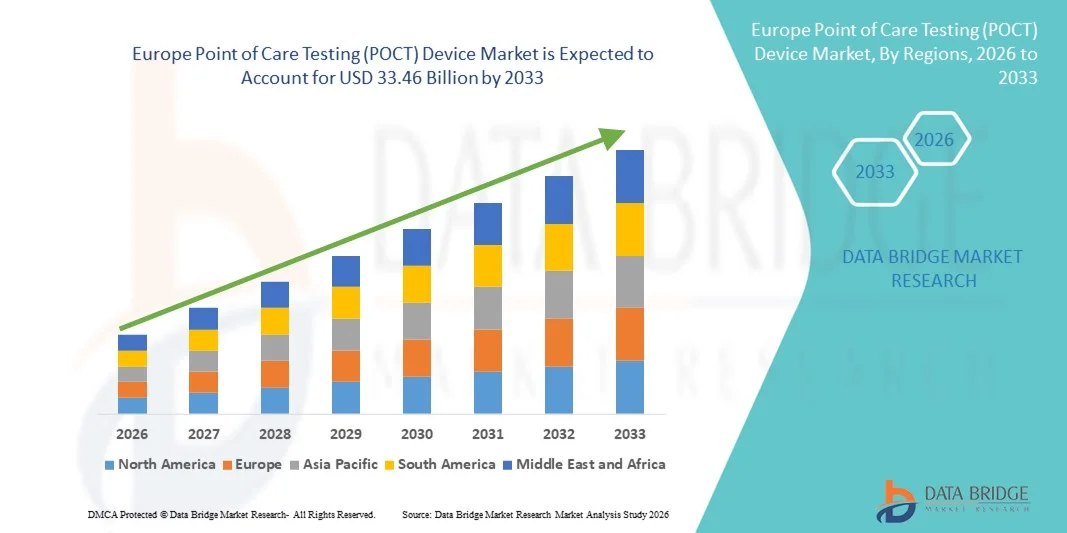
- The Europe Point of Care Testing (POCT) device market size was valued at USD 16.43 billion in 2025 and is expected to reach USD 33.46 billion by 2033, at a CAGR of 9.3% during the forecast period
- The market growth is largely driven by the increasing demand for rapid diagnostics and decentralized testing solutions across hospitals, clinics, and home care settings, supported by advancements in miniaturized and connected diagnostic technologies
- Furthermore, growing prevalence of chronic diseases, rising awareness of early disease detection, and the need for timely clinical decision-making are positioning POCT devices as essential tools in modern healthcare. These factors are collectively accelerating the adoption of POCT solutions, thereby significantly propelling the market’s expansion
Europe Point of Care Testing (POCT) Device Market Analysis
- POCT devices, providing rapid and decentralized diagnostic testing at or near the patient site, are increasingly crucial in modern healthcare settings across hospitals, clinics, and home care due to their convenience, faster turnaround times, and seamless integration with digital health systems
- The growing adoption of POCT devices is primarily driven by rising demand for quick diagnostic results, increasing prevalence of chronic and infectious diseases, and the need for timely clinical decision-making in both acute and routine care
- Germany dominated the Europe POCT device market with the largest revenue share of 38.5% in 2025, supported by advanced healthcare infrastructure, high healthcare spending, and the presence of leading diagnostic technology companies, with hospitals and clinics increasingly adopting POCT solutions for rapid diagnostics and chronic disease management
- Poland is expected to be the fastest growing country in the Europe POCT device market during the forecast period due to increasing healthcare investments, expanding diagnostic networks, and rising awareness about early disease detection
- Blood Glucose Testing Kits segment dominated the POCT device market with a market share of 41.7% in 2025, driven by the rising prevalence of diabetes across Europe, increasing patient demand for portable self‑monitoring solutions, and continual technological improvements in accuracy, ease‑of‑use, and connected glucose monitoring platforms
Report Scope and Europe Point of Care Testing (POCT) Device Market Segmentation
|
Attributes |
Europe Point of Care Testing (POCT) Device Key Market Insights |
|
Segments Covered |
|
|
Countries Covered |
Europe
|
|
Key Market Players |
|
|
Market Opportunities |
|
|
Value Added Data Infosets |
In addition to the insights on market scenarios such as market value, growth rate, segmentation, geographical coverage, and major players, the market reports curated by the Data Bridge Market Research also include in-depth expert analysis, patient epidemiology, pipeline analysis, pricing analysis, and regulatory framework |
Europe Point of Care Testing (POCT) Device Market Trends
Advancement Through Connectivity and AI-Enabled Diagnostics
- A significant and accelerating trend in the Europe POCT device market is the growing integration of AI and cloud connectivity, enabling real-time data analysis and remote monitoring for faster clinical decision-making
- For instance, the Abbott i-STAT Alinity system allows clinicians to receive instant test results via a connected platform, improving workflow efficiency and patient management
- AI-enabled POCT devices can predict abnormal patient trends, suggest early interventions, and optimize testing protocols based on historical data, enhancing diagnostic accuracy and personalized care
- The integration of POCT devices with electronic health records (EHRs) and hospital information systems facilitates seamless data sharing, centralized monitoring, and better patient management across care teams
- Increasing miniaturization and portability of POCT devices are allowing bedside and home testing, supporting patient-centered care and expanding market reach
- Adoption of wearable and non-invasive POCT technologies is rising, enabling continuous monitoring of biomarkers without frequent blood draws or laboratory visits
- This trend toward smarter, connected diagnostics is reshaping healthcare expectations, pushing providers to adopt POCT solutions that combine rapid results with intelligent insights
- The demand for POCT devices with AI-driven analytics and cloud connectivity is increasing rapidly in hospitals, clinics, and home care, as healthcare providers aim for faster, data-driven decision-making
Europe Point of Care Testing (POCT) Device Market Dynamics
Driver
Increasing Need for Rapid Diagnostics and Chronic Disease Management
- The rising prevalence of chronic diseases and demand for timely clinical decisions are significant drivers for the heightened adoption of POCT devices across Europe
- For instance, Roche Diagnostics introduced new handheld POCT devices for diabetes management that allow rapid glucose and ketone testing in outpatient settings
- As healthcare systems prioritize early detection and faster diagnosis, POCT devices offer immediate results, reducing delays associated with centralized laboratory testing
- Furthermore, increasing awareness of infectious disease outbreaks and the need for decentralized testing in hospitals and clinics is driving POCT adoption
- Growing adoption of telemedicine and remote patient monitoring programs is boosting demand for POCT devices that provide real-time home-based diagnostic solutions
- Rising government initiatives supporting rapid diagnostics and preventive healthcare programs are encouraging hospitals and clinics to deploy POCT solutions widely
- The convenience of portable testing, rapid results for multiple analytes, and integration with mobile and digital platforms are key factors propelling POCT usage in both acute and routine care settings
- Government initiatives and hospital programs promoting early diagnosis, remote monitoring, and patient-centered care further support the growth of POCT devices across Europe
Restraint/Challenge
Regulatory Compliance and Accuracy Concerns
- Stringent regulatory requirements and compliance standards across European countries pose a significant challenge to the rapid deployment of POCT devices in healthcare settings
- For instance, delays in CE marking approval for new multiplex POCT assays can slow market entry and adoption in hospitals and clinics
- Accuracy and reliability concerns of POCT results compared to central laboratory testing create hesitancy among healthcare providers, particularly for critical care decisions
- Ensuring quality control, calibration, and proper staff training is crucial to minimize errors and maintain confidence in POCT outcomes
- Limited interoperability with hospital information systems and EHRs can hinder seamless data integration and workflow efficiency for healthcare providers
- Reimbursement challenges and inconsistent coverage policies across countries can restrict adoption of high-cost POCT devices in certain healthcare settings
- In addition, relatively high costs of advanced multiplex or AI-enabled POCT devices can limit adoption, especially in smaller clinics or budget-constrained healthcare facilities
- Overcoming these challenges through streamlined regulatory processes, robust validation studies, and cost-effective device solutions will be essential for sustained market expansion
Europe Point of Care Testing (POCT) Device Market Scope
The market is segmented on the basis of product type, prescription, distribution channel, and end users.
- By Product Type
On the basis of product type, the Europe POCT Device Market is segmented into blood glucose testing kits, cardio metabolic monitoring kits, infectious disease testing kits, cholesterol testing kits, pregnancy and fertility test kits, tumor/cancer markers, urinalysis testing kits, cholesterol test strips, hematology testing kits, drugs of abuse testing kits, fecal occult testing kits, rapid coagulation testing kits, and others. The Blood Glucose Testing Kits segment dominated the market with a largest market revenue share of 41.7% in 2025, driven by the high prevalence of diabetes in Europe, increased patient awareness, and the rising demand for portable self-monitoring solutions. Patients and healthcare providers prefer these kits due to their accuracy, ease-of-use, and the ability to integrate with mobile apps and digital health platforms. Hospitals and clinics also adopt these devices for rapid bedside monitoring, while home healthcare users benefit from convenience and real-time tracking. Technological improvements such as continuous glucose monitoring (CGM) and AI-enabled predictive alerts have further boosted adoption. The strong distribution network of OTC and prescription-based glucose kits ensures widespread accessibility, enhancing market dominance.
The Infectious Disease Testing Kits segment is anticipated to witness the fastest growth rate during 2026–2033, driven by emerging infectious disease outbreaks, increasing demand for rapid and decentralized diagnostics, and adoption in hospitals, clinics, and home healthcare settings. Rising awareness of diseases such as influenza, RSV, COVID-19, and other respiratory and gastrointestinal infections is prompting healthcare providers to adopt rapid POCT devices. Technological advancements in multiplex testing, lateral flow assays, and AI-assisted detection improve diagnostic accuracy and speed, accelerating growth. Government initiatives to enhance public health preparedness also support adoption. Moreover, growing integration with telemedicine platforms allows remote monitoring and patient management, making infectious disease testing kits highly sought-after.
- By Prescription
On the basis of prescription, the Europe POCT Device Market is segmented into Prescription-Based Testing and Over-The-Counter (OTC) Testing. The Prescription-Based Testing segment dominated the market in 2025 due to stringent regulatory requirements, clinical accuracy, and usage primarily in hospitals and clinics for critical diagnostics. These devices are preferred in acute care and chronic disease management where precise and validated results are essential. Hospitals and specialized clinics often rely on prescription POCT devices for glucose, cardiac markers, and infectious disease detection, ensuring reliable diagnostics. The professional administration and trained staff requirements reinforce market dominance. Furthermore, partnerships between device manufacturers and healthcare providers have strengthened adoption in Europe.
The OTC Testing segment is expected to witness the fastest growth from 2026 to 2033, driven by rising patient self-care trends, increasing awareness about preventive healthcare, and growing preference for home testing solutions. OTC POCT devices allow patients to monitor chronic conditions such as diabetes, fertility, and cardiovascular risks without visiting a healthcare facility. Digital integration with mobile apps and cloud-based monitoring platforms has made self-testing convenient and reliable. Expanding e-commerce channels and pharmacy availability also fuel adoption. The convenience of self-monitoring, coupled with technological improvements and affordability, supports rapid growth in this segment.
- By Distribution Channel
On the basis of distribution channel, the Europe POCT Device Market is segmented into direct tenders and retail. The Direct Tenders segment dominated the market in 2025, driven by bulk procurement by hospitals, clinics, and government health programs. Large healthcare institutions prefer direct tenders for cost efficiency, supply chain reliability, and access to premium diagnostic technologies. This segment benefits from long-term contracts with POCT device manufacturers, ensuring consistent supply for hospital labs and ambulatory care centers. Direct tenders also enable integration with hospital information systems and centralized monitoring, which is crucial for managing chronic and infectious diseases. Regulatory compliance, quality assurance, and after-sales support further enhance the preference for direct procurement.
The Retail segment is expected to witness the fastest CAGR from 2026 to 2033, driven by growing demand for home healthcare testing, OTC kits, and consumer awareness about preventive diagnostics. Retail distribution allows pharmacies, online platforms, and medical stores to reach individual consumers quickly. Convenience, product variety, and affordability make retail a preferred channel for Blood Glucose Kits, Fertility Kits, and other home-use POCT devices. The rise of e-commerce and digital marketing in Europe further supports retail expansion. Home testing and self-monitoring trends continue to accelerate the adoption of retail-distributed POCT devices.
- By End Users
On the basis of end users, the Europe POCT Device Market is segmented into hospitals, clinics, ambulatory care, home healthcare, and research laboratories. The Hospitals segment dominated the market in 2025, driven by high patient volumes, need for rapid diagnostics, and critical care applications. Hospitals adopt POCT devices for cardiac markers, glucose monitoring, infectious disease testing, and coagulation testing. Integration with hospital information systems and electronic health records allows efficient workflow and data management. Hospitals’ preference for prescription-based, high-accuracy devices further reinforces market dominance. In addition, government health initiatives and reimbursement policies support hospital adoption of advanced POCT solutions.
The Home Healthcare segment is expected to witness the fastest growth from 2026 to 2033, driven by rising chronic diseases, patient self-management trends, and technological integration with mobile and wearable devices. Patients increasingly prefer home monitoring for diabetes, fertility, cholesterol, and cardiac health. Easy-to-use, connected POCT devices empower individuals to manage conditions proactively. Growth is further accelerated by telemedicine adoption, aging populations, and awareness campaigns promoting preventive care. Home healthcare adoption allows early detection and reduces hospital visits, contributing to the rapid growth of this segment.
Europe Point of Care Testing (POCT) Device Market Regional Analysis
- Germany dominated the Europe POCT device market with the largest revenue share of 38.5% in 2025, supported by advanced healthcare infrastructure, high healthcare spending, and the presence of leading diagnostic technology companies, with hospitals and clinics increasingly adopting POCT solutions for rapid diagnostics and chronic disease management
- Healthcare providers in the country highly value the rapid turnaround times, ease of use, and seamless integration of POCT devices with hospital information systems and electronic health records (EHRs)
- This widespread adoption is further supported by government initiatives promoting early diagnosis, rising prevalence of chronic and infectious diseases, and growing demand for decentralized testing, establishing POCT devices as essential tools in both hospital and outpatient settings
The Germany Point of Care Testing (POCT) Device Market Insight
The Germany POCT device market is expected to expand at a considerable CAGR during the forecast period, driven by well-developed healthcare infrastructure and the high adoption of innovative diagnostic technologies. Hospitals and clinics value the rapid and accurate results provided by POCT devices, which enable better management of chronic diseases, emergency care, and outpatient services. Government initiatives supporting preventive healthcare, early diagnosis, and decentralized testing are significantly boosting market adoption. In addition, the integration of POCT devices with hospital information systems, electronic health records, and mobile platforms is improving workflow efficiency and enabling healthcare providers to make timely clinical decisions, particularly in acute care and critical care settings.
France Point of Care Testing (POCT) Device Market Insight
The France POCT device market is witnessing steady growth due to the increasing demand for rapid diagnostics and point-of-care testing in hospitals, clinics, and emergency care units. Rising prevalence of chronic and infectious diseases, alongside government support for preventive healthcare programs and early diagnosis initiatives, is driving adoption. For instance, healthcare facilities are increasingly integrating AI-enabled POCT devices that provide real-time results for multiple biomarkers, improving patient management and reducing laboratory workload. The combination of portable devices, connectivity features, and compatibility with hospital information systems enhances operational efficiency and ensures that clinicians can make timely, evidence-based decisions.
Italy Point of Care Testing (POCT) Device Market Insight
The Italy POCT device market is poised to grow at a significant CAGR during the forecast period, fueled by increasing healthcare investments, expanding hospital networks, and rising awareness about early disease detection. Hospitals, clinics, and home care settings are adopting POCT solutions to reduce laboratory turnaround times, enhance patient management, and improve outcomes in chronic and acute care. For instance, portable and AI-driven POCT devices are being deployed in emergency care, outpatient services, and home healthcare monitoring. Government initiatives supporting preventive healthcare programs and reimbursement schemes for rapid diagnostics are further encouraging the widespread adoption of POCT solutions across the country.
Poland Point of Care Testing (POCT) Device Market Insight
The Poland POCT device market is expected to grow at the fastest CAGR during the forecast period, driven by increasing healthcare investments, expanding hospital and clinic networks, and rising awareness about early disease detection. Adoption of rapid diagnostic solutions is accelerating across hospitals, outpatient clinics, and home care, particularly for chronic disease management and infectious disease monitoring. For instance, portable and AI-enabled POCT devices are being deployed in emergency care and primary care settings to provide timely, accurate results. Government initiatives promoting preventive healthcare, digital health integration, and reimbursement schemes are further boosting market growth and driving widespread adoption.
Europe Point of Care Testing (POCT) Device Market Share
The Europe Point of Care Testing (POCT) Device industry is primarily led by well-established companies, including:
- Abbott (U.S.)
- F. Hoffmann La Roche Ltd. (Switzerland)
- Siemens Healthineers AG (Germany)
- Danaher (U.S.)
- Bio Rad Laboratories, Inc. (U.S.)
- BD (U.S.)
- Quidel Corporation (U.S.)
- Thermo Fisher Scientific Inc. (U.S.)
- Trinity Biotech plc (Ireland)
- EKF Diagnostics Holdings plc (U.K.)
- Nova Biomedical (U.S.)
- Werfen S.A. (Spain)
- LumiraDx (U.K.)
- QuantuMDx Group Ltd. (U.K.)
- ACON Laboratories, Inc. (U.S.)
- BIOMÉRIEUX (France)
- Sysmex Corporation (Japan)
- Radiometer (Denmark)
- Abionic SA (Switzerland)
- BioGnost Ltd. (Croatia)
What are the Recent Developments in Europe Point of Care Testing (POCT) Device Market?
- In September 2025, QIAGEN secured European CE‑IVDR certification for its full QIAstat‑Dx portfolio, including expanded panels for central nervous system infections, enabling rapid, multiplexed POCT diagnostics for gastrointestinal and respiratory pathogens and reinforcing rigorous regulatory compliance under the EU’s In Vitro Diagnostic Regulation
- In April 2025, the National Health Service (NHS) in the UK rolled out N‑Tidal Diagnose, the first AI‑based point‑of‑care COPD diagnostic test that diagnoses chronic obstructive pulmonary disease at the point of care within minutes, providing a non‑spirometry alternative to traditional testing and enhancing primary care respiratory diagnostics in Europe
- In September 2024, QIAGEN received European IVDR certification for the QIAstat‑Dx syndromic testing instruments and assays, including multiplex panels for gastrointestinal and respiratory infections, broadening POCT capabilities and ensuring higher diagnostic quality standards across Europe
- In June 2023, Sysmex launched the PA‑100 AST System in Europe, a point‑of‑care testing device that rapidly detects antimicrobial susceptibility in urine samples in just ~30 minutes, supporting faster clinical decisions and helping combat antimicrobial resistance at near‑patient settings
- In February 2023, QIAGEN’s QuantiFERON‑TB Gold Plus tuberculosis blood test gained CE‑marking under the EU’s new IVDR framework, demonstrating compliance with more stringent EU diagnostic safety and performance requirements and ensuring continued availability of a leading TB POCT assay across European markets

- Interactive Data Analysis Dashboard
- Company Analysis Dashboard for high growth potential opportunities
- Research Analyst Access for customization & queries
- Competitor Analysis with Interactive dashboard
- Latest News, Updates & Trend analysis
- Harness the Power of Benchmark Analysis for Comprehensive Competitor Tracking
Data collection and base year analysis are done using data collection modules with large sample sizes. The stage includes obtaining market information or related data through various sources and strategies. It includes examining and planning all the data acquired from the past in advance. It likewise envelops the examination of information inconsistencies seen across different information sources. The market data is analysed and estimated using market statistical and coherent models. Also, market share analysis and key trend analysis are the major success factors in the market report. To know more, please request an analyst call or drop down your inquiry.
The key research methodology used by DBMR research team is data triangulation which involves data mining, analysis of the impact of data variables on the market and primary (industry expert) validation. Data models include Vendor Positioning Grid, Market Time Line Analysis, Market Overview and Guide, Company Positioning Grid, Patent Analysis, Pricing Analysis, Company Market Share Analysis, Standards of Measurement, Global versus Regional and Vendor Share Analysis. To know more about the research methodology, drop in an inquiry to speak to our industry experts.
Data Bridge Market Research is a leader in advanced formative research. We take pride in servicing our existing and new customers with data and analysis that match and suits their goal. The report can be customized to include price trend analysis of target brands understanding the market for additional countries (ask for the list of countries), clinical trial results data, literature review, refurbished market and product base analysis. Market analysis of target competitors can be analyzed from technology-based analysis to market portfolio strategies. We can add as many competitors that you require data about in the format and data style you are looking for. Our team of analysts can also provide you data in crude raw excel files pivot tables (Fact book) or can assist you in creating presentations from the data sets available in the report.













