


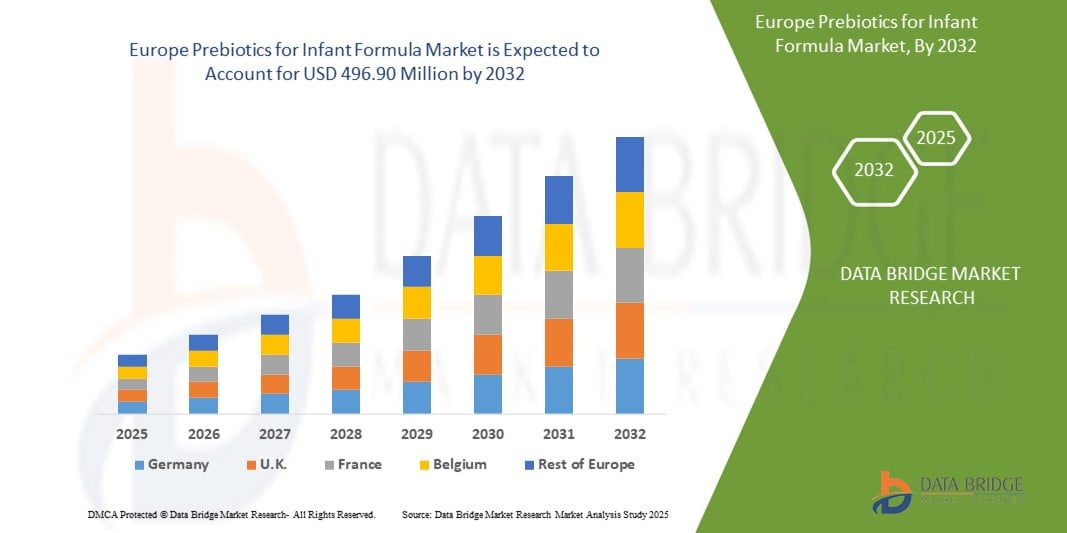
What is the Europe Prebiotics for Infant Formula Market Size and Growth Rate?
- The Europe prebiotics for infant formula market size was valued at USD 309.41 million in 2024 and is expected to reach USD 496.90 million by 2032, at a CAGR of 6.10% during the forecast period
- Market expansion is primarily driven by increasing awareness among parents about infant gut health and the importance of prebiotics in mimicking the functional benefits of human milk oligosaccharides (HMOs)
- In addition, growing demand for premium infant nutrition products, combined with rising disposable incomes and increased female workforce participation, is significantly propelling market growth across emerging economies in the region
What are the Major Takeaways of Prebiotics for Infant Formula Market?
- Prebiotics for Infant Formula, particularly those containing galacto-oligosaccharides (GOS) and fructo-oligosaccharides (FOS), are gaining traction for promoting healthy gut microbiota, boosting immunity, and supporting overall infant health
- Market demand is largely driven by the shift toward functional and fortified baby food, increased penetration of international infant formula brands, and greater healthcare professional endorsements for prebiotic inclusion
- The growing preference for close-to-breastmilk substitutes and increasing focus on pediatric nutrition innovation are expected to further accelerate the adoption of prebiotic-enriched infant formulas in Europe
- Germany dominated the Europe prebiotics for infant formula market in 2024, accounting for the largest revenue share of 47.36%, driven by a strong healthcare infrastructure, premium consumer preferences, and a robust presence of scientific research in infant nutrition
- U.K. is witnessing fastest growth rate of 8.89%, backed by rising awareness of gut microbiome development in infants. Parents are increasingly opting for premium formulas featuring HMOs, PDX, and inulin, while local manufacturers and global players expand product lines to address both nutritional quality and allergen-free options
- The Human Milk Oligosaccharides (HMOs) segment dominated the market with the largest revenue share of 36.4% in 2024, owing to their close resemblance to naturally occurring prebiotics found in breast milk
Report Scope and Prebiotics for Infant Formula Market Segmentation
|
Attributes |
Prebiotics for Infant Formula Key Market Insights |
|
Segments Covered |
|
|
Countries Covered |
Europe
|
|
Key Market Players |
|
|
Market Opportunities |
|
|
Value Added Data Infosets |
In addition to the insights on market scenarios such as market value, growth rate, segmentation, geographical coverage, and major players, the market reports curated by the Data Bridge Market Research also include in-depth expert analysis, pricing analysis, brand share analysis, consumer survey, demography analysis, supply chain analysis, value chain analysis, raw material/consumables overview, vendor selection criteria, PESTLE Analysis, Porter Analysis, and regulatory framework. |
What is the Key Trend in the Prebiotics for Infant Formula Market?
“Innovation in Human Milk Oligosaccharide (HMO) Integration”
- A prominent trend in the Europe prebiotics for infant formula market is the increasing inclusion of Human Milk Oligosaccharides (HMOs), which closely mimic the beneficial prebiotics found in natural breast milk. HMOs support gut health, immunity, and cognitive development in infants, making them a key focus area for premium formula brands
- For instance, Abbott Laboratories has introduced formulas containing 2’-FL HMO under its Similac brand in Europe markets, aimed at replicating the natural benefits of breast milk for non-breastfed infants
- Market players are investing in biotechnology-driven fermentation processes to produce HMOs at scale. Companies such as DSM and FrieslandCampina Ingredients are collaborating with local brands to expand HMO-based offerings in countries such as China, Japan, and India
- The surge in research linking HMOs to stronger immune responses and long-term infant health is driving increased parental preference for formulas that offer similar nutritional advantages to breastfeeding
- As scientific advancements continue, the integration of multiple HMOs and customization of prebiotic blends are expected to become a central differentiator in product innovation, further shaping consumer demand in the region
What are the Key Drivers of Prebiotics for Infant Formula Market?
- Rising awareness about infant gut microbiome development and the benefits of prebiotics in replicating breast milk’s health effects is a major growth driver
- For instance, in June 2024, Danone launched an advanced formula range enriched with GOS and FOS prebiotics in China, aimed at boosting immunity and digestion in infants
- The market is also driven by growing urbanization and lifestyle shifts, leading to increased reliance on infant formula, especially among working mothers in emerging economies such as India, Indonesia, and Vietnam
- In addition, the region is witnessing strong government and pediatric support for fortified nutrition to address early childhood development concerns, further accelerating demand for high-quality prebiotic-enriched formulas
- Rapid expansion of e-commerce platforms and growing availability of global brands through online channels is improving product accessibility and fueling cross-border demand
Which Factor is challenging the Growth of the Prebiotics for Infant Formula Market?
- One of the primary challenges is high product cost, especially for prebiotic-enriched and HMO-based infant formulas, which limits affordability for a large segment of price-sensitive consumers
- For instance, while premium brands such as Nestlé’s NAN Supreme offer advanced prebiotic blends, their price points are often out of reach for rural and lower-income households in countries such as India and the Philippines
- In addition, stringent regulatory approvals and varying standards across countries can delay product launches and increase costs for manufacturers seeking to expand regionally
- There is also a persistent lack of awareness about the specific health benefits of prebiotics compared to basic formula options, particularly in underdeveloped markets where education on early nutrition remains limited
- Overcoming these challenges through localized pricing strategies, wider healthcare education campaigns, and collaborative efforts with governments and NGOs will be key to unlocking long-term market growth
How is the Prebiotics for Infant Formula Market Segmented?
The market is segmented on the basis of type, source, grade, form, product type, and infant age.
• By Type
On the basis of type, the Europe prebiotics for infant formula market is segmented into Human Milk Oligosaccharides (HMOs), Galactooligosaccharides (GOS), Fructooligosaccharides (FOS), Mannan-Oligosaccharides (MOS), Polydextrose (PDX), Lactulose (LOS), and Inulin. The Human Milk Oligosaccharides (HMOs) segment dominated the market with the largest revenue share of 36.4% in 2024, owing to their close resemblance to naturally occurring prebiotics found in breast milk. HMOs support gut health, immune function, and cognitive development, driving their inclusion in high-end and premium infant formulas.
The Galactooligosaccharides (GOS) segment is expected to witness the fastest growth rate from 2025 to 2032, driven by increasing consumer awareness of gut microbiota benefits and the rising availability of GOS-fortified formulas at affordable price points.
• By Source
On the basis of source, the market is segmented into Bacteria, Algae, Fungi, and Plants & Vegetables. The Plants & Vegetables segment held the largest market revenue share in 2024, accounting for 41.8%, due to the wide availability, cost-effectiveness, and natural origin of plant-based prebiotics such as inulin and FOS. Manufacturers are leveraging plant-derived ingredients to appeal to health-conscious and sustainability-focused consumers.
The Bacteria segment is expected to exhibit the fastest CAGR from 2025 to 2032, as technological advancements in fermentation processes enable efficient production of complex prebiotics such as HMOs and GOS with bacterial strains.
• By Grade
On the basis of grade, the market is segmented into Inorganic and Organic. The Inorganic segment dominated the market in 2024 with a revenue share of 58.3%, attributed to its affordability, higher availability, and widespread application in conventional infant formula products.
The Organic segment is anticipated to grow at the fastest pace from 2025 to 2032, driven by increasing demand for clean-label, chemical-free baby nutrition and regulatory support for organic certifications across Europe markets.
• By Form
On the basis of form, the market is segmented into Powder and Liquid. The Powder segment accounted for the largest market share of 67.1% in 2024, owing to its longer shelf life, ease of transport, and wide usage across both retail and institutional sales.
The Liquid segment is expected to register the highest growth rate during the forecast period due to rising consumer preference for ready-to-feed (RTF) formulas, particularly in urban areas where convenience and time-saving are valued.
• By Product Type
On the basis of product type, the market is segmented into Standard Formula, Toddler Formula, Follow-Up Formula, and Special Formula. The Standard Formula segment led the market with a dominant share of 40.6% in 2024, driven by its widespread use among infants aged 0–6 months and broad availability through both domestic and international brands.
The Special Formula segment is expected to experience the fastest CAGR from 2025 to 2032, spurred by rising awareness of infant allergies, digestive disorders, and specialized nutritional needs requiring tailored formulations.
• By Infant Age
On the basis of infant age, the market is segmented into 0–6 Months, 6–12 Months, and 1–3 Years. The 0–6 Months age group dominated the market in 2024 with a revenue share of 49.7%, supported by higher dependency on formula feeding in the early postnatal phase, especially among working mothers and in urban households.
The 1–3 Years age segment is projected to grow at the fastest rate, driven by the increasing trend of nutritional supplementation in toddlers to support cognitive and physical development post-weaning.
Which Region Holds the Largest Share of the Prebiotics for Infant Formula Market?
- Germany dominated the Europe prebiotics for infant formula market in 2024, accounting for the largest revenue share of 47.36%, driven by a strong healthcare infrastructure, premium consumer preferences, and a robust presence of scientific research in infant nutrition
- German parents prioritize infant formulas enriched with HMOs, GOS, and inulin, reflecting a high demand for clinically validated, gut-health-enhancing products
- Supportive government regulations, widespread awareness of early childhood nutrition, and the dominance of well-established European brands reinforce Germany’s leadership in the regional market
France Prebiotics for Infant Formula Market Insight
France is a mature but steadily growing market, supported by a strong emphasis on organic and clean-label formulations. High parental trust in science-based products and a proactive approach toward infant health drive consistent demand for FOS-, GOS-, and lactulose-based formulas. A well-developed retail pharmacy network and early adoption of innovative blends contribute to France’s sustained market share.
U.K. Prebiotics for Infant Formula Market Insight
The U.K. is witnessing fastest growth rate of 8.89%, backed by rising awareness of gut microbiome development in infants. Parents are increasingly opting for premium formulas featuring HMOs, PDX, and inulin, while local manufacturers and global players expand product lines to address both nutritional quality and allergen-free options. Post-Brexit regulatory harmonization has also encouraged innovation and imports of functional ingredients.
Italy Prebiotics for Infant Formula Market Insight
Italy is showing moderate but steady growth, with rising consumer demand for natural and organic prebiotics in infant nutrition. Influenced by Mediterranean dietary preferences, Italian parents favor formulas with plant-derived ingredients like inulin and GOS. The market is shaped by increasing e-commerce availability and evolving pediatric recommendations emphasizing early immune support.
Spain Prebiotics for Infant Formula Market Insight
Spain is emerging as a high-potential market in Europe, driven by increasing awareness of digestive health and preventive nutrition in infancy. Growing demand for FOS- and GOS-enriched formulas is supported by educational campaigns and rising health consciousness among new parents. Strategic collaborations between local producers and international brands are enhancing product accessibility in pharmacies and supermarkets.
Which are the Top Companies in Prebiotics for Infant Formula Market?
The prebiotics for infant formula industry is primarily led by well-established companies, including:
- Jennewein Biotechnologie GmbH (Germany)
- zuChem Inc. (U.S.)
- Biosynth Carbosynth (Switzerland)
- ELICITYL SA (France)
- Dextra Laboratories Limited (U.K.)
- Glycom A/S (Denmark)
- Tereos (France)
- Ingredion Incorporated (U.S.)
- Royal FrieslandCampina N.V. (Netherlands)
- Südzucker AG (Germany)
- Cargill, Incorporated (U.S.)
- Fonterra Co-operative Group (New Zealand)
- Royal Cosun (Netherlands)
- COSUCRA (Belgium)
- New Francisco (Yunfu City) Biotechnology Corporation Limited (China)
- Dana Dairy Group (Switzerland)
- Glycosyn LLC (U.S.)
- DuPont (U.S.)
What are the Recent Developments in Europe Prebiotics for Infant Formula Market?
- In September 2024, Samyang Corporation held a groundbreaking ceremony for its new Specialty Plant in Ulsan, committing approximately USD 105 million to the project. The facility will house South Korea’s largest allulose production plant with an annual capacity of 13,000 tons, alongside a prebiotics production unit manufacturing resistant dextrin and fructo-oligosaccharide powder. This expansion marks a strategic move by Samyang to enhance its footprint in North America, Japan, and Southeast Asia’s health-oriented ingredient markets
- In January 2024, the biotics sector experienced several key updates, including progress toward establishing postbiotic standards in China and rising demands for stricter probiotic regulations in Hong Kong. These developments highlight the growing need for regulatory clarity and quality control within the global biotics industry
- In November 2023, Ting Li Development, the investment arm of Ting Hsin International Group which commands nearly 35% of China’s instant food and beverage market—entered a strategic alliance focused on reducing sugar and carbohydrate levels in its product portfolio. This collaboration reflects the increasing industry emphasis on health-conscious formulations in the Asian F&B sector
- In June 2023, Sanofi partnered with AB-BIOTICS to launch a line of probiotics aimed at improving cholesterol levels for consumers in South Korea. This initiative underscores the role of functional supplements in addressing prevalent health concerns in the Asian market

- Interactive Data Analysis Dashboard
- Company Analysis Dashboard for high growth potential opportunities
- Research Analyst Access for customization & queries
- Competitor Analysis with Interactive dashboard
- Latest News, Updates & Trend analysis
- Harness the Power of Benchmark Analysis for Comprehensive Competitor Tracking
Europe Prebiotics For Infant Formula Market, Supply Chain Analysis and Ecosystem Framework
To support market growth and help clients navigate the impact of geopolitical shifts, DBMR has integrated in-depth supply chain analysis into its Europe Prebiotics For Infant Formula Market research reports. This addition empowers clients to respond effectively to global changes affecting their industries. The supply chain analysis section includes detailed insights such as Europe Prebiotics For Infant Formula Market consumption and production by country, price trend analysis, the impact of tariffs and geopolitical developments, and import and export trends by country and HSN code. It also highlights major suppliers with data on production capacity and company profiles, as well as key importers and exporters. In addition to research, DBMR offers specialized supply chain consulting services backed by over a decade of experience, providing solutions like supplier discovery, supplier risk assessment, price trend analysis, impact evaluation of inflation and trade route changes, and comprehensive market trend analysis.
Data collection and base year analysis are done using data collection modules with large sample sizes. The stage includes obtaining market information or related data through various sources and strategies. It includes examining and planning all the data acquired from the past in advance. It likewise envelops the examination of information inconsistencies seen across different information sources. The market data is analysed and estimated using market statistical and coherent models. Also, market share analysis and key trend analysis are the major success factors in the market report. To know more, please request an analyst call or drop down your inquiry.
The key research methodology used by DBMR research team is data triangulation which involves data mining, analysis of the impact of data variables on the market and primary (industry expert) validation. Data models include Vendor Positioning Grid, Market Time Line Analysis, Market Overview and Guide, Company Positioning Grid, Patent Analysis, Pricing Analysis, Company Market Share Analysis, Standards of Measurement, Global versus Regional and Vendor Share Analysis. To know more about the research methodology, drop in an inquiry to speak to our industry experts.
Data Bridge Market Research is a leader in advanced formative research. We take pride in servicing our existing and new customers with data and analysis that match and suits their goal. The report can be customized to include price trend analysis of target brands understanding the market for additional countries (ask for the list of countries), clinical trial results data, literature review, refurbished market and product base analysis. Market analysis of target competitors can be analyzed from technology-based analysis to market portfolio strategies. We can add as many competitors that you require data about in the format and data style you are looking for. Our team of analysts can also provide you data in crude raw excel files pivot tables (Fact book) or can assist you in creating presentations from the data sets available in the report.













