


What is the Europe Protective Gloves Market Size and Growth Rate?
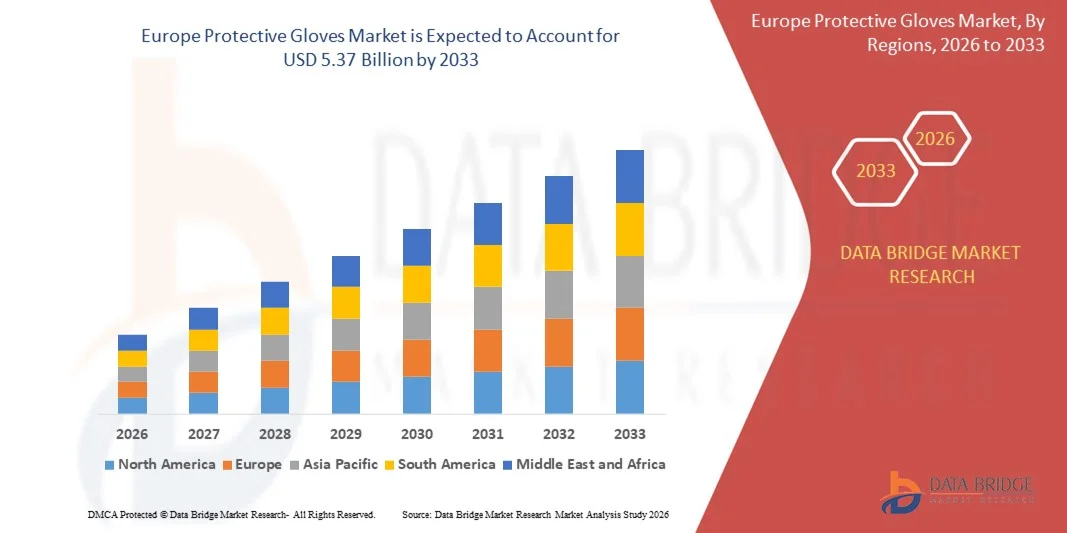
- As per Data Bridge Market Research Analysis the Europe protective gloves market size was valued at USD 3.29 billion in 2025 and is expected to reach USD 5.37 billion by 2033, at a CAGR of 6.30% during the forecast period
- The market growth is largely fuelled by stringent workplace safety regulations across industrial, healthcare, and chemical sectors, coupled with rising employer focus on worker protection and compliance
- Increasing healthcare expenditure and the sustained use of protective gloves in hospitals, clinics, and laboratories for infection prevention are further supporting market expansion
Market Size & Forecas
- Global Market Value (2025): USD 3.29 billion
- Expected Market Value (2033): USD 5.37 billion
- Forecast CAGR (2026–2033): 6.30%
What are the Major Takeaways of Europe Protective Gloves Market?
- The market is characterised by consistent demand driven by regulatory mandates, high safety standards, and strong end-user awareness regarding hand protection in hazardous working environments
- Technological advancements in glove materials, such as enhanced durability, comfort, and chemical resistance, are improving product performance and encouraging replacement demand
- Germany held a dominant position in the European protective gloves market in 2025, supported by a strong industrial base and advanced manufacturing sector. High demand from automotive, chemicals, and engineering industries continues to drive market leadership. Strict EU workplace safety regulations ensure consistent glove usage across industries
- U.K. is expected to witness the highest compound annual growth rate (CAGR) in the Europe protective gloves market due to expanding healthcare services, growing emphasis on worker safety, and increasing adoption across food processing, pharmaceuticals, and construction sectors. Rising post-pandemic hygiene awareness and employer-led safety initiatives are accelerating glove adoption
- The nitrile gloves segment held the largest market revenue share in 2025 driven by their superior chemical resistance, durability, and latex-free properties, making them widely preferred across healthcare, manufacturing, and chemical handling applications. Nitrile gloves are commonly adopted due to their balance of protection, comfort, and regulatory acceptance
Report Scope and Europe Protective Gloves Market Segmentation
|
Attributes |
Europe Protective Gloves Key Market Insights |
|
Segments Covered |
|
|
Countries Covered |
Europe
|
|
Key Market Players |
|
|
Market Opportunities |
|
|
Value Added Data Infosets |
In addition to the insights on market scenarios such as market value, growth rate, segmentation, geographical coverage, and major players, the market reports curated by the Data Bridge Market Research also include import export analysis, production capacity overview, production consumption analysis, price trend analysis, climate change scenario, supply chain analysis, value chain analysis, raw material/consumables overview, vendor selection criteria, PESTLE Analysis, Porter Analysis, and regulatory framework. |
What is the Key Trend in the Europe Protective Gloves Market?
Rising Focus on Workplace Safety and Hygiene Standards
- The increasing emphasis on worker safety and hygiene across industries is significantly shaping the protective gloves market, as employers prioritize compliance with occupational safety standards and risk mitigation. Protective gloves are gaining widespread adoption due to their ability to reduce exposure to chemicals, biological agents, cuts, and abrasions, while supporting safe working environments. This trend is strengthening demand across healthcare, manufacturing, food processing, construction, and chemical industries, encouraging manufacturers to innovate with improved materials and ergonomic designs
- Growing awareness regarding infection prevention, cross-contamination control, and personal protection has accelerated the use of disposable and reusable protective gloves in healthcare, food handling, and laboratory applications. End users are increasingly seeking gloves that offer enhanced barrier protection, comfort, and durability, prompting manufacturers to focus on material innovation such as nitrile, latex alternatives, and biodegradable options
- Safety regulations and corporate compliance policies are influencing purchasing decisions, with organizations emphasizing certified products, consistent quality, and reliable supply. These factors are helping suppliers strengthen long-term contracts and brand trust, while also driving the adoption of standards-based testing and quality assurance practices. Companies are increasingly highlighting compliance credentials and performance attributes in marketing strategies to differentiate offerings
- For instance, major manufacturers expanded their protective glove portfolios by introducing powder-free, allergy-safe, and high-dexterity variants designed for medical, industrial, and food contact applications. These launches were aimed at addressing rising demand for safer and more hygienic protective equipment, with strong uptake across institutional and commercial procurement channels
- While demand for protective gloves continues to rise, sustained market growth depends on continuous material innovation, cost control, and maintaining consistent performance under diverse working conditions. Manufacturers are also focusing on automation, supply chain resilience, and product customization to meet evolving safety requirements and volume demand
Europe Protective Gloves Market Dynamics
Driver
Growing Emphasis on Occupational Safety and Regulatory Compliance
- Increasing enforcement of workplace safety regulations and standards is a key driver for the protective gloves market. Employers are mandating the use of protective gloves to reduce injury risks, prevent contamination, and ensure compliance with health and safety guidelines. This is encouraging manufacturers to develop gloves that meet specific industry certifications and performance benchmarks
- Expanding applications across healthcare, industrial manufacturing, construction, food processing, and chemical handling are supporting market growth. Protective gloves help enhance worker safety, hygiene, and operational efficiency, enabling organizations to minimize downtime and liability while maintaining productivity. The growing complexity of industrial processes further reinforces the need for specialized protective gloves
- Employers and institutional buyers are actively investing in protective glove solutions through bulk procurement, long-term supply agreements, and safety training initiatives. These efforts are supported by rising awareness of employee well-being and risk management, and they also encourage collaboration between glove manufacturers, distributors, and safety solution providers to improve product performance and user compliance
- For instance, leading end-use industries increased adoption of cut-resistant, chemical-resistant, and disposable protective gloves to address evolving safety needs and stricter compliance requirements. These initiatives supported product differentiation, improved safety outcomes, and reinforced the importance of personal protective equipment in daily operations
- Although regulatory and safety-driven demand supports market expansion, continued growth will depend on balancing cost, comfort, and protection levels. Investment in advanced materials, sustainable alternatives, and scalable manufacturing processes will be critical to meet rising global demand and maintain competitive positioning
Restraint/Challenge
Price Sensitivity and Environmental Concerns Related to Disposable Gloves
- The cost of high-quality protective gloves, particularly specialized and certified variants, remains a challenge for price-sensitive buyers. Fluctuating raw material prices and rising production costs can impact affordability, especially for small and medium enterprises with limited safety budgets. This can slow adoption in cost-conscious sectors
- Environmental concerns associated with single-use and disposable gloves are also restraining market growth. Increasing scrutiny around waste generation and disposal practices is prompting some end users to reconsider usage volumes or seek reusable alternatives. Limited recycling options and lack of awareness about sustainable glove solutions further compound this challenge
- Supply chain disruptions and demand volatility can affect product availability and pricing stability. Dependence on specific raw materials and global sourcing networks increases exposure to shortages and lead time uncertainties. Companies must invest in diversified sourcing, inventory management, and localized production to mitigate these risks
- For instance, industrial and institutional buyers reported challenges related to rising glove costs and waste management requirements, leading to selective usage policies and extended replacement cycles. These factors affected procurement volumes and encouraged evaluation of alternative protective solutions
- Addressing these challenges will require innovation in cost-effective materials, development of eco-friendly and recyclable glove options, and improved awareness of long-term safety and sustainability benefits. Collaboration between manufacturers, employers, and regulatory bodies will be essential to unlock sustained growth in the protective gloves market
How is the Europe Protective Gloves Market Segmented?
The market is segmented on the basis of product, type, application, distribution channel, and end user.
- By Product
On the basis of product, the Europe protective gloves market is segmented into Nitrile Gloves, Latex Gloves, Vinyl Gloves, Puncture Resistant Gloves, Polyethylene Gloves, Cotton Fabric Gloves, Butyl Gloves, Aluminized Gloves, Neoprene Gloves, Kevlar Gloves, Leather Gloves, and Others. The nitrile gloves segment held the largest market revenue share in 2025 driven by their superior chemical resistance, durability, and latex-free properties, making them widely preferred across healthcare, manufacturing, and chemical handling applications. Nitrile gloves are commonly adopted due to their balance of protection, comfort, and regulatory acceptance.
The puncture resistant gloves segment is expected to witness strong growth from 2026 to 2033, driven by increasing safety requirements in construction, manufacturing, mining, and mechanical applications. These gloves are gaining popularity for their enhanced protection against sharp objects and mechanical hazards, supporting their growing use in high-risk work environments.
- By Type
On the basis of type, the Europe protective gloves market is segmented into Disposable and Reusable. The disposable gloves segment accounted for the larger market share in 2025 supported by high usage in healthcare, food handling, and laboratory applications where hygiene and contamination control are critical. Disposable gloves offer convenience, ease of replacement, and compliance with safety protocols.
The reusable gloves segment is expected to witness strong growth from 2026 to 2033 due to rising demand from industrial, construction, and chemical sectors where durability and long-term cost efficiency are prioritized. Reusable gloves are increasingly preferred for applications requiring repeated use and higher mechanical or thermal resistance.
- By Application
On the basis of application, the market is segmented into Biological, Chemical, Mechanical, Thermal, Anti-Static, and Others. The biological application segment held the largest revenue share in 2025 driven by extensive use of protective gloves for infection control, hygiene maintenance, and contamination prevention in healthcare and food processing environments.
The chemical segment is expected to witness strong growth from 2026 to 2033 supported by increasing industrial activity and stricter workplace safety regulations. Gloves designed for chemical and mechanical protection are widely adopted to reduce occupational hazards and improve worker safety.
- By Distribution Channel
On the basis of distribution channel, the Europe protective gloves market is segmented into Retail and Direct Sales/B2B. The direct sales and B2B segment dominated the market in 2025 driven by bulk procurement by hospitals, manufacturing facilities, construction companies, and industrial enterprises. This channel offers consistent supply, cost advantages, and customized product specifications.
The retail segment is expected to witness strong growth from 2026 to 2033 due to rising demand from small businesses, individual users, and sports or household applications. Increased availability of protective gloves through specialty stores and online platforms is supporting this growth.
- By End User
On the basis of end user, the market is segmented into Healthcare, Food and Beverages, Oil & Gas, Transportation, Fire Protection, Construction, Manufacturing, Sports, Military, Mining, and Others. The healthcare segment accounted for the largest market share in 2025 driven by high consumption of disposable gloves for medical examinations, surgical procedures, and infection prevention practices.
The construction segment is projected to witness strong growth from 2026 to 2033 due to rising emphasis on worker safety and compliance with occupational safety standards. Increased use of mechanical, thermal, and puncture resistant gloves in these industries is supporting sustained demand growth.
Which Region Holds the Largest Share of the Europe Protective Gloves Market?
- Germany held a dominant position in the European protective gloves market in 2025, supported by a strong industrial base and advanced manufacturing sector. High demand from automotive, chemicals, and engineering industries continues to drive market leadership. Strict EU workplace safety regulations ensure consistent glove usage across industries
- The presence of established manufacturers and focus on high-quality protective products strengthen market performance. In addition, continuous innovation in materials supports sustained demand
U.K. Protective Gloves Market Insight
The U.K. protective gloves market is projected to witness strong growth from 2026 to 2033 in Europe, driven by expanding healthcare services and rising emphasis on worker safety. Increasing adoption across food processing, pharmaceuticals, and construction sectors supports market expansion. Post-pandemic hygiene awareness continues to drive demand for disposable gloves. Regulatory compliance and employer-led safety initiatives further boost adoption. In addition, growing investments in healthcare infrastructure contribute to sustained market growth
Which are the Top Companies in Europe Protective Gloves Market?
The Europe protective gloves industry is primarily led by well-established companies, including:
• Semperit Group (Austria)
• UVEX Group (Germany)
• Ansell Europe (Germany)
• MAPA Professional (France)
• SHOWA Europe (Germany)
• Polyco Healthline (U.K.)
• Bunzl Safety (U.K.)
• Globus Group (U.K.)
• Ejendals (Sweden)
• ATG Intelligent Glove Solutions (Germany)
• Tegera (Sweden)
• Euro Protection (France)
• Lanzi Group (Italy)
• Delta Plus Group (France)
• Juba Personal Protective Equipment (Spain)

- Interactive Data Analysis Dashboard
- Company Analysis Dashboard for high growth potential opportunities
- Research Analyst Access for customization & queries
- Competitor Analysis with Interactive dashboard
- Latest News, Updates & Trend analysis
- Harness the Power of Benchmark Analysis for Comprehensive Competitor Tracking
Europe Protective Gloves Market, Supply Chain Analysis and Ecosystem Framework
To support market growth and help clients navigate the impact of geopolitical shifts, DBMR has integrated in-depth supply chain analysis into its Europe Protective Gloves Market research reports. This addition empowers clients to respond effectively to global changes affecting their industries. The supply chain analysis section includes detailed insights such as Europe Protective Gloves Market consumption and production by country, price trend analysis, the impact of tariffs and geopolitical developments, and import and export trends by country and HSN code. It also highlights major suppliers with data on production capacity and company profiles, as well as key importers and exporters. In addition to research, DBMR offers specialized supply chain consulting services backed by over a decade of experience, providing solutions like supplier discovery, supplier risk assessment, price trend analysis, impact evaluation of inflation and trade route changes, and comprehensive market trend analysis.
Data collection and base year analysis are done using data collection modules with large sample sizes. The stage includes obtaining market information or related data through various sources and strategies. It includes examining and planning all the data acquired from the past in advance. It likewise envelops the examination of information inconsistencies seen across different information sources. The market data is analysed and estimated using market statistical and coherent models. Also, market share analysis and key trend analysis are the major success factors in the market report. To know more, please request an analyst call or drop down your inquiry.
The key research methodology used by DBMR research team is data triangulation which involves data mining, analysis of the impact of data variables on the market and primary (industry expert) validation. Data models include Vendor Positioning Grid, Market Time Line Analysis, Market Overview and Guide, Company Positioning Grid, Patent Analysis, Pricing Analysis, Company Market Share Analysis, Standards of Measurement, Global versus Regional and Vendor Share Analysis. To know more about the research methodology, drop in an inquiry to speak to our industry experts.
Data Bridge Market Research is a leader in advanced formative research. We take pride in servicing our existing and new customers with data and analysis that match and suits their goal. The report can be customized to include price trend analysis of target brands understanding the market for additional countries (ask for the list of countries), clinical trial results data, literature review, refurbished market and product base analysis. Market analysis of target competitors can be analyzed from technology-based analysis to market portfolio strategies. We can add as many competitors that you require data about in the format and data style you are looking for. Our team of analysts can also provide you data in crude raw excel files pivot tables (Fact book) or can assist you in creating presentations from the data sets available in the report.













