


Europe Rett Syndrome Market Size
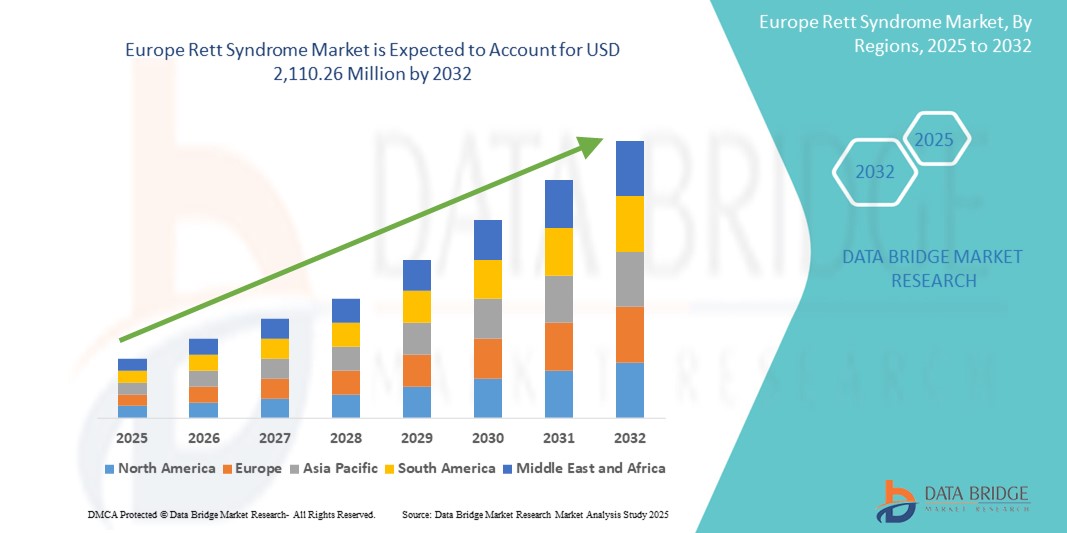
- The Europe Rett syndrome market size was valued at USD 14.35 million in 2024 and is expected to reach USD 2,110.26 million by 2032, at a CAGR of74.1% during the forecast period
- The market growth is largely fueled by increasing awareness, early diagnosis, and advancements in genetic testing across Europe, enabling timely and accurate identification of Rett syndrome in affected individuals. This has led to a rise in the number of patients receiving appropriate and targeted interventions, thereby supporting market expansion
- Furthermore, growing investments in rare disease research and a supportive regulatory framework across the European Union are accelerating the development and approval of innovative therapeutics. These factors are driving the adoption of novel treatment options, significantly boosting the growth of the Europe Rett Syndrome market
Europe Rett Syndrome Market Analysis
- Rett Syndrome, a rare genetic neurological disorder that affects brain development, primarily in females, is witnessing growing awareness and research attention across Europe. The increasing focus on early diagnosis, gene therapy innovation, and supportive care infrastructure is boosting market activity in both clinical and commercial segments
- The escalating demand for novel therapeutic approaches is primarily fueled by the limited efficacy of current symptomatic treatments, rising patient advocacy, and expanded research funding by governments and private organizations in Europe
- Germany dominated the Europe Rett syndrome market in 2024, owing to robust healthcare infrastructure, increased funding for rare disease research, and the early adoption of innovative treatment approaches such as gene and enzyme therapies
- France is expected to witness the highest CAGR in the Europe Rett syndrome market during the forecast period, continuing to make considerable strides in rare disease management due to strong government-backed initiatives such as the French National Plan for Rare Diseases
- The classic Rett syndrome segment dominated the Europe Rett Syndrome market with a market share of 71.3% in 2024, owing to its higher prevalence and earlier diagnosis. Increased clinical awareness, availability of genetic testing for MECP2 mutations, and focused research on managing classic symptoms have contributed to the segment’s dominance
Report Scope and Europe Rett Syndrome Market Segmentation
|
Attributes |
Europe Rett Syndrome Key Market Insights |
|
Segments Covered |
|
|
Countries Covered |
Europe
|
|
Key Market Players |
|
|
Market Opportunities |
|
|
Value Added Data Infosets |
In addition to the insights on market scenarios such as market value, growth rate, segmentation, geographical coverage, and major players, the market reports curated by the Data Bridge Market Research also include in-depth expert analysis, pricing analysis, brand share analysis, consumer survey, demography analysis, supply chain analysis, value chain analysis, raw material/consumables overview, vendor selection criteria, PESTLE Analysis, Porter Analysis, and regulatory framework. |
Europe Rett Syndrome Market Trends
“Growing Therapeutic Advancements and Increasing Clinical Research”
- A significant and accelerating trend in the Europe Rett syndrome market is the expansion of gene therapy and neurodevelopmental research targeting MECP2 mutations—the primary cause of Rett syndrome. These scientific advancements are enhancing therapeutic pipelines and improving the precision of future treatment options
- For instance, various biotechnology firms and academic institutions in Europe are focusing on RNA-based therapeutics, gene editing, and small-molecule drugs aimed at restoring MECP2 function or compensating for its loss. Such developments are expected to redefine clinical outcomes in patients by addressing the root cause of the disorder
- In addition, the increasing adoption of multidisciplinary care frameworks across hospitals and specialty centers is enabling early diagnosis, comprehensive symptom management, and improved long-term quality of life for affected individuals. These care models typically integrate neurology, physiotherapy, behavioral therapy, and nutritional support in a single coordinated setting
- Furthermore, the development of wearable assistive devices, adaptive communication technologies, and supportive mobility tools tailored for Rett syndrome patients is gaining traction in the region. These innovations empower patients with better functional independence and reduce caregiver burden
- Companies and healthcare providers in countries such as Germany, France, and the U.K. are also partnering with patient advocacy groups to increase awareness, streamline access to therapies, and expand the availability of orphan drugs through government-backed reimbursement programs
- This trend toward more targeted, personalized, and integrated care solutions is fundamentally transforming the treatment landscape, positioning the Europe Rett Syndrome Market for sustained clinical and commercial growth in the years ahead
Europe Rett Syndrome Market Dynamics
Driver
“Growing Need Due to Rising Diagnosis Rates and Advancements in Genetic Research”
- The increasing prevalence of Rett syndrome across Europe, combined with growing awareness and improved diagnostic capabilities, is a major driver of market growth. Early genetic testing and newborn screening initiatives in countries such as Germany, France, and the U.K. are leading to timely diagnosis and early intervention
- For instance, in April 2024, Anavex Life Sciences announced positive progress in its Phase III clinical trial for Anavex 2-73 (blarcamesine), a small molecule targeting Rett Syndrome through sigma-1 receptor activation. This and other pipeline advancements are expected to drive the Europe Rett Syndrome market over the forecast period
- As families and healthcare providers seek more targeted treatment options, there is growing interest in disease-modifying therapies and gene therapies that address MECP2 mutations—the root cause of Rett Syndrome. These therapeutic strategies represent a significant shift from symptomatic management to potentially curative approaches
- Furthermore, European governments and regulatory bodies, such as the EMA (European Medicines Agency), are promoting the development and fast-tracking of orphan drugs through incentives, grants, and priority review designations, thus fueling research and innovation in the rare disease space
- Increasing collaboration between biotech companies, academic institutions, and Rett Syndrome foundations is fostering a supportive ecosystem for clinical trials, patient registries, and awareness campaigns. These developments are crucial in shaping long-term care infrastructure and expanding patient access to emerging therapies
Restraint/Challenge
“High Cost of Treatment and Limited Access to Specialized Care”
- The high cost associated with advanced therapies, including gene therapy and personalized medicine, remains a significant challenge for Rett syndrome treatment across Europe. Since Rett Syndrome is a rare disorder, treatment options are often classified as orphan drugs, which can come with premium pricing
- For instance, even with orphan drug status, novel therapies often require multi-year R&D and complex manufacturing processes, making them less accessible for national healthcare systems with budget constraints. This limits equitable access, especially in Eastern European countries and rural regions
- Specialized Rett care also requires multidisciplinary support—neurologists, geneticists, therapists, and nutritionists—which are not uniformly available across all parts of Europe. Families may have to travel long distances or face waiting lists to receive proper care
- Another challenge lies in the lack of standardized treatment protocols and insufficient clinical data due to the relatively small patient population. This hampers physician familiarity and delays widespread adoption of novel treatments
- Addressing these barriers through increased government funding, greater pan-European research collaboration, and the establishment of more dedicated Rett Syndrome centers will be crucial to improving outcomes and expanding the Europe Rett Syndrome Market sustainably
Europe Rett Syndrome Market Scope
The market is segmented on the basis of type, stages, treatment type, drug type, route of administration, end user, and distribution channel.
- By Types
On the basis of type, the Europe Rett syndrome market is segmented into Classic Rett Syndrome and Atypical Rett Syndrome. The Classic Rett Syndrome segment dominated the largest market revenue share of 71.3% in 2024 due to the higher prevalence and earlier diagnosis.
The Atypical Rett Syndrome segment is anticipated to witness the fastest CAGR of 8.6% from 2025 to 2032, driven by advancements in genetic diagnostics and increased awareness.
- By Stages
On the basis of stages, the Europe Rett syndrome market is segmented into Stage I, Stage II, Stage III, and Stage IV. Stage II (Rapid Destructive Stage) held the largest revenue share of 39.4% in 2024, given it is the most common stage when formal diagnosis is made.
Stage III (Plateau Stage) is expected to register the fastest CAGR of 7.9% during the forecast period due to long-term therapy and sustained care needs.
- By Treatment Type
On the basis of treatment type, the Europe Rett syndrome market is segmented into drug class, therapy type, and others. The therapy type segment held the largest market share of 54.2% in 2024, highlighting the central role of supportive care.
The Drug Class segment is projected to grow at the highest CAGR of 9.3% from 2025 to 2032 due to ongoing innovations in neuroprotective and gene-targeted therapies.
- By Drug Type
On the basis of drug type, the Europe Rett syndrome market is segmented into branded and generics. The branded drug segment captured a market share of 63.1% in 2024, driven by limited availability of approved treatments.
The generics segment is expected to grow at a CAGR of 6.8% over the forecast period due to wider accessibility and cost-effectiveness.
- By Route of Administration
On the basis of route of administration, the Europe Rett syndrome market is segmented into oral, parenteral, and others. The oral segment dominated with the largest share of 66.7% in 2024, due to ease of use and widespread application in symptom management.
The parenteral segment is poised to grow at the fastest CAGR of 8.2% from 2025 to 2032, supported by new injectable therapies and clinical trial pipeline drugs.
- By End User
On the basis of end user, the Europe Rett syndrome market is segmented into hospitals, specialty clinics, research organizations, and others. Hospitals accounted for the highest revenue share of 48.9% in 2024, being the key centers for diagnosis and integrated care.
Specialty clinics are anticipated to grow at the fastest CAGR of 9.1% from 2025 to 2032, due to increasing investments in rare disease infrastructure and outpatient neurology services.
- By Distribution Channel
On the basis of distribution channel, the Europe Rett syndrome market is segmented into hospital pharmacy, retail pharmacy, online pharmacy, and others. Hospital pharmacy dominated with a market share of 45.6% in 2024, due to centralized purchasing and treatment provision.
The online pharmacy segment is projected to grow at the fastest CAGR of 10.4% from 2025 to 2032, driven by digital adoption and direct-to-patient delivery models.
Europe Rett Syndrome Market Regional Analysis
- Europe dominated the global Rett syndrome market with the largest revenue share of 30.3% in 2024, driven by advanced healthcare infrastructure, increased awareness of rare genetic disorders, and strong support for research and clinical trials across major European countries
- The region benefits from favorable government initiatives, high diagnostic rates, and the presence of prominent pharmaceutical and biotechnology companies focused on rare disease treatment
- Public health campaigns and collaborative efforts between advocacy groups, healthcare providers, and academic institutions are further boosting diagnosis and treatment accessibility
Germany Europe Rett Syndrome Market Insight
The Germany Rett syndrome market accounted for the largest market share in Europe with 28.5% in 2024, owing to robust healthcare infrastructure, increased funding for rare disease research, and the early adoption of innovative treatment approaches such as gene and enzyme therapies. The presence of active patient registries and comprehensive newborn screening programs are also key contributors to market expansion.
U.K. Europe Rett Syndrome Market Insight
The U.K. Rett syndrome market held a market share of 22.6% in 2024 and is projected to grow at a significant CAGR over the forecast period, supported by rising awareness among healthcare professionals and families, as well as the increasing availability of advanced diagnostic tools. The National Health Service (NHS) and various genetic research foundations play a critical role in promoting early diagnosis and access to therapeutic interventions.
France Europe Rett Syndrome Market Insight
The France Rett syndrome market captured 18.2% of the total Europe market revenue in 2024, continuing to make considerable strides in rare disease management due to strong government-backed initiatives such as the French National Plan for Rare Diseases. The growing number of clinical trials, patient registries, and collaborative R&D projects is expected to drive market growth over the coming years.
Europe Rett Syndrome Market Share
The Europe Rett Syndrome industry is primarily led by well-established companies, including:
- Zydus Group (India)
- Viatris Inc. (U.S.)
- Hikma Pharmaceuticals PLC (U.K.)
- LUPIN (India)
- Teva Pharmaceutical Industries Ltd. (Israel)
- Dr. Reddy’s Laboratories Ltd. (India)
- Amneal Pharmaceuticals LLC (U.S.)
- Cipla Inc. (India)
- GLENMARK PHARMACEUTICALS LTD (India)
- Anavex Life Sciences Corp (U.S.)
- AMO PHARMA (U.K.)
- Novartis AG (Switzerland)
- UCB S.A. (Belgium)
- Sun Pharmaceutical Industries Ltd. (India)
- Pfizer Inc. (U.S.)
- GSK plc. (U.K.)
- Otsuka Pharmaceuticals Co., Ltd (Tokyo)
- Aspen Holdings (South Africa)
- Validus Pharmaceuticals LLC (U.S.)
- H. LUNDBECK A/S (Denmark)
- Aurobindo Pharma (India)
- Children’s Hospital Colorado (U.S.)
Latest Developments in Europe rett syndrome market
- In September 2023, Anavex Life Sciences Corp. announced promising results from a long-term clinical study displaying the disease-modifying effects of ANAVEX 2-73 (blarcamesine) for Rett syndrome. The study demonstrated sustained improvements in clinical symptoms and biomarkers over 148 weeks, highlighting blarcamesine's potential as a novel drug activating sigma-1 receptors associated with neuroprotection and neuroplasticity
- In August 2023, Neuren Pharmaceuticals received FDA approval for Daybue (trofinetide), marking it as the first treatment for Rett syndrome. Daybue, a synthetic analog of a natural neurotrophic peptide, enhances synaptic function and reduces neuroinflammation. The approval was based on positive outcomes from two phase 3 clinical trials, indicating Daybue's efficacy in improving core symptoms such as breathing, communication, mood, and motor function in Rett syndrome patients
- In June 2020, Otsuka Pharmaceuticals Co., Ltd. disclosed a strategic Research and Development (R&D) collaboration with Axcelead Drug Discovery, specifically focusing on neuroscience research. This collaboration has proven fruitful, significantly enriching Otsuka's drug development pipelines with a broader range of potential candidates. The collaboration emphasizes Otsuka's commitment to advancing neuroscience solutions, leveraging Axcelead's expertise to explore innovative therapeutic avenues and enhance the company's capabilities in addressing neurological disorders

- Interactive Data Analysis Dashboard
- Company Analysis Dashboard for high growth potential opportunities
- Research Analyst Access for customization & queries
- Competitor Analysis with Interactive dashboard
- Latest News, Updates & Trend analysis
- Harness the Power of Benchmark Analysis for Comprehensive Competitor Tracking
Data collection and base year analysis are done using data collection modules with large sample sizes. The stage includes obtaining market information or related data through various sources and strategies. It includes examining and planning all the data acquired from the past in advance. It likewise envelops the examination of information inconsistencies seen across different information sources. The market data is analysed and estimated using market statistical and coherent models. Also, market share analysis and key trend analysis are the major success factors in the market report. To know more, please request an analyst call or drop down your inquiry.
The key research methodology used by DBMR research team is data triangulation which involves data mining, analysis of the impact of data variables on the market and primary (industry expert) validation. Data models include Vendor Positioning Grid, Market Time Line Analysis, Market Overview and Guide, Company Positioning Grid, Patent Analysis, Pricing Analysis, Company Market Share Analysis, Standards of Measurement, Global versus Regional and Vendor Share Analysis. To know more about the research methodology, drop in an inquiry to speak to our industry experts.
Data Bridge Market Research is a leader in advanced formative research. We take pride in servicing our existing and new customers with data and analysis that match and suits their goal. The report can be customized to include price trend analysis of target brands understanding the market for additional countries (ask for the list of countries), clinical trial results data, literature review, refurbished market and product base analysis. Market analysis of target competitors can be analyzed from technology-based analysis to market portfolio strategies. We can add as many competitors that you require data about in the format and data style you are looking for. Our team of analysts can also provide you data in crude raw excel files pivot tables (Fact book) or can assist you in creating presentations from the data sets available in the report.













