


Europe RFID (Radio Frequency Identification) Market Size
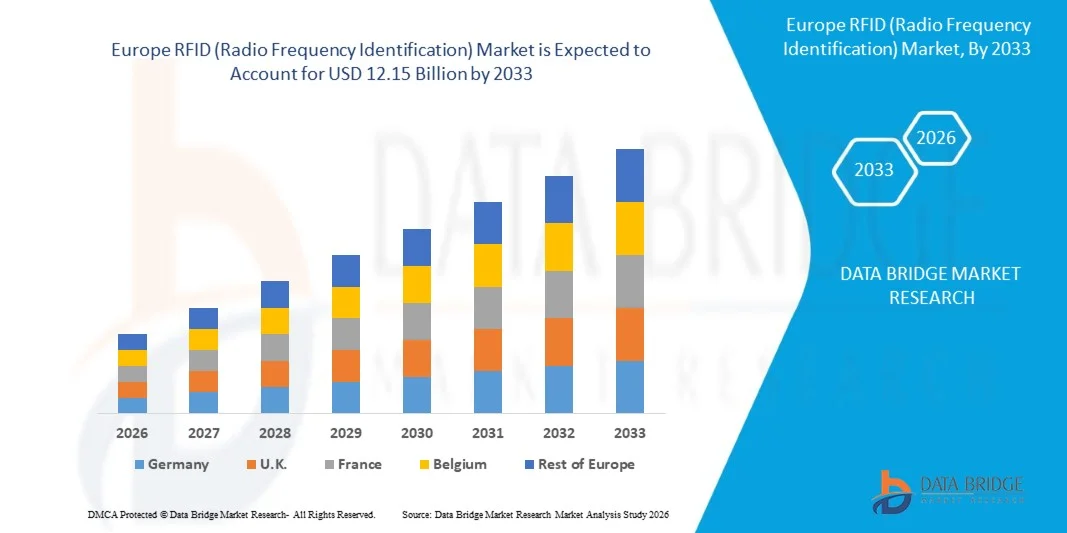
- The Europe RFID (Radio Frequency Identification) Market size was valued at USD 5.46 billion in 2025 and is expected to reach USD 12.15 billion by 2033, at a CAGR of 10.5% during the forecast period
- The market growth is largely fueled by the increasing adoption of RFID (Radio Frequency Identification) technology across retail, logistics, healthcare, and industrial sectors, enabling real-time tracking, inventory management, and process automation
- Furthermore, rising demand for secure, efficient, and contactless identification solutions in supply chains, asset management, and access control is establishing RFID (Radio Frequency Identification) as a preferred technology for operational efficiency. These converging factors are accelerating the deployment of RFID (Radio Frequency Identification) systems, thereby significantly boosting the industry's growth
Europe RFID (Radio Frequency Identification) Market Analysis
- RFID (Radio Frequency Identification) solutions, offering wireless identification and tracking of objects, assets, and personnel, are increasingly vital in modern industrial, retail, and healthcare operations due to enhanced efficiency, accuracy, and data-driven decision-making capabilities
- The escalating demand for RFID (Radio Frequency Identification) is primarily fueled by technological advancements in tags, readers, and software, growing focus on automation and digital transformation, and the need for real-time visibility in complex supply chains
- Germany dominated the Europe RFID (Radio Frequency Identification) Market in 2025, due to its advanced manufacturing, automotive, and logistics sectors, which rely heavily on real-time tracking and inventory management
- U.K. is expected to be the fastest growing country in the Europe RFID (Radio Frequency Identification) Market during the forecast period due to growing implementation of RFID (Radio Frequency Identification) in retail, healthcare, and transportation sectors
- Tags segment dominated the market with a market share of 48% in 2025, due to their essential role in identifying and tracking objects across various industries. RFID (Radio Frequency Identification) tags are widely used due to their versatility, low cost, and compatibility with multiple frequencies, making them suitable for applications ranging from inventory management to supply chain tracking
Report Scope and Europe RFID (Radio Frequency Identification) Market Segmentation
|
Attributes |
RFID (Radio Frequency Identification) Key Market Insights |
|
Segments Covered |
|
|
Countries Covered |
Europe
|
|
Key Market Players |
|
|
Market Opportunities |
|
|
Value Added Data Infosets |
In addition to the insights on market scenarios such as market value, growth rate, segmentation, geographical coverage, and major players, the market reports curated by the Data Bridge Market Research also include in-depth expert analysis, geographically represented company-wise production and capacity, network layouts of distributors and partners, detailed and updated price trend analysis and deficit analysis of supply chain and demand. |
Europe RFID (Radio Frequency Identification) Market Trends
“Rising Adoption of RFID in Retail and Supply Chain Automation”
- A significant trend in the Europe RFID (Radio Frequency Identification) Market is the increasing adoption of RFID (Radio Frequency Identification) technology across retail, logistics, and supply chain operations, driven by the growing need for real-time inventory visibility and operational efficiency. This adoption is transforming inventory management practices and enabling retailers and logistics providers to reduce losses and improve order accuracy
- For instance, Walmart has implemented RFID (Radio Frequency Identification) solutions to track merchandise across its global supply chain, enhancing inventory accuracy and reducing stockouts. Such deployments demonstrate the operational benefits of RFID (Radio Frequency Identification) in large-scale retail and distribution networks
- The use of RFID (Radio Frequency Identification) in asset tracking is expanding as companies leverage tags and readers to monitor equipment, vehicles, and high-value goods across warehouses and production facilities. This trend is enabling businesses to optimize asset utilization, reduce theft, and streamline maintenance schedules
- In the healthcare sector, hospitals and pharmaceutical companies are deploying RFID (Radio Frequency Identification) to track medical equipment, surgical instruments, and medications. This integration is improving patient safety, reducing errors, and facilitating compliance with regulatory standards
- Logistics and transportation providers are increasingly relying on RFID (Radio Frequency Identification) for container tracking, shipment verification, and automated gate entry systems. The technology is helping organizations enhance supply chain transparency and accelerate delivery timelines
- The retail and manufacturing industries are integrating RFID (Radio Frequency Identification) with IoT and cloud platforms to enable predictive analytics, automated replenishment, and smarter inventory decisions. This trend is reinforcing RFID’s role as a critical enabler of digital supply chain transformation
Europe RFID (Radio Frequency Identification) Market Dynamics
Driver
“Increasing Demand for Real-Time Asset Tracking and Inventory Management”
- The demand for real-time monitoring of assets and inventory across retail, logistics, and industrial sectors is driving the adoption of RFID (Radio Frequency Identification) systems. These solutions allow organizations to maintain accurate stock levels, reduce shrinkage, and improve operational efficiency
- For instance, Decathlon uses RFID (Radio Frequency Identification) tags to streamline inventory management in its retail stores, enabling faster stock audits and improved product availability. Such deployments illustrate the tangible benefits of RFID (Radio Frequency Identification) in retail operations
- The growing complexity of global supply chains is accelerating the need for automated tracking systems that can handle high volumes of shipments and assets. RFID (Radio Frequency Identification) provides a reliable method to monitor items throughout the supply chain and improve visibility
- Increasing regulatory compliance requirements in industries such as pharmaceuticals and food are compelling organizations to adopt RFID (Radio Frequency Identification) for traceability. RFID (Radio Frequency Identification) systems support accurate record-keeping, product authentication, and recall management, reinforcing market growth
- The continuous development of low-cost, high-performance RFID (Radio Frequency Identification) tags and readers is making deployment more feasible across various industries. This accessibility is driving adoption and positioning RFID (Radio Frequency Identification) as a standard solution for inventory and asset management
Restraint/Challenge
“High Initial Implementation Costs and Integration Complexity”
- The Europe RFID (Radio Frequency Identification) Market faces challenges due to the significant upfront investment required for hardware, software, and system integration. These costs can be a barrier, particularly for small and medium-sized enterprises seeking to implement comprehensive RFID (Radio Frequency Identification) solutions
- For instance, companies integrating RFID (Radio Frequency Identification) into existing warehouse systems, such as Macy’s, face complex deployment scenarios that require customization, staff training, and IT system upgrades. Such challenges can delay ROI and increase project complexity
- Ensuring interoperability between RFID (Radio Frequency Identification) components and legacy IT systems is technically challenging and may involve extensive reconfiguration or middleware solutions. This can slow adoption and increase implementation risk
- The need for skilled personnel to manage RFID (Radio Frequency Identification) infrastructure, interpret data, and maintain systems adds to operational costs. Organizations must invest in workforce training and technical support to maximize the technology’s benefits
- Environmental factors, including interference from metal surfaces and liquids, can affect RFID (Radio Frequency Identification) performance and require careful planning for tag placement and system design. Addressing these constraints is critical to achieving reliable performance and long-term operational efficiency
Europe RFID (Radio Frequency Identification) Market Scope
The market is segmented on the basis of product and end user.
• By Product
On the basis of product, the Europe RFID (Radio Frequency Identification) Market is segmented into tags, readers, and software tools. The tags segment dominated the market with the largest market revenue share of 48% in 2025, driven by their essential role in identifying and tracking objects across various industries. RFID (Radio Frequency Identification) tags are widely used due to their versatility, low cost, and compatibility with multiple frequencies, making them suitable for applications ranging from inventory management to supply chain tracking. Businesses increasingly rely on tags for real-time visibility, automated data capture, and improved operational efficiency. The availability of specialized tags, such as passive, active, and semi-active types, further enhances adoption across sectors.
The readers segment is anticipated to witness the fastest growth rate from 2026 to 2033, fueled by the rising deployment of RFID (Radio Frequency Identification) systems in industrial, retail, and healthcare environments. For instance, companies such as Zebra Technologies are innovating in reader technology to provide faster scanning, greater range, and better data accuracy. RFID (Radio Frequency Identification) readers enable real-time monitoring, seamless integration with enterprise systems, and scalable deployment, making them critical for large-scale tracking operations. Increasing demand for automated data collection and contactless tracking solutions is accelerating the adoption of advanced RFID (Radio Frequency Identification) readers, especially in smart warehouses and logistics networks.
• By End User
On the basis of end user, the Europe RFID (Radio Frequency Identification) Market is segmented into industrial, transportation, retail, consumer packaged goods, healthcare, education, and others. The industrial segment dominated the market in 2025, driven by extensive adoption in manufacturing, warehousing, and supply chain operations for asset tracking, inventory management, and process automation. Industrial applications of RFID (Radio Frequency Identification) provide enhanced operational efficiency, reduced errors, and better visibility across production and distribution workflows. Companies are increasingly integrating RFID (Radio Frequency Identification) solutions with IoT platforms and enterprise resource planning (ERP) systems to optimize operations. The ability to withstand harsh environmental conditions and support high-volume operations makes RFID (Radio Frequency Identification) particularly valuable in industrial settings.
The retail segment is expected to witness the fastest CAGR from 2026 to 2033, fueled by the increasing implementation of RFID (Radio Frequency Identification) for inventory accuracy, loss prevention, and enhanced customer experiences. For instance, retail giants such as Walmart have adopted RFID (Radio Frequency Identification) extensively to streamline stock management, reduce out-of-stock situations, and improve checkout efficiency. RFID (Radio Frequency Identification) enables retailers to track items in real time, analyze consumer behavior, and implement automated replenishment processes. Growing demand for smart retail solutions, omnichannel operations, and efficient supply chain visibility is driving rapid adoption in the retail sector.
Europe RFID (Radio Frequency Identification) Market Regional Analysis
- Germany dominated the Europe RFID (Radio Frequency Identification) Market with the largest revenue share in 2025, driven by its advanced manufacturing, automotive, and logistics sectors, which rely heavily on real-time tracking and inventory management
- The country’s well-established industrial ecosystem, supported by companies such as Siemens and T-Systems, reinforces consistent demand for RFID (Radio Frequency Identification) solutions across manufacturing, transportation, and retail applications requiring high accuracy and efficiency
- Increasing adoption of Industry 4.0 practices, warehouse automation, and smart logistics solutions strengthens Germany’s leading position in the Europe RFID (Radio Frequency Identification) Market
U.K. Europe RFID (Radio Frequency Identification) Market Insight
The U.K. is projected to register the fastest CAGR in the Europe RFID (Radio Frequency Identification) Market during the forecast period, supported by growing implementation of RFID (Radio Frequency Identification) in retail, healthcare, and transportation sectors. Increasing consumer demand for efficient supply chain management, contactless tracking, and automated inventory systems is driving adoption across multiple industries. Companies such as Zebra Technologies are focusing on innovative RFID (Radio Frequency Identification) deployment and software solutions, accelerating market growth. The U.K.’s strong emphasis on digital transformation, smart infrastructure development, and government initiatives for technology adoption positions it as the fastest-growing market in Europe.
France Europe RFID (Radio Frequency Identification) Market Insight
France is expected to witness steady growth during the forecast period, driven by ongoing adoption of RFID (Radio Frequency Identification) for industrial automation, retail inventory management, and healthcare tracking solutions. The country’s focus on technological modernization and integration of smart systems supports the consistent use of RFID (Radio Frequency Identification) across various applications. Investments in smart warehouses, transportation tracking systems, and retail automation contribute to market development. Major companies such as STMicroelectronics continue to strengthen their presence in RFID (Radio Frequency Identification) hardware and software solutions, supporting growth. Sustained emphasis on industrial digitization, retail efficiency, and technology innovation reinforces France’s steady growth within the Europe RFID (Radio Frequency Identification) Market.
Europe RFID (Radio Frequency Identification) Market Share
The RFID (Radio Frequency Identification) industry is primarily led by well-established companies, including:
- Alien Technology, LLC (U.S.)
- CCL Industries (Canada)
- Impinj, Inc. (U.S.)
- Invengo Technology Pte. Ltd (Singapore)
- Nedap N.V. (Netherlands)
- AVERY DENNISON CORPORATION (U.S.)
- Confidex Ltd (Finland)
- Omni-ID (U.K.)
- HID Global Corporation (U.S.)
- HONEYWELL INTERNATIONAL INC (U.S.)
- Zebra Technologies Corp. (U.S.)
- Checkpoint Systems (U.S.)
- NXP Semiconductors (Netherlands)
- Securitag Assembly Group Co., LTD (China)
Latest Developments in Europe RFID (Radio Frequency Identification) Market
- In June 2024, Zebra Technologies Corp. launched the Zebra FXR90, a new UHF RFID fixed reader series designed for ultra-rugged performance and harsh environmental conditions with dual IP65/67 sealing. Operating across -40 °C to +65 °C, it offers enhanced flexibility compared to typical fixed readers. The FXR90 can read up to 1,300 tags per second with a maximum distance of 100 feet using its integrated antenna. This development strengthens Zebra’s position in industrial and logistics applications and supports growing demand for robust, high-performance RFID (Radio Frequency Identification) solutions across manufacturing, warehousing, and supply chain operations
- In April 2024, AVERY DENNISON CORPORATION expanded its AD Pure series with inlays and tags that are completely PET-plastic free, produced using sustainable antenna manufacturing on paper. These inlays reduce the carbon footprint by 70%–90% compared to traditional methods, confirmed by independent Life Cycle Analysis studies. The AD Pure products address increasing demand for eco-friendly RFID (Radio Frequency Identification) solutions in retail, logistics, and consumer goods, helping businesses achieve sustainability targets while maintaining reliable identification and tracking performance
- In March 2024, Galaxy Entertainment Group and Melco Resorts announced plans to implement RFID-enabled tablets in casinos to manage inventory, track player activity, and reduce fraud. This adoption highlights RFID’s expanding use beyond industrial and retail sectors, demonstrating its growing role in hospitality and entertainment for operational efficiency, security, and real-time data management. The deployment is expected to improve resource monitoring and provide insights for better decision-making
- In January 2024, HID Global collaborated with Olea Kiosk to integrate RFID (Radio Frequency Identification) into check-in and access control solutions, enhancing user authentication and streamlining operational workflows. The integration strengthens security and efficiency for commercial and institutional environments, demonstrating RFID’s growing importance in smart building applications and identity management systems. This partnership supports broader adoption of contactless, automated access solutions
- In January 2024, Newland AIDC partnered with Impinj to expand its RFID (Radio Frequency Identification) product portfolio using advanced tag reading technology. The collaboration improves performance in range, accuracy, and scalability, enabling high-precision tracking in retail, logistics, and industrial applications. This development positions Newland AIDC competitively in the market and addresses rising demand for reliable and efficient RFID (Radio Frequency Identification) solutions across multiple sectors

- Interactive Data Analysis Dashboard
- Company Analysis Dashboard for high growth potential opportunities
- Research Analyst Access for customization & queries
- Competitor Analysis with Interactive dashboard
- Latest News, Updates & Trend analysis
- Harness the Power of Benchmark Analysis for Comprehensive Competitor Tracking
Europe Rfid Market, Supply Chain Analysis and Ecosystem Framework
To support market growth and help clients navigate the impact of geopolitical shifts, DBMR has integrated in-depth supply chain analysis into its Europe Rfid Market research reports. This addition empowers clients to respond effectively to global changes affecting their industries. The supply chain analysis section includes detailed insights such as Europe Rfid Market consumption and production by country, price trend analysis, the impact of tariffs and geopolitical developments, and import and export trends by country and HSN code. It also highlights major suppliers with data on production capacity and company profiles, as well as key importers and exporters. In addition to research, DBMR offers specialized supply chain consulting services backed by over a decade of experience, providing solutions like supplier discovery, supplier risk assessment, price trend analysis, impact evaluation of inflation and trade route changes, and comprehensive market trend analysis.
Data collection and base year analysis are done using data collection modules with large sample sizes. The stage includes obtaining market information or related data through various sources and strategies. It includes examining and planning all the data acquired from the past in advance. It likewise envelops the examination of information inconsistencies seen across different information sources. The market data is analysed and estimated using market statistical and coherent models. Also, market share analysis and key trend analysis are the major success factors in the market report. To know more, please request an analyst call or drop down your inquiry.
The key research methodology used by DBMR research team is data triangulation which involves data mining, analysis of the impact of data variables on the market and primary (industry expert) validation. Data models include Vendor Positioning Grid, Market Time Line Analysis, Market Overview and Guide, Company Positioning Grid, Patent Analysis, Pricing Analysis, Company Market Share Analysis, Standards of Measurement, Global versus Regional and Vendor Share Analysis. To know more about the research methodology, drop in an inquiry to speak to our industry experts.
Data Bridge Market Research is a leader in advanced formative research. We take pride in servicing our existing and new customers with data and analysis that match and suits their goal. The report can be customized to include price trend analysis of target brands understanding the market for additional countries (ask for the list of countries), clinical trial results data, literature review, refurbished market and product base analysis. Market analysis of target competitors can be analyzed from technology-based analysis to market portfolio strategies. We can add as many competitors that you require data about in the format and data style you are looking for. Our team of analysts can also provide you data in crude raw excel files pivot tables (Fact book) or can assist you in creating presentations from the data sets available in the report.













