


Silicone Textile Chemicals Market Size
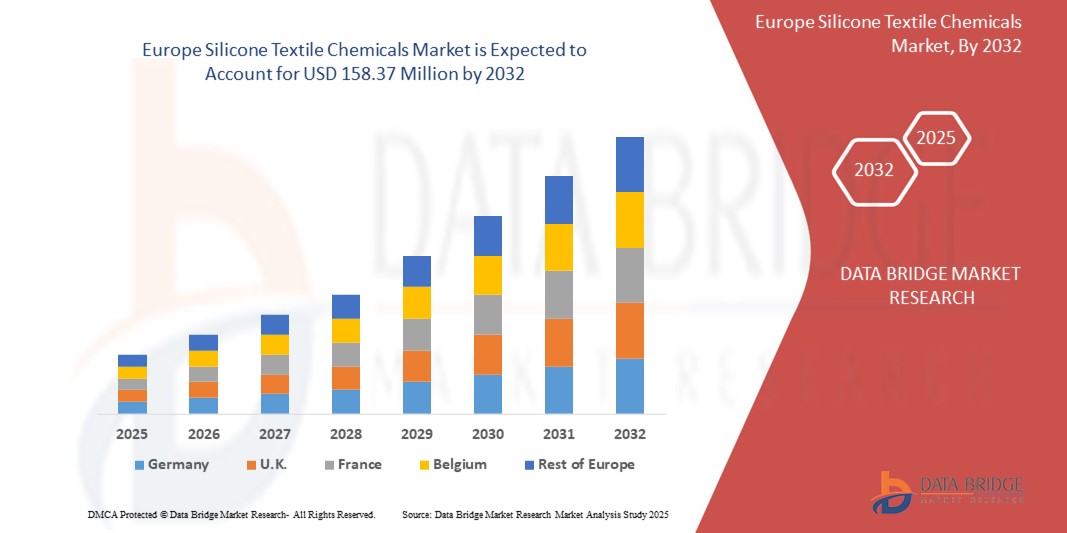
- The Europe Silicone Textile Chemicals Market size was valued at USD 114.20 Million in 2024 and is expected to reach USD 158.37 Million by 2032, at a CAGR of 3.7% during the forecast period
- The market growth is largely fueled by the rising disposable income of the middle-class population
- Rising research and development proficiencies and growth and expansion of various end user verticals such as textiles industry especially in the developing economies will also directly and positively impact the growth rate of the market
Silicone Textile Chemicals Market Analysis
- Silicone technology has brought in a revolution in the textile industry. Silicone textile chemicals are high purity silicone-based chemicals that are majorly used for the finishing purposes. Silicone textile chemicals are used in the form of fluids, emulsions, oils and antifoams and play an important role as softeners and water repellent agents for fabrics of all kinds
- Growth in the demand for silicone textile chemicals especially in developed economies such as Germany and France, growing use of silicone textile chemicals for a wide range of end user applications such as apparel, home and office furnishing, technical textiles and others
- Germany dominates the Silicone Textile Chemicals market with the largest revenue share of 28.31% in 2025, characterized by its strong textile manufacturing base, technological innovation, and strict adherence to environmental regulations.
- Italy is expected to be the fastest growing region in the Silicone Textile Chemicals market during the forecast period due to rising demand for advanced silicone-based finishes that enhance softness, durability, and eco-friendliness.
- Silicon softeners segment is expected to dominate the Silicone Textile Chemicals market with a market share of 43.11% in 2025, driven by its cost-effectiveness, ease of formulation, and broad applicability across textile types
Report Scope and Silicone Textile Chemicals Market Segmentation
|
Attributes |
Silicone Textile Chemicals Key Market Insights |
|
Segments Covered |
|
|
Countries Covered |
Europe
|
|
Key Market Players |
|
|
Market Opportunities |
|
|
Value Added Data Infosets |
In addition to the insights on market scenarios such as market value, growth rate, segmentation, geographical coverage, and major players, the market reports curated by the Data Bridge Market Research also include in-depth expert analysis, pricing analysis, brand share analysis, consumer survey, demography analysis, supply chain analysis, value chain analysis, raw material/consumables overview, vendor selection criteria, PESTLE Analysis, Porter Analysis, and regulatory framework. |
Silicone Textile Chemicals Market Trends
“Shift Toward Sustainable and Circular Textile Processing”
- A prominent trend in the European Silicone Textile Chemicals Market is the shift toward sustainable and circular textile production, driven by strict EU environmental regulations and climate targets. Manufacturers are increasingly using silicone-based chemicals that support resource efficiency and low-emission processing.
- For instance, European textile producers are adopting water-saving silicone softeners and low-temperature curing emulsions, which help meet REACH and Green Deal objectives while reducing energy and water use.
- R&D in the region focuses on bio-based and recyclable silicone formulations to align with circular economy goals. These innovations are being tested in pilot projects across textile hubs in Germany, Italy, and Scandinavia.
- Digital tools are also gaining traction—AI and IoT solutions are being integrated to monitor chemical usage and fabric treatment performance in real time, improving precision and accountability.
- This sustainability-focused transformation is driving demand for advanced silicone textile solutions that help European manufacturers comply with regulations, enhance fabric properties, and minimize environmental impact.
Silicone Textile Chemicals Market Dynamics
Driver
“Stringent EU Environmental Policies and Green Consumer Demand”
- The implementation of rigorous EU-wide chemical regulations such as REACH and the push toward climate neutrality are major drivers for the Silicone Textile Chemicals market in Europe. These policies encourage the use of safer and more sustainable chemical alternatives.
- European consumers are increasingly eco-conscious and demand textiles that are both high-performing and environmentally friendly, pushing brands and textile processors to adopt silicone-based finishes with low environmental footprints.
- Additionally, the EU's Eco-design and Circular Economy Action Plan fosters innovation in sustainable textile chemistry, giving silicone-based technologies a competitive edge in the market.
Restraint/Challenge
“High Compliance Costs and Complex Certification Processes”
- Compliance with European regulations involves high costs for testing, certification, and product development, particularly for small and medium-sized textile processors operating on tight margins.
- The complexity of navigating multiple national and EU-level certifications (e.g., OEKO-TEX, GOTS, Bluesign) can slow down product launches and increase time to market for silicone textile chemical innovations.
- Addressing this challenge will require greater collaboration across industry stakeholders and support for SMEs through funding, streamlined certification frameworks, and access to sustainable innovation hubs.
Silicone Textile Chemicals Market Scope
The market is segmented on the basis of type, form, silicone technology, silicone modifications, textile type, and application.
- By Type
On the basis of type, the silicone textile chemicals market is segmented into silicon softeners, micro emulsion silicon, and others. The silicon softeners segment dominates the largest market revenue share of 43.11% in 2025, driven by its cost-effectiveness, ease of formulation, and broad applicability across textile types. Manufacturers favor silicon softeners due to their compatibility with traditional and modern textile finishes, and their ability to impart softness, flexibility, and enhanced hand-feel to fabrics. The market also sees rising demand due to environmentally compliant formulations and their proven performance in bulk dyeing and finishing operations.
The micro emulsion silicon segment is anticipated to witness the fastest growth rate of 24.9% from 2025 to 2032, fueled by its superior penetration, smoother surface finish, and versatility in blending with other softeners. Increasing use in high-end garments and technical fabrics supports this growth, along with the demand for sustainable, high-performance finishes in premium textile products.
- By Form
On the basis of form, the silicone textile chemicals market is segmented into fluids, emulsions, and antifoams. The fluids held the largest market revenue share in 2025 driven by their easy integration into manufacturing lines, stable performance under various processing conditions, and strong demand from the apparel and home furnishing sectors. These fluid forms allow high efficiency in the treatment process and are often tailored for specific textile properties like softness, drape, and static control.
The emulsions segment is expected to witness the fastest CAGR from 2025 to 2032, supported by increasing demand for cost-effective and water-based alternatives to conventional oils. Emulsions offer environmental compliance and versatility across applications, making them a favorable choice for textile processors seeking enhanced finishing results with reduced environmental impact.
- By Silicone Technology
On the basis of silicone technology, the meat testing market is segmented into polydimethylsiloxanes and special silicone fluids. The polydimethylsiloxanes segment accounted for the largest market revenue share in 2025, attributed to their well-established safety profile, cost-efficiency, and broad compatibility with textile formulations. Their consistent performance in imparting softness and improved tear strength positions them as a preferred base for a wide range of fabric softeners.
The special silicone fluids segment is projected to witness the fastest CAGR from 2025 to 2032, driven by growing demand in niche markets such as technical and medical textiles. These fluids offer enhanced durability, resistance to washing, and hydrophobicity, making them ideal for advanced textile finishes and high-performance fabrics.
- By Silicone Modifications
On the basis of silicone modifications, the meat testing market is segmented into methyl group, amino group, hydrophilic group, hydrogen group, and other organo modifications. The amino group segment dominates the largest market revenue share in 2025, due to its superior softening effects, fabric smoothness, and excellent compatibility with various textile chemistries. It is highly preferred in cotton and synthetic finishing processes for its long-lasting soft feel.
The hydrophilic group segment is expected to register the fastest CAGR from 2025 to 2032, owing to increasing demand for breathable, quick-drying, and moisture-managing fabrics in sportswear and technical textiles. Enhanced wearer comfort and rising consumer preference for functional garments further fuel this growth.
- By Textile Type
On the basis of textile type, the meat testing market is segmented into component fibers, synthetic fibers, and inorganic fibers. The synthetic fibers segment accounted for the largest market revenue share in 2025, owing to the high usage of polyester and nylon in mass textile manufacturing. The compatibility of silicone finishes with synthetic substrates enhances fabric softness, dye uptake, and aesthetic value.
The inorganic fibers segment is anticipated to witness the fastest CAGR from 2025 to 2032, supported by growing adoption in protective clothing, insulation materials, and specialty applications. These fibers benefit from silicone treatments for thermal stability and enhanced surface functionality, crucial in high-performance end-uses.
- By Application
On the basis of application, the meat testing market is segmented into apparel, home and office furnishing, technical textiles, and others. The apparel segment accounted for the largest market revenue share in 2025, driven by rising fashion trends, increased disposable income, and demand for comfortable, durable clothing. Silicone treatments are widely used to enhance softness, stretch, and wrinkle resistance in garments.
The technical textiles segment is projected to experience the fastest CAGR from 2025 to 2032, fueled by its growing importance in automotive, medical, and industrial sectors. The demand for performance-enhancing finishes, such as water repellency, antimicrobial effects, and thermal resistance, positions silicone treatments as essential in this high-growth category.
Silicone Textile Chemicals Market Regional Analysis
- Germany dominates the Silicone Textile Chemicals Market with the largest revenue share of 28.31% in 2024, driven by its advanced textile manufacturing base, strong R&D infrastructure, and strict adherence to sustainability and REACH regulations.
- German companies are early adopters of eco-friendly silicone technologies and invest heavily in innovation and automation.
- Additionally, the country’s robust export network and presence of leading chemical manufacturers (e.g., Wacker Chemie AG, BASF SE) further support its dominance, making Germany a key hub for high-performance and sustainable textile chemical solutions in Europe.
U.K. Silicone Textile Chemicals Market Insight
The U.K. silicone textile chemicals market is anticipated to grow at a noteworthy CAGR during the forecast period, driven by demand for eco-labeled and skin-safe textile finishes. Post-Brexit regulatory transitions have encouraged manufacturers to upgrade chemical formulations for better compliance. Consumer preference for breathable, soft-touch fabrics and water-repellent treatments is supporting steady silicone chemical adoption in domestic production.
Italy Silicone Textile Chemicals Market Insight
The Italy Silicone Textile Chemicals market is poised to grow at the fastest CAGR of over 18.12% in 2025, driven by Italy’s strong presence in fashion, luxury textiles, and technical fabrics is driving demand for advanced silicone-based finishes that enhance softness, durability, and eco-friendliness. With increasing investments in sustainable textile innovation and compliance with EU regulations like REACH, Italian manufacturers are shifting toward low-impact, high-performance chemical solutions. Collaborative initiatives and modernization of textile clusters in regions like Lombardy further fuel this growth trajectory.
Silicone Textile Chemicals Market Share
The Silicone Textile Chemicals industry is primarily led by well-established companies, including:
- Mitsubishi Chemical Corporation (Japan)
- Shin-Etsu Chemical Co., Ltd. (Japan)
- Huntsman International LLC (U.S.)
- Wacker Chemie AG (Germany)
- Momentive (U.S.)
- Evonik Industries AG (Germany)
- Elkem ASA (Norway)
- NICCA U.S.A. Inc. (U.S.)
- Piedmont Chemical Industries (U.S.)
- CHT Germany GmbH (Germany)
- Weifang Ruiguang Chemical Co., Ltd. (China)
- zxchem group (China)
- Dow (U.S.)
- Nouryon (Netherlands)
Latest Developments in Europe Silicone Textile Chemicals Market
- In 2023, leading chemical firms such as Dow, Arkema, and BASF intensified their adoption of digital technologies to boost operational efficiency. This shift has been critical for improving the productivity of textile chemicals, including silicone-based formulations, amid volatile raw material prices and ongoing supply chain issues.
- In 2022, the industry witnessed a strong shift toward sustainable and eco-friendly silicone solutions. Companies like Wacker Chemie and Momentive ramped up investments in developing greener alternatives to conventional textile chemicals, largely in response to increasing environmental awareness and tighter global regulatory standards.

- Interactive Data Analysis Dashboard
- Company Analysis Dashboard for high growth potential opportunities
- Research Analyst Access for customization & queries
- Competitor Analysis with Interactive dashboard
- Latest News, Updates & Trend analysis
- Harness the Power of Benchmark Analysis for Comprehensive Competitor Tracking
Europe Silicone Textile Chemicals Market, Supply Chain Analysis and Ecosystem Framework
To support market growth and help clients navigate the impact of geopolitical shifts, DBMR has integrated in-depth supply chain analysis into its Europe Silicone Textile Chemicals Market research reports. This addition empowers clients to respond effectively to global changes affecting their industries. The supply chain analysis section includes detailed insights such as Europe Silicone Textile Chemicals Market consumption and production by country, price trend analysis, the impact of tariffs and geopolitical developments, and import and export trends by country and HSN code. It also highlights major suppliers with data on production capacity and company profiles, as well as key importers and exporters. In addition to research, DBMR offers specialized supply chain consulting services backed by over a decade of experience, providing solutions like supplier discovery, supplier risk assessment, price trend analysis, impact evaluation of inflation and trade route changes, and comprehensive market trend analysis.
Data collection and base year analysis are done using data collection modules with large sample sizes. The stage includes obtaining market information or related data through various sources and strategies. It includes examining and planning all the data acquired from the past in advance. It likewise envelops the examination of information inconsistencies seen across different information sources. The market data is analysed and estimated using market statistical and coherent models. Also, market share analysis and key trend analysis are the major success factors in the market report. To know more, please request an analyst call or drop down your inquiry.
The key research methodology used by DBMR research team is data triangulation which involves data mining, analysis of the impact of data variables on the market and primary (industry expert) validation. Data models include Vendor Positioning Grid, Market Time Line Analysis, Market Overview and Guide, Company Positioning Grid, Patent Analysis, Pricing Analysis, Company Market Share Analysis, Standards of Measurement, Global versus Regional and Vendor Share Analysis. To know more about the research methodology, drop in an inquiry to speak to our industry experts.
Data Bridge Market Research is a leader in advanced formative research. We take pride in servicing our existing and new customers with data and analysis that match and suits their goal. The report can be customized to include price trend analysis of target brands understanding the market for additional countries (ask for the list of countries), clinical trial results data, literature review, refurbished market and product base analysis. Market analysis of target competitors can be analyzed from technology-based analysis to market portfolio strategies. We can add as many competitors that you require data about in the format and data style you are looking for. Our team of analysts can also provide you data in crude raw excel files pivot tables (Fact book) or can assist you in creating presentations from the data sets available in the report.













