


Surgical Microscopes Market Size
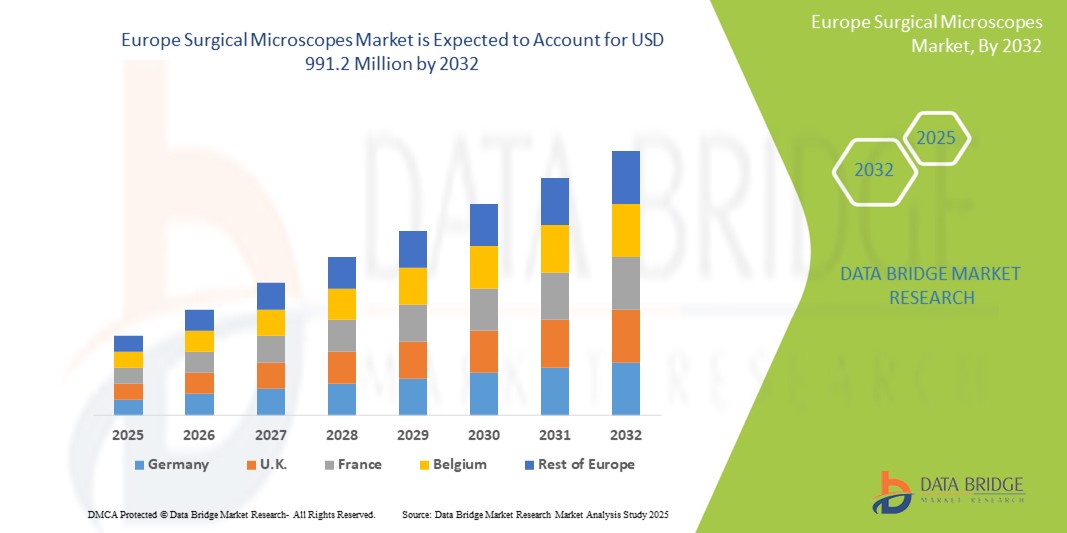
- The Europe Surgical Microscopes market size was valued at USD 429.8 million in 2024 and is expected to reach USD 991.2 million by 2032, at a CAGR of 11.06% during the forecast period
- The Europe surgical microscopes market encompasses a range of specialized optical instruments designed to provide surgeons with magnified, illuminated, and stereoscopic views of the surgical field.
- These devices are crucial for performing complex microsurgeries across various medical specialties, enhancing precision, and improving patient outcomes. Key types include on-casters, wall-mounted, tabletop, and ceiling-mounted microscopes, and they are utilized in applications such as ophthalmology, neurosurgery, ENT surgery, dentistry, and plastic & reconstructive surgeries.
Surgical Microscopes Market Analysis
- Surgical Microscopes market fueled by the increasing demand for minimally invasive surgical procedures, which necessitate enhanced visualization, and the rising prevalence of chronic diseases (such as cancer, neurological disorders, and cardiovascular diseases) requiring complex surgical interventions across Europe. Furthermore, continuous technological advancements, including high-definition imaging, fluorescence guidance, 3D visualization systems, and digital platform integration, are driving market expansion. These converging factors, alongside a growing geriatric population and increasing investments in healthcare infrastructure, are accelerating the adoption of surgical microscopes, thereby significantly boosting the industry's growth.
- The escalating demand for surgical microscopes is primarily fueled by the need for improved accuracy and precision in surgical operations, the expanding applications of operating microscopes in various medical fields, and the increasing awareness of the benefits of advanced visualization technologies.
- Germany dominates the Surgical Microscopes market in Europe, holding the largest revenue share of 30.1% in 2025, driven by its highly developed healthcare infrastructure, strong presence of academic medical centers, and high adoption of advanced surgical technologies. The country’s leadership in neurosurgery, ophthalmology, ENT, and dental microsurgery is contributing significantly to demand for high-precision surgical microscopes. Furthermore, extensive R&D activities and favorable reimbursement frameworks continue to support early adoption of cutting-edge optical and digital visualization systems.
- Germany is also expected to be the fastest-growing country in the Europe Surgical Microscopes market during the forecast period, supported by the integration of surgical microscopes with digital imaging, fluorescence-guided surgery, and robotic platforms. The rise in minimally invasive and microsurgical procedures, coupled with strategic collaborations between hospitals and medtech innovators, is expanding the clinical application range and enhancing procedural accuracy across surgical specialties.
- Neuro and Spine Surgery are expected to dominate the Europe Surgical Microscopes market with a market share of 27.6% in 2025, owing to increasing incidence of brain and spinal disorders, growing demand for precision-guided surgeries, and rising number of neurosurgical procedures across European countries. These microscopes offer superior magnification, depth perception, and illumination, making them indispensable in complex surgeries. Continuous improvements in 3D visualization, ergonomic design, and image documentation capabilities are further driving adoption in leading neurocenters and university hospitals.
Report Scope and Surgical Microscopes Market Segmentation
|
Attributes |
Surgical Microscopes Key Market Insights |
|
Segments Covered |
|
|
Countries Covered |
Europe
|
|
Key Market Players |
|
|
Market Opportunities |
|
|
Value Added Data Infosets |
In addition to the insights on market scenarios such as market value, growth rate, segmentation, geographical coverage, and major players, the market reports curated by the Data Bridge Market Research also include in-depth expert analysis, pricing analysis, brand share analysis, consumer survey, demography analysis, supply chain analysis, value chain analysis, raw material/consumables overview, vendor selection criteria, PESTLE Analysis, Porter Analysis, and regulatory framework. |
Surgical Microscopes Market Trends
“Advancements in minimally invasive surgical techniques”
- Technological Advancements in Minimally Invasive Procedures and Personalized Devices: A significant and accelerating trend in the Europe Surgical Microscopes market is the continuous technological advancement, particularly in minimally invasive surgical techniques and the development of personalized devices. This evolution is significantly enhancing patient outcomes, reducing recovery times, and improving overall treatment efficacy.
- For instance, innovations in orthopedic implants and fixation devices allow surgeons to perform complex procedures with fewer complications and faster recovery. The increasing adoption of minimally invasive procedures, which offer benefits like reduced pain and scarring, is expanding the use of specialized Surgical Microscopes.
- The market is also seeing a growing trend towards personalized devices, driven by 3D printing technology. This allows for the creation of custom-designed orthotics and prosthetics tailored to the specific needs of each patient, offering better fit, support, and function.
- Furthermore, there's an increased focus on rehabilitation and preventive care, leading to demand for orthotic devices, braces, and smart rehabilitation tools that aid in recovery and prevent future injuries. Wearable technology is playing a significant role in this area, providing real-time feedback and monitoring.
- This trend towards more precise, less invasive, and patient-specific solutions is fundamentally reshaping the treatment landscape for foot and ankle conditions in Europe
Surgical Microscopes Market Dynamics
Driver
“Rising demand for minimally invasive surgeries”
- Increasing Demand for Minimally Invasive Surgeries and Rising Chronic Disease Prevalence: The growing demand for minimally invasive surgical procedures (MIS) across Europe, coupled with the increasing prevalence of chronic diseases requiring surgical intervention, is a major driver for the growth of the surgical microscopes market
- For instance, MIS procedures, such as those in neurosurgery, ENT, and ophthalmology, require precise visualization that surgical microscopes provide, leading to quicker recovery times and reduced hospital stays. The rising incidence of chronic ailments like cancer, neurological disorders, and cardiovascular diseases necessitates more complex surgical techniques, where enhanced magnification and illumination offered by surgical microscopes are indispensable
- The increasing geriatric population is more susceptible to age-related disorders requiring surgical procedures, further accelerating the demand for surgical microscopes.
- Government initiatives and increased funding for preventive healthcare and advanced medical care also contribute to the adoption of these technologies.
- The non-invasive nature of many procedures enabled by microscopes, along with their ability to improve accuracy and outcomes, offers a significant advantage, driving product demand
Restraint/Challenge
“High cost of advanced Surgical Microscopes”
- High Equipment Costs and Lack of Skilled Professionals: The substantial costs associated with advanced surgical microscopes, coupled with a shortage of experienced professionals and limited technical knowledge regarding their operation, present significant challenges to widespread market adoption.
- For instance, premium-range surgical microscopes incorporating advanced features like 3D visualization and digital integration can be prohibitively expensive, deterring smaller healthcare facilities or those with budget constraints from investing.
- The need for specialized training and expertise to operate and maintain these sophisticated devices can limit their adoption, especially in regions with a scarcity of skilled neuro and cosmetic surgeons or trained technicians.
- Additionally, heavy custom duties on medical devices and stringent regulatory frameworks regarding their approval and use can pose challenges to market expansion, leading to lengthy approval processes and high compliance costs.
- Concerns regarding the inconsistency in readings or performance of different surgical microscopes may also exist
Surgical Microscopes Market Scope
The market is segmented on the basis type, price range, application and end user.
- By Type
On the basis of Product, the Surgical Microscopes Market is into On Casters, Wall Mounted, Table Top, and Ceiling Mounted. The On Casters Devices segment is expected to dominate the market with the largest revenue share of 49.2% 2025, driven by its mobility, flexibility, and widespread use across various surgical departments. Its ability to be repositioned easily without compromising on magnification or stability makes it the preferred option in multi-specialty hospitals and operating rooms.
The Ceiling Mounted segment is anticipated to witness the fastest growth rate of 5.2% from 2025 to 2032, owing to increased adoption in high-end surgical suites. These microscopes offer excellent ergonomics, reduced floor clutter, and seamless integration with operating room digital systems—making them ideal for neurosurgery and spine procedures where stability and unobstructed access are essential.
- By Price Range
On the basis of Price Range, the Surgical Microscopes Market is into Low-Range, Mid-Range, and Premium-Range surgical microscopes. The Mid-Range segment is expected to dominate the market with the largest revenue share, as it strikes a balance between functionality and affordability, making it attractive to medium-sized hospitals and specialty clinics. These devices support essential features like adjustable zoom, LED lighting, and HD imaging, meeting the needs of common surgical procedures.
The Premium-Range segment is anticipated to witness the fastest growth rate, Growth is fueled by demand for high-end technologies such as 4K imaging, fluorescence visualization, robotic integration, and ergonomic control systems—especially in advanced neurosurgery, ophthalmology, and ENT procedures across Western Europe.
- By Application
On the basis of application, the Surgical Microscopes market is segmented into Neuro and Spine Surgery, Plastic and Reconstructive Surgery, Ophthalmology, Gynaecology and Urology, Oncology, Ear, Nose, and Throat (ENT) Surgery, Dentistry, and Documentation. The Neuro and Spine Surgery held the largest market revenue share in 2025 owing to the high complexity of such procedures and the critical need for enhanced magnification, illumination, and precision. The use of surgical microscopes in minimally invasive neurosurgical interventions is rising across Germany, France, and the U.K.
The Ophthalmology is expected to witness the fastest CAGR from 2025 to 2032 driven by increasing cataract procedures, diabetic retinopathy cases, and advancements in microincision surgeries. The availability of compact, high-resolution microscopes tailored for both anterior and posterior segment surgeries is accelerating adoption in this field.
- By End users
On the basis of end users, the Surgical Microscopes market is segmented into Hospitals, Outpatient Facilities, Ambulatory Centers, Clinics, and Others. The Hospitals segment accounted for the largest market revenue share in 2024, supported by the growing volume of complex surgeries and the presence of multidisciplinary operating units. These facilities benefit from integrated imaging and surgical navigation systems, making them major adopters of premium surgical microscopes.
Ambulatory Centers segment is expected to witness the fastest CAGR from 2025 to 2032, propelled by the rise in outpatient surgical procedures and demand for cost-effective, space-saving equipment. These centers are increasingly investing in mid-range and on-caster microscopes to support ENT, ophthalmology, and gynecological surgeries with shorter patient turnover times.
Surgical Microscopes Market Regional Analysis
- Germany dominates the Europe Surgical Microscopes market, capturing the largest revenue share of 30.1% in 2025, driven by its highly advanced surgical infrastructure, a strong presence of specialized hospitals, and early adoption of high-precision imaging technologies. The country is a leader in neurosurgery, ophthalmology, ENT, and dental microsurgery—key application areas where surgical microscopes are indispensable for enhanced visualization and accuracy.
- Germany’s dominance is further reinforced by strategic investments in digital operating rooms and integrated surgical systems. Hospitals and research institutions in cities such as Berlin, Munich, and Hamburg are actively implementing 3D visualization, fluorescence-guided surgery, and robotic-assisted microscopes to improve surgical outcomes. The presence of global and regional manufacturers, combined with consistent government funding in healthcare technology innovation, accelerates product deployment and local manufacturing.
- Additionally, Germany’s collaborative ecosystem—including academic centers, medtech startups, and healthcare providers—plays a crucial role in driving next-generation surgical visualization solutions. Surgeons benefit from continuous training and access to best-in-class technologies, making Germany a cornerstone of surgical innovation in Europe.
France Surgical Microscopes Market Insight
The France Surgical Microscopes market is projected to grow at a significant CAGR during the forecast period, supported by rising healthcare modernization initiatives, expansion of outpatient surgery centers, and growing adoption of minimally invasive techniques across multiple specialties. France’s national focus on reducing surgical complications and improving procedural efficiency is fueling demand for advanced optical tools like surgical microscopes. Public and private hospitals across France are upgrading their surgical suites with ceiling-mounted and premium-range microscopes, particularly in neurosurgery, ophthalmology, and gynecology. The French government’s support for innovation in healthcare technology—combined with reimbursement reforms—is encouraging wider use of image-guided and ergonomically designed microscopes.
U.K. Surgical Microscopes Market Insight
The U.K. Surgical Microscopes market is poised for strong growth, bolstered by NHS investments in surgical innovation, rising demand for ambulatory care, and an increasing number of microsurgical procedures in ophthalmology, oncology, and ENT. The U.K. is rapidly adopting smart operating technologies, driven by initiatives to reduce hospital stays and enhance surgical precision. Despite regulatory and economic uncertainties post-Brexit, the U.K. continues to align with international standards, ensuring steady import and usage of advanced surgical imaging equipment. Leading NHS hospitals and private healthcare groups are embracing ceiling-mounted and robotic-compatible microscopes to streamline surgical workflows and improve intraoperative visualization. The country’s growing network of ambulatory surgical centers and specialty clinics is fueling demand for mid-range and caster-mounted microscopes that offer flexibility without compromising performance. Academic institutions and innovation hubs in cities like London, Manchester, and Cambridge are playing a pivotal role in evaluating emerging technologies, including augmented reality (AR) and AI-enabled surgical microscopes.
Surgical Microscopes Market Share
The Surgical Microscopes industry is primarily led by well-established companies, including:
- Carl Zeiss Meditec AG (Germany)
- Leica Microsystems (Danaher Corporation) (Germany)
- Olympus Corporation (Japan)
- Haag-Streit Surgical GmbH (Germany)
- Alcon, Inc. (U.S.)
- Topcon Corporation (Japan)
- Takagi Seiko Co., Ltd. (Japan)
- Synaptive Medical (Canada)
- Seiler Instrument, Inc. (U.S.
- Karl Kaps GmbH & Co. Kg (Germany)
- Metall Zug Group (Haag-Streit) (Switzerland
- ARRI Medical (ARRI Group) (Germany)
- Chammed Co., Ltd. (South Korea)
- Atmos Medizintechnik GmbH & Company KG (Germany)
- Intamed (U.S.)
Latest Developments in Europe Surgical Microscopes Market
- In March 2024, InBody introduced the InBody 380, an advanced body composition analyzer. While not a microscope, it underscores the accelerated adoption of high-precision medical devices in clinical settings, complementing the capabilities of surgical microscopes in complex procedures.
- In October 2020, Takagi Ophthalmic Instruments Europe Ltd. launched the OM-6 Operating Microscope, the first compact, entry-level ophthalmic microscope featuring an LED light source. This development signifies a push toward affordable and efficient visualization tools for eye surgeries across Europe.
- In April 2019, Med X Change Inc. introduced the 4Klear surgical microscope camera, offering integrated 4K recording. This dual-function innovation enhances real-time visualization and documentation, critical for training, remote consultations, and precision-based surgical interventions.[AJ1] [PK2]

- Interactive Data Analysis Dashboard
- Company Analysis Dashboard for high growth potential opportunities
- Research Analyst Access for customization & queries
- Competitor Analysis with Interactive dashboard
- Latest News, Updates & Trend analysis
- Harness the Power of Benchmark Analysis for Comprehensive Competitor Tracking
Data collection and base year analysis are done using data collection modules with large sample sizes. The stage includes obtaining market information or related data through various sources and strategies. It includes examining and planning all the data acquired from the past in advance. It likewise envelops the examination of information inconsistencies seen across different information sources. The market data is analysed and estimated using market statistical and coherent models. Also, market share analysis and key trend analysis are the major success factors in the market report. To know more, please request an analyst call or drop down your inquiry.
The key research methodology used by DBMR research team is data triangulation which involves data mining, analysis of the impact of data variables on the market and primary (industry expert) validation. Data models include Vendor Positioning Grid, Market Time Line Analysis, Market Overview and Guide, Company Positioning Grid, Patent Analysis, Pricing Analysis, Company Market Share Analysis, Standards of Measurement, Global versus Regional and Vendor Share Analysis. To know more about the research methodology, drop in an inquiry to speak to our industry experts.
Data Bridge Market Research is a leader in advanced formative research. We take pride in servicing our existing and new customers with data and analysis that match and suits their goal. The report can be customized to include price trend analysis of target brands understanding the market for additional countries (ask for the list of countries), clinical trial results data, literature review, refurbished market and product base analysis. Market analysis of target competitors can be analyzed from technology-based analysis to market portfolio strategies. We can add as many competitors that you require data about in the format and data style you are looking for. Our team of analysts can also provide you data in crude raw excel files pivot tables (Fact book) or can assist you in creating presentations from the data sets available in the report.













