


Europe Vagus Nerve Stimulation Market Size
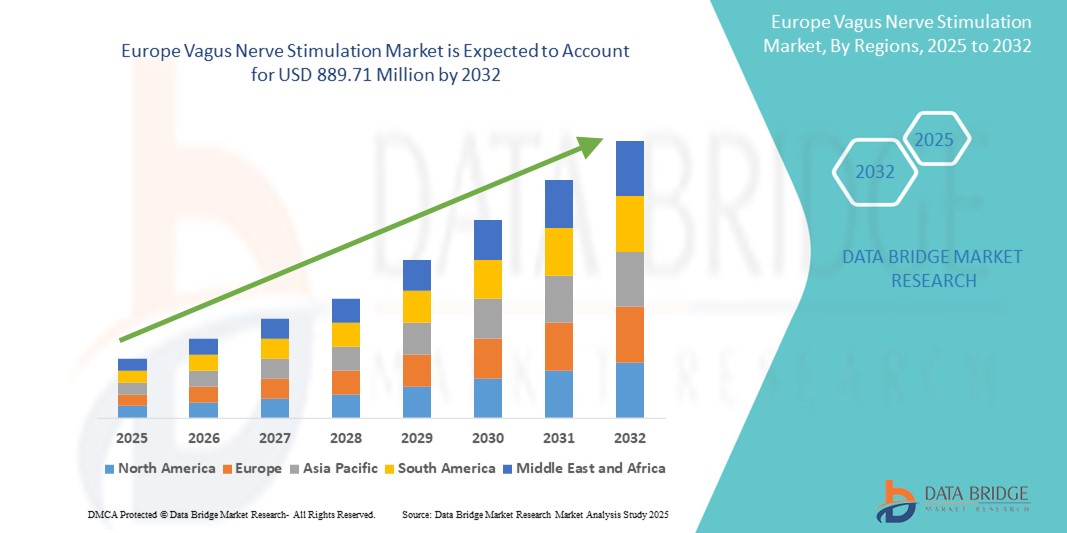
- The Europe vagus nerve stimulation market size was valued at USD 278.98 million in 2024 and is expected to reach USD 889.71 million by 2032, at a CAGR of 15.60% during the forecast period
- The market growth is largely fueled by the rising incidence of neurological and psychological disorders across the region, leading to increased demand for advanced therapeutic solutions such as vagus nerve stimulation (VNS). The growing burden of epilepsy, treatment-resistant depression, and other chronic conditions is driving the adoption of VNS devices in both hospital and outpatient settings
- Furthermore, favorable reimbursement policies, ongoing clinical research, and increased awareness among healthcare professionals and patients are establishing vagus nerve stimulation as a preferred neuromodulation therapy. These converging factors are accelerating the uptake of Europe Vagus Nerve Stimulation solutions, thereby significantly boosting the industry's growth
Europe Vagus Nerve Stimulation Market Analysis
- Vagus Nerve Stimulation (VNS), a neuromodulation therapy involving electrical impulses to the vagus nerve, is gaining prominence in Europe as a non-pharmacological treatment for conditions such as epilepsy, depression, and cluster headaches. Its application is expanding due to rising neurological disorder prevalence and growing acceptance of implantable medical devices
- The growing demand for VNS devices in Europe is primarily driven by the increasing incidence of drug-resistant epilepsy, greater awareness about neuromodulation therapies, and continuous advancements in minimally invasive neurostimulation technologies. Additionally, the supportive reimbursement policies and rising healthcare investments across major EU nations are fueling adoption
- Germany dominated the Europe vagus nerve stimulation market with the largest revenue share of 28.7% in 2024, attributed to a well-developed neurology care network, high healthcare spending, and strong demand for implantable medical technologies. The country's focus on personalized medicine and its proactive stance toward integrating innovative neuromodulation therapies contribute significantly to market expansion
- France is anticipated to witness the highest CAGR in the European vagus nerve stimulation market during the forecast period. This growth is fueled by increasing awareness of non-drug treatment options for neurological conditions and government support for neurotechnology research. The presence of academic institutions and hospitals participating in VNS-related clinical studies is further driving adoption
- The implantable VNS devices segment accounted for the largest revenue share of 64.3% in 2024, owing to their established clinical efficacy in managing treatment-resistant epilepsy and depression. These devices are preferred in hospital environments for chronic neurological care
Report Scope and Europe Vagus Nerve Stimulation Market Segmentation
|
Attributes |
Europe Vagus Nerve Stimulation Key Market Insights |
|
Segments Covered |
|
|
Countries Covered |
Europe
|
|
Key Market Players |
|
|
Market Opportunities |
|
|
Value Added Data Infosets |
In addition to the insights on market scenarios such as market value, growth rate, segmentation, geographical coverage, and major players, the market reports curated by the Data Bridge Market Research also include in-depth expert analysis, pricing analysis, brand share analysis, consumer survey, demography analysis, supply chain analysis, value chain analysis, raw material/consumables overview, vendor selection criteria, PESTLE Analysis, Porter Analysis, and regulatory framework. |
Europe Vagus Nerve Stimulation Market Trends
“Rising Demand for Minimally Invasive Neuromodulation Therapies”
- A growing trend in the Europe vagus nerve stimulation (VNS) market is the increasing demand for minimally invasive neuromodulation techniques to treat neurological and psychiatric disorders, such as epilepsy, depression, and cluster headaches. VNS therapy offers long-term relief with fewer side effects compared to pharmaceutical options, making it increasingly attractive for both patients and healthcare providers
- For instance, LivaNova PLC, a key player in the VNS space, has expanded its portfolio with advanced implantable pulse generators that offer improved programmability and longer battery life, enhancing patient comfort and treatment outcomes
- Europe is witnessing a rising prevalence of neurological conditions, with epilepsy alone affecting more than 6 million people in the region. This has resulted in greater adoption of alternative therapies like VNS, especially where traditional treatments fail or lead to adverse effects. Moreover, increasing awareness among healthcare professionals and patients regarding the benefits of VNS therapy is expected to further drive market expansion
- Technological advancements, including smaller implant sizes, improved battery longevity, and MRI-compatible devices, are improving the safety and efficacy profile of VNS systems. These improvements are boosting the adoption rate of the therapy across European countries such as Germany, France, and the U.K.
- Furthermore, the European market benefits from supportive regulatory frameworks and growing investment in neurological research. Reimbursement policies in countries like Germany and the Netherlands also promote the uptake of VNS devices, particularly for treatment-resistant depression and refractory epilepsy
- With the continued evolution of personalized medicine and increased clinical trial data supporting VNS efficacy, the market is set to experience robust growth in the coming years. Companies like ElectroCore and Nevro are actively exploring non-invasive VNS options, expanding accessibility and opening new patient segments
Europe Vagus Nerve Stimulation Market Dynamics
Driver
“Growing Need Due to Rising Prevalence of Neurological Disorders and Demand for Alternative Therapies”
- The rising incidence of neurological and psychiatric disorders—such as epilepsy, treatment-resistant depression, and migraines—across Europe is a key driver fueling the demand for vagus nerve stimulation therapies
- For instance, in April 2024, LivaNova PLC expanded its clinical trial operations in Europe to study VNS for difficult-to-treat depression, reflecting increased investment in neuromodulation as a non-pharmacological intervention. Such initiatives are expected to drive market growth during the forecast period
- As patients and healthcare providers increasingly seek alternatives to long-term pharmacological treatments due to side effects and limited efficacy, VNS offers a minimally invasive and often long-lasting solution
- Furthermore, advancements in both invasive and non-invasive VNS devices are enabling broader access and personalized treatment approaches, making the technology more attractive for widespread clinical use
- The convenience of home-based therapy options, coupled with a rising preference for personalized, non-drug treatments, is further accelerating the adoption of VNS systems across both public and private healthcare facilities in the region
Restraint/Challenge
“High Cost and Limited Reimbursement Coverage”
- The relatively high cost of VNS devices and implantation procedures continues to pose a significant barrier, especially in healthcare systems where reimbursement coverage is inconsistent or limited
- For instance, while countries like Germany have robust reimbursement pathways for VNS in epilepsy, others in Eastern Europe may face hurdles due to budget constraints or lack of updated clinical guidelines
- Moreover, the need for surgical implantation of traditional VNS systems can deter patients who are reluctant to undergo invasive procedures, particularly in mild-to-moderate conditions
- Despite the growing interest in non-invasive VNS, these devices are still emerging, and their clinical acceptance and insurance support remain limited in many regions
- To overcome these challenges, expanding reimbursement policies, increasing clinician awareness, and investing in cost-effective, non-invasive VNS technologies will be critical to ensure long-term market penetration and equitable patient access
Europe Vagus Nerve Stimulation Market Scope
The market is segmented on the basis of product type, biomaterial, application, patient type, end user, and distribution channel.
- By Product Type
On the basis of product type, the Europe vagus nerve stimulation market is segmented into implantable VNS devices and external VNS devices. The implantable VNS devices segment accounted for the largest revenue share of 64.3% in 2024, owing to their established clinical efficacy in managing treatment-resistant epilepsy and depression. These devices are preferred in hospital environments for chronic neurological care.
The external VNS devices segment is expected to grow at the fastest CAGR of 18.5% from 2025 to 2032, driven by the rising preference for non-invasive, wearable options, especially in migraine and tinnitus treatment.
- By Biomaterial
On the basis of biomaterial, the Europe vagus nerve stimulation market is segmented into ceramics, metallic, and polymeric materials. The metallic segment held the largest market share in 2024 due to its durability, electrical conductivity, and biocompatibility for implantable devices.
The polymeric segment is projected to grow at a fastest CAGR during the forecast period, owing to advancements in flexible, lightweight polymers that enhance patient comfort and are used in external VNS devices.
- By Application
On the basis of application, the Europe vagus nerve stimulation market is segmented into pain management, epileptic seizures, obesity management, depression and anxiety, and others. The epileptic seizures segment dominated the market with a share of 46.1% in 2024, supported by the growing burden of drug-resistant epilepsy.
The pain management is expected to witness the fastest CAGR from 2025 to 2032, due to clinical acceptance and broader application scopes.
- By Patient Type
On the basis of patient type, the Europe vagus nerve stimulation market is segmented into adults, pediatric, and geriatric. The adult segment accounted for the highest share in 2024 due to a higher diagnosis rate of neurological conditions in this demographic.
The geriatric segment is expected to witness the fastest CAGR from 2025 to 2032, driven by an aging population with rising incidences of depression, epilepsy, and chronic pain conditions.
- By End User
On the basis of end user, the Europe vagus nerve stimulation market is segmented into hospitals, ambulatory surgery centres, specialty centers, and others. Hospitals led the market with a 55.9% share in 2024, supported by the presence of advanced surgical setups and skilled neurologists.
Specialty centers are expected to expand at the fastest CAGR of 17.8% from 2025 to 2032, due to the growing adoption of outpatient neuromodulation therapy using non-invasive VNS.
- By Distribution Channel
On the basis of distribution channel, the Europe vagus nerve stimulation market is segmented into direct tender, retail sales, and others. The direct tender segment held the largest share in 2024 due to high-volume institutional purchases by hospitals and government bodies.
The retail sales segment is expected to witness the fastest CAGR from 2025 to 2032, particularly for external VNS devices sold to individual users for home-based therapies.
Europe Vagus Nerve Stimulation Market Regional Analysis
- The Europe vagus nerve stimulation market accounted for 31.2% of the global revenue share in 2024
- The region’s leadership is attributed to its strong clinical infrastructure, increasing prevalence of neurological disorders such as epilepsy and treatment-resistant depression, and rising investment in neuromodulation-based research
- Supportive reimbursement policies and a robust pipeline of medical technology innovations further reinforce Europe's dominance in the global VNS market
Germany Vagus Nerve Stimulation Market Insight
The Germany vagus nerve stimulation market captured the largest revenue share of 28.7% in 2024 within Europe, driven by the country’s advanced healthcare infrastructure and early adoption of neuromodulation technologies. Germany is a leader in clinical research and device innovation, with a strong presence of local and international medical device manufacturers. The high awareness of neurostimulation therapies, combined with strong reimbursement policies and a focus on chronic neurological disorders, is fueling sustained market expansion.
France Vagus Nerve Stimulation Market Insight
The France vagus nerve stimulation market accounted for a substantial 14.3% revenue share in 2024, supported by a rise in mental health and neurological disorder cases. National strategies aimed at improving mental healthcare and increasing access to advanced neurotechnologies are supporting growth. The country’s robust public healthcare infrastructure and active participation in clinical trials further contribute to the increasing adoption of both implantable and external VNS systems.
U.K. Vagus Nerve Stimulation Market Insight
The U.K. vagus nerve stimulation market held a revenue share of 13.7% in 2024 and is projected to grow at a noteworthy CAGR during the forecast period. The rising prevalence of treatment-resistant depression and epilepsy is driving demand for alternative treatment modalities like VNS therapy. Additionally, the country's strong digital health ecosystem and integration of neuromodulation solutions into primary and mental healthcare practices are encouraging adoption across both public and private healthcare facilities.
Netherlands Vagus Nerve Stimulation Market Insight
The Netherlands vagus nerve stimulation market captured a 6.1% share of the European market in 2024, reflecting its proactive approach to healthcare technology implementation. The Dutch market benefits from advanced academic medical centers and a favorable innovation climate. Adoption of VNS therapy is growing in both adult and pediatric populations due to improved accessibility, government-backed pilot programs, and collaborations between tech companies and healthcare providers.
Europe Vagus Nerve Stimulation Market Share
The Europe vagus nerve stimulation industry is primarily led by well-established companies, including:
- Koninklijke Philips N.V. (Netherlands)
- GE Healthcare (U.S.)
- Siemens Healthineers AG (Germany)
- Schiller AG (Switzerland)
- Fukuda Denshi Co., Ltd. (Japan)
- Mindray Medical International Limited (China)
- Nihon Kohden Corporation (Japan)
- Mortara Instrument, Inc. (U.S.)
- BPL Medical Technologies (India)
- Medtronic plc (Ireland)
Latest Developments in Europe Vagus Nerve Stimulation Market
- In March 2024, Synergia Medical announced the successful first-in-human implantation of its NAO.VNS vagus nerve stimulation device in Belgium, as part of the AURORA clinical trial. This trial reached its primary safety endpoints at 3 months with no serious adverse events reported. The company now plans to begin pivotal trials in Europe, the U.S., and Canada, positioning itself at the forefront of next-gen VNS therapies
- In April 2024, a landmark clinical trial published in Nature demonstrated that gamified, closed-loop vagus nerve stimulation significantly improves arm and hand function in stroke patients after just 12 weeks of therapy. This innovation combines VNS with physical therapy in a closed feedback loop, unlocking new treatment possibilities for post-stroke rehabilitation
- In February 2024, researchers published data showing that vagus nerve stimulation enhances quality of life in epilepsy patients—not only through seizure control but by improving mood, anxiety, and sleep. The study, which followed 113 adult patients from 2021–2024, adds new weight to VNS therapy’s role in holistic neurological care
- In January 2024, Pulsetto, a health tech company, launched its non-invasive VNS wearable in the U.K. retail market. Designed to reduce stress and anxiety through low-level stimulation of the vagus nerve, the GBP 500 gadget integrates with a mobile app and targets wellness-conscious consumers. Its entry reflects the growing trend of consumer-grade bioelectronic devices in Europe
- In August 2023, The Guardian reported the rapid progress of brain and nerve stimulation implants—including VNS systems—for treating conditions like epilepsy, arthritis, and even incontinence. The article highlighted key advancements across UK and EU clinical research hubs, emphasizing Europe’s accelerating role in next-generation neuromodulation innovation.

- Interactive Data Analysis Dashboard
- Company Analysis Dashboard for high growth potential opportunities
- Research Analyst Access for customization & queries
- Competitor Analysis with Interactive dashboard
- Latest News, Updates & Trend analysis
- Harness the Power of Benchmark Analysis for Comprehensive Competitor Tracking
Data collection and base year analysis are done using data collection modules with large sample sizes. The stage includes obtaining market information or related data through various sources and strategies. It includes examining and planning all the data acquired from the past in advance. It likewise envelops the examination of information inconsistencies seen across different information sources. The market data is analysed and estimated using market statistical and coherent models. Also, market share analysis and key trend analysis are the major success factors in the market report. To know more, please request an analyst call or drop down your inquiry.
The key research methodology used by DBMR research team is data triangulation which involves data mining, analysis of the impact of data variables on the market and primary (industry expert) validation. Data models include Vendor Positioning Grid, Market Time Line Analysis, Market Overview and Guide, Company Positioning Grid, Patent Analysis, Pricing Analysis, Company Market Share Analysis, Standards of Measurement, Global versus Regional and Vendor Share Analysis. To know more about the research methodology, drop in an inquiry to speak to our industry experts.
Data Bridge Market Research is a leader in advanced formative research. We take pride in servicing our existing and new customers with data and analysis that match and suits their goal. The report can be customized to include price trend analysis of target brands understanding the market for additional countries (ask for the list of countries), clinical trial results data, literature review, refurbished market and product base analysis. Market analysis of target competitors can be analyzed from technology-based analysis to market portfolio strategies. We can add as many competitors that you require data about in the format and data style you are looking for. Our team of analysts can also provide you data in crude raw excel files pivot tables (Fact book) or can assist you in creating presentations from the data sets available in the report.













