


What is the Europe Virtual Reality Market Size and Growth Rate?
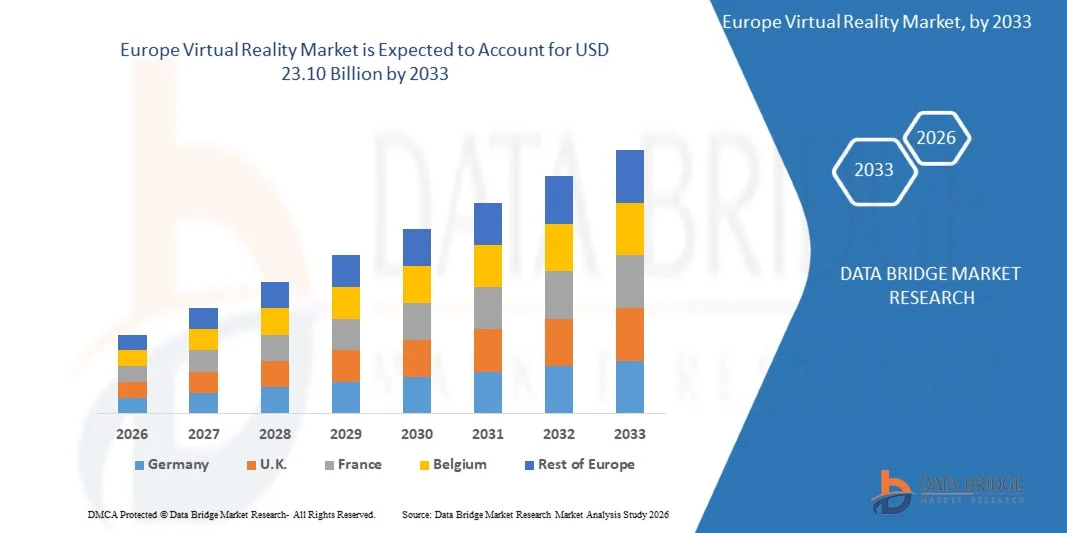
- As per Data Bridge Market Research analysis, the Europe virtual reality market was valued at USD 7.60 billion in 2025 and is projected to reach USD 23.10 billion by 2033, growing at a CAGR of 15.00% from 2026 to 2033.
- The market is experiencing consistent growth driven by increasing demand for immersive digital experiences, rising adoption of virtual reality technologies across commercial and consumer applications, growing investments in extended reality infrastructure, and the increasing use of VR for training, simulation, entertainment, healthcare, education, and enterprise applications.
- The increasing emphasis on digital transformation, combined with the growing availability of advanced head-mounted displays, motion-tracking technologies, and immersive software solutions, is encouraging businesses and consumers across Europe to adopt virtual reality solutions. These technologies enable interactive training, realistic simulation, remote collaboration, virtual product experiences, and enhanced entertainment, supporting broader adoption of virtual reality across multiple industries.
Market Size & Forecast
- Global Market Value (2025): USD 7.60 Billion
- Expected Market Value (2033): USD 23.10 Billion
- Forecast CAGR (2026–2033): 15.00%
- Leading Region in 2025: North America
- Fastest Growing Region: Asia Pacific
What are the Major Takeaways of the Europe Virtual Reality Market?
- Hardware dominated the Europe virtual reality market, accounting for 35.51% of the market share in 2025, supported by strong demand for head-mounted displays, sensors, tracking systems, and other VR equipment used across consumer, commercial, and enterprise applications.
- Content is expected to be the fastest-growing component segment in the Europe virtual reality market during the 2026–2033 forecast period, driven by increasing demand for immersive gaming, entertainment, education, training, and interactive digital experiences.
- The gaming and entertainment segment dominated the Europe virtual reality market, accounting for approximately 36.8% of the market share in 2025, supported by a large gaming base, increasing consumer adoption of VR headsets, and growing demand for immersive entertainment experiences.
- The education and training segment is expected to register strong growth during the 2026–2033 forecast period, supported by increasing adoption of immersive simulations, virtual training environments, skills development programs, and interactive learning applications.
- The standalone VR headsets segment dominated the Europe virtual reality market, accounting for approximately 54.5% of the market share in 2025, supported by their portability, integrated processing capabilities, ease of use, and growing consumer adoption.
- The semi and fully immersive technology segment is expected to register significant growth during the 2026–2033 forecast period, supported by increasing demand for highly interactive and realistic experiences across gaming, healthcare, education, training, and enterprise applications.
- The consumer application segment accounted for 43.5% of the market share in 2025, supported by growing adoption of virtual reality for gaming, entertainment, social experiences, and other consumer-oriented applications.
Report Scope and Europe Virtual Reality Market Segmentation
|
Attributes |
Europe Virtual Reality Key Market Insights |
|
Segments Covered |
|
|
Countries Covered |
North America
Europe
Asia-Pacific
Middle East and Africa
South America
|
|
Key Market Players |
|
|
Market Opportunities |
|
|
Value Added Data Infosets |
In addition to the market insights such as market value, growth rate, market segments, geographical coverage, market players, and market scenario, the market report curated by the Data Bridge Market Research team includes in-depth expert analysis, import/export analysis, pricing analysis, production consumption analysis, and pestle analysis. |
What is the Key Trend in the Europe Virtual Reality Market?
- Virtual reality developers are increasingly integrating artificial intelligence, spatial computing, and advanced 3D technologies to create more realistic, interactive, and personalized immersive experiences across entertainment, gaming, education, healthcare, training, and enterprise applications.
- For instance, in June 2025, Apple introduced visionOS 26 for Apple Vision Pro, adding generative-AI-powered spatial scenes, more realistic Personas, spatial widgets, shared spatial experiences, and new enterprise APIs for applications across design, training, sales, and education.
- Increasing integration of artificial intelligence with virtual and spatial reality platforms is enabling more responsive digital environments, improved content creation, and personalized user experiences across consumer and enterprise applications.
- For instance, in March 2025, Apple introduced Apple Intelligence features for Apple Vision Pro through visionOS 2.4, including Writing Tools, Image Playground, Genmoji, and Spatial Gallery, expanding the use of AI and spatial content within immersive computing environments.
- VR developers are also focusing on advanced displays, improved tracking, spatial interaction, and more comfortable hardware to enhance immersion and support longer-duration use across gaming, professional training, healthcare, and enterprise applications.
- For instance, in October 2025, Apple introduced an upgraded Apple Vision Pro with the M5 chip and Dual Knit Band, improving display rendering, battery life, refresh rates, comfort, and AI-powered workflows. The system uses multiple cameras and sensors to support real-time spatial interaction.
- As digital transformation increasingly emphasizes immersive collaboration, simulation, virtual training, and interactive digital experiences, the development of Europe virtual reality with AI integration, spatial computing, advanced displays, and enterprise-focused capabilities is expected to continue, supporting broader adoption across consumer and commercial applications.
What are the Key Drivers of the Europe Virtual Reality Market?
- The increasing demand for immersive entertainment, interactive gaming, virtual training, simulation, and digital collaboration is increasing adoption of europe virtual reality across consumer and commercial applications.
- For instance, in June 2025, Apple introduced new enterprise capabilities for Apple Vision Pro designed to support workflows in design, training, sales, and education, including team device sharing and enterprise-focused APIs.
- Technology companies and VR developers are increasingly integrating artificial intelligence, computer vision, eye tracking, hand tracking, and spatial computing to improve interaction with virtual environments and enable more natural user experiences.
- For instance, in June 2025, Apple introduced new spatial-scene capabilities that use a generative AI algorithm and computational depth to create lifelike depth and multiple perspectives from photographs, demonstrating the growing integration of AI into immersive experiences.
- The expansion of VR applications across healthcare, education, enterprise training, product visualization, entertainment, and professional simulation is further supporting market adoption by increasing the practical use cases for immersive technologies.
- For instance, in October 2025, Apple highlighted enterprise applications of Vision Pro in areas including design, education, healthcare, sales, and pilot training, demonstrating the expansion of spatial computing beyond gaming and entertainment.
Which Factors are Challenging the Growth of the Europe Virtual Reality Market?
- Europe virtual reality faces technical and economic challenges related to high hardware costs, limited availability of specialized immersive content, device comfort, motion sickness, privacy considerations, and the complexity associated with developing and deploying VR applications.
- For instance, in October 2025, Apple priced the upgraded Apple Vision Pro with M5 at USD 3,499, illustrating the relatively high upfront cost associated with advanced spatial-computing hardware compared with conventional consumer electronics.
- These technical requirements can increase deployment complexity because advanced VR systems require high-performance processors, cameras, sensors, specialized software, and reliable connectivity to deliver responsive and realistic immersive experiences.
- For instance, in October 2025, Apple stated that the Vision Pro uses 12 cameras, five sensors, and six microphones, with the R1 chip processing inputs to provide a real-time view of the surrounding environment, demonstrating the hardware complexity required for advanced spatial experiences.
- Extended use of head-mounted displays can also create concerns related to comfort, ergonomics, motion sickness, and user fatigue, which can affect the duration and frequency of VR usage across consumer and professional applications.
- For instance, in October 2025, Apple introduced the Dual Knit Band with the upgraded Vision Pro specifically alongside improvements in comfort, while also highlighting longer battery performance and enhanced display capabilities for extended use.
How is the Europe Virtual Reality Market Segmented?
The Europe virtual reality market is segmented on the basis of component, device type, technology, and application.
- By Component
On the basis of component, the Europe virtual reality market is segmented into hardware and software. The hardware segment dominated the market with a 35.51% share in 2025, supported by increasing demand for head-mounted displays, sensors, controllers, tracking systems, and other VR equipment across consumer, commercial, and enterprise applications. Advances in display quality, processing capabilities, motion tracking, and device ergonomics are improving the performance and usability of VR hardware. Increasing adoption of immersive technologies across gaming, entertainment, healthcare, education, and enterprise applications is supporting demand for advanced VR hardware.
The software segment is projected to register the fastest growth at a CAGR of 16.2% from 2026 to 2033, driven by increasing demand for immersive applications, virtual simulations, interactive content, and enterprise VR platforms. Advances in artificial intelligence, spatial computing, real-time 3D environments, and cloud-based technologies are enabling more responsive and personalized VR experiences. Increasing use of VR software for healthcare, education, employee training, product visualization, and remote collaboration is supporting the expansion of software solutions across Europe.
- By Device Type
On the basis of device type, the Europe virtual reality market is segmented into head-mounted displays, projectors & display walls, and gesture-tracking devices. The head-mounted displays segment dominated the market with a 54.5% share in 2025, supported by increasing adoption of standalone and connected VR headsets across gaming, entertainment, training, healthcare, and education applications. Improvements in display resolution, processing performance, field of view, tracking capabilities, and device comfort are enhancing the user experience. Growing availability of consumer and enterprise-focused VR headsets is further supporting segment growth.
The gesture-tracking devices segment is projected to register the fastest growth at a CAGR of 17.1% from 2026 to 2033, driven by increasing demand for natural and intuitive interaction within immersive environments. Advances in hand tracking, body tracking, eye tracking, computer vision, and motion-sensing technologies are enabling users to interact with virtual environments without relying solely on traditional controllers. Increasing applications in healthcare, gaming, training, education, and enterprise environments are supporting adoption of gesture-tracking technologies.
- By Technology
On the basis of technology, the Europe virtual reality market is segmented into fully immersive, semi-immersive, and non-immersive. The fully immersive segment dominated the market in 2025, supported by increasing demand for highly realistic virtual experiences across gaming, entertainment, simulation, training, and healthcare applications. Head-mounted displays, motion tracking, spatial audio, and interactive controls are enabling users to experience digitally simulated environments with greater realism and engagement. Increasing investments in immersive content and advanced VR hardware are supporting the adoption of fully immersive technologies.
The semi-immersive segment is projected to register the fastest growth at a CAGR of 15.8% from 2026 to 2033, driven by increasing adoption of simulation-based training across industrial, educational, healthcare, engineering, and defense applications. Semi-immersive systems provide interactive virtual environments while supporting controlled deployment and cost-efficient training compared with highly complex immersive installations. Growing demand for professional simulation, technical training, and virtual learning environments is supporting segment expansion.
- By Application
On the basis of application, the Europe virtual reality market is segmented into aerospace & defense, commercial, consumer, enterprise, healthcare, and other applications. The consumer segment dominated the market with a 43.5% share in 2025, supported by increasing demand for gaming, entertainment, social experiences, and interactive digital content. Growing adoption of standalone VR headsets, expanding VR content libraries, and improvements in graphics, motion tracking, and user interfaces are enhancing consumer engagement. Increasing availability of affordable and user-friendly VR devices is further supporting adoption across European consumers.
The healthcare segment is projected to register the fastest growth at a CAGR of 17.5% from 2026 to 2033, driven by increasing use of VR for medical training, surgical simulation, rehabilitation, therapy, pain management, and patient education. VR technologies enable healthcare professionals and patients to access controlled and interactive virtual environments for training and therapeutic applications. Increasing digitalization of healthcare services and growing adoption of immersive technologies for clinical and educational purposes are supporting segment growth.
Which Region Holds the Largest Share of the Europe Virtual Reality Market?
- Western Europe dominated the Europe virtual reality market with the largest revenue share of 35.7% in 2025, supported by strong adoption of virtual reality technologies, advanced digital infrastructure, increasing investments in immersive technologies, and growing use of VR across gaming, entertainment, healthcare, education, and enterprise applications
- The region also benefits from established technology ecosystems, increasing adoption of head-mounted displays, advanced VR software solutions, and growing demand for immersive training and simulation. Increasing investments in spatial computing, artificial intelligence, and extended reality technologies are further supporting the development of the Europe virtual reality market.
Europe Virtual Reality Market Insight
The Europe virtual reality market is witnessing strong growth due to increasing adoption of immersive technologies across gaming, entertainment, healthcare, education, enterprise, and industrial applications. Growing demand for virtual training, simulation, interactive digital experiences, and spatial computing solutions is supporting market expansion. In addition, increasing investments in advanced head-mounted displays, VR software, artificial intelligence, and immersive content are accelerating the adoption of virtual reality solutions across Europe.
Which are the Top Companies in Europe Virtual Reality Market?
The Europe Virtual Reality industry is primarily led by well-established companies, including:
- Meta Platforms, Inc. (U.S.)
- Sony Group Corporation (Japan)
- Microsoft Corporation (U.S.)
- Alphabet Inc. (U.S.)
- Apple Inc. (U.S.)
- HTC Corporation (Taiwan)
- Samsung Electronics Co., Ltd. (South Korea)
- Lenovo Group Limited (China)
- DPVR (China)
- Varjo Technologies Oy (Finland)
- Pico Technology Co., Ltd. (China)
- Immersive Robotics (U.K.)
- Unity Software Inc. (U.S.)
- NVIDIA Corporation (U.S.)
- Qualcomm Incorporated (U.S.)
- Autodesk, Inc. (U.S.)
- EON Reality, Inc. (U.S.)
- Virtalis Holdings Limited (U.K.)
- Ultraleap Ltd. (U.K.)
- VRgineers, Inc. (Czech Republic)
What are Latest Developments in Europe Virtual Reality Market?
- In March 2025, Apple introduced Apple Intelligence features for Apple Vision Pro through visionOS 2.4, including Writing Tools, Image Playground, Genmoji, and the Spatial Gallery. The update expanded the use of artificial intelligence within Apple's spatial computing platform and provided users with new tools for creating and interacting with immersive content. The development highlights the growing integration of AI capabilities into virtual and spatial reality technologies.
- In June 2025, Apple introduced visionOS 26 for Apple Vision Pro, adding generative-AI-powered spatial scenes, more realistic Personas, spatial widgets, shared spatial experiences, and new enterprise APIs. The update expanded capabilities for immersive content, collaboration, training, and enterprise applications. The development highlights the increasing integration of artificial intelligence and spatial computing technologies into virtual reality ecosystems.
- In October 2025, Apple introduced an upgraded Apple Vision Pro featuring the M5 chip and a new Dual Knit Band. The updated device provides improved display rendering, higher refresh rates, enhanced battery performance, and greater wearing comfort. The development highlights continued hardware innovation focused on improving performance, usability, and immersive experiences across virtual and spatial reality applications.
- In June 2025, Meta expanded its virtual and mixed reality ecosystem through updates to Meta Quest and its Horizon platform, supporting improvements in immersive experiences, social interaction, and spatial computing capabilities. The company continued developing applications and hardware features aimed at gaming, entertainment, and broader consumer use. The development highlights continued investment in VR platforms and immersive digital experiences.
- In February 2025, Sony Interactive Entertainment continued expanding the PlayStation VR2 ecosystem through new games, content, and platform support for its virtual reality headset. The expansion supports greater availability of immersive gaming experiences and strengthens the role of VR hardware and content within the entertainment sector. The development highlights continued demand for high-quality VR gaming and consumer immersive applications.
- In March 2025, NVIDIA continued advancing technologies supporting artificial intelligence, simulation, and spatial computing through its graphics processing and software platforms. The company's technologies enable developers and enterprises to create realistic digital environments, simulations, and AI-enabled immersive applications. The development highlights the increasing convergence of artificial intelligence, accelerated computing, simulation, and virtual reality technologies.

- Interactive Data Analysis Dashboard
- Company Analysis Dashboard for high growth potential opportunities
- Research Analyst Access for customization & queries
- Competitor Analysis with Interactive dashboard
- Latest News, Updates & Trend analysis
- Harness the Power of Benchmark Analysis for Comprehensive Competitor Tracking
Data collection and base year analysis are done using data collection modules with large sample sizes. The stage includes obtaining market information or related data through various sources and strategies. It includes examining and planning all the data acquired from the past in advance. It likewise envelops the examination of information inconsistencies seen across different information sources. The market data is analysed and estimated using market statistical and coherent models. Also, market share analysis and key trend analysis are the major success factors in the market report. To know more, please request an analyst call or drop down your inquiry.
The key research methodology used by DBMR research team is data triangulation which involves data mining, analysis of the impact of data variables on the market and primary (industry expert) validation. Data models include Vendor Positioning Grid, Market Time Line Analysis, Market Overview and Guide, Company Positioning Grid, Patent Analysis, Pricing Analysis, Company Market Share Analysis, Standards of Measurement, Global versus Regional and Vendor Share Analysis. To know more about the research methodology, drop in an inquiry to speak to our industry experts.
Data Bridge Market Research is a leader in advanced formative research. We take pride in servicing our existing and new customers with data and analysis that match and suits their goal. The report can be customized to include price trend analysis of target brands understanding the market for additional countries (ask for the list of countries), clinical trial results data, literature review, refurbished market and product base analysis. Market analysis of target competitors can be analyzed from technology-based analysis to market portfolio strategies. We can add as many competitors that you require data about in the format and data style you are looking for. Our team of analysts can also provide you data in crude raw excel files pivot tables (Fact book) or can assist you in creating presentations from the data sets available in the report.













