


Water Purifier Market Analysis
The European water purifier market is experiencing significant growth driven by increasing consumer awareness of water quality, rising concerns over waterborne diseases, and stricter government regulations. Advanced filtration technologies like reverse osmosis, UV treatment, and multi-stage systems are gaining traction due to their ability to address a wide range of contaminants such as heavy metals, chemicals, and bacteria. The market is also being fueled by innovations in eco-friendly and smart water purification solutions. Germany, with its high demand for sustainable and high-quality water, is a key market driver in Europe. Despite challenges like strong public trust in tap water and high maintenance costs, the market is expected to continue expanding due to growing health and environmental consciousness.
Water Purifier Market Size
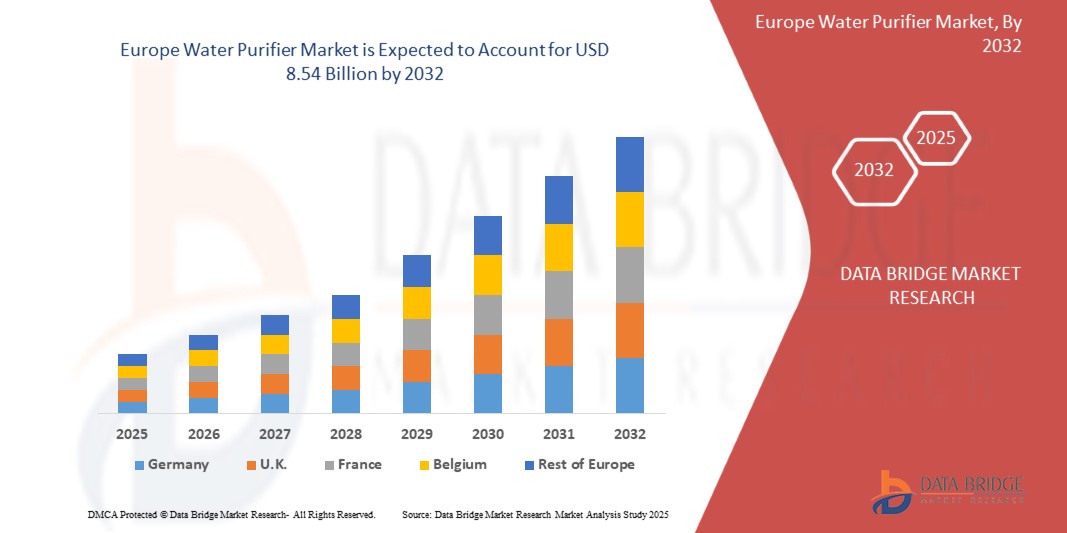
The Europe Water Purifier market size was valued at USD 6.07 billion in 2024 and is projected to reach USD 8.54 billion by 2032, with a CAGR of 4.35% during the forecast period of 2025 to 2032. In addition to the insights on market scenarios such as market value, growth rate, segmentation, geographical coverage, and major players, the market reports curated by the Data Bridge Market Research also include import export analysis, production capacity overview, production consumption analysis, price trend analysis, climate change scenario, supply chain analysis, value chain analysis, raw material/consumables overview, vendor selection criteria, PESTLE Analysis, Porter Analysis, and regulatory framework.
Water purifier Market Trends
“Growing Adoption of Eco-Friendly and Sustainable Water Purification Solutions”
The European water purifier market is witnessing key trends such as the growing adoption of eco-friendly and sustainable water purification solutions. Consumers are increasingly opting for energy-efficient systems, and there’s a rising demand for smart water purifiers integrated with IoT technologies for real-time monitoring and performance optimization. Reverse osmosis and UV-based purifiers remain popular, with advancements in filtration efficiency and reduced water wastage. The demand for point-of-use (POU) systems is rising, driven by the need for affordable, convenient solutions in residential settings. Furthermore, the increasing prevalence of health-conscious consumers and heightened awareness of waterborne diseases is fueling market growth across Europe.
Report Scope and Water Purifier Market Segmentation
|
Attributes |
Water Purifier Key Market Insights |
|
Segments Covered |
|
|
Countries Covered |
Germany, U.K., Italy, France, Spain, Switzerland, Netherlands, Belgium, Russia, Turkey, and Rest of Europe |
|
Key Market Players |
BRITA (Germany), Culligan (U.S.) , BWT Holding GmbH (Austria), A.O. Smith Water Technologies(Netherlands), LG Electronics(South korea), Amway Corp.(U.S.), Midea(China), KENT RO SYSTEMS LTD(India), Eureka Forbes(India), COWAY (MALAYSIA)(South Korea), TORAY INDUSTRIES, INC.(tokyo), Zhuhai Gree Electric Appliances Co., Ltd.(china), Honeywell International Inc.(U.S.), Whirlpool Corporation(U.S.), Havells India Ltd.(India), Angel Drinking Water Industrial Group(China), and Fonto de vivo(France) |
|
Market Opportunities |
|
|
Value Added Data Infosets |
In addition to the insights on market scenarios such as market value, growth rate, segmentation, geographical coverage, and major players, the market reports curated by the Data Bridge Market Research also include import export analysis, production capacity overview, production consumption analysis, price trend analysis, climate change scenario, supply chain analysis, value chain analysis, raw material/consumables overview, vendor selection criteria, PESTLE Analysis, Porter Analysis, and regulatory framework. |
Water Purifier Market Definition
A water purifier is a device or system designed to remove impurities, contaminants, and harmful substances from water, making it safe for drinking, cooking, and other household or industrial uses. Water purifiers work through various filtration methods, including activated carbon filters, reverse osmosis (RO), ultraviolet (UV) light, and sediment filters, to eliminate pollutants such as bacteria, viruses, chlorine, heavy metals, pesticides, and sediments. Some purifiers are equipped with multi-stage filtration systems, combining different methods for enhanced purification. In addition to improving water taste and odor, these systems ensure that water meets safety standards by removing harmful substances that can cause health issues. Water purifiers are commonly used in households, commercial establishments, and industries to provide clean, potable water while addressing concerns about water quality and contamination.
Water Purifier Market Dynamics
Drivers
- Increasing Concerns over Water Pollution
Germany, known for its high standards of water quality, is increasingly grappling with the challenges posed by water pollution. As industrialization and agriculture intensify, pollution from various sources such as pesticides, heavy metals, pharmaceutical residues, and industrial chemicals has led to growing concerns about the safety of drinking water. While Germany’s tap water is generally considered safe, the presence of these contaminants has triggered widespread awareness and concern among the population. The agricultural runoff, in particular, is a significant issue, with nitrates and pesticides leaching into groundwater supplies and rivers, which are major sources of drinking water. Germany’s commitment to maintaining the safety of drinking water through regulatory oversight is strong; however, localized pollution events and contamination from industrial activities in certain regions of the country have heightened public concern. This situation has been worsened by emerging issues such as microplastics and hormone-disrupting chemicals, which are not always removed in conventional water treatment processes. The impact of such pollutants is becoming a more critical issue in the public and scientific discourse, resulting in increased consumer demand for water purifiers.
For instance,
In November 2019, according to an article by MDPI, the study highlights the growing concerns over water pollution in Europe, including pesticide residues and pharmaceutical contaminants. As pollutants increasingly affect water quality, countries such as Germany are seeing rising demand for water purifiers to ensure safe drinking water and mitigate pollution-related health risks.
- Heightened Awareness of Waterborne Diseases and the Health Benefits
The heightened awareness of waterborne diseases and the health benefits of consuming purified water has become a major driver for the water purifier market in Germany. While Germany’s tap water quality generally meets high standards, concerns about specific contaminants such as bacteria, viruses, and chemicals have prompted consumers to seek additional filtration solutions. Public awareness campaigns, education on waterborne diseases, and the increasing interest in overall health and wellness are fueling the growing demand for water purifiers. Germany, like many other European countries, has seen a shift in public awareness regarding the potential health risks posed by consuming untreated or poorly treated water. Contaminants like bacteria (e.g., E. coli), heavy metals (e.g., lead and arsenic), and endocrine-disrupting chemicals have been associated with various waterborne diseases and long-term health issues. Although Germany’s strict water regulations ensure tap water quality, localized pollution events or deteriorating plumbing infrastructure in older buildings can lead to occasional contamination. For instance, in older urban neighborhoods or rural areas, where water pipes may be corroded or outdated, tap water may still pose health risks.
For instance,
In July 2024, according to an article by European Environment Agency, The report highlights the growing concern over waterborne diseases in Europe, exacerbated by climate change and water contamination. With an increasing risk of waterborne pathogens, including bacteria and viruses, there is rising awareness in Germany, driving demand for water purifiers to safeguard public health.
Opportunities
- Innovations in Water Filtration Technology
Innovations in water filtration technology present a significant opportunity for the European water purifier market, particularly in Germany. As consumers become more aware of water quality concerns, technological advancements in filtration systems are playing a key role in driving market growth. Newer filtration technologies, such as advanced reverse osmosis (RO) systems, UV purifiers, and activated carbon filters, offer better purification capabilities, addressing emerging contaminants like microplastics, pharmaceuticals, pesticides, and heavy metals. One of the most exciting innovations in recent years is the development of smart water purifiers. These systems are equipped with sensors that monitor water quality in real-time and adjust filtration processes accordingly. For example, smart water purifiers can alert users when it’s time to replace filters, optimize water usage, and even connect to mobile apps for remote monitoring. These technological advancements are making water purification more user-friendly and efficient, driving adoption, particularly among tech-savvy consumers in Germany.
For instance,
According to an article by Waterman Australia, the article discusses the use of nanoparticles in water purification, which is a cutting-edge innovation that is gaining traction globally. Nanoparticles, such as silver, copper, and titanium oxide, can be used to enhance water filtration by removing a wide range of contaminants, including bacteria, viruses, heavy metals, and microplastics. This technology improves the efficiency and effectiveness of water purifiers, offering consumers a higher level of water safety and quality. As demand for advanced filtration systems rises in Europe, particularly in Germany, these nanoparticle-based solutions present a significant opportunity for the water purifier market.
- Expanding Urban Population across Europe
The expanding urban population across Europe, and particularly in Germany, represents a significant opportunity for the water purifier market. As urbanization continues to accelerate, more people are moving into cities and metropolitan areas, driving higher demand for clean and safe drinking water. This trend is particularly important in Germany, where urban areas like Berlin, Munich, and Frankfurt are seeing rapid population growth. With increased population density and higher water consumption, urban centers require more advanced and effective solutions to maintain water quality. In urban environments, water contamination can be more prevalent due to aging infrastructure, industrial pollution, and high population density, which puts greater strain on municipal water supplies. Urban areas often face challenges related to water supply, such as the risk of contamination from heavy metals, pesticides, or microplastics, leading to concerns about the safety and quality of tap water. As a result, more city dwellers are turning to home water purifiers to ensure that their drinking water meets the highest quality standards. This shift creates a growing market for water filtration systems, particularly in Germany’s rapidly expanding cities.
For instance,
In August 2023, According to an article by MDPI, the article discusses the pressures on water quality and availability due to rapid urbanization across Europe. As cities grow, the challenge of ensuring safe and clean drinking water intensifies, particularly in areas with aging infrastructure. The expanding urban population is fueling the demand for advanced water purification systems to mitigate issues like pollution, contamination, and resource scarcity, which creates significant growth opportunities for the water purifier market in Europe, including Germany.
Restraints/Challenges
- Significant Upfront Costs
The high upfront costs associated with purchasing advanced water purifiers are a key restraint in the European, and particularly the German, water purifier market. While consumers in Germany are increasingly aware of the need for clean, safe drinking water, the initial investment required for high-quality water filtration systems can be a significant barrier. This issue is particularly relevant for families and small households that are hesitant to make large financial commitments to purchase expensive water purification systems. The price of advanced water filters, such as reverse osmosis systems, UV purifiers, or multi-stage filtration units, can vary significantly based on the technology used and the brand. In some cases, high-end water purifiers can cost hundreds of euros, which may be an obstacle for many households, especially when alternatives such as bottled water or basic filtration pitchers are perceived as more affordable options. Moreover, the cost barrier is compounded by the perception that tap water in Germany is generally of high quality and safe to consume, due to the country’s strict drinking water regulations. Many German consumers may question the need for expensive home purification systems when tap water is already regulated to meet high standards. This creates a situation where, despite increasing awareness of emerging contaminants (e.g., microplastics, pharmaceuticals), the upfront cost of water purifiers remains a key deterrent for adoption, particularly among lower- and middle-income households.
- Strong Public Trust in Tap Water Quality
One of the primary challenges for the water purifier market in Germany is the strong public trust in the quality of tap water. Germany is renowned for its high standards in water quality and is consistently ranked among the countries with the safest tap water in the world. The German government invests heavily in maintaining strict regulations to ensure that public water supply systems meet high safety and health standards. The country has a comprehensive water treatment and monitoring system, which ensures that municipal water is consistently safe for consumption.
As a result of this high public trust in tap water, many German consumers may not see the need for water purifiers. Unlike other countries with water quality issues such as contamination from industrial pollutants, chlorine, or unsafe drinking water practices, Germany's water quality is generally free of such concerns. Public awareness campaigns and the widespread availability of information about the high safety of German tap water make it challenging for water purifier manufacturers to convince the population to purchase water purification systems for their homes.
This market report provides details of new recent developments, trade regulations, import-export analysis, production analysis, value chain optimization, market share, impact of domestic and localized market players, analyses opportunities in terms of emerging revenue pockets, changes in market regulations, strategic market growth analysis, market size, category market growths, application niches and dominance, product approvals, product launches, geographic expansions, technological innovations in the market. To gain more info on the market contact Data Bridge Market Research for an Analyst Brief, our team will help you take an informed market decision to achieve market growth.
Impact and Current Market Scenario of Raw Material Shortage and Shipping Delays
Data Bridge Market Research offers a high-level analysis of the market and delivers information by keeping in account the impact and current market environment of raw material shortage and shipping delays. This translates into assessing strategic possibilities, creating effective action plans, and assisting businesses in making important decisions. Apart from the standard report, we also offer in-depth analysis of the procurement level from forecasted shipping delays, distributor mapping by region, commodity analysis, production analysis, price mapping trends, sourcing, category performance analysis, supply chain risk management solutions, advanced benchmarking, and other services for procurement and strategic support.
Expected Impact of Economic Slowdown on the Pricing and Availability of Products
When economic activity slows, industries begin to suffer. The forecasted effects of the economic downturn on the pricing and accessibility of the products are taken into account in the market insight reports and intelligence services provided by DBMR. With this, our clients can typically keep one step ahead of their competitors, project their sales and revenue, and estimate their profit and loss expenditures.
Water Purifier Market Scope
The market is segmented on the basis of technology, type, installation type, filter type, portability, body material, water type, storage capacity, application, and distribution channel. The growth amongst these segments will help you analyse meagre growth segments in the industries and provide the users with a valuable market overview and market insights to help them make strategic decisions for identifying core market applications.
Technology
- Reverse Osmosis
- Sediment Filter
- Water Softener
- UF Purification
- UV Purification
- Gravity Purifier
- Multi-Stage Purifiers
- Media Water Purifier
- Others
Type
- Electric
- Non-Electric
Installation Type
- Point Of Use Systems
- Point of Entry Systems
Filter Type
- Reverse Osmosis Filters
- Mechanical Filters
- Absorption Filters
- Ion Exchange Filters
- Sequestration Filters
Portability
- Non-Portable Water Purifiers
- Portable Water Purifiers
Body Material
- Plastic
- Steel
WATER TYPE
- Borewell
- Mixed
- Municipal
Storage Capacity
- 15-20 Litres
- More Than 20 Litres
- 15 Litres
- 10 Litres
- Less Than 5 Litres
Application
- Residential
- Commercial
Distribution Channel
- Offline
- Online
Water Purifier Market Regional Analysis
The market is analysed and market size insights and trends are provided by country, technology, type, installation type, filter type, portability, body material, water type, storage capacity, application, and distribution channel as referenced above.
The countries covered in the market report are Germany, U.K., Italy, France, Spain, Switzerland, Netherlands, Belgium, Russia, Turkey, and rest of Europe.
Germany dominates the European water purifier market due to its strong industrial base, high consumer awareness of water quality, and stringent environmental regulations. In addition, Germany’s advanced technological innovations and high demand for sustainable water purification solutions drive market leadership.
U.K. growth in the Europe water purifier Market is driven by heightened concerns over water quality, stricter regulations, increasing consumer awareness of health, and growing demand for eco-friendly, sustainable filtration solutions.
The country section of the report also provides individual market impacting factors and changes in regulation in the market domestically that impacts the current and future trends of the market. Data points such as down-stream and upstream value chain analysis, technical trends and porter's five forces analysis, case studies are some of the pointers used to forecast the market scenario for individual countries. Also, the presence and availability of global brands and their challenges faced due to large or scarce competition from local and domestic brands, impact of domestic tariffs and trade routes are considered while providing forecast analysis of the country data.
Water Purifier Market Share
The market competitive landscape provides details by competitor. Details included are company overview, company financials, revenue generated, market potential, investment in research and development, new market initiatives, global presence, production sites and facilities, production capacities, company strengths and weaknesses, product launch, product width and breadth, application dominance. The above data points provided are only related to the companies' focus related to market.
Water Purifier Market Leaders Operating in the Market Are:
- BRITA (Germany)
- Culligan (U.S.)
- BWT Holding GmbH (Austria)
- A.O. Smith Water Technologies (Netherlands)
- LG Electronics (South Korea)
- Amway Corp. (U.S.)
- Midea (China)
- KENT RO SYSTEMS LTD (India)
- Eureka Forbes (India)
- COWAY (MALAYSIA) (South Korea)
- TORAY INDUSTRIES, INC. (Tokyo)
- Zhuhai Gree Electric Appliances Co., Ltd. (China)
- Honeywell International Inc. (U.S.)
- Whirlpool Corporation (U.S.)
- Havells India Ltd. (India)
- Angel Drinking Water Industrial Group (China)
- Fonto de vivo.(China)
Latest Developments in Water Purifier Market
- In January 2024, the Company announced the acquisition of Primo Water's EMEA businesses, excluding the U.K., Portugal, and Israel. This transaction expanded Culligan's footprint to 12 countries and enhanced its capacity to provide clean, sustainable water solutions
- In September 2024, the Company was honored as a five-time finalist at the 2024 IDEA Design Awards, recognized for design excellence with products like the BEREX Pebble Chair, BEREX Massage Bed, and Icon Water Purifier

- Interactive Data Analysis Dashboard
- Company Analysis Dashboard for high growth potential opportunities
- Research Analyst Access for customization & queries
- Competitor Analysis with Interactive dashboard
- Latest News, Updates & Trend analysis
- Harness the Power of Benchmark Analysis for Comprehensive Competitor Tracking
Europe Water Purifier Market, Supply Chain Analysis and Ecosystem Framework
To support market growth and help clients navigate the impact of geopolitical shifts, DBMR has integrated in-depth supply chain analysis into its Europe Water Purifier Market research reports. This addition empowers clients to respond effectively to global changes affecting their industries. The supply chain analysis section includes detailed insights such as Europe Water Purifier Market consumption and production by country, price trend analysis, the impact of tariffs and geopolitical developments, and import and export trends by country and HSN code. It also highlights major suppliers with data on production capacity and company profiles, as well as key importers and exporters. In addition to research, DBMR offers specialized supply chain consulting services backed by over a decade of experience, providing solutions like supplier discovery, supplier risk assessment, price trend analysis, impact evaluation of inflation and trade route changes, and comprehensive market trend analysis.
Data collection and base year analysis are done using data collection modules with large sample sizes. The stage includes obtaining market information or related data through various sources and strategies. It includes examining and planning all the data acquired from the past in advance. It likewise envelops the examination of information inconsistencies seen across different information sources. The market data is analysed and estimated using market statistical and coherent models. Also, market share analysis and key trend analysis are the major success factors in the market report. To know more, please request an analyst call or drop down your inquiry.
The key research methodology used by DBMR research team is data triangulation which involves data mining, analysis of the impact of data variables on the market and primary (industry expert) validation. Data models include Vendor Positioning Grid, Market Time Line Analysis, Market Overview and Guide, Company Positioning Grid, Patent Analysis, Pricing Analysis, Company Market Share Analysis, Standards of Measurement, Global versus Regional and Vendor Share Analysis. To know more about the research methodology, drop in an inquiry to speak to our industry experts.
Data Bridge Market Research is a leader in advanced formative research. We take pride in servicing our existing and new customers with data and analysis that match and suits their goal. The report can be customized to include price trend analysis of target brands understanding the market for additional countries (ask for the list of countries), clinical trial results data, literature review, refurbished market and product base analysis. Market analysis of target competitors can be analyzed from technology-based analysis to market portfolio strategies. We can add as many competitors that you require data about in the format and data style you are looking for. Our team of analysts can also provide you data in crude raw excel files pivot tables (Fact book) or can assist you in creating presentations from the data sets available in the report.













