


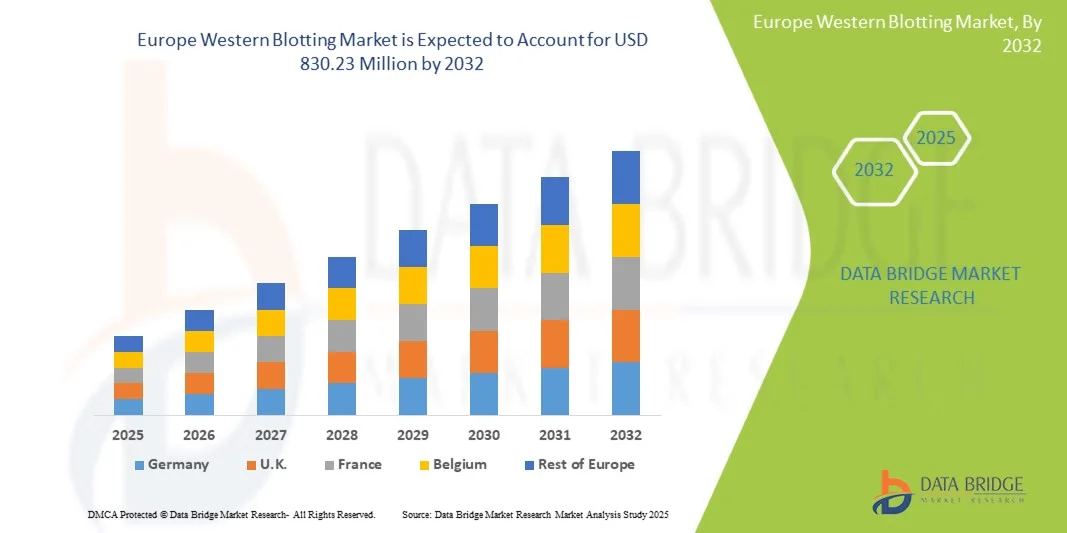
Europe Western Blotting Market Size
- The Europe Western Blotting Market size was valued at USD 545.1 million in 2024 and is expected to reach USD 830.23 million by 2032, at a CAGR of 5.40% during the forecast period
- The market growth is largely fueled by the growing adoption and technological progress within molecular biology and proteomics research, leading to increased digitalization and automation in laboratories across both academic and industrial settings
- Furthermore, rising demand for reliable, sensitive, and user-friendly solutions for protein detection and analysis is establishing Western blotting as one of the gold-standard techniques in life sciences research. These converging factors are accelerating the uptake of Western Blotting solutions, thereby significantly boosting the industry's growth
Europe Western Blotting Market Analysis
- Western blotting, a widely used analytical technique for protein detection and quantification, remains a cornerstone of molecular biology, clinical diagnostics, and biopharmaceutical research. Its applications in identifying specific proteins, monitoring post-translational modifications, and validating antibody specificity make it indispensable in both academic and industrial laboratories across Europe
- The escalating demand for western blotting systems and reagents is primarily fueled by the growing prevalence of chronic diseases such as cancer and infectious disorders, the rise in proteomics research, and increasing R&D investments by pharmaceutical and biotechnology companies. In addition, automation and digital imaging advancements are enhancing reproducibility and accuracy, further boosting adoption across European laboratories
- Germany dominated the Europe Western Blotting Market in Europe with the largest revenue share of 32.5% in 2024, supported by its strong biopharmaceutical manufacturing base, advanced research infrastructure, and high adoption of automated blotting instruments in both academic and commercial labs. Germany’s emphasis on life sciences innovation and government-backed funding programs for proteomics research further strengthened its leading position
- France is expected to be the fastest-growing country in the Europe Western Blotting Market during the forecast period, driven by expanding cancer research initiatives, growing clinical applications of protein analysis, and the rapid adoption of advanced imaging systems in research hospitals and diagnostic laboratories. The government’s increasing support for biotechnology startups and collaborations with international pharmaceutical firms are also fueling market expansion
- The blotting systems segment dominated the Europe Western Blotting Market largest revenue share of 44.3% in 2024, due to the demand for precise protein transfer, high reproducibility, and robust performance. Advanced blotting systems are increasingly adopted in clinical, pharmaceutical, and academic labs for both high-throughput and specialized workflows
Report Scope and Europe Western Blotting Market Segmentation
|
Attributes |
Western Blotting Key Market Insights |
|
Segments Covered |
|
|
Countries Covered |
Europe
|
|
Key Market Players |
|
|
Market Opportunities |
|
|
Value Added Data Infosets |
In addition to the insights on market scenarios such as market value, growth rate, segmentation, geographical coverage, and major players, the market reports curated by the Data Bridge Market Research also include in-depth expert analysis, pricing analysis, brand share analysis, consumer survey, demography analysis, supply chain analysis, value chain analysis, raw material/consumables overview, vendor selection criteria, PESTLE Analysis, Porter Analysis, and regulatory framework. |
Europe Western Blotting Market Trends
Enhanced Workflow Efficiency and Automation Integration
- A significant and accelerating trend in the Europe Western Blotting Market is the growing adoption of automated blotting systems and digital imaging technologies. These advancements are enhancing workflow efficiency, reproducibility, and accuracy in protein detection and analysis across academic, clinical, and industrial laboratories
- For instance, modern Western blotting platforms now incorporate automated sample loading, electrophoresis, and transfer systems, reducing manual handling and minimizing human error. High-throughput imaging systems also allow for simultaneous detection of multiple proteins, improving both speed and consistency of results
- Automation in Western blotting enables laboratories to process larger sample volumes while maintaining precision, which is particularly important for high-demand research areas such as proteomics, oncology, and infectious disease studies. New detection chemistries and multiplexing capabilities further expand experimental possibilities
- The integration of advanced imaging software with blotting platforms allows researchers to quantify protein expression more accurately, compare multiple experimental conditions, and generate publication-quality data efficiently. Centralized data management also helps in maintaining proper documentation and compliance with regulatory standards in pharmaceutical and clinical research
- This trend towards automated, high-throughput, and integrated blotting systems is fundamentally reshaping laboratory workflows, enabling scientists to conduct more complex experiments with greater efficiency and reliability. Companies such as Bio-Rad, GE Healthcare, and LI-COR are actively developing solutions that combine enhanced automation with versatile detection options to meet growing European demand
- The demand for automated and semi-automated Western blotting systems is growing rapidly across both research and clinical sectors, driven by the need for faster results, higher reproducibility, and streamlined laboratory workflows
Europe Western Blotting Market Dynamics
Driver
Growing Need Due to Rising Demand for Advanced Diagnostic and Research Tools
- The increasing adoption of advanced diagnostic and research technologies, coupled with rising investments in life sciences and clinical research, is a significant driver for the heightened demand for Western Blotting systems.
- For instance, in April 2024, Merck KGaA (Germany) announced the launch of a new automated Western Blotting system designed to improve protein detection accuracy and streamline laboratory workflows. Such initiatives by leading companies are expected to drive Europe Western Blotting Market growth in the forecast period
- As research institutions, diagnostic laboratories, and pharmaceutical companies increasingly focus on high-accuracy protein detection and biomarker validation, Western Blotting systems offer essential capabilities for sensitive and specific analysis
- Furthermore, the growing emphasis on personalized medicine, proteomics research, and infectious disease diagnostics is making Western Blotting an indispensable tool in laboratories across Europe, enabling accurate detection, quantification, and confirmation of proteins
- The convenience of automated blotting systems, high-throughput imaging platforms, and integrated workflow solutions are key factors propelling the adoption of Western Blotting systems across research and clinical diagnostics. The trend towards integrating digital data management and reproducible protocols further supports market growth
Restraint/Challenge
Concerns Regarding High Initial Costs and Technical Complexity
- The Europe Western Blotting Market faces significant adoption challenges due to the relatively high initial costs of advanced instruments, such as automated blotting systems, high-resolution imagers, and integrated workflow platforms. These costs can be a barrier for smaller laboratories, academic research centers, and emerging biotech companies, limiting broader utilization
- In addition to high costs, the technical complexity of Western Blotting systems presents another major restraint. Many instruments require specialized training and expertise to operate effectively, maintain reproducibility, and interpret results accurately. Laboratories with limited skilled personnel may struggle to implement these systems optimally
- Consumables and reagents associated with Western Blotting, including antibodies and detection kits, also contribute to ongoing operational expenses, increasing the total cost of ownership and limiting adoption in cost-sensitive regions
- Furthermore, some laboratories face challenges integrating Western Blotting instruments into existing workflows due to differences in equipment compatibility, software requirements, or laboratory infrastructure. This can slow implementation and reduce operational efficiency
- Addressing these challenges requires manufacturers to offer simplified, semi-automated systems, comprehensive training programs, and robust technical support. Companies like Tecan and Merck KGaA are increasingly focusing on user-friendly interfaces and integrated solutions to reduce complexity
- While gradual price reductions and more affordable product options are emerging, the perception of a premium for advanced Western Blotting technology persists, which may deter smaller labs or institutions with limited budgets from upgrading from traditional or semi-manual methods
- Overall, mitigating high costs, reducing technical complexity, and providing accessible solutions will be critical to driving widespread adoption and ensuring sustained growth in the European Europe Western Blotting Market
Europe Western Blotting Market Scope
The market is segmented on the basis of end-user, application, product, product type, and instruments.
• By End-User
On the basis of end-user, the Europe Western Blotting Market is segmented into diagnostic laboratories, research institutions, and pharmaceutical & biotechnology companies. The diagnostic laboratories segment dominated the largest market revenue share of 38.5% in 2024, driven by high adoption of Western blotting techniques for protein analysis, biomarker validation, and clinical diagnostics. These laboratories benefit from standardized protocols, high reproducibility, and automated blotting systems. Increased investment in laboratory infrastructure across Germany, the U.K., and France, alongside government-backed funding for life sciences research, supports this dominance. Advanced diagnostic labs prefer instruments that combine blotting, imaging, and data analysis for efficient workflows. The presence of large-scale hospital and clinical networks further reinforces the segment’s leading position.
The research institutions segment is expected to witness the fastest CAGR of 9.2% from 2025 to 2032, fueled by the growing focus on proteomics, molecular biology studies, and high-throughput research. Universities and specialized research centers are incorporating semi-automated and automated blotting systems to reduce manual errors and improve efficiency. Increasing collaborations with pharmaceutical companies and expanding research grants are supporting adoption. The segment is also driven by the rising need for advanced imaging systems and integrated data analysis platforms in research workflows. Decentralized research labs in emerging European countries are increasingly contributing to the market growth.
• By Application
On the basis of application, the Europe Western Blotting Market is segmented into scientific research, medical diagnostics, agricultural application, food & beverages, and other applications. The scientific research segment held the largest market share of 42.3% in 2024, attributed to the extensive use of Western blotting in molecular biology, proteomics, and disease research. Researchers rely on blotting techniques for protein detection, pathway analysis, and biomarker validation. Automation in blotting systems and the availability of high-sensitivity imagers further support widespread adoption. European research labs prioritize reproducibility and throughput, making scientific research the dominant application segment. The availability of advanced consumables and reagents also strengthens the position of this segment.
The medical diagnostics segment is expected to witness the fastest CAGR of 8.9% from 2025 to 2032, driven by the rising prevalence of chronic and infectious diseases requiring precise protein analysis. Diagnostic laboratories and hospitals are increasingly deploying automated blotting instruments for faster, accurate workflows. High-sensitivity detection methods and integration with imaging instruments are accelerating adoption. The demand is further supported by government initiatives promoting early disease detection, the growing number of clinical trials, and personalized medicine approaches in Europe.
• By Product
On the basis of product, the Europe Western Blotting Market is segmented into consumables and instruments. The instruments segment dominated with 46.7% revenue share in 2024, driven by high adoption of automated and semi-automated blotting systems, imagers, and gel electrophoresis instruments. These instruments are critical for achieving reproducibility, high throughput, and precise protein separation. Growing investments in laboratory automation and adoption of high-end imaging platforms strengthen this segment’s position. Furthermore, increasing research in proteomics, biomarker discovery, and clinical diagnostics fuels continuous demand for sophisticated instruments. The trend toward integrating instruments with digital analysis and data management systems also enhances efficiency, accuracy, and ease of use in laboratories across Europe.
The consumables segment is expected to witness the fastest CAGR of 9.5% from 2025 to 2032, fueled by recurring usage of membranes, reagents, buffers, and antibodies. Consumables are essential for reliable blotting performance, and demand increases with the growth of research and diagnostic activities. Continuous development of high-specificity consumables and the rising number of proteomics and biomarker studies in Europe are further accelerating segment growth. Moreover, the increasing adoption of high-throughput and automated blotting systems drives higher consumable requirements. Expansion of clinical trials and government-funded research projects also contributes to sustained demand across the region
• By Product Type
On the basis of product type, the Europe Western Blotting Market is segmented into automated dry blotting systems, semi-dry blotting systems, and traditional wet transfer blotting systems. The traditional wet transfer blotting systems segment dominated with a 41.2% market share in 2024, owing to its reliability, compatibility with various protein types, and widespread adoption in research and diagnostic labs. Wet transfer systems are preferred for high-precision applications and labs requiring robust workflows. Their versatility and reproducibility make them the leading choice among European laboratories.
The automated dry blotting systems segment is expected to witness the fastest CAGR of 10.1% from 2025 to 2032, driven by the need for higher throughput, reduced labor, and minimized errors. Automation enables simultaneous processing of multiple samples with consistent quality. Integration with imaging and data analysis systems enhances productivity in both research and diagnostic laboratories. Growth is supported by increasing adoption of fully automated laboratory platforms and the rising focus on efficiency and reproducibility. In addition, the growing number of proteomics studies and biomarker research in Europe fuels demand for automated systems. Ongoing technological advancements and the development of compact, user-friendly instruments further accelerate market expansion.
• By Instruments
On the basis of instruments, the Europe Western Blotting Market is segmented into blotting systems, gel electrophoresis instruments, and imagers. The blotting systems segment held the largest revenue share of 44.3% in 2024, due to the demand for precise protein transfer, high reproducibility, and robust performance. Advanced blotting systems are increasingly adopted in clinical, pharmaceutical, and academic labs for both high-throughput and specialized workflows. In addition, the integration of blotting systems with automated platforms and imaging solutions enhances workflow efficiency and reduces manual errors. Growing investment in proteomics research and biomarker discovery across Europe further supports the adoption and expansion of advanced blotting systems in laboratories.
The imagers segment is expected to witness the fastest CAGR of 9.8% from 2025 to 2032, driven by the rising demand for high-sensitivity detection, quantitative analysis, and digital documentation. Imagers integrated with automated blotting workflows improve data accuracy, reduce manual intervention, and allow multiplexed detection. European laboratories’ emphasis on precision, reproducibility, and integration of imaging with software analytics supports rapid growth in this segment. Moreover, the increasing adoption of advanced imaging systems in diagnostic laboratories and research institutions enhances throughput and efficiency. Continuous innovation in imaging technologies, including higher resolution and faster scanning capabilities, further fuels segment expansion.
Europe Western Blotting Market Regional Analysis
- The Europe Western Blotting Market is projected to grow at a substantial CAGR during the forecast period, driven by rising adoption of protein analysis techniques across research, diagnostics, and clinical applications
- Germany dominated the Europe Western Blotting Market in Europe with the largest revenue share of 32.5% in 2024, supported by its strong biopharmaceutical manufacturing base, advanced research infrastructure, and high adoption of automated blotting instruments in both academic and commercial labs. Germany’s emphasis on life sciences innovation and government-backed funding programs for proteomics research further strengthened its leading position
- France is expected to be the fastest-growing country in the Europe Western Blotting Market during the forecast period, driven by expanding cancer research initiatives, growing clinical applications of protein analysis, and the rapid adoption of advanced imaging systems in research hospitals and diagnostic laboratories. The government’s increasing support for biotechnology startups and collaborations with international pharmaceutical firms are also fueling market expansion
Germany Europe Western Blotting Market Insight
The Germany Europe Western Blotting Market remains the leading country in the European Europe Western Blotting Market, accounting for the largest revenue share of 32.5% in 2024. The market leadership is underpinned by a robust biopharmaceutical manufacturing base, advanced research infrastructure, and high adoption of automated blotting instruments across academic and commercial labs. Emphasis on life sciences innovation, government-backed funding programs for proteomics research, and strong collaborations between universities and biotech firms continue to reinforce Germany’s position. In addition, the integration of Western Blotting systems in clinical diagnostics and R&D workflows strengthens the country’s market dominance.
France Europe Western Blotting Market Insight
The France Europe Western Blotting Market is projected to be the fastest-growing country in the European Europe Western Blotting Market during the forecast period. Growth is driven by expanding cancer research programs, increasing clinical applications of protein analysis, and rapid adoption of advanced imaging and blotting systems in research hospitals and diagnostic laboratories. Supportive government initiatives, collaboration with international pharmaceutical companies, and rising biotechnology startup activity are further accelerating growth. The increasing focus on high-throughput protein detection and automation in laboratories reinforces France’s strong growth trajectory within the region.
Europe Western Blotting Market Share
The western blotting industry is primarily led by well-established companies, including:
- Thermo Fisher Scientific Inc. (U.S.)
- Bio-Rad Laboratories, Inc. (U.S.)
- GE Healthcare (U.K.)
- Merck KGaA (Germany)
- LI-COR, Inc. (U.S.)
- Advansta Inc. (U.S.)
- PerkinElmer (U.S.)
- Analytik Jena GmbH+Co. KG (Germany)
- F. Hoffmann-La Roche Ltd. (Switzerland)
- Agilent Technologies, Inc. (U.S.)
- Bio-Techne (U.S.)
- CYTOSKELETON, INC. (U.S.)
- ROCKLAND IMMUNOCHEMICALS, INC. (U.S.)
- EpigenTek Group Inc. (U.S.)
- Azure Biosystems, Inc. (U.S.)
Latest Developments in Europe Western Blotting Market
- In July 2024, Bio-Techne Corporation announced the launch of the Leo System, a next-generation Simple Western instrument designed to offer higher throughput, flexibility, and efficiency compared to previous models. The Leo System enables simultaneous processing of up to 100 samples in a single 3-hour run, allowing scientists to process more samples in a day. This advancement aims to streamline protein analysis workflows and enhance productivity in research settings
- In February 2025, Bio-Rad Laboratories completed its acquisition of Stilla Technologies, a developer of next-generation digital PCR systems. This acquisition is expected to enhance Bio-Rad's capabilities in the biotechnology sector, particularly in digital PCR applications. The integration of Stilla's technologies aims to expand Bio-Rad's product offerings and strengthen its position in the molecular biology market
- In March 2025, Thermo Fisher Scientific introduced a new line of ready-to-use transfer buffers and blocking solutions for Western blotting applications. These products are designed to improve the consistency and efficiency of protein transfer and detection, catering to the growing demand for high-quality reagents in research laboratories
- In July 2025, Cyanagen, an Italian company, showcased its WESTAR ECL product line at the ADLM 2025 conference. The WESTAR line includes chemiluminescent substrates such as ANTARES and ETA C ULTRA 2.0, which offer extended signal duration and enhanced sensitivity for Western blotting applications. This presentation highlights Cyanagen's commitment to advancing protein analysis technologies

- Interactive Data Analysis Dashboard
- Company Analysis Dashboard for high growth potential opportunities
- Research Analyst Access for customization & queries
- Competitor Analysis with Interactive dashboard
- Latest News, Updates & Trend analysis
- Harness the Power of Benchmark Analysis for Comprehensive Competitor Tracking
Data collection and base year analysis are done using data collection modules with large sample sizes. The stage includes obtaining market information or related data through various sources and strategies. It includes examining and planning all the data acquired from the past in advance. It likewise envelops the examination of information inconsistencies seen across different information sources. The market data is analysed and estimated using market statistical and coherent models. Also, market share analysis and key trend analysis are the major success factors in the market report. To know more, please request an analyst call or drop down your inquiry.
The key research methodology used by DBMR research team is data triangulation which involves data mining, analysis of the impact of data variables on the market and primary (industry expert) validation. Data models include Vendor Positioning Grid, Market Time Line Analysis, Market Overview and Guide, Company Positioning Grid, Patent Analysis, Pricing Analysis, Company Market Share Analysis, Standards of Measurement, Global versus Regional and Vendor Share Analysis. To know more about the research methodology, drop in an inquiry to speak to our industry experts.
Data Bridge Market Research is a leader in advanced formative research. We take pride in servicing our existing and new customers with data and analysis that match and suits their goal. The report can be customized to include price trend analysis of target brands understanding the market for additional countries (ask for the list of countries), clinical trial results data, literature review, refurbished market and product base analysis. Market analysis of target competitors can be analyzed from technology-based analysis to market portfolio strategies. We can add as many competitors that you require data about in the format and data style you are looking for. Our team of analysts can also provide you data in crude raw excel files pivot tables (Fact book) or can assist you in creating presentations from the data sets available in the report.













