Europe White Goods Market Size
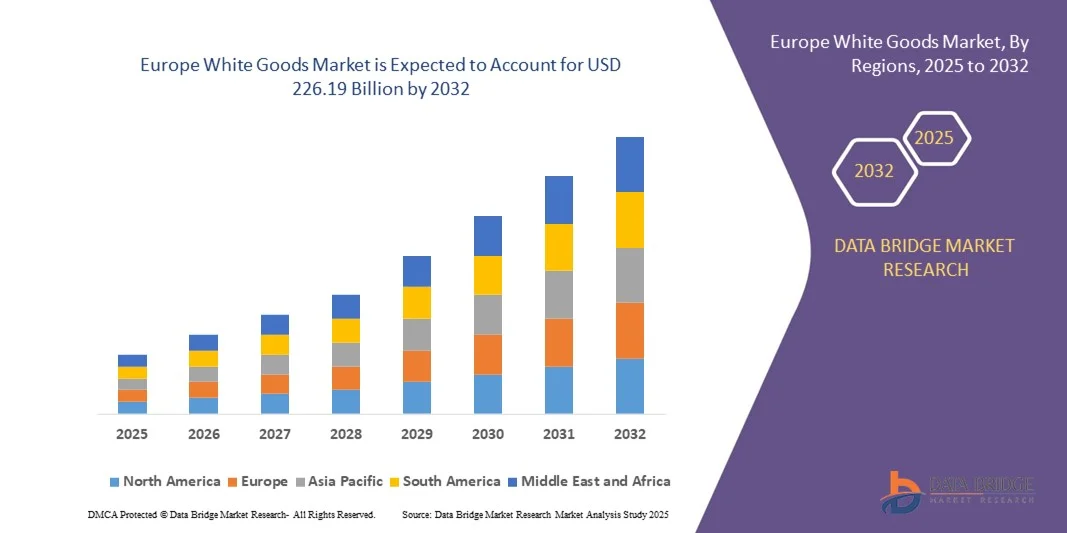
- The Europe White Goods Market size was valued at USD 175.81 billion in 2024 and is projected to reach USD 226.19 billion by 2032, growing at a CAGR of 3.20% during the forecast period
- Market growth is driven by rising urbanization, increasing disposable income, and a growing preference for energy-efficient and smart appliances across European households
- Additionally, advancements in IoT integration, sustainability initiatives, and evolving consumer lifestyles are fueling demand for high-performance, eco-friendly white goods, further accelerating industry expansion across residential and commercial sectors
Europe White Goods Market Analysis
- White goods, encompassing major household appliances such as refrigerators, washing machines, and dishwashers, are essential to modern living, offering convenience, efficiency, and enhanced lifestyle quality across residential and commercial settings in Europe
- The increasing demand for white goods is primarily fueled by rising consumer awareness of energy efficiency, the growing popularity of smart home integration, and expanding middle-class purchasing power across the region
- Germany is Dominated the Europe white goods market with the largest revenue share of 41.7% in 2024, supported by mature infrastructure, early adoption of energy-efficient technologies, and strong presence of leading appliance manufacturers, particularly in Germany, France, and the UK
- U.K. is expected to witness the fastest growth during the forecast period due to rapid urbanization, housing development, and increasing household appliance penetration
- The air conditioner segment dominated the market with the largest market revenue share of 38.5% in 2024, driven by rising demand for energy-efficient cooling solutions across residential and commercial sectors
Report Scope and Europe White Goods Market Segmentation
|
Attributes |
White Goods Key Market Insights |
|
Segments Covered |
|
|
Countries Covered |
|
|
Key Market Players |
|
|
Market Opportunities |
|
|
Value Added Data Infosets |
In addition to the insights on market scenarios such as market value, growth rate, segmentation, geographical coverage, and major players, the market reports curated by the Data Bridge Market Research also include in-depth expert analysis, pricing analysis, brand share analysis, consumer survey, demography analysis, supply chain analysis, value chain analysis, raw material/consumables overview, vendor selection criteria, PESTLE Analysis, Porter Analysis, and regulatory framework. |
Europe White Goods Market Trends
Enhanced Convenience Through AI and Smart Connectivity
- A significant and accelerating trend in the Europe White Goods Market is the integration of artificial intelligence (AI) and smart connectivity within appliances, enabling advanced automation, predictive maintenance, and personalized user experiences. This technological evolution is driving increased adoption across both residential and commercial sectors.
- For instance, AI-powered washing machines from LG and Samsung can automatically detect fabric types and load sizes to optimize wash cycles, while smart refrigerators from Bosch and Siemens can monitor contents and suggest grocery lists via connected apps.
- AI integration also enables white goods to learn user behavior over time — such as preferred washing modes or optimal cooling settings — and adjust their operations accordingly, improving energy efficiency and overall user satisfaction. Voice control through ecosystems like Amazon Alexa, Google Assistant, and Apple HomeKit further enhances hands-free convenience.
- The seamless connectivity of these appliances with broader smart home platforms allows centralized control and real-time monitoring through smartphones or digital assistants. Users can remotely preheat ovens, start laundry cycles, or check refrigerator temperatures, enhancing control and flexibility in daily routines.
- This shift toward intelligent, user-responsive white goods is reshaping expectations for household appliances. Manufacturers like Electrolux, Miele, and Haier are incorporating AI and IoT capabilities to deliver smarter, more intuitive products that align with connected living trends.
- The growing demand for AI-enabled and voice-controlled white goods is expected to surge, as consumers across Europe increasingly seek time-saving, efficient, and integrated home solutions that complement their digital lifestyles.
Europe White Goods Market Dynamics
Driver
Growing Demand Driven by Sustainability Goals and Smart Living Adoption
- The increasing emphasis on energy conservation, environmental sustainability, and smart living across Europe is a major factor fueling the demand for modern white goods. Government regulations and consumer awareness are pushing manufacturers toward more energy-efficient, eco-friendly appliances.
- For instance, the EU’s Energy Labeling Regulation, revised in 2021, continues to influence consumer choices by making energy efficiency a key purchasing criterion. This has encouraged brands like Bosch, Siemens, and Electrolux to introduce advanced appliances with low energy consumption and eco-modes, catering to environmentally conscious consumers.
- As smart home ecosystems become more mainstream, consumers are opting for connected white goods that offer remote monitoring, predictive maintenance alerts, and AI-driven performance optimization. This shift supports better energy use and enables time-saving automation in daily tasks.
- Additionally, modern white goods now often integrate with popular smart home platforms like Google Home and Amazon Alexa, allowing users to control appliances using voice commands or mobile apps. This convenience, combined with the ability to track performance metrics, contributes to rising demand across both residential and commercial sectors.
- The market is also seeing increased demand for space-saving, multifunctional appliances—particularly in urban areas with limited living space. Consumer preferences for sleek designs, quieter operation, and smart diagnostics are prompting innovation from leading manufacturers.
Restraint/Challenge
High Costs and Complexity in Product Integration
- Despite growing demand, the high upfront costs of advanced, energy-efficient white goods and the complexities associated with integrating smart features remain notable challenges for widespread adoption in Europe.
- Premium models often come at significantly higher price points due to advanced technology, smart connectivity, and sustainable design. While long-term savings in energy bills are a benefit, the initial investment can deter price-sensitive consumers, especially in lower-income or cost-conscious markets.
- Moreover, the integration of AI, IoT, and smart features into traditional appliance categories can present compatibility and usability challenges. Not all smart appliances are interoperable across different platforms, leading to fragmentation in the user experience and requiring additional hubs or devices.
- Installation complexity, lack of consumer awareness, and limited technical know-how also hinder adoption. Some consumers are reluctant to adopt smart appliances due to perceived difficulty in setup, concerns about software updates, or doubts about long-term durability.
- To overcome these barriers, industry players must focus on reducing product costs through manufacturing efficiencies, ensuring seamless cross-platform integration, and enhancing after-sales support and user education to build confidence in adopting smart white goods.
Europe White Goods Market Scope
The market is segmented on the basis of type, end-user and Distribution channel.
- By Product
On the basis of product, the market is segmented into air conditioner, refrigerator, washing machine, dishwasher, microwave oven, and others. The air conditioner segment dominated the market with the largest market revenue share of 38.5% in 2024, driven by rising demand for energy-efficient cooling solutions across residential and commercial sectors. Increasing global temperatures and urbanization have accelerated the adoption of advanced air conditioning units featuring smart and inverter technologies.
The integration of IoT and smart controls further fuels this demand, offering consumers enhanced comfort and energy savings. Meanwhile, the dishwasher segment is expected to witness the fastest growth rate of 19.8% from 2025 to 2032. Growing awareness about hygiene and convenience, along with rising disposable incomes, especially in emerging markets, support the increasing popularity of dishwashers. Their adoption in urban households and commercial kitchens is also growing due to labor-saving benefits and water efficiency.
- By End-User
On the basis of end-user, the market is segmented into residential and commercial. The residential segment held the largest market revenue share of 54.3% in 2024, driven by rapid urbanization, increasing home automation adoption, and rising consumer preference for convenience and energy efficiency. Smart appliances like refrigerators, washing machines, and air conditioners have gained significant traction among homeowners looking to enhance lifestyle and optimize energy consumption.
The government initiatives promoting energy-efficient appliances and rising disposable incomes contribute to growth. The commercial segment is anticipated to witness the fastest CAGR of 17.5% from 2025 to 2032, fueled by expanding hospitality, healthcare, and office infrastructure sectors. Commercial establishments increasingly demand durable, high-performance appliances with smart features to improve operational efficiency, reduce costs, and comply with sustainability goals, thereby boosting market expansion.
- By Distribution Channel
On the basis of distribution channel, the market is segmented into supermarket and hypermarket, specialty store, retail store, e-commerce, and others. The supermarket and hypermarket segment dominated the market with the largest revenue share of 45.7% in 2024, owing to wide product assortments, competitive pricing, and convenience for consumers. These channels benefit from high foot traffic and the ability to bundle promotions across multiple appliance categories, driving significant sales volumes.
E-commerce is expected to witness the fastest growth rate of 23.4% from 2025 to 2032, propelled by increasing internet penetration, smartphone usage, and changing consumer buying behavior. The convenience of home delivery, easy price comparisons, and detailed product information on online platforms contribute to rapid adoption. Additionally, manufacturers and brands are investing heavily in digital marketing and direct-to-consumer sales models, further accelerating e-commerce growth.
Europe White Goods Market Regional Analysis
- Germany dominated the white goods market with the largest revenue share of 41.7% in 2024, driven by rising consumer demand for energy-efficient, eco-friendly, and smart appliances across both residential and commercial sectors
- Consumers in the region prioritize products that offer high performance, sustainability, and intelligent features such as AI-driven automation, app connectivity, and voice control compatibility with platforms like Google Assistant and Amazon Alexa
- This widespread adoption is supported by strong regulatory frameworks promoting energy efficiency (such as EU energy labeling), growing environmental awareness, and increasing investment in smart home infrastructure—positioning Europe as a leading market for modern white goods across households, hospitality, and healthcare applications
France White Goods Market Insight
The France white goods market is experiencing consistent growth, supported by increasing demand for connected, energy-saving appliances and government policies aimed at reducing carbon footprints. French consumers are gravitating toward smart and multifunctional appliances that enhance convenience and reduce energy costs. Renovation projects and new housing developments are key drivers, with strong uptake in residential segments. The commercial sector, especially hospitality, also shows growing interest in sustainable white goods to meet environmental and operational efficiency goals.
U.K. White Goods Market Insight
The U.K. white goods market is expanding steadily due to rising home renovation activities and increased consumer awareness of energy efficiency. British consumers are increasingly adopting smart appliances that offer remote control and integration with home ecosystems such as Alexa and Google Home. Strong e-commerce penetration facilitates easy access to innovative products. The commercial sector, including rental properties and hospitality, is also adopting high-performance appliances to meet sustainability goals and operational needs.
Belgium White Goods Market Insight
Belgium’s white goods market is growing steadily with rising consumer demand for smart, energy-efficient home appliances. Belgian consumers prioritize products that reduce electricity consumption and offer smart connectivity features. Residential renovations and new housing projects contribute to market growth, while businesses in hospitality and healthcare are investing in commercial-grade white goods with sustainability certifications. Government initiatives promoting green technology further encourage market expansion.
Spain White Goods Market Insight
Spain’s white goods market is on an upward trajectory, driven by urban development, increasing consumer spending, and a growing preference for smart appliances. Spanish consumers are adopting energy-efficient refrigerators, washing machines, and cooking equipment to reduce utility costs amid rising energy prices. The hospitality sector is a significant contributor to demand, focusing on durable, easy-to-maintain appliances. Additionally, government subsidies for energy-efficient home upgrades support market growth.
Europe White Goods Market Share
The White Goods industry is primarily led by well-established companies, including:
- Whirlpool Corporation (U.S.)
- Johnson Controls (U.S.)
- IFB Industries (India)
- Samsung (South Korea)
- LG Electronics (South Korea)
- Panasonic Corporation (Japan)
- Symphony Limited (India)
- Blue Star Limited (India)
- ARÇELIK A.S. (Turkey)
- Godrej & Boyce Mfg. Co. Ltd. (India)
- AB Electrolux (Sweden)
- Hitachi, Ltd. (Japan)
- Sharp Corporation (Japan)
- Haier Inc. (China)
- Midea Group (China)
- Siemens (Germany)
- TCL Corporation (China)
- Mitsubishi Electric Corporation (Japan)
- Robert Bosch GmbH (Germany)
- The Middleby Corporation (U.S.)
What are the Recent Developments in Europe White Goods Market?
- In April 2023, Bosch Home Appliances, a leading global manufacturer, launched a new line of AI-enabled smart refrigerators in Germany designed to optimize energy consumption and food preservation. This initiative demonstrates Bosch’s commitment to innovation and sustainability, addressing consumer demand for intelligent appliances that reduce environmental impact while enhancing convenience. By leveraging cutting-edge technology and smart home integration, Bosch is strengthening its presence in the expanding Europe White Goods Market.
- In March 2023, Whirlpool Corporation introduced its latest connected washing machine series tailored for the European market, featuring remote monitoring and adaptive washing cycles that adjust to fabric types and load sizes. Targeting both residential and commercial laundries, this product line emphasizes efficiency and user convenience. Whirlpool’s move reflects its strategic focus on smart appliance innovation to capture growing consumer interest in connected white goods across Europe.
- In March 2023, Electrolux Group successfully deployed a smart kitchen appliance ecosystem in collaboration with several smart home providers in Scandinavia, aimed at integrating cooking, refrigeration, and cleaning devices for enhanced energy management and user experience. This project highlights Electrolux’s dedication to fostering smarter, energy-efficient living environments and reinforces its leadership in the evolving European market.
- In February 2023, Miele GmbH & Co. KG, renowned for premium household appliances, announced a partnership with a leading IoT platform in Belgium to develop advanced predictive maintenance solutions for its smart washing machines and dishwashers. This collaboration is designed to reduce downtime and optimize appliance lifespan, reflecting Miele’s focus on enhancing customer satisfaction and operational efficiency through innovation in the Europe White Goods Market.
- In January 2023, Samsung Electronics Europe unveiled the latest generation of smart ovens with integrated voice assistant compatibility and enhanced AI-driven cooking programs at the IFA Berlin trade show. These ovens allow users to control cooking remotely and receive recipe recommendations, showcasing Samsung’s commitment to merging technology with convenience. The launch underscores the company’s strategic intent to expand its footprint in Europe’s competitive white goods sector by offering cutting-edge connected appliances.

- Interactive Data Analysis Dashboard
- Company Analysis Dashboard for high growth potential opportunities
- Research Analyst Access for customization & queries
- Competitor Analysis with Interactive dashboard
- Latest News, Updates & Trend analysis
- Harness the Power of Benchmark Analysis for Comprehensive Competitor Tracking
Data collection and base year analysis are done using data collection modules with large sample sizes. The stage includes obtaining market information or related data through various sources and strategies. It includes examining and planning all the data acquired from the past in advance. It likewise envelops the examination of information inconsistencies seen across different information sources. The market data is analysed and estimated using market statistical and coherent models. Also, market share analysis and key trend analysis are the major success factors in the market report. To know more, please request an analyst call or drop down your inquiry.
The key research methodology used by DBMR research team is data triangulation which involves data mining, analysis of the impact of data variables on the market and primary (industry expert) validation. Data models include Vendor Positioning Grid, Market Time Line Analysis, Market Overview and Guide, Company Positioning Grid, Patent Analysis, Pricing Analysis, Company Market Share Analysis, Standards of Measurement, Global versus Regional and Vendor Share Analysis. To know more about the research methodology, drop in an inquiry to speak to our industry experts.
Data Bridge Market Research is a leader in advanced formative research. We take pride in servicing our existing and new customers with data and analysis that match and suits their goal. The report can be customized to include price trend analysis of target brands understanding the market for additional countries (ask for the list of countries), clinical trial results data, literature review, refurbished market and product base analysis. Market analysis of target competitors can be analyzed from technology-based analysis to market portfolio strategies. We can add as many competitors that you require data about in the format and data style you are looking for. Our team of analysts can also provide you data in crude raw excel files pivot tables (Fact book) or can assist you in creating presentations from the data sets available in the report.