


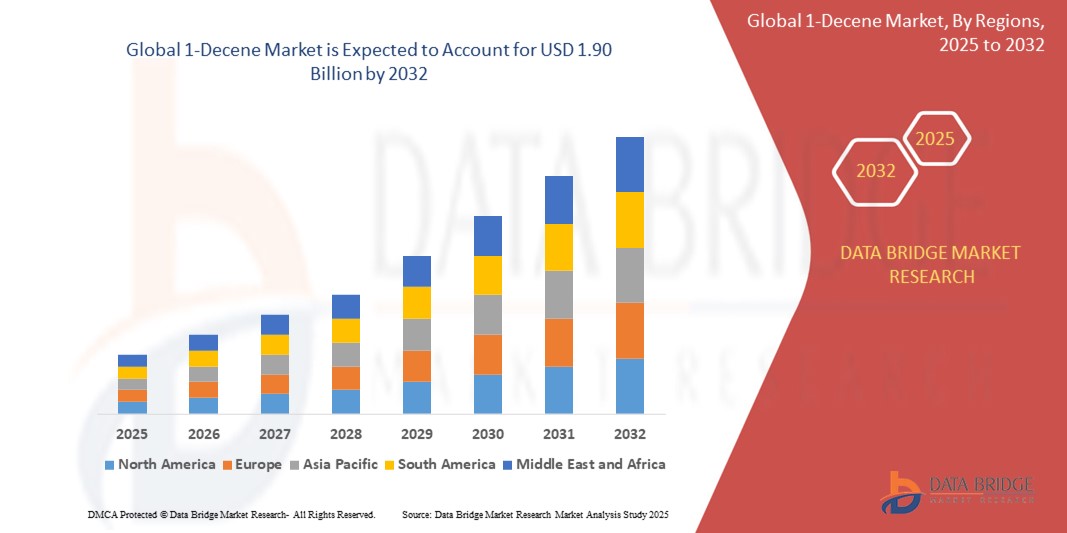
1-Decene Market Size
- The global 1-decene market size was valued at USD 1.14 billion in 2024 and is expected to reach USD 1.90 billion by 2032, at a CAGR of 6.65% during the forecast period
- The market growth is largely fuelled by the rising demand for synthetic lubricants, particularly polyalphaolefins (PAOs), which are a key derivative of 1-decene and widely used in automotive, aerospace, and industrial applications
- In addition, the increasing focus on energy efficiency, engine performance, and extended oil drain intervals is driving adoption of high-performance base oils, thereby expanding the market for 1-decene globally
1-Decene Market Analysis z
- The growing utilization of 1-decene as a comonomer in polyethylene production, especially in linear low-density polyethylene (LLDPE) and high-density polyethylene (HDPE), is expected to boost market growth over the forecast period
- Technological advancements in catalyst systems and expansion of production capacities by key players are improving product availability and cost efficiency, enabling broader industrial application
- North America dominated the 1-decene market with the largest revenue share of 39.4% in 2024, driven by extensive industrial applications in synthetic lubricants, polyethylene production, and detergent alcohols
- Asia-Pacific region is expected to witness the highest growth rate in the global 1-decene market, driven by expanding automotive and packaging industries, growing urbanization, and the availability of cost-effective manufacturing and labor resources
- The synthetic segment accounted for the largest revenue share in 2024, owing to its widespread use in the production of polyalphaolefins (PAOs) and other high-performance lubricants. The consistent quality, high purity, and established production infrastructure for synthetic 1-decene make it the preferred choice across various industrial applications. In addition, its compatibility with advanced catalytic processes further strengthens its position in the market
Report Scope and 1-Decene Market Segmentation
|
Attributes |
1-Decene Key Market Insights |
|
Segments Covered |
|
|
Countries Covered |
North America
Europe
Asia-Pacific
Middle East and Africa
South America
|
|
Key Market Players |
|
|
Market Opportunities |
|
|
Value Added Data Infosets |
In addition to the insights on market scenarios such as market value, growth rate, segmentation, geographical coverage, and major players, the market reports curated by the Data Bridge Market Research also include import export analysis, production capacity overview, production consumption analysis, price trend analysis, climate change scenario, supply chain analysis, value chain analysis, raw material/consumables overview, vendor selection criteria, PESTLE Analysis, Porter Analysis, and regulatory framework. |
1-Decene Market Trends
“Rising Use of 1-Decene in Eco-Friendly Synthetic Lubricants”
- The increasing emphasis on environmental sustainability is pushing lubricant manufacturers to shift toward biodegradable synthetic base stocks made using 1-decene, especially polyalphaolefins (PAOs), due to their low toxicity and reduced ecological footprint which align with global emission and sustainability goals
- With the rise of high-performance engines and electric vehicles, demand for lubricants that offer thermal stability, low volatility, and extended service life is accelerating the use of 1-decene-based PAOs as they help improve energy efficiency and engine durability
- Regulatory frameworks such as REACH in Europe and EPA guidelines in the U.S. are tightening restrictions on traditional lubricant formulations, encouraging the adoption of cleaner alternatives such as 1-decene derivatives that meet both performance and environmental standards
- The industrial and aerospace sectors are adopting synthetic lubricants derived from 1-decene due to their superior performance under extreme conditions, helping minimize maintenance costs and reduce downtime, especially in precision-heavy environments such as turbines and gearboxes
- For instance, ExxonMobil and Chevron Phillips Chemical have expanded their PAO production using 1-decene feedstock to cater to rising demand for high-efficiency lubricants, supporting the global shift toward eco-conscious and performance-driven fluid systems across automotive and industrial markets
1-Decene Market Dynamics
Driver
“Strong Growth in Synthetic Lubricants Segment”
- The rising demand for high-performance synthetic lubricants is significantly driving the use of 1-decene, especially in the production of polyalphaolefins (PAOs) which offer better efficiency and durability. These lubricants are increasingly preferred in the automotive, aerospace, and industrial sectors. Their ability to operate under extreme conditions makes them ideal for modern machinery and engines.
- Regulatory pressures promoting low-emission and fuel-efficient technologies are encouraging the adoption of PAO-based lubricants. 1-decene, being a key raw material for PAOs, is benefiting from this shift toward environmentally compliant formulations. These lubricants also support longer drain intervals and reduced environmental impact.
- The rapid expansion of electric vehicles and hybrid models is generating fresh demand for thermal fluids and gear oils. PAO-based products derived from 1-decene are gaining traction due to their superior thermal management capabilities. This trend is expected to boost 1-decene consumption in mobility applications.
- Key manufacturers are investing in backward integration and expanding production capacity for alpha olefins. This ensures stable supply and better cost management, making 1-decene more accessible to global lubricant producers. It also encourages innovation in next-generation lubricants and fluid technologies.
- For instance, Chevron Phillips Chemical and INEOS Oligomers have undertaken capacity expansions to meet growing global demand for PAO lubricants, highlighting their commitment to supporting long-term 1-decene supply reliability.
Restraint/Challenge
“Fluctuating Prices and Limited Feedstock Availability”
- Ethylene, the main raw material used in 1-decene production, experiences frequent price swings due to crude oil and natural gas market volatility. This instability leads to unpredictable production costs and reduced profit margins. Manufacturers may face challenges in maintaining competitive pricing.
- Global supply of alpha olefins, including 1-decene, is concentrated among a few major players, increasing vulnerability to production disruptions. Unplanned maintenance or geopolitical risks can lead to supply shortages. These interruptions may affect downstream production in lubricant and polymer sectors.
- Smaller companies and emerging market players are especially impacted by raw material price volatility. The inability to hedge against cost fluctuations limits their competitiveness. This can deter investments in applications that rely heavily on 1-decene derivatives.
- Limited feedstock availability also restricts the scalability of applications such as synthetic lubricants and specialty polymers. Companies may explore alternatives or reduce dependence on 1-decene, slowing down market expansion. This creates inconsistency in demand and supply cycles globally.
- For instance, extreme weather events along the U.S. Gulf Coast in 2021 temporarily halted production at major alpha olefin plants, causing supply chain disruptions and price spikes for 1-decene worldwide.
1-Decene Market Scope
The market is segmented on the basis of grade, application, end-use, and derivative.
- By Grade
On the basis of grade, the 1-decene market is segmented into bio-based and synthetic. The synthetic segment accounted for the largest revenue share in 2024, owing to its widespread use in the production of polyalphaolefins (PAOs) and other high-performance lubricants. The consistent quality, high purity, and established production infrastructure for synthetic 1-decene make it the preferred choice across various industrial applications. In addition, its compatibility with advanced catalytic processes further strengthens its position in the market.
The bio-based segment is expected to witness the fastest growth rate from 2025 to 2032, driven by rising environmental concerns and increased focus on sustainable alternatives. Technological advancements and supportive regulatory policies are encouraging manufacturers to explore renewable feedstocks for 1-decene production. Growing demand for eco-friendly chemicals in automotive, packaging, and consumer goods sectors is further supporting the expansion of the bio-based segment.
- By Application
On the basis of application, the 1-decene market is segmented into polyethylene, poly alpha olefins, detergent alcohol, surfactants, plasticizers, synthetic lubricants, and others. The poly alpha olefins (PAOs) segment held the largest revenue share in 2024 due to growing demand for synthetic lubricants used in automotive, industrial, and aerospace sectors. PAOs derived from 1-decene offer superior oxidative stability, low volatility, and excellent thermal performance, making them ideal for high-performance lubrication.
The polyethylene segment is expected to witness the fastest growth rate from 2025 to 2032, due to increasing demand for linear low-density polyethylene (LLDPE) and high-density polyethylene (HDPE). 1-Decene serves as a co-monomer in polymer production, providing flexibility and strength to final products used in packaging, containers, and construction materials.
- By End-Use
On the basis of end-use, the 1-decene market is segmented into food and beverage industry, pharmaceutical industry, paints and dyes industry, and others. The pharmaceutical industry dominated the market in 2024, driven by growing usage of high-purity alpha olefins in drug formulation and solvent production. 1-Decene's chemical stability and compatibility with pharmaceutical standards make it suitable for medical applications requiring stringent quality control.
The food and beverage industry is expected to witness the fastest growth rate from 2025 to 2032, supported by increased demand for food-grade lubricants and processing aids. Rising investments in food safety and hygiene are pushing companies to adopt synthetic solutions derived from 1-decene that meet regulatory standards and performance requirements.
- By Derivative
On the basis of derivative, the 1-decene market is segmented into polyalphaolefins, oxo alcohols, linear alkyl benzene, linear mercaptans, chlorinated alpha olefins, and others. The polyalphaolefins segment led the market in 2024 due to its dominant role in high-end lubricant formulations. PAOs produced from 1-decene are widely used in automotive, industrial, and compressor oils, driven by performance requirements and regulatory pressure for low-emission products.
The linear alkyl benzene segment is expected to witness the fastest growth rate from 2025 to 2032, due to rising demand for biodegradable surfactants in household and industrial cleaning products. The segment benefits from 1-decene's role as a key raw material, especially as consumer preference shifts toward sustainable and efficient cleaning solutions.
1-Decene Market Regional Analysis
- North America dominated the 1-decene market with the largest revenue share of 39.4% in 2024, driven by extensive industrial applications in synthetic lubricants, polyethylene production, and detergent alcohols
- Consumers and manufacturers in the region benefit from a mature petrochemical infrastructure, advanced refining technologies, and a strong focus on performance chemicals such as polyalphaolefins and oxo alcohols
- The widespread adoption of 1-decene across automotive, pharmaceutical, and consumer goods industries is further supported by ongoing research and innovation, positioning North America as a global leader in high-purity alpha olefins
U.S. 1-Decene Market Insight
The U.S. 1-decene market captured the largest revenue share within North America in 2024, owing to its robust domestic production, technological advancements, and strong demand for synthetic base oils. Key market players are investing in expanding alpha olefin production capacities to meet rising demand in both local and export markets. The increasing need for energy-efficient and low-emission lubricants in the automotive and aerospace sectors continues to propel the growth of 1-decene consumption across various end uses.
Asia-Pacific 1-Decene Market Insight
The Asia-Pacific 1-decene market is expected to witness the fastest growth rate from 2025 to 2032, driven by increasing industrialization, rising demand for plasticizers and surfactants, and expanding automotive manufacturing in countries such as China, India, and South Korea. Government-backed initiatives promoting domestic chemical production and the presence of cost-effective manufacturing make Asia-Pacific a key growth region. Rapid infrastructure development and the growing focus on synthetic lubricants are also contributing to the surge in demand for 1-decene across multiple applications.
China 1-Decene Market Insight
The China 1-decene market accounted for the largest revenue share in Asia-Pacific in 2024, driven by its large-scale petrochemical production and growing demand for packaging, automotive lubricants, and personal care ingredients. China is a leading consumer of polyethylene and surfactants, both of which utilize 1-decene as a critical feedstock. Domestic capacity expansions and the push for self-sufficiency in raw materials continue to strengthen China's role in the regional and global 1-decene landscape.
Japan 1-Decene Market Insight
The Japan 1-decene market is expected to witness the fastest growth rate from 2025 to 2032, driven by the country's advanced automotive and electronics industries which demand high-performance synthetic lubricants and specialty chemicals. The rising emphasis on environmentally friendly formulations has increased the use of 1-decene-derived surfactants and plasticizers in industrial and consumer applications. With a strong technological base and growing focus on energy efficiency, Japan continues to support the adoption of alpha olefin-based products in both manufacturing and end-use segments.
Europe 1-Decene Market Insight
The Europe 1-decene market is expected to witness the fastest growth rate from 2025 to 2032, supported by the region’s stringent environmental regulations and increased demand for high-performance, biodegradable surfactants and lubricants. The use of 1-decene in eco-friendly industrial formulations and the transition to synthetic alternatives in automotive and aerospace applications are key drivers. In addition, Europe’s well-established specialty chemical industry and its emphasis on sustainability are supporting the consistent adoption of 1-decene-based solutions.
Germany 1-Decene Market Insight
The Germany 1-decene market is expected to witness the fastest growth rate from 2025 to 2032, underpinned by the country’s advanced chemical manufacturing sector and high demand for synthetic lubricants and detergent intermediates. Germany’s leadership in the automotive and industrial machinery industries supports the need for high-quality polyalphaolefins, which are derived from 1-decene. The country's focus on circular economy practices and clean technologies is further accelerating innovation and sustainable product development in the chemical value chain.
U.K. 1-Decene Market Insight
The U.K. 1-decene market is expected to witness the fastest growth rate from 2025 to 2032, supported by increased demand for bio-based surfactants and high-quality synthetic lubricants across industrial sectors. Regulatory pressure to reduce emissions and promote sustainable alternatives is encouraging the shift toward 1-decene derivatives such as polyalphaolefins and linear alkyl benzene. The country's advanced research infrastructure and emphasis on green chemistry are fostering innovation and wider adoption of 1-decene in both established and emerging applications.
1-Decene Market Share
The 1-Decene industry is primarily led by well-established companies, including:
- Shell International B.V. (Netherlands)
- INEOS AG (U.K.)
- Chevron Phillips Chemical Company LLC (U.S.)
- SABIC (Saudi Arabia)
- Exxon Mobil Corporation (U.S.)
- Qatar Chemical Company Ltd (Qatar)
- Idemitsu Kosan Co., Ltd (Japan)
- Thermo Fisher Scientific India Pvt. Ltd. (U.S.)
- Spectrum Chemical Manufacturing Corp (U.S.)
- GELEST, INC (U.S.)

- Interactive Data Analysis Dashboard
- Company Analysis Dashboard for high growth potential opportunities
- Research Analyst Access for customization & queries
- Competitor Analysis with Interactive dashboard
- Latest News, Updates & Trend analysis
- Harness the Power of Benchmark Analysis for Comprehensive Competitor Tracking
Global 1 Decene Market, Supply Chain Analysis and Ecosystem Framework
To support market growth and help clients navigate the impact of geopolitical shifts, DBMR has integrated in-depth supply chain analysis into its Global 1 Decene Market research reports. This addition empowers clients to respond effectively to global changes affecting their industries. The supply chain analysis section includes detailed insights such as Global 1 Decene Market consumption and production by country, price trend analysis, the impact of tariffs and geopolitical developments, and import and export trends by country and HSN code. It also highlights major suppliers with data on production capacity and company profiles, as well as key importers and exporters. In addition to research, DBMR offers specialized supply chain consulting services backed by over a decade of experience, providing solutions like supplier discovery, supplier risk assessment, price trend analysis, impact evaluation of inflation and trade route changes, and comprehensive market trend analysis.
Data collection and base year analysis are done using data collection modules with large sample sizes. The stage includes obtaining market information or related data through various sources and strategies. It includes examining and planning all the data acquired from the past in advance. It likewise envelops the examination of information inconsistencies seen across different information sources. The market data is analysed and estimated using market statistical and coherent models. Also, market share analysis and key trend analysis are the major success factors in the market report. To know more, please request an analyst call or drop down your inquiry.
The key research methodology used by DBMR research team is data triangulation which involves data mining, analysis of the impact of data variables on the market and primary (industry expert) validation. Data models include Vendor Positioning Grid, Market Time Line Analysis, Market Overview and Guide, Company Positioning Grid, Patent Analysis, Pricing Analysis, Company Market Share Analysis, Standards of Measurement, Global versus Regional and Vendor Share Analysis. To know more about the research methodology, drop in an inquiry to speak to our industry experts.
Data Bridge Market Research is a leader in advanced formative research. We take pride in servicing our existing and new customers with data and analysis that match and suits their goal. The report can be customized to include price trend analysis of target brands understanding the market for additional countries (ask for the list of countries), clinical trial results data, literature review, refurbished market and product base analysis. Market analysis of target competitors can be analyzed from technology-based analysis to market portfolio strategies. We can add as many competitors that you require data about in the format and data style you are looking for. Our team of analysts can also provide you data in crude raw excel files pivot tables (Fact book) or can assist you in creating presentations from the data sets available in the report.













