


What is the Global 2 Ethylhexanol (2 EH) Market Size and Growth Rate?
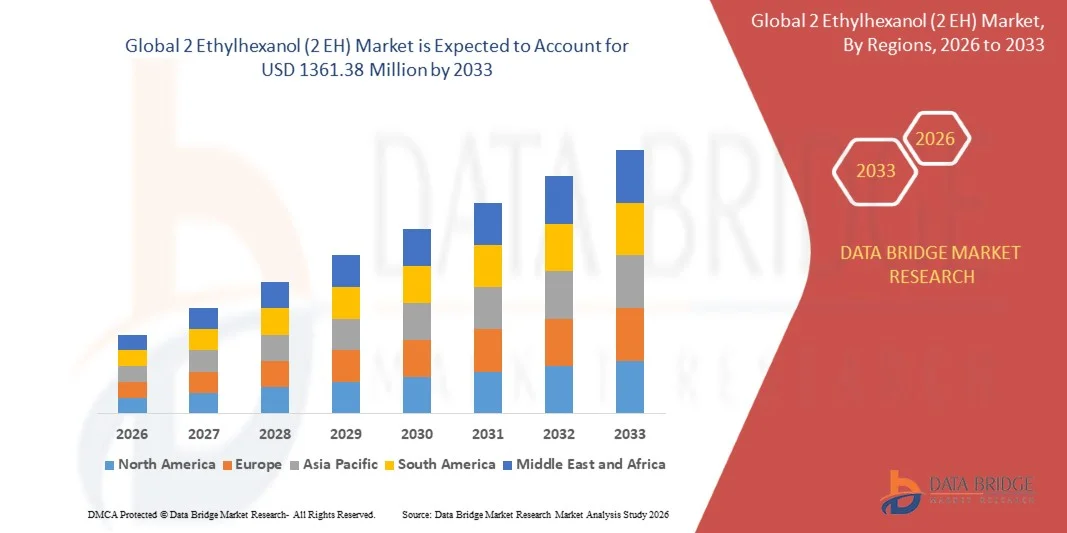
- As per Data Bridge Market Research Analysis the Global 2 Ethylhexanol (2 EH) market size was valued at USD 869.78 million in 2025 and is expected to reach USD 1361.38 million by 2033, at a CAGR of 5.76% during the forecast period
- Increasing demand for plasticizers, particularly dioctyl phthalate (DOP) and dioctyl terephthalate (DOTP), expanding applications in coatings, adhesives, solvents, and surfactants, and rising consumption of flexible PVC products across construction, automotive, and packaging industries are key factors driving market growth
- Growth in chemical manufacturing, rising infrastructure development, and increasing demand for high-performance industrial chemicals further support the expansion of the 2 EH market
Market Size & Forecast
- Global Market Value (2025): USD 869.78 Billion
- Expected Market Value (2033): USD 1361.38 Billion
- Forecast CAGR (2026–2033): 5.76%
What are the Major Takeaways of 2 Ethylhexanol (2 EH) Market?
- Growing demand for PVC-based flooring, cables, and films in developing countries, coupled with expanding construction and automotive production, is creating significant growth opportunities for the 2 EH market
- Increasing R&D activities aimed at developing non-phthalate plasticizers and high-purity 2 EH grades are expected to support long-term market expansion
- Asia-Pacific dominated the 2 Ethylhexanol (2 EH) market with a 36.14% revenue share in 2025, driven by strong expansion in chemicals manufacturing, large-scale plasticizers production, and rising utilization of 2-EH in coatings, adhesives, lubricants, and pharmaceutical intermediates across China, India, Japan, South Korea, and Southeast Asia
- Europe is projected to register the fastest CAGR of 9.47% from 2026 to 2033, driven by rising demand for sustainable plasticizers, expanding automotive coatings applications, and increasing consumption of 2-EH in adhesives, specialty chemicals, and engineered materials
- The Plasticizers segment dominated the market with a 58.6% share in 2025, as 2 Ethylhexanol is a critical raw material for producing phthalate and non-phthalate plasticizers such as DOTP, DOP, DEHT, and DINP
Report Scope and 2 Ethylhexanol (2 EH) Market Segmentation
|
Attributes |
2 Ethylhexanol (2 EH) Key Market Insights |
|
Segments Covered |
|
|
Countries Covered |
North America
Europe
Asia-Pacific
Middle East and Africa
South America
|
|
Key Market Players |
|
|
Market Opportunities |
|
|
Value Added Data Infosets |
In addition to the insights on market scenarios such as market value, growth rate, segmentation, geographical coverage, and major players, the market reports curated by the Data Bridge Market Research also include in-depth expert analysis, pricing analysis, brand share analysis, consumer survey, demography analysis, supply chain analysis, value chain analysis, raw material/consumables overview, vendor selection criteria, PESTLE Analysis, Porter Analysis, and regulatory framework. |
What is the Key Trend in the 2 Ethylhexanol (2 EH) Market?
“Increasing Adoption of Non-Phthalate Plasticizers and High-Purity 2 EH Grades”
- The 2 Ethylhexanol (2 EH) market is experiencing a strong shift toward eco-friendly, non-phthalate plasticizers such as DOTP and DEHT, driven by tightening global regulations on conventional phthalates
- Manufacturers are expanding production of high-purity 2 EH grades designed for specialty applications in coatings, adhesives, surfactants, and lubricants to meet rising performance standards in industrial and automotive sectors
- Growing demand for low-VOC solvents, sustainable additives, and high-performance chemical intermediates is accelerating the adoption of advanced 2 EH formulations across multiple industries
- For instance, chemical companies such as BASF, Eastman, SABIC, LG Chem, and OQ Chemicals have increased their focus on bio-based and safer plasticizer solutions to address sustainability requirements
- Rising consumption of flexible PVC products, high-efficiency coatings, and specialty chemicals is reinforcing the shift toward improved 2 EH derivatives
- As global industries transition toward green chemistry and low-toxicity materials, 2 Ethylhexanol will continue to play a critical role in modern plasticizer systems, high-grade solvents, and industrial chemicals
What are the Key Drivers of 2 Ethylhexanol (2 EH) Market?
- Rising demand for plasticizers used in PVC flooring, cables, films, and synthetic leather is a major driver accelerating 2 EH consumption across construction, automotive, and packaging sectors
- For instance, in 2024–2025, leading producers such as BASF, Eastman, OQ Chemicals, and Formosa Plastics expanded their 2 EH and plasticizer capacities to meet global demand for flexible PVC products
- Increasing use of 2 EH as a key raw material in coatings, adhesives, surfactants, and lubricants is boosting market penetration across industrial manufacturing
- Advancements in chemical processing, catalyst technologies, and energy-efficient production systems are supporting large-scale 2 EH manufacturing
- Growing industrialization, urbanization, and infrastructure development in the U.S., Europe, and Asia-Pacific are driving demand for PVC-based building materials and specialty chemicals
- Supported by steady investments in chemicals R&D, capacity expansions, and downstream PVC product manufacturing, the 2 EH market is expected to record robust long-term growth
Which Factor is Challenging the Growth of the 2 Ethylhexanol (2 EH) Market?
- Environmental concerns and regulatory restrictions on phthalate-based plasticizers present significant challenges, limiting demand for traditional 2 EH-derived products
- For instance, between 2024–2025, stricter compliance requirements in the U.S. and Europe increased costs for producers relying on conventional DOP and DEHP formulations
- Volatility in propylene prices, supply chain disruptions, and dependency on petrochemical feedstocks create uncertainty for manufacturers
- Limited awareness in emerging markets regarding non-phthalate alternatives, sustainability standards, and product performance slows adoption
- Competition from bio-based plasticizers, alternative solvents, and next-generation chemical intermediates intensifies pricing pressures and reduces differentiation
- To address these concerns, companies are focusing on renewable feedstocks, low-toxicity additives, cost-optimized production, and enhanced regulatory compliance to strengthen global acceptance of 2 EH and its derivatives
How is the 2 Ethylhexanol (2 EH) Market Segmented?
The market is segmented on the basis of application.
• By Application
On the basis of application, the 2 Ethylhexanol (2 EH) market is segmented into Plasticizers, 2-EH Acrylate, 2-EH Nitrate, and Other Applications. The Plasticizers segment dominated the market with a 58.6% share in 2025, as 2 Ethylhexanol is a critical raw material for producing phthalate and non-phthalate plasticizers such as DOTP, DOP, DEHT, and DINP. These plasticizers are widely used in PVC flooring, cables, films, wall coverings, synthetic leather, and automotive interiors, driving consistently high demand. Rapid urbanization, expansion of the construction sector, and increased usage of flexible PVC across packaging, electrical infrastructure, and industrial applications further strengthen segment leadership.
The 2-EH Acrylate segment is projected to grow at the fastest CAGR from 2026 to 2033, driven by increasing demand for high-performance acrylate esters used in paints, coatings, adhesives, sealants, and specialty polymers. 2-EH acrylate offers excellent weather resistance, superior film formation, and improved durability, making it essential for automotive coatings, industrial finishes, and architectural paints.
Which Region Holds the Largest Share of the 2 Ethylhexanol (2 EH) Market?
- Asia-Pacific dominated the 2 Ethylhexanol (2 EH) market with a 36.14% revenue share in 2025, driven by strong expansion in chemicals manufacturing, large-scale plasticizers production, and rising utilization of 2-EH in coatings, adhesives, lubricants, and pharmaceutical intermediates across China, India, Japan, South Korea, and Southeast Asia. Rapid industrialization, construction growth, and increasing output of DEHP and other 2-EH-based plasticizers continue to elevate regional consumption
- Leading producers in Asia-Pacific are expanding oxo-alcohol capacities, adopting advanced catalysts, and strengthening backward integration with propylene suppliers, resulting in improved manufacturing efficiency and competitive pricing advantages. High demand from automotive, construction, paints & coatings, and specialty chemicals further reinforces regional dominance
- Strong export capabilities, supportive industrial policies, and expanding downstream chemical clusters position Asia-Pacific as the central hub for global 2 Ethylhexanol (2 EH) production and consumption
China 2 Ethylhexanol (2 EH) Market Insight
China leads the region due to massive oxo-alcohol production capacity, strong domestic demand for plasticizers, coatings, and specialty chemicals, and extensive integration across petrochemical value chains. Government-backed industrial expansion and competitive pricing further strengthen domestic and export growth.
Japan 2 Ethylhexanol (2 EH) Market Insight
Japan shows steady growth driven by advanced automotive manufacturing, precision chemicals production, and strong demand for high-quality coatings and adhesives. The country’s focus on premium chemical formulations and reliability supports consistent 2-EH adoption.
Europe 2 Ethylhexanol (2 EH) Market – Fastest Growing Region
Europe is projected to register the fastest CAGR of 9.47% from 2026 to 2033, driven by rising demand for sustainable plasticizers, expanding automotive coatings applications, and increasing consumption of 2-EH in adhesives, specialty chemicals, and engineered materials. Strong regulatory push toward eco-friendly chemical formulations, rapid EV adoption, and robust construction activities support accelerated market expansion across the region.
Germany 2 Ethylhexanol (2 EH) Market Insight
Germany represents a major contributor in Europe due to its extensive chemicals manufacturing base, strong automotive production, and rising demand for high-performance coatings, adhesives, and specialty intermediates. Increasing emphasis on sustainable plasticizer production and advanced chemical engineering technologies strengthens market growth.
France 2 Ethylhexanol (2 EH) Market Insight
France shows steady expansion driven by growing consumption of coatings, lubricants, adhesives, and construction chemicals. Government support for industrial innovation, rising automotive refinishing activities, and increasing investment in chemical process optimization contribute to consistent demand for 2-EH and its derivatives.
Which are the Top Companies in 2 Ethylhexanol (2 EH) Market?
The 2 ethylhexanol (2 EH) industry is primarily led by well-established companies, including:
- Formosa Plastics Corporation (Taiwan)
- OQ Chemicals GmbH (Germany)
- Shandong Haiwang Chemical Co., Ltd (China)
- TIANJIN ZHONGXIN CHEMTECH CO. LTD. (China)
- Eastman Chemical Company (U.S.)
- Merck KGaA (Germany)
- Arkema (France)
- Sasol Limited (South Africa)
- SABIC (Saudi Arabia)
- Dow (U.S.)
- BASF SE (Germany)
- Mitsubishi Chemical Corporation (Japan)
- LG Chem (South Korea)
- Evonik Industries AG (Germany)
- Exxon Mobil Corporation (U.S.)
What are the Recent Developments in Global 2 Ethylhexanol (2 EH) Market?
- In February 2024, Eastman collaborated with Dentist Group Nord Pal Plast, a leading mechanical recycler, to strengthen plastic recycling capabilities and improve processing efficiency. This partnership aims to advance circular economy practices by enhancing the treatment of plastic waste, ultimately supporting more sustainable industrial operations. This initiative is expected to significantly boost global efforts toward large-scale plastic circularity
- In December 2022, Saudi Basic Industries Corporation (SABIC) inaugurated a new industrial chemicals facility in Jeddah, enhancing the Kingdom’s capacity to produce safe plasticizers for various manufacturing applications. The plant is the first in Saudi Arabia to utilize SABIC’s ethyl hexanol (2-EH) for manufacturing dioctyl terephthalate (DOTP), a key input for plasticizer production. This development strengthens Saudi Arabia’s strategic position in the global plasticizers market
- In September 2022, Anqing Shuguang Petrochemical Oxo obtained a license from Johnson Matthey and Dow to manufacture approximately 200 kta of 2-ethyl hexanol and 25 kta of iso-butyraldehyde. This marks the company’s second LP Oxo Technology license and supports its expansion into China’s rapidly growing oxo-alcohols market, with the new plant scheduled to begin operations in 2024. This milestone reinforces Anqing’s role as a key contributor to China’s oxo-chemical production landscape
- In June 2022, Evonik Venture Capital invested in two sustainability-focused funds, Azolla Ventures I and Chrysalix’s Carbon Neutrality Fund, aimed at advancing CO₂ reduction technologies across North America. These investments represent the first deployment under Evonik’s €150 million Sustainability Tech Fund, though financial specifics remain undisclosed. This move underscores Evonik’s long-term commitment to fostering sustainable industrial innovation
- In January 2022, Shandong Haiwang Chemical Co. Ltd. successfully completed and commissioned its sodium bromide expansion project in Gammon Province, Laos. The facility reached a significant production milestone on January 3, following a rigorous 78-day construction period. This expansion strengthens the company’s production footprint and enhances supply capabilities in the regional chemical market

- Interactive Data Analysis Dashboard
- Company Analysis Dashboard for high growth potential opportunities
- Research Analyst Access for customization & queries
- Competitor Analysis with Interactive dashboard
- Latest News, Updates & Trend analysis
- Harness the Power of Benchmark Analysis for Comprehensive Competitor Tracking
Global 2 Ethylhexanol 2 Eh Market, Supply Chain Analysis and Ecosystem Framework
To support market growth and help clients navigate the impact of geopolitical shifts, DBMR has integrated in-depth supply chain analysis into its Global 2 Ethylhexanol 2 Eh Market research reports. This addition empowers clients to respond effectively to global changes affecting their industries. The supply chain analysis section includes detailed insights such as Global 2 Ethylhexanol 2 Eh Market consumption and production by country, price trend analysis, the impact of tariffs and geopolitical developments, and import and export trends by country and HSN code. It also highlights major suppliers with data on production capacity and company profiles, as well as key importers and exporters. In addition to research, DBMR offers specialized supply chain consulting services backed by over a decade of experience, providing solutions like supplier discovery, supplier risk assessment, price trend analysis, impact evaluation of inflation and trade route changes, and comprehensive market trend analysis.
Data collection and base year analysis are done using data collection modules with large sample sizes. The stage includes obtaining market information or related data through various sources and strategies. It includes examining and planning all the data acquired from the past in advance. It likewise envelops the examination of information inconsistencies seen across different information sources. The market data is analysed and estimated using market statistical and coherent models. Also, market share analysis and key trend analysis are the major success factors in the market report. To know more, please request an analyst call or drop down your inquiry.
The key research methodology used by DBMR research team is data triangulation which involves data mining, analysis of the impact of data variables on the market and primary (industry expert) validation. Data models include Vendor Positioning Grid, Market Time Line Analysis, Market Overview and Guide, Company Positioning Grid, Patent Analysis, Pricing Analysis, Company Market Share Analysis, Standards of Measurement, Global versus Regional and Vendor Share Analysis. To know more about the research methodology, drop in an inquiry to speak to our industry experts.
Data Bridge Market Research is a leader in advanced formative research. We take pride in servicing our existing and new customers with data and analysis that match and suits their goal. The report can be customized to include price trend analysis of target brands understanding the market for additional countries (ask for the list of countries), clinical trial results data, literature review, refurbished market and product base analysis. Market analysis of target competitors can be analyzed from technology-based analysis to market portfolio strategies. We can add as many competitors that you require data about in the format and data style you are looking for. Our team of analysts can also provide you data in crude raw excel files pivot tables (Fact book) or can assist you in creating presentations from the data sets available in the report.













