


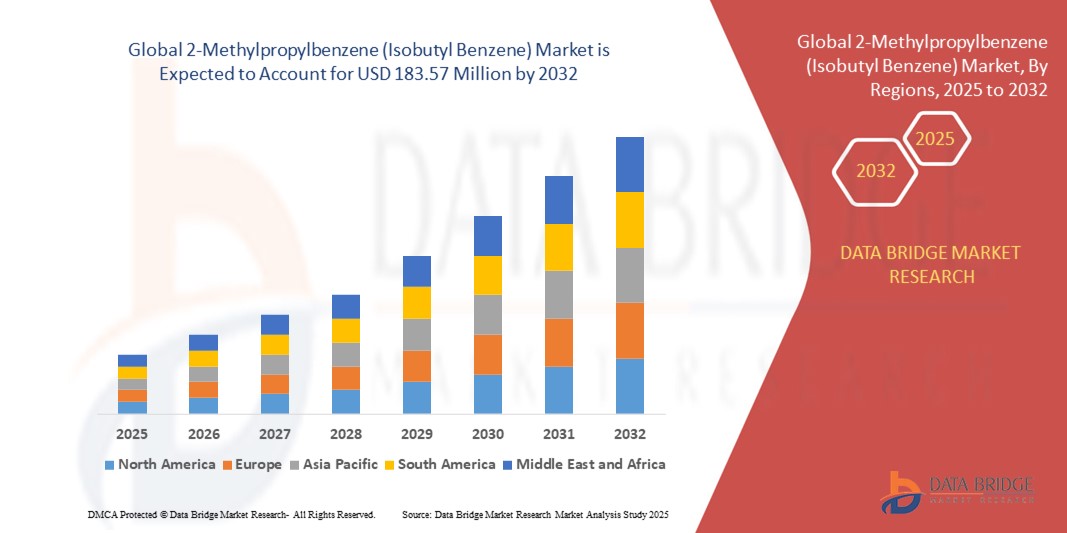
2-Methylpropylbenzene (Isobutyl Benzene) Market Size
- The global 2-methylpropylbenzene (isobutyl benzene) market size was valued at USD 120.53 million in 2024 and is expected to reach USD 183.57 million by 2032, at a CAGR of 5.40% during the forecast period
- The market growth is largely fueled by the increasing demand for isobutyl benzene as a key intermediate in the production of ibuprofen, coupled with the expansion of pharmaceutical manufacturing across emerging economies. Rising prevalence of chronic diseases, higher consumption of over-the-counter pain relief drugs, and growing global access to healthcare are accelerating consumption, thereby strengthening the market’s revenue base
- Furthermore, supportive government policies, capacity expansions by leading producers, and technological advancements in chemical synthesis are driving efficiency and supply stability. These converging factors are boosting demand for high-purity isobutyl benzene, significantly supporting the industry’s long-term growth trajectory
2-Methylpropylbenzene (Isobutyl Benzene) Market Analysis
- 2-Methylpropylbenzene, commonly known as isobutyl benzene, is an aromatic hydrocarbon primarily used as an intermediate in the synthesis of ibuprofen and other specialty chemicals. Its demand is closely linked to the pharmaceutical sector, with additional applications in coatings, surfactants, and chemical formulations
- The escalating demand for isobutyl benzene is primarily fueled by the growing pharmaceutical industry, rising global ibuprofen consumption, and increasing investments in specialty and fine chemical production. In addition, expanding production capacities in Asia-Pacific and long-term supply contracts with global pharmaceutical companies are reinforcing the market’s strong growth outlook
- Asia-Pacific dominated the 2-methylpropylbenzene (isobutyl benzene) market with a share of 45.7% in 2024, due to expanding pharmaceutical manufacturing, growing demand for ibuprofen intermediates, and a strong base of specialty chemical producers
- North America is expected to be the fastest growing region in the 2-methylpropylbenzene (isobutyl benzene) market during the forecast period due to high demand for ibuprofen, strong pharmaceutical R&D, and growing reliance on high-purity intermediates
- Pharmaceutical grade segment dominated the market with a market share of 69% in 2024, due to its critical role as an intermediate in the synthesis of ibuprofen and other analgesic drugs. The global rise in demand for over-the-counter painkillers and anti-inflammatory medications continues to fuel consumption, especially in regions with growing healthcare accessibility. Strict quality and purity standards in the pharmaceutical industry also ensure consistent demand for high-grade isobutyl benzene, as it is directly linked to patient safety and regulatory compliance. In addition, increasing prevalence of chronic diseases and higher health awareness are solidifying the pharmaceutical grade as the most significant contributor to market revenue
Report Scope and 2-Methylpropylbenzene (Isobutyl Benzene) Market Segmentation
|
Attributes |
2-Methylpropylbenzene (Isobutyl Benzene) Key Market Insights |
|
Segments Covered |
|
|
Countries Covered |
North America
Europe
Asia-Pacific
Middle East and Africa
South America
|
|
Key Market Players |
|
|
Market Opportunities |
|
|
Value Added Data Infosets |
In addition to the insights on market scenarios such as market value, growth rate, segmentation, geographical coverage, and major players, the market reports curated by the Data Bridge Market Research also include import export analysis, production capacity overview, production consumption analysis, price trend analysis, climate change scenario, supply chain analysis, value chain analysis, raw material/consumables overview, vendor selection criteria, PESTLE Analysis, Porter Analysis, and regulatory framework. |
2-Methylpropylbenzene (Isobutyl Benzene) Market Trends
Growing Focus on Bio-Based Isobutyl Benzene
- The market for 2-Methylpropylbenzene (Isobutyl Benzene) is witnessing a notable shift toward bio-based alternatives as sustainability gains greater importance across the chemical industry. With rising regulatory pressure to reduce dependency on petroleum-based raw materials, bio-based isobutyl benzene is gaining traction as a viable substitute that reduces environmental impact
- For instance, BASF has been investing in research initiatives to develop bio-based aromatic hydrocarbons, including intermediates such as isobutyl benzene, to strengthen its sustainable chemical portfolio. Such efforts demonstrate how major chemical producers are aligning with the global trend of reducing carbon footprints through renewable feedstocks
- Adoption of bio-based isobutyl benzene is being encouraged by pharmaceutical companies that are striving to adopt greener production pathways. As ibuprofen remains the primary downstream product of isobutyl benzene, sustainable alternatives can help address the dual goals of maintaining drug supply security while meeting ESG commitments
- Advances in biotechnology and catalytic conversion processes are further improving yields and cost-effectiveness of bio-based intermediates. These developments are making renewable isobutyl benzene increasingly competitive with conventional grades in both performance and pricing
- Regional governments are also providing incentives for the commercialization of bio-based chemicals. This regulatory support is expected to enhance investment in scaling bio-based isobutyl benzene production, simultaneously driving down costs through economies of scale
- In conclusion, the growing emphasis on bio-based isobutyl benzene highlights an important transformation within the market. As pharmaceutical demand and sustainability converge, bio-based solutions are likely to become mainstream, offering producers new opportunities and long-term resilience against environmental and regulatory constraints
2-Methylpropylbenzene (Isobutyl Benzene) Market Dynamics
Driver
Rising Ibuprofen Demand Worldwide
- The primary driver for the isobutyl benzene market is the rising global demand for ibuprofen, which uses isobutyl benzene as its key intermediate. Widespread applications of ibuprofen as an analgesic and anti-inflammatory drug have significantly contributed to the growth of this chemical in the pharmaceutical sector
- For instance, IOL Chemicals and Pharmaceuticals Ltd., a leading ibuprofen manufacturer, has expanded its production capacity to meet the growing export demand in North America and Europe. Such expansions emphasize the direct link between rising drug consumption and increasing demand for isobutyl benzene as a critical raw material
- The surge in healthcare consumption, driven by expanding populations, improved medical access, and rising incidences of fever, pain, and inflammation-related conditions, is further elevating ibuprofen production. As a result, producers of isobutyl benzene are ramping up supply capacities to align with this growing requirement
- Global pharmaceutical industry growth, coupled with the trend of generic drug manufacturing, is adding momentum to the demand curve of ibuprofen and its intermediates. Countries with strong generics markets such as India and China are especially contributing to demand expansion
- Overall, the steady rise in ibuprofen consumption globally is ensuring stable long-term demand for isobutyl benzene. This alignment between pharmaceutical consumption patterns and chemical intermediate production guarantees continued relevance for the compound in global supply chains
Restraint/Challenge
Raw Material Price Volatility
- Volatility in raw material prices remains a significant challenge to the isobutyl benzene market. As it is traditionally derived from petroleum-based sources, any fluctuations in crude oil markets directly influence input costs, thereby affecting the profitability and stability of producers
- For instance, frequent crude oil price disruptions in recent years have posed challenges for companies such as SI Group, which rely heavily on stable feedstock supply chains. These fluctuations create uncertainty in cost structures and limit long-term financial planning for manufacturers of isobutyl benzene
- The dependency on petrochemical derivatives exposes producers to risks from demand and supply imbalances, geopolitical disruptions, and crude oil production adjustments. This makes market pricing highly unpredictable, impacting competitiveness especially in price-sensitive pharmaceutical intermediate markets
- Price instability is further aggravated by constrained supply chains and uneven regional availability of petrochemical feedstocks. These uncertainties often force smaller companies to reduce margins or struggle with consistent supply, thereby limiting their market growth potential
- To mitigate the risks of raw material volatility, companies are increasingly diversifying toward bio-based routes and strategic partnerships for stable sourcing. Nonetheless, price unpredictability remains a major restraint that could affect expansion strategies in the long term unless sustainable alternatives are widely adopted
2-Methylpropylbenzene (Isobutyl Benzene) Market Scope
The market is segmented on the basis of product type and end-user.
- By Product Type
On the basis of product type, the 2-Methylpropylbenzene market is segmented into pharmaceutical grade, industrial grade, and bio grade. The pharmaceutical grade segment dominated the largest market revenue share of 69% in 2024, supported by its critical role as an intermediate in the synthesis of ibuprofen and other analgesic drugs. The global rise in demand for over-the-counter painkillers and anti-inflammatory medications continues to fuel consumption, especially in regions with growing healthcare accessibility. Strict quality and purity standards in the pharmaceutical industry also ensure consistent demand for high-grade isobutyl benzene, as it is directly linked to patient safety and regulatory compliance. In addition, increasing prevalence of chronic diseases and higher health awareness are solidifying the pharmaceutical grade as the most significant contributor to market revenue.
The bio grade segment is anticipated to witness the fastest growth rate from 2025 to 2032, driven by increasing adoption of sustainable and eco-friendly production practices. Bio-based isobutyl benzene is gaining momentum as manufacturers and end users shift focus towards green chemistry and reducing reliance on petroleum-derived raw materials. Supportive government policies and rising sustainability certifications are further encouraging investment in bio-based alternatives. In addition, industries aiming to lower carbon footprints and appeal to environmentally conscious consumers are accelerating adoption, making bio grade a transformative growth driver in the market’s future landscape.
- By End User
On the basis of end user, the 2-Methylpropylbenzene market is segmented into pharmaceuticals, coatings, surfactants, and others. The pharmaceuticals segment held the largest market revenue share in 2024, primarily due to its extensive use in ibuprofen production, which accounts for a significant portion of global demand for isobutyl benzene. The steady rise in pharmaceutical manufacturing, particularly in Asia-Pacific and North America, has bolstered the segment’s dominance. Moreover, growing generic drug production and expanding R&D pipelines in analgesics continue to enhance the consumption of isobutyl benzene within the pharmaceutical sector. This strong and recurring demand cycle cements pharmaceuticals as the core revenue generator in the market.
The coatings segment is expected to record the fastest growth rate from 2025 to 2032, supported by the compound’s utility as a solvent and intermediate in specialty chemical formulations. The expansion of the construction, automotive, and industrial sectors is creating strong demand for advanced coatings that enhance durability, corrosion resistance, and performance. Isobutyl benzene plays a vital role in manufacturing resins and coatings that meet these evolving industrial needs. In addition, urbanization trends, infrastructure projects, and increased spending on automotive finishes are key accelerators that position the coatings segment as the fastest-expanding application area in the coming years.
2-Methylpropylbenzene (Isobutyl Benzene) Market Regional Analysis
- Asia-Pacific dominated the 2-methylpropylbenzene (isobutyl benzene) market with the largest revenue share of 45.7% in 2024, driven by expanding pharmaceutical manufacturing, growing demand for ibuprofen intermediates, and a strong base of specialty chemical producers
- The region’s cost-efficient manufacturing ecosystem, rapid capacity expansions in chemical production, and increasing exports of pharmaceutical intermediates are fueling market growth
- Favorable government policies, availability of skilled labor, and rising industrialization across countries such as China and India are supporting consumption in pharmaceutical, coatings, and surfactant applications
China 2-Methylpropylbenzene Market Insight
China held the largest share in the Asia-Pacific 2-methylpropylbenzene market in 2024, supported by its dominant pharmaceutical manufacturing base and extensive production of ibuprofen APIs. The country’s robust industrial infrastructure, large-scale export capability, and government-backed investments in chemical parks have further strengthened demand. Continuous expansion of specialty and fine chemical industries is expected to maintain China’s leading role in global supply.
India 2-Methylpropylbenzene Market Insight
India is witnessing the fastest growth in the Asia-Pacific region, fueled by rising generic drug production, expansion of pharmaceutical infrastructure, and strong demand for ibuprofen intermediates. Government initiatives such as “Make in India” and a push for self-reliance in key pharmaceutical raw materials are boosting local consumption. In addition, growth in agrochemicals and coatings industries further enhances India’s role as the fastest-expanding market in the region.
Europe 2-Methylpropylbenzene Market Insight
The Europe 2-methylpropylbenzene market is expanding steadily, supported by stringent quality regulations in pharmaceuticals and rising demand for high-purity intermediates in drug manufacturing. Strong focus on sustainability, advanced chemical synthesis, and R&D-driven production in specialty chemicals is driving adoption. The pharmaceutical sector remains the largest consumer, while coatings and surfactants also contribute to steady demand growth.
Germany 2-Methylpropylbenzene Market Insight
Germany’s market is driven by its leadership in pharmaceutical R&D, advanced chemical manufacturing, and export-oriented production model. Strong collaboration between academia and industry supports innovation in ibuprofen synthesis and related intermediates. With a well-established specialty chemicals sector, Germany remains a critical hub for high-quality supply across Europe.
U.K. 2-Methylpropylbenzene Market Insight
The U.K. market benefits from a mature pharmaceutical and life sciences industry, increasing efforts to localize raw material supply chains, and growing demand for specialty intermediates. Post-Brexit strategies have strengthened domestic chemical production and research collaborations. Rising investments in fine chemical synthesis and strong academic-industry partnerships further support market growth.
North America 2-Methylpropylbenzene Market Insight
North America is projected to grow at the fastest CAGR from 2025 to 2032, driven by high demand for ibuprofen, strong pharmaceutical R&D, and growing reliance on high-purity intermediates. The region is also seeing increased reshoring of chemical production and investments in sustainable manufacturing. Close collaboration between pharmaceutical giants and specialty chemical producers is accelerating regional market expansion.
U.S. 2-Methylpropylbenzene Market Insight
The U.S. accounted for the largest share in the North America market in 2024, owing to its strong pharmaceutical base, advanced R&D infrastructure, and significant ibuprofen production. The country’s emphasis on innovation, regulatory compliance, and reliable supply chains supports consumption of isobutyl benzene. Presence of key global players and robust distribution networks further consolidate the U.S.’s leading position in the region.
2-Methylpropylbenzene (Isobutyl Benzene) Market Share
The 2-methylpropylbenzene (isobutyl benzene) industry is primarily led by well-established companies, including:
- Thermo Fisher Scientific (U.S.)
- Merck KGaA (U.S.)
- TCI Chemicals (India) Pvt. Ltd. (Japan)
- IOL (India)
- SI Group, Inc. (U.S.)
- Vizag Chemicals (India)
- Vinati Organics Limited (India)
- Shandong Xinhua Pharma (China)
- Ralington Pharma (India)
- SynQuest Laboratories (U.S.)
Latest Developments in Global 2-Methylpropylbenzene (Isobutyl Benzene) Market
- In May 2025, Mangalore Refinery and Petrochemicals Limited (MRPL) secured a U.S. patent for its novel process to synthesize isobutyl benzene using a side-chain alkylation route and announced the establishment of a pilot plant for scale-up. This development is expected to significantly impact the global IBB market by diversifying supply sources beyond existing Indian producers and fostering competition. By advancing toward commercial production, MRPL is positioning itself as a potential alternative supplier for pharmaceutical intermediates, particularly ibuprofen, thereby strengthening India’s presence in the global specialty chemical landscape
- In November 2024, Vinati Organics commissioned a new facility with a capacity of around 39,000 MTPA for butyl phenols, which incorporates isobutyl benzene as a key feedstock. This downstream integration move enhances Vinati’s ability to capture value across the IBB supply chain while simultaneously reducing India’s dependence on imports. The facility supports the company’s strategy of offering diversified specialty chemical solutions, which is expected to boost domestic demand for IBB and open up new application areas in resins, coatings, and additives
- In 2021, Vinati Organics announced an investment of nearly ₹800 crore to expand ATBS capacity, develop a butyl phenol factory, and merge with Veeral Additives Pvt. Ltd. This broad diversification strengthened the company’s specialty chemical portfolio while ensuring sustained demand for isobutyl benzene in downstream derivatives. The expansion created a multiplier effect on the market by increasing backward and forward integration, consolidating Vinati’s market dominance, and reinforcing India’s position as a global supplier of intermediates for pharmaceuticals and industrial applications

- Interactive Data Analysis Dashboard
- Company Analysis Dashboard for high growth potential opportunities
- Research Analyst Access for customization & queries
- Competitor Analysis with Interactive dashboard
- Latest News, Updates & Trend analysis
- Harness the Power of Benchmark Analysis for Comprehensive Competitor Tracking
Global 2 Methylpropylbenzene Isobutyl Benzene Market, Supply Chain Analysis and Ecosystem Framework
To support market growth and help clients navigate the impact of geopolitical shifts, DBMR has integrated in-depth supply chain analysis into its Global 2 Methylpropylbenzene Isobutyl Benzene Market research reports. This addition empowers clients to respond effectively to global changes affecting their industries. The supply chain analysis section includes detailed insights such as Global 2 Methylpropylbenzene Isobutyl Benzene Market consumption and production by country, price trend analysis, the impact of tariffs and geopolitical developments, and import and export trends by country and HSN code. It also highlights major suppliers with data on production capacity and company profiles, as well as key importers and exporters. In addition to research, DBMR offers specialized supply chain consulting services backed by over a decade of experience, providing solutions like supplier discovery, supplier risk assessment, price trend analysis, impact evaluation of inflation and trade route changes, and comprehensive market trend analysis.
Data collection and base year analysis are done using data collection modules with large sample sizes. The stage includes obtaining market information or related data through various sources and strategies. It includes examining and planning all the data acquired from the past in advance. It likewise envelops the examination of information inconsistencies seen across different information sources. The market data is analysed and estimated using market statistical and coherent models. Also, market share analysis and key trend analysis are the major success factors in the market report. To know more, please request an analyst call or drop down your inquiry.
The key research methodology used by DBMR research team is data triangulation which involves data mining, analysis of the impact of data variables on the market and primary (industry expert) validation. Data models include Vendor Positioning Grid, Market Time Line Analysis, Market Overview and Guide, Company Positioning Grid, Patent Analysis, Pricing Analysis, Company Market Share Analysis, Standards of Measurement, Global versus Regional and Vendor Share Analysis. To know more about the research methodology, drop in an inquiry to speak to our industry experts.
Data Bridge Market Research is a leader in advanced formative research. We take pride in servicing our existing and new customers with data and analysis that match and suits their goal. The report can be customized to include price trend analysis of target brands understanding the market for additional countries (ask for the list of countries), clinical trial results data, literature review, refurbished market and product base analysis. Market analysis of target competitors can be analyzed from technology-based analysis to market portfolio strategies. We can add as many competitors that you require data about in the format and data style you are looking for. Our team of analysts can also provide you data in crude raw excel files pivot tables (Fact book) or can assist you in creating presentations from the data sets available in the report.













