


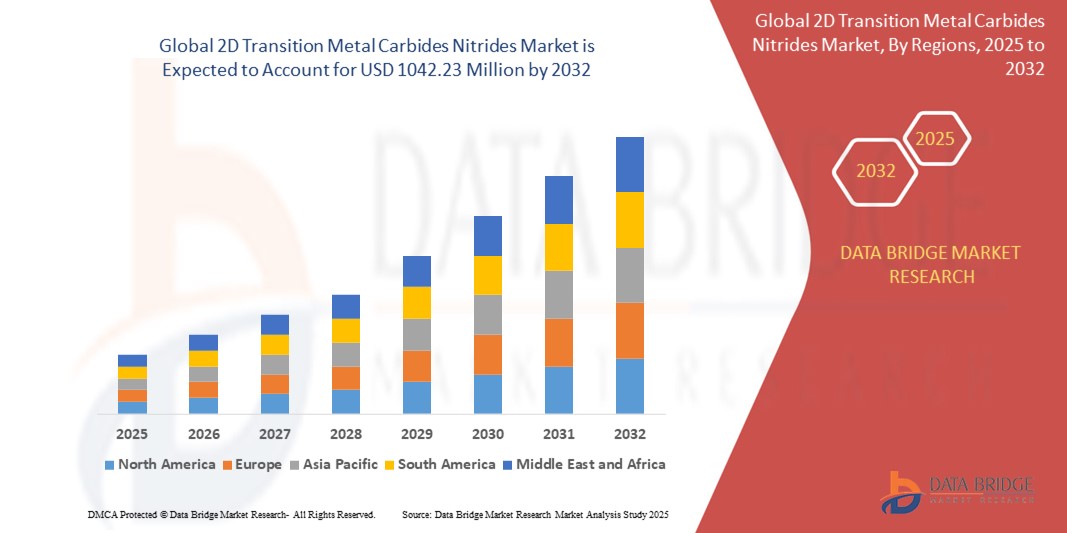
What is the Global 2D Transition Metal Carbides Nitrides Market Size and Growth Rate?
- The global 2D transition metal carbides nitrides market size was valued at USD 179.40 million in 2024 and is expected to reach USD 1042.23 million by 2032, at a CAGR of 24.60% during the forecast period
- Market growth is primarily driven by the rising demand for advanced energy storage, next-generation electronics, and environmental remediation technologies, which increasingly utilize MXene-based materials
- The growing focus on lightweight, high-performance, and conductive materials in sectors such as aerospace, automotive, and healthcare is further accelerating global demand for 2D Transition Metal Carbides Nitrides
What are the Major Takeaways of 2D Transition Metal Carbides Nitrides Market?
- 2D Transition Metal Carbides Nitrides (MXenes) are emerging as key materials due to their excellent conductivity, large surface area, and chemical tunability, making them ideal for use in supercapacitors, batteries, sensors, and biomedical devices
- The market is witnessing increased research and commercialization of energy-efficient and sustainable nanomaterials, with MXenes positioned at the forefront of next-gen material innovation
- Rising investments in R&D initiatives across Asia-Pacific, North America, and Europe, coupled with strategic collaborations among material science companies and academic institutions, are expected to significantly shape market dynamics through 2032
- North America led the global 2D transition metal carbides nitrides market with the largest revenue share of 44.26% in 2024, driven by robust investments in nanomaterials research, strong demand for advanced energy storage systems, and a well-established base of academic and industrial research institutions
- Asia-Pacific region is projected to grow at the fastest CAGR of 11.56% from 2025 to 2032, led by rapid industrialization, rising demand for energy-efficient materials, and government support for nanotech innovation in countries such as China, Japan, and South Korea
- The Titanium-Based MXenes segment dominated the market with the largest revenue share of 39.8% in 2024, attributed to their high electrical conductivity, chemical stability, and extensive research applications in energy storage, sensors, and EMI shielding
Report Scope and 2D Transition Metal Carbides Nitrides Market Segmentation
|
Attributes |
2D Transition Metal Carbides Nitrides Key Market Insights |
|
Segments Covered |
|
|
Countries Covered |
North America
Europe
Asia-Pacific
Middle East and Africa
South America
|
|
Key Market Players |
|
|
Market Opportunities |
|
|
Value Added Data Infosets |
In addition to the insights on market scenarios such as market value, growth rate, segmentation, geographical coverage, and major players, the market reports curated by the Data Bridge Market Research also include in-depth expert analysis, pricing analysis, brand share analysis, consumer survey, demography analysis, supply chain analysis, value chain analysis, raw material/consumables overview, vendor selection criteria, PESTLE Analysis, Porter Analysis, and regulatory framework. |
What is the Key Trend in the 2D Transition Metal Carbides Nitrides Market?
“Advanced Energy Storage Solutions through MXene Innovation”
- A key trend driving the global 2D transition metal carbides nitrides (MXenes) market is their increasing application in high-performance energy storage systems, particularly supercapacitors and lithium-ion batteries. MXenes’ unique combination of metal-such as conductivity, tunable surface chemistry, and 2D structure offers substantial advantages in enhancing energy density and charge-discharge cycles
- For instance, in January 2024, researchers from Drexel University developed a novel MXene-based electrode material that demonstrated over 90% capacitance retention after 10,000 cycles, reinforcing the role of MXenes in scalable energy storage applications
- MXenes are also being tailored through surface functionalization techniques to improve ion transport and stability in harsh environments, making them highly attractive for next-gen solid-state batteries and wearable electronics
- In addition, their capability to form hybrid structures with graphene or carbon nanotubes is enhancing conductivity and electrochemical performance. Such innovations are fostering the emergence of flexible and ultrathin energy devices for portable and IoT-enabled electronics
- As demand for efficient, lightweight, and sustainable power sources rises across automotive, aerospace, and grid-level storage, MXenes are rapidly becoming a material of choice for clean energy technologies
- This trend highlights the transformative role of 2D Transition Metal Carbides Nitrides in addressing future energy challenges through scalable, high-efficiency materials engineering
What are the Key Drivers of 2D Transition Metal Carbides Nitrides Market?
- The growing demand for high-conductivity, lightweight, and multifunctional nanomaterials is a major driver of the 2D transition metal carbides nitrides market, particularly across electronics, energy storage, and biomedical sectors
- For instance, in March 2024, Murata Manufacturing Co., Ltd. partnered with a research institute to explore MXene-based supercapacitors for next-gen EVs, marking a significant commercial step in the adoption of MXenes in high-demand sectors
- Increasing investment in clean energy technologies and the transition to electric vehicles (EVs) are amplifying the need for materials such as MXenes, which offer high charge mobility and low resistivity, essential for battery and capacitor efficiency
- Moreover, the biocompatibility and hydrophilic nature of certain MXene types are accelerating their use in biosensors, drug delivery systems, and medical implants, expanding the market into healthcare and life science
- As manufacturers and researchers continue to unlock the functional tunability and scalable synthesis of MXenes, their adoption in consumer electronics, defense applications, and environmental technologies is expected to grow significantly
- These factors collectively support a robust growth trajectory for the 2D Transition Metal Carbides Nitrides market through 2032, fueled by technological advancements and multi-sector applicability
Which Factor is challenging the Growth of the 2D Transition Metal Carbides Nitrides Market?
- One of the primary challenges to the widespread adoption of 2D transition metal carbides nitrides (MXenes) is the use of hazardous chemicals such as hydrofluoric acid (HF) in their synthesis. HF is highly corrosive, posing serious risks to human health and the environment, which makes large-scale, industrial-level production complex and restricted under strict safety regulations
- For instance, academic and industrial research has raised concerns over the sustainability and scalability of HF-based etching methods, which remain the most common technique for producing high-quality MXenes. These methods often require controlled lab environments and trained personnel, limiting their commercial viability for broader material adoption
- Addressing this issue requires the development of greener, safer, and more scalable synthesis alternatives, such as fluoride-free or electrochemical etching processes. Researchers and startups are actively exploring these pathways to reduce production risks and environmental impact. In addition, proper waste management protocols and containment infrastructure are needed to ensure safe handling and disposal of synthesis byproducts
- Beyond synthesis, the long-term stability of MXenes in ambient conditions remains a concern, as some types are prone to oxidation, which can degrade performance in key applications. Overcoming these material challenges is essential to unlock the full potential of MXenes across industries such as energy storage, electronics, and healthcare
- Ultimately, tackling toxic chemical usage, stability concerns, and regulatory barriers through safer fabrication methods and protective coatings will be crucial for sustained market growth and commercialization of MXenes in the coming years
How is the 2D Transition Metal Carbides Nitrides Market Segmented?
The market is segmented on the basis of material type, synthesis method, form, application, and end use industry.
• By Material Type
On the basis of material type, the 2D transition metal carbides nitrides market is segmented into Titanium-Based MXenes, Niobium-Based MXenes, Vanadium-Based MXenes, Molybdenum-Based MXenes, Tantalum-Based MXenes, and Other MXene Types. The Titanium-Based MXenes segment dominated the market with the largest revenue share of 39.8% in 2024, attributed to their high electrical conductivity, chemical stability, and extensive research applications in energy storage, sensors, and EMI shielding. Their relatively easier synthesis and scalable production processes make them a preferred choice for both commercial and academic research.
Niobium-Based MXenes are expected to witness the fastest growth rate from 2025 to 2032, driven by their superior pseudocapacitive properties and increased demand in supercapacitor and biosensing applications.
• By Synthesis Method
On the basis of synthesis method, the market is segmented into Hydrofluoric Acid (HF) Etching, Fluoride Salt + HCl Etching, Other Fluoride Salt Combinations, Electrochemical Etching, Molten Salt Etching, and Other Synthesis Methods. The Hydrofluoric Acid (HF) Etching segment held the largest market share of 34.6% in 2024, due to its widespread use in laboratory synthesis for achieving high-purity MXenes with well-defined layered structures. Despite safety concerns, HF etching remains the benchmark for controlled etching of MAX phases.
However, Electrochemical Etching is projected to record the fastest CAGR during 2025–2032, as industries and researchers increasingly adopt greener and safer alternatives for scalable MXene production with reduced environmental hazards.
• By Form
On the basis of form, the market is segmented into Powder, Dispersion/Ink, Film, Composite Materials, and Other Forms. The Powder segment captured the largest revenue share of 36.1% in 2024, attributed to its versatility in downstream applications such as batteries, coatings, and composites. Powdered MXenes are easier to store, transport, and integrate into various industrial processes.
The Film segment is expected to witness the highest growth rate from 2025 to 2032, fueled by rising use in flexible electronics, membranes, and EMI shielding materials due to their exceptional electrical and mechanical properties.
• By Application
On the basis of application, the market is segmented into Energy Storage, Electronics & Optoelectronics, Environmental Remediation, Biomedical Applications, Composites & Coatings, and Other Applications. Energy Storage emerged as the dominant application segment with a market share of 31.4% in 2024, owing to the exceptional capacitance and conductivity of MXenes in supercapacitors and lithium-ion batteries. Their ability to support rapid ion transport and storage mechanisms makes them highly sought-after in next-gen energy solutions.
The Biomedical Applications segment is projected to grow at the fastest CAGR through 2032, driven by increasing research in drug delivery, cancer therapy, and biosensors due to MXenes’ biocompatibility and functional surface chemistry.
• By End-Use Industry
On the basis of end-use industry, the market is segmented into Electronics & Semiconductors, Energy & Power, Healthcare & Pharmaceuticals, Automotive & Transportation, Environmental & Water Treatment, Aerospace & Defense, Research & Academia, and Other End-Use Industries. Electronics & Semiconductors held the largest market share of 27.8% in 2024, supported by MXenes’ metallic conductivity, flexibility, and growing integration into printed electronics, antennas, and EMI shielding devices. Their nanoscale properties make them ideal for miniaturized, high-performance electronic components.
The Energy & Power segment is expected to grow at the fastest pace during the forecast period, owing to increasing demand for sustainable materials in renewable energy, grid storage, and EV battery applications.
Which Region Holds the Largest Share of the 2D Transition Metal Carbides Nitrides Maret?
- North America led the global 2D transition metal carbides nitrides market with the largest revenue share of 44.26% in 2024, driven by robust investments in nanomaterials research, strong demand for advanced energy storage systems, and a well-established base of academic and industrial research institutions
- The region benefits from extensive funding into clean energy and next-generation electronics, particularly for MXenes in batteries, supercapacitors, and electromagnetic interference (EMI) shielding
- Leading U.S.-based universities and national labs are playing a central role in innovating scalable synthesis techniques, which has helped maintain North America's leadership position
- The market is also buoyed by collaborations between material science firms and end-use sectors such as aerospace, automotive, and defense, which actively seek advanced 2D materials for lightweight, durable, and conductive applications.=
U.S. 2D Transition Metal Carbides Nitrides Market Insight
The U.S. dominated North America’s 2D transition metal carbides nitrides market revenue in 2024, thanks to a dynamic research ecosystem and early-stage adoption across multiple industries. Government-backed energy programs and Department of Defense initiatives are encouraging the use of MXenes in energy storage, coatings, and sensing technologies. The U.S. also leads in patent filings and pilot-scale manufacturing of MXenes, strengthening its global influence.
Europe 2D Transition Metal Carbides Nitrides Market Insight
Europe is projected to grow at a notable CAGR over the forecast period, supported by sustainable innovation policies and increased adoption in environmental and biomedical applications. The region’s strong emphasis on green chemistry and recycling of energy materials aligns with efforts to develop eco-friendly synthesis methods for MXenes. Public-private R&D investments and applications in flexible electronics are accelerating MXene demand across countries such as Germany, France, and the U.K.
U.K. 2D Transition Metal Carbides Nitrides Market Insight
The U.K. market is expected to expand at a noteworthy CAGR, fueled by government-funded initiatives into advanced materials and growing usage in wearable devices, healthcare sensors, and flexible batteries. Collaborations between universities and tech start-ups are enhancing innovation in graphene and MXene composites, reinforcing the U.K.’s push toward digital transformation and energy security.
Germany 2D Transition Metal Carbides Nitrides Market Insight
Germany is poised for significant CAGR growth, driven by its advanced manufacturing base and focus on nanotechnology integration in automotive, electronics, and green energy sectors. MXenes are being explored for thermal shielding, EMI protection, and lightweight composites in Germany’s thriving industrial ecosystem. Regulatory support for next-gen materials and a strong sustainability agenda are further propelling MXene research and commercialization.
Which Region is the Fastest Growing in the 2D Transition Metal Carbides Nitrides Market?
Asia-Pacific region is projected to grow at the fastest CAGR of 11.56% from 2025 to 2032, led by rapid industrialization, rising demand for energy-efficient materials, and government support for nanotech innovation in countries such as China, Japan, and South Korea. Asia-Pacific is emerging as a key manufacturing and R&D hub for 2D materials, supported by low-cost production, academic advancements, and strong demand in electronics and batteries. Government policies promoting smart cities, electric mobility, and renewable energy are also fostering the adoption of MXene-based solutions for filtration, sensing, and storage. Growing local consumption and export-oriented production are making APAC a focal point for future MXene commercialization.
Japan 2D Transition Metal Carbides Nitrides Market Insight
Japan's market is growing steadily, supported by its strong semiconductor industry and demand for miniaturized, high-performance materials. MXenes are increasingly used in flexible electronics, wearables, and low-resistance conductors. The country’s aging population is also prompting innovation in healthcare applications, including biosensors and drug delivery systems.
China 2D Transition Metal Carbides Nitrides Market Insight
China held the largest market revenue share in Asia-Pacific in 2024, propelled by robust manufacturing capacity, academic research, and national innovation strategies. MXenes are being developed for use in supercapacitors, lithium-ion batteries, electromagnetic shielding, and wastewater treatment. The country’s push toward carbon neutrality and advanced materials leadership continues to boost demand.
Which are the Top Companies in 2D Transition Metal Carbides Nitrides Market?
The 2D transition metal carbides nitrides industry is primarily led by well-established companies, including:
- Murata Manufacturing Co., Ltd. (Japan)
- General Electric Company (U.S.)
- DuPont (U.S.)
- LG Chem Ltd. (South Korea)
- Samsung Electronics Co., Ltd. (South Korea)
- Hitachi Ltd. (Japan)
- Nano Research Elements, Inc. (U.S.)
- Plansee SE (Austria)
- Merck KGaA (Germany)
- Advanced Nano Products Co., Ltd. (South Korea)
- 2D Layer Materials LLC (U.S.)
- Versarien plc (U.K.)
- Y-Carbon, Inc. (U.S.)
- American Elements (U.S.)
- ACS Material LLC (U.S.)
- XG Sciences, Inc. (U.S.)
- NanoResearch Lab (India)
- NEI Corporation (U.S.)
- Avanzare Innovacion Tecnologica S.L. (Spain)

- Interactive Data Analysis Dashboard
- Company Analysis Dashboard for high growth potential opportunities
- Research Analyst Access for customization & queries
- Competitor Analysis with Interactive dashboard
- Latest News, Updates & Trend analysis
- Harness the Power of Benchmark Analysis for Comprehensive Competitor Tracking
Global 2d Transition Metal Carbides Nitrides Market, Supply Chain Analysis and Ecosystem Framework
To support market growth and help clients navigate the impact of geopolitical shifts, DBMR has integrated in-depth supply chain analysis into its Global 2d Transition Metal Carbides Nitrides Market research reports. This addition empowers clients to respond effectively to global changes affecting their industries. The supply chain analysis section includes detailed insights such as Global 2d Transition Metal Carbides Nitrides Market consumption and production by country, price trend analysis, the impact of tariffs and geopolitical developments, and import and export trends by country and HSN code. It also highlights major suppliers with data on production capacity and company profiles, as well as key importers and exporters. In addition to research, DBMR offers specialized supply chain consulting services backed by over a decade of experience, providing solutions like supplier discovery, supplier risk assessment, price trend analysis, impact evaluation of inflation and trade route changes, and comprehensive market trend analysis.
Data collection and base year analysis are done using data collection modules with large sample sizes. The stage includes obtaining market information or related data through various sources and strategies. It includes examining and planning all the data acquired from the past in advance. It likewise envelops the examination of information inconsistencies seen across different information sources. The market data is analysed and estimated using market statistical and coherent models. Also, market share analysis and key trend analysis are the major success factors in the market report. To know more, please request an analyst call or drop down your inquiry.
The key research methodology used by DBMR research team is data triangulation which involves data mining, analysis of the impact of data variables on the market and primary (industry expert) validation. Data models include Vendor Positioning Grid, Market Time Line Analysis, Market Overview and Guide, Company Positioning Grid, Patent Analysis, Pricing Analysis, Company Market Share Analysis, Standards of Measurement, Global versus Regional and Vendor Share Analysis. To know more about the research methodology, drop in an inquiry to speak to our industry experts.
Data Bridge Market Research is a leader in advanced formative research. We take pride in servicing our existing and new customers with data and analysis that match and suits their goal. The report can be customized to include price trend analysis of target brands understanding the market for additional countries (ask for the list of countries), clinical trial results data, literature review, refurbished market and product base analysis. Market analysis of target competitors can be analyzed from technology-based analysis to market portfolio strategies. We can add as many competitors that you require data about in the format and data style you are looking for. Our team of analysts can also provide you data in crude raw excel files pivot tables (Fact book) or can assist you in creating presentations from the data sets available in the report.













