What is the 3D Camera Market Size and Growth Rate?
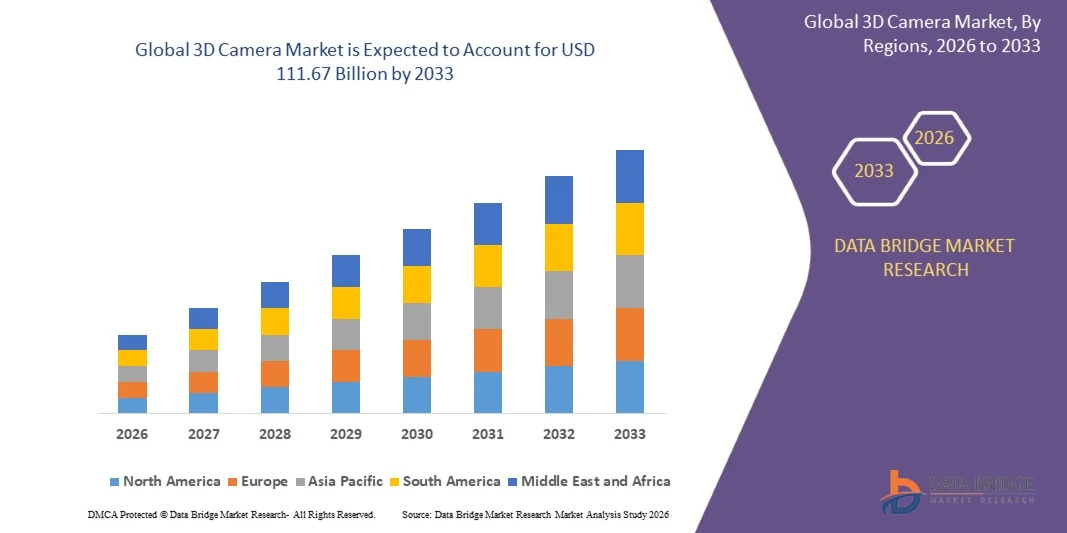
- As per Data Bridge Market Research analysis, the 3D camera market was valued at USD 39.98 billion in 2025 and is projected to reach USD 111.67 billion by 2033, growing at a CAGR of 13.70% from 2026 to 2033.
- The market is experiencing rapid growth driven by rising demand for depth sensing in smartphones, increasing adoption of robotics and automation, and expanding use of 3D imaging in automotive, healthcare, and security applications.
- The increasing shift toward immersive content, facial recognition, and autonomous machines, combined with growing integration of depth sensors, artificial intelligence, and edge processors, is supporting market adoption. 3D cameras are being applied across phones, laptops, robots, vehicles, and medical devices, offering manufacturers greater accuracy in capturing space through 3D imaging, 3D sensors, and 3D machine vision systems.
Market Size & Forecast
- Global Market Value (2025): USD 39.98 Billion
- Expected Market Value (2033): USD 111.67 Billion
- Forecast CAGR (2026–2033): 13.70%
- Leading Region in 2025: Asia-Pacific
- Fastest Growing Region: Asia-Pacific
What are the Major Takeaways of the 3D Camera Market?
- Asia-Pacific dominated the 3D camera market with the largest revenue share of 38.40% in 2025, supported by large smartphone and consumer electronics production, rapid robotics deployment, and strong domestic sensor and camera manufacturers.
- Asia-Pacific is also expected to be the fastest-growing region at a CAGR of 15.60% from 2026 to 2033, fueled by robotics investment, rising smartphone and automotive adoption, and expanding smart manufacturing.
- The target-free camera segment led the market with a 57.30% share in 2025, driven by ease of use, faster setup, and wide adoption in consumer and professional devices.
- Target cameras are the fastest-growing type, projected to register a CAGR of 14.60%, reflecting rising demand for high-precision measurement and scanning in industrial and medical uses.
- The stereo vision segment dominated the technology category with a 41.80% revenue share in 2025, led by low cost, passive sensing, and strong performance in outdoor and robotics use.
- Smartphones & tablets accounted for 43.60% of the market share in 2025, preferred for face unlock, augmented reality, and computational photography.
- The robotics & industrial systems segment is the fastest-growing application, with a CAGR of 17.80%, driven by humanoids, autonomous mobile robots, and automated inspection.
Report Scope and 3D Camera Market Segmentation
|
Attributes |
3D Camera Key Market Insights |
|
Segments Covered |
|
|
Countries Covered |
North America
Europe
Asia-Pacific
Middle East and Africa
South America
|
|
Key Market Players |
|
|
Market Opportunities |
|
|
Value Added Data Infosets |
In addition to the insights on market scenarios such as market value, growth rate, segmentation, geographical coverage, and major players, the market reports curated by the Data Bridge Market Research also include in-depth expert analysis, pricing analysis, brand share analysis, consumer survey, demography analysis, supply chain analysis, value chain analysis, raw material/consumables overview, vendor selection criteria, PESTLE Analysis, Porter Analysis, and regulatory framework. |
What is the Key Trend in the 3D Camera Market?
- 3D cameras are increasingly evolving from simple depth sensors into intelligent perception platforms, combining stereo or time-of-flight sensing, on-device AI, and software tools that let machines see, map, and act in real time.
- For instance, in October 2025, RealSense announced a strategic collaboration with NVIDIA to integrate its depth cameras with Jetson Thor, Isaac Sim, and Holoscan Sensor Bridge, accelerating the use of 3D perception in humanoids and autonomous mobile robots and helping developers move faster from prototype to production
- In July 2026, Basler AG introduced its Stereo mini 3D stereo camera system for mobile robots, warehouse drones, and industrial automation, focusing on compact design, reliable depth capture, and cost-effective machine vision integration.
- Edge AI is moving into the camera itself, as manufacturers add dedicated processors for neural networks, enabling real-time telemetry, obstacle detection, and customizable vision pipelines without sending data to the cloud.
- Developers are increasingly offering complete perception stacks, as buyers compare cameras on depth accuracy, range, frame rate, power use, and software support across robotics, access control, and consumer products.
- For instance, in July 2025, according to The Robot Report, RealSense launched the D555 PoE depth camera and a new in-house chip delivering 5 TOPS of on-board AI compute, unlocking edge processing, real-time telemetry, and customizable vision pipelines for robot makers and other device developers
- As physical AI, robotics, biometrics, and smartphone innovation continue to advance, 3D cameras are expected to expand beyond imaging into navigation, manipulation, authentication, and spatial computing.
What are the Key Drivers of the 3D Camera Market?
- The rapid growth of robotics, autonomous machines, and augmented reality has significantly increased demand for 3D cameras that deliver accurate depth information in real time.
- For instance, in September 2026, according to Cognex, the company agreed to acquire RealSense for USD 500 million to enter robotic perception, noting that RealSense is expected to generate USD 80 million to USD 90 million in 2026 revenue, more than 50% growth over the prior year.
- Smartphone makers, robot builders, automotive suppliers, hospitals, and security providers are adopting 3D cameras to enable face authentication, navigation, measurement, and inspection with higher accuracy than 2D cameras can provide.
- In March 2026, Teledyne e2v launched the Perciva 5D camera, combining 2D and 3D imaging with on-device AI processing to support industrial inspection, retail automation, and robotic vision applications.
- With investors, large technology firms, and industrial automation leaders backing depth-sensing companies, 3D cameras can gain wider visibility, qualification, and repeat orders across robotics, consumer electronics, and industrial applications.
What Factors Are Challenging the Growth of the 3D Camera Market?
- 3D cameras face cost and performance challenges, as high-precision industrial models are expensive and depth accuracy can suffer in bright sunlight, reflective surfaces, and low-texture scenes.
- These costs can limit adoption among small manufacturers and price-sensitive consumer markets, while integration complexity and data processing requirements may slow deployment in some applications. Supply chain constraints for specialized optics and sensors can also affect delivery times and pricing.
- Privacy concerns around facial recognition, evolving data protection rules, and the lack of common standards for depth data further restrict growth, requiring vendors to invest in secure processing, compliance, and interoperability that may increase development costs.
- In March 2026, Basler AG partnered with Orbbec to develop the Basler Stereo mini 3D camera for logistics and factory automation, including applications involving autonomous mobile robots and automated material handling.
- The combination of high sensor costs, environmental performance limits, privacy regulation, and intense competition can constrain adoption among cost-sensitive buyers and smaller vendors, particularly where existing two-dimensional cameras already meet basic needs.
How is the 3D Camera Market Segmented?
The 3D camera market is segmented on the basis of type, technology, application, and end-use industry.
- By Type
On the basis of type, the 3D camera market is segmented into target-free camera and target camera. The target-free camera segment dominated the market with 57.30% share in 2025, supported by ease of use, faster setup, and wide adoption in consumer and professional devices. These cameras capture depth without markers or reference targets, which suits phones, laptops, and robots. They are available in compact modules at falling prices. Integration with common software tools simplifies development. Strong demand from consumer electronics and robotics continues to strengthen the segment’s leadership. Open software support and reference designs also reduce engineering time for device makers adopting these cameras.
The target camera segment is projected to register the fastest growth at a CAGR of 14.60% from 2026 to 2033, driven by increasing demand for high-precision measurement and scanning in industrial and medical uses. Target-based systems use reference markers to reach high accuracy in metrology, reverse engineering, and surgical navigation. Manufacturers use them for quality control and digital twin creation. Growing adoption of 3D printing and virtual production supports demand. Software advances are improving automation and ease of use. Rising use in digital twins, dental scanning, and heritage documentation is also creating new demand for precise scanning systems.
- By Technology
On the basis of technology, the 3D camera market is segmented into stereo vision, time-of-flight, and structured light. The stereo vision segment dominated the market with 41.80% share in 2025, supported by low cost, passive sensing, and strong performance in outdoor and robotics use. Two lenses capture images from different positions to calculate depth, similar to human vision. The approach works over long ranges and in ambient light. Mature algorithms and wide component availability reduce costs. Continuous improvement in on-device processing further strengthens its leadership. Dense depth maps, global shutter sensors, and high dynamic range improve reliability in complex scenes and varied lighting.
The time-of-flight segment is projected to register the fastest growth at a CAGR of 15.20% from 2026 to 2033, driven by rising use in smartphones, robots, and automotive cabin sensing. Time-of-flight sensors measure the time light takes to return from objects, providing fast and accurate depth maps. Compact modules suit mobile devices and wearables. Improved resolution and lower power use are expanding applications. Better performance in low light and moving scenes supports adoption. Suppliers are also developing indirect and direct time-of-flight designs for longer ranges and higher resolution.
- By Application
On the basis of application, the 3D camera market is segmented into smartphones & tablets, professional cameras, computers, and robotics & industrial systems. The smartphones & tablets segment dominated the application category with 43.60% share in 2025, supported by face unlock, augmented reality, and computational photography. Large production volumes make this the largest consumer of depth sensors. Phone makers continue to add features such as portrait effects and 3D scanning. Established supply chains and strong demand for premium devices continue to reinforce this segment's leadership. Growing interest in spatial video, 3D avatars, and gesture control also keeps feature development active among device makers.
The robotics & industrial systems segment is projected to register the fastest growth at a CAGR of 17.80% from 2026 to 2033, driven by humanoids, autonomous mobile robots, and automated inspection. 3D cameras give robots the ability to detect obstacles, grasp objects, and navigate. Warehouse and factory automation are increasing orders. Partnerships between camera makers and robotics platform providers are accelerating development. Reliability, safety, and total cost remain key considerations for adoption. Developers are also investing in simulation tools that train robots with synthetic depth data before deployment in real facilities.
- By End-Use Industry
On the basis of end-use industry, the 3D camera market is segmented into consumer electronics, automotive, healthcare, industrial & robotics, security & surveillance, and others. The consumer electronics segment dominated the end-use category with 46.20% share in 2025, supported by smartphones, tablets, laptops, gaming devices, and virtual reality headsets. Manufacturers use depth sensing to improve security and user experience. High production volumes and fast product cycles keep demand strong. Established supplier relationships continue to reinforce this segment's leadership. Gaming consoles, smart TVs, and wearable headsets are also adding cameras for motion tracking, expanding the addressable device base.
The automotive segment is projected to register the fastest growth at a CAGR of 15.40% from 2026 to 2033, driven by driver monitoring, in-cabin sensing, and advanced driver assistance. 3D cameras detect driver attention, occupant position, and gestures. Safety regulations and consumer demand for comfort features support adoption. Combination with radar and lidar improves perception. Reliability under temperature and vibration remains an important requirement. Insurance incentives and new vehicle assessment programs are also encouraging wider use of occupant and driver monitoring technology.
Which Region Holds the Largest Share of the 3D Camera Market?
- Asia-Pacific dominated the 3D camera market with the largest revenue share of 38.40% in 2025, supported by large smartphone and consumer electronics production, rapid robotics deployment, and strong domestic sensor and camera manufacturers.
- The region also benefits from a dense electronics supply chain, strong demand for smartphones and consumer devices, and a growing base of robotics and sensor manufacturers. Increasing investment in automation and smart factories continues to strengthen Asia-Pacific’s position in the global market. Strong government support for semiconductor and robotics industries also encourages local development and production.
Japan 3D Camera Market Insight
The Japan 3D camera market is witnessing consistent growth due to strong image sensor expertise, advanced robotics, and high demand for precision imaging. Electronics makers, automotive suppliers, and medical device firms are increasingly adopting depth sensing. Moreover, strong demand for quality, miniaturization, and innovation in sensing technology is further contributing to market growth in Japan. Close cooperation between sensor makers, device manufacturers, and universities also supports rapid innovation.
China 3D Camera Market Insight
The China 3D camera market is growing rapidly, driven by large smartphone manufacturing, a booming robotics industry, and strong investment in artificial intelligence. Growing production of humanoid and service robots is significantly boosting market demand. In addition, strong domestic camera makers, government support for intelligent manufacturing, and falling component costs are positioning China as a key growth market across Asia-Pacific. Large pilot projects in logistics, retail, and manufacturing also help camera makers scale production and test new designs.
Europe 3D Camera Market Insight
The Europe 3D camera market is growing as manufacturers increasingly adopt advanced imaging, machine vision, and automation technologies. Demand is driven by automotive manufacturing, robotics, quality inspection, healthcare imaging, and consumer electronics. Germany, the U.K., and France represent important markets due to their established industrial and technology sectors. Time-of-flight, structured-light, and stereoscopic imaging technologies are expanding application capabilities. Rising investments in Industry 4.0, smart factories, and automated inspection systems are expected to create further growth opportunities.
U.K. 3D Camera Market Insight
The U.K. 3D camera market is experiencing steady growth, supported by strong robotics research, active start-ups, and demand for imaging in healthcare and security. Universities, automation firms, and creative industries are increasingly adopting 3D capture. Furthermore, strong innovation funding, film and gaming sectors, and growing use in logistics are supporting wider adoption of 3D cameras in the U.K. Active collaboration between universities and companies also helps move 3D research into commercial products.
Germany 3D Camera Market Insight
The Germany 3D camera market is expanding steadily due to the country’s strong industrial automation sector, leading machine vision companies, and demand from the automotive industry. Manufacturers, system integrators, and research institutes are increasingly utilizing 3D cameras for inspection and robot guidance. Continuous innovation in sensors, high quality standards, and Germany’s focus on precision manufacturing are further driving market growth in the country. Strong exports of machine vision systems also support demand for high-quality sensors and camera modules.
Which are the Top Companies in 3D Camera Market?
The 3D camera industry is primarily led by well-established companies, including:
- Sony Group Corporation (Japan)
- RealSense, Inc. (U.S.)
- Orbbec Inc. (China)
- Cognex Corporation (U.S.)
- Basler AG (Germany)
- Samsung Electronics Co., Ltd. (South Korea)
- Apple Inc. (U.S.)
- Microsoft Corporation (U.S.)
- STMicroelectronics N.V. (Switzerland)
- Infineon Technologies AG (Germany)
- OmniVision Technologies, Inc. (U.S.)
- Teledyne Technologies Incorporated (U.S.)
- Zivid AS (Norway)
- Stereolabs (France)
- Luxonis Holding Corporation (U.S.)
- Photoneo s.r.o. (Slovakia)
- SICK AG (Germany)
- ifm electronic gmbh (Germany)
- Hikrobot Co., Ltd. (China)
- LUCID Vision Labs, Inc. (Canada)
What are Latest Developments in 3D Camera Market?
- In September 2026, Cognex announced a definitive agreement to acquire RealSense for approximately USD 500 million in cash, adding 3D depth sensing and robotic perception to its machine vision portfolio. The transaction is expected to close in the fourth quarter of 2026 and positions Cognex in humanoids, autonomous mobile robots, and physical AI.
- In June 2026, RealSense unveiled the D585 Pro depth camera and Perception Studio software at Automate 2026, expanding its AI-native vision offering for robotics. The launch reflects the shift toward cameras that combine depth sensing, on-device AI, and developer tools for industrial and mobile robots. The product expands the company’s range for fixed arm robots, autonomous mobile robots, and humanoid platforms.
- In March 2026, Basler AG partnered with Orbbec to develop the Basler Stereo mini 3D camera for logistics and factory automation, including applications involving autonomous mobile robots and automated material handling.
- In March 2026, IDS Imaging Development Systems began series production of its Nion 3D time-of-flight camera, featuring 1.2-megapixel resolution, integrated depth processing, and stable imaging for robotics, logistics, and industrial automation.
- In October 2025, RealSense announced a strategic collaboration with NVIDIA to integrate its depth cameras with Jetson Thor, Isaac Sim, and Holoscan Sensor Bridge. The collaboration is designed to give humanoid and autonomous mobile robot developers high-fidelity sensor data and faster paths from prototype to production. The work also builds on the company’s growing developer community and its focus on edge AI computing.
- In May 2025, Photoneo launched the MotionCam-3D Color (Blue), designed for high-speed 3D scanning of moving objects and improved reconstruction of transparent, reflective, and metallic surfaces in industrial automation.
- In March 2025, LUCID Vision Labs announced that its Helios2 Narrow 3D time-of-flight camera had entered series production, offering focused illumination and improved depth accuracy for industrial inspection and space-constrained applications.

- Interactive Data Analysis Dashboard
- Company Analysis Dashboard for high growth potential opportunities
- Research Analyst Access for customization & queries
- Competitor Analysis with Interactive dashboard
- Latest News, Updates & Trend analysis
- Harness the Power of Benchmark Analysis for Comprehensive Competitor Tracking
Data collection and base year analysis are done using data collection modules with large sample sizes. The stage includes obtaining market information or related data through various sources and strategies. It includes examining and planning all the data acquired from the past in advance. It likewise envelops the examination of information inconsistencies seen across different information sources. The market data is analysed and estimated using market statistical and coherent models. Also, market share analysis and key trend analysis are the major success factors in the market report. To know more, please request an analyst call or drop down your inquiry.
The key research methodology used by DBMR research team is data triangulation which involves data mining, analysis of the impact of data variables on the market and primary (industry expert) validation. Data models include Vendor Positioning Grid, Market Time Line Analysis, Market Overview and Guide, Company Positioning Grid, Patent Analysis, Pricing Analysis, Company Market Share Analysis, Standards of Measurement, Global versus Regional and Vendor Share Analysis. To know more about the research methodology, drop in an inquiry to speak to our industry experts.
Data Bridge Market Research is a leader in advanced formative research. We take pride in servicing our existing and new customers with data and analysis that match and suits their goal. The report can be customized to include price trend analysis of target brands understanding the market for additional countries (ask for the list of countries), clinical trial results data, literature review, refurbished market and product base analysis. Market analysis of target competitors can be analyzed from technology-based analysis to market portfolio strategies. We can add as many competitors that you require data about in the format and data style you are looking for. Our team of analysts can also provide you data in crude raw excel files pivot tables (Fact book) or can assist you in creating presentations from the data sets available in the report.