


3D Collaborative Design Platforms Market Overview
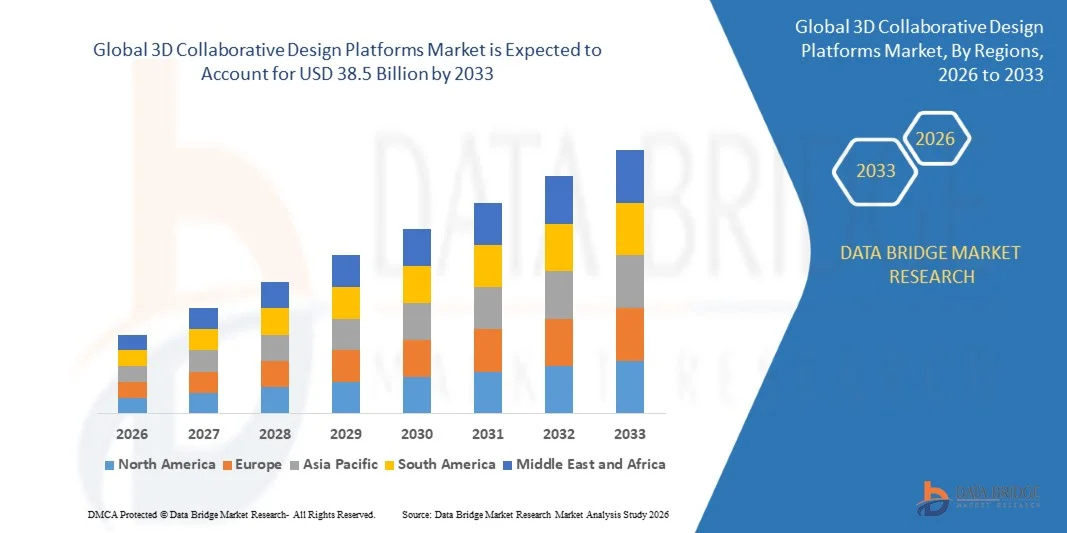
The 3D Collaborative Design Platforms Market was valued at USD 6.9 billion in 2025 and is projected to reach USD 38.5 billion by 2033, growing at a CAGR of 23.1% from 2026 to 2033. The market is witnessing strong expansion driven by the rapid shift toward cloud-based engineering ecosystems, increasing adoption of digital twin technologies, and growing demand for real-time multi-user collaboration in product design and development workflows.
The increasing complexity of industrial products, combined with globalized supply chains, is accelerating the need for integrated 3D design environments that enable engineers, designers, and manufacturers to collaborate in real time. These platforms are replacing traditional siloed CAD systems by offering cloud-enabled, simulation-integrated, and AI-enhanced design environments that reduce development cycles and improve innovation efficiency.
Key Market Trends & Insights
- North America dominated the global market with the largest revenue share of 34.62% in 2025, driven by strong adoption of advanced CAD/PLM ecosystems and early integration of cloud-based engineering platforms.
- Software Platforms held the largest component share of 68.14% in 2025 due to widespread adoption of cloud-native CAD, simulation, and collaborative design tools across industries.
- Asia-Pacific is expected to be the fastest-growing region at a CAGR of 7.4% from 2026 to 2033, supported by rapid industrialization, manufacturing expansion, and increasing adoption of digital engineering tools in China, India, and Japan.
- The Services segment is expected to be the fastest-growing component in the 3D Collaborative Design Platforms Market, registering a CAGR of 25.1% (2026–2033).
- Growth is driven by rising demand for implementation, integration, consulting, and managed services during cloud migration.
- By Deployment Mode, the Cloud-based (SaaS) segment dominated the 3D Collaborative Design Platforms Market, accounting for a share of 57.3% in 2025, driven by its scalability, remote accessibility, and lower infrastructure requirements.
- By Deployment Mode, the Cloud-based (SaaS) segment is also the fastest-growing, projected to register a CAGR of 24.6% (2026–2033) due to rapid enterprise cloud migration and increasing demand for real-time global design collaboration.
- By Organization Size, the Large Enterprises segment dominates the market with a share of around 64.3% in 2025, supported by strong investments in advanced digital engineering platforms and integrated product development ecosystems.
- By Organization Size, the Small & Medium Enterprises (SMEs) segment is the fastest-growing, expected to expand at a CAGR of 26.0% (2026–2033) as affordable SaaS-based solutions enable wider access to advanced 3D collaborative design tools.
Market Size & Forecast
- Global Market Value (2025): USD 6.9 Billion
- Expected Market Value (2033): USD 38.5 Billion
- Forecast CAGR (2026–2033): 23.1%
- Leading Region in 2025: North America
- Fastest Growing Region: Asia-Pacific
Report Scope and 3D Collaborative Design Platforms Market Segmentation
|
Attributes |
3D Collaborative Design Platforms Key Market Insights |
|
Segments Covered |
|
|
Countries Covered |
North America · U.S. · Canada · Mexico Europe · Germany · France · U.K. · Netherlands · Switzerland · Belgium · Russia · Italy · Spain · Turkey · Rest of Europe Asia-Pacific · China · Japan · India · South Korea · Singapore · Malaysia · Australia · Thailand · Indonesia · Philippines · Rest of Asia-Pacific Middle East and Africa · Saudi Arabia · U.A.E. · South Africa · Egypt · Israel · Rest of Middle East and Africa South America · Brazil · Argentina · Rest of South America |
|
Key Market Players |
· Dassault Systèmes SE (France) · Siemens AG (Germany) · Autodesk Inc. (U.S.) · PTC Inc. (U.S.) · Ansys Inc. (U.S.) · Bentley Systems Inc. (U.S.) · Trimble Inc. (U.S.) · Hexagon AB (Sweden) · SAP SE (Germany) · NVIDIA Corporation (U.S.) · Altair Engineering Inc. (U.S.) · Aras Corporation (U.S.) · Arena Solutions (U.S.) · Oracle Corporation (U.S.) · Microsoft Corporation (U.S.) · IBM Corporation (U.S.) · Graebert GmbH (Germany) · Onshape (U.S.) · Fusion 360 ecosystem (Autodesk) · Siemens Digital Industries Software (Germany) · Cadence Design Systems Inc. (U.S.) |
|
Market Opportunities |
· Integration of AI-powered generative design tools in collaborative platforms · Expansion of cloud-native digital twin ecosystems across manufacturing and AEC industries · Rising adoption of immersive XR (VR/AR/MR) collaboration environments in product design workflows |
|
Value Added Data Infosets |
In addition to the market insights such as market value, growth rate, market segments, geographical coverage, market players, and market scenario, the market report curated by the Data Bridge Market Research team includes in-depth expert analysis, import/export analysis, pricing analysis, production consumption analysis, and pestle analysis. |
3D Collaborative Design Platforms Market Trends
Trend: Expansion of Cloud-Native Collaborative Engineering Ecosystems
Enterprises are rapidly transitioning from legacy desktop-based CAD systems to cloud-native 3D collaborative platforms that enable real-time co-authoring, version control, and cross-functional design integration. These platforms allow distributed engineering teams to work simultaneously on complex product models, significantly reducing design iteration cycles and improving product innovation speed. Integration with PLM and ERP systems further enhances lifecycle visibility and operational efficiency.
3D Collaborative Design Platforms Market Dynamics
Key Market Driver: Rising Adoption of Digital Twin and Connected Product Development
The increasing adoption of digital twin technology across manufacturing, automotive, aerospace, and energy sectors is significantly driving demand for 3D collaborative design platforms. These systems enable real-time synchronization between physical assets and digital models, allowing engineers to simulate, monitor, and optimize product performance throughout the lifecycle. This integration is accelerating demand for high-performance cloud-based design ecosystems with simulation and analytics capabilities.
Key Restraint/Challenge: Data Security and Interoperability Concerns
Despite strong growth, concerns around data security, intellectual property protection, and interoperability across different CAD/PLM systems remain key challenges. Enterprises operating in defense, aerospace, and high-tech manufacturing are particularly cautious about migrating sensitive design data to cloud-based platforms. Additionally, lack of standardization across design tools can lead to integration inefficiencies and workflow fragmentation.
Key Market Opportunity: AI-Driven Generative Design and Immersive Collaboration
The integration of artificial intelligence and generative design capabilities represents a major opportunity for market expansion. AI-enabled platforms can automatically generate optimized design alternatives based on performance constraints, cost targets, and material efficiency. Furthermore, immersive collaboration environments using AR/VR technologies are enabling engineers to interact with 3D models in real time, enhancing decision-making and accelerating product development cycles across industries.
3D Collaborative Design Platforms Market Scope
The 3D Collaborative Design Platforms Market is segmented on the basis of component, deployment mode, organization size, application, and end-use industry.
- By Component
On the basis of component, the 3D Collaborative Design Platforms Market is segmented into software platforms and services. The Software Platforms segment dominated the market with a share of 68.14% in 2025, owing to widespread adoption of cloud-based CAD, PLM, and simulation-integrated design environments across industries. These platforms act as the core backbone of digital engineering workflows, enabling real-time collaboration, version control, and seamless product lifecycle integration.
The Services segment is expected to register the fastest growth at a CAGR of 25.1% from 2026 to 2033, driven by rising demand for implementation, integration, consulting, training, and managed services as enterprises transition toward cloud-based collaborative ecosystems.
- By Deployment Mode
On the basis of deployment mode, the 3D Collaborative Design Platforms Market is segmented into cloud-based (SaaS) and on-premise solutions. The Cloud-based (SaaS) segment dominated the market with a share of 57.3% in 2025, due to its scalability, cost efficiency, and ability to support real-time global collaboration across distributed engineering teams.
The Cloud-based (SaaS) segment is also expected to register the fastest growth at a CAGR of 24.6% from 2026 to 2033, driven by rapid digital transformation, increasing enterprise cloud migration, and growing demand for flexible subscription-based engineering software.
- By Organization Size
On the basis of organization size, the 3D Collaborative Design Platforms Market is segmented into large enterprises and small & medium enterprises (SMEs). The Large Enterprises segment dominated the market with a share of 64.3% in 2025, supported by strong investments in advanced digital engineering ecosystems and global product development infrastructure.
The SMEs segment is expected to register the fastest growth at a CAGR of 26.0% from 2026 to 2033, driven by increasing adoption of affordable SaaS-based tools and the growing need for digital transformation in product design and engineering workflows.
- By Application
On the basis of application, the 3D Collaborative Design Platforms Market is segmented into product design & development, simulation & prototyping, engineering collaboration, digital twin development, lifecycle management integration, virtual testing & validation, and others. The Engineering Collaboration segment dominated the market with a share of 28.96% in 2025, driven by strong demand for real-time co-design capabilities across geographically distributed engineering teams.
The Digital Twin Development segment is expected to register the fastest growth at a CAGR of 7.8% from 2026 to 2033, fueled by rising adoption of Industry 4.0 technologies, smart manufacturing initiatives, and increasing need for real-time asset monitoring and predictive design optimization.
- By End-Use Industry
On the basis of end-use industry, the 3D Collaborative Design Platforms Market is segmented into aerospace & defense, automotive & transportation, manufacturing & industrial equipment, architecture, engineering & construction (AEC), consumer electronics, healthcare & medical devices, energy & utilities, and others. The Automotive & Transportation segment dominated the market with a share of 22.81% in 2025, driven by increasing adoption of digital engineering tools for EV development, autonomous vehicle design, and simulation-based validation.
The Aerospace & Defense segment is expected to register the fastest growth at a CAGR of 7.2% from 2026 to 2033, due to rising demand for highly secure, precision-driven collaborative design platforms for mission-critical systems and advanced aerospace engineering programs.
3D Collaborative Design Platforms Market Regional Analysis
North America dominated the 3D collaborative design platforms market and accounted for the largest revenue share of 34.62% in 2025, supported by strong adoption of advanced CAD/PLM ecosystems, early cloud migration, and the presence of major software vendors and industrial technology companies. The region also benefits from high investment in digital engineering, rapid integration of AI-driven design tools, and widespread adoption of digital twin technologies across automotive, aerospace, and manufacturing sectors. Increasing demand for real-time cross-functional collaboration and cloud-native engineering platforms continues to strengthen North America’s leadership position in the global market.
U.S. 3D Collaborative Design Platforms Market Insight
The U.S. market is witnessing strong growth due to rapid digital transformation across manufacturing, aerospace, automotive, and high-tech industries. Increasing adoption of cloud-based CAD/PLM platforms, generative design tools, and AI-enabled engineering workflows is driving demand. The presence of major technology providers and strong R&D investment in digital twin and simulation-driven design is further accelerating market expansion across enterprise and SME segments.
Europe 3D Collaborative Design Platforms Market Insight
Europe remains a key contributor to the global market, supported by strong industrial engineering capabilities, strict product development standards, and high adoption of digital manufacturing technologies. The region is witnessing increased use of collaborative design platforms across automotive OEMs, aerospace firms, and industrial equipment manufacturers. Growing focus on sustainability, smart manufacturing, and cross-border engineering collaboration is further boosting market adoption.
U.K. 3D Collaborative Design Platforms Market Insight
The U.K. market is experiencing steady growth driven by increasing deployment of cloud-based engineering platforms in aerospace, automotive, and construction sectors. Rising adoption of digital twin technologies, coupled with strong demand for remote collaboration tools in distributed engineering teams, is supporting market expansion. The country’s growing focus on innovation in design automation and simulation-based engineering is further strengthening adoption.
Germany 3D Collaborative Design Platforms Market Insight
Germany’s market is expanding due to its strong automotive manufacturing base and advanced industrial engineering ecosystem. High adoption of Industry 4.0 technologies, digital factory initiatives, and simulation-driven product development is driving demand for collaborative design platforms. Leading automotive and machinery manufacturers are increasingly integrating cloud-based CAD and PLM systems to improve efficiency and reduce product development cycles.
Asia-Pacific 3D Collaborative Design Platforms Market Insight
The Asia-Pacific market is expected to witness the fastest growth, driven by rapid industrialization, expanding manufacturing activities, and increasing adoption of digital engineering tools in countries such as China, India, and Japan. Rising investments in smart factories, growing demand for cloud-based design solutions, and increasing presence of global engineering centers are accelerating regional growth. Additionally, cost-effective SaaS adoption is expanding access among SMEs.
Japan 3D Collaborative Design Platforms Market Insight
Japan’s market is growing steadily due to strong adoption of advanced manufacturing technologies and precision engineering practices. Automotive and electronics manufacturers are increasingly using collaborative design platforms for product innovation, simulation, and lifecycle management. Integration of AI, robotics, and digital twin technologies is further enhancing engineering efficiency and design accuracy across industries.
China 3D Collaborative Design Platforms Market Insight
China is one of the fastest-growing markets, driven by rapid industrial expansion, strong government support for digital transformation, and increasing adoption of cloud-based engineering platforms. Growing investments in automotive R&D, consumer electronics, and industrial automation are fueling demand for collaborative design tools. The rise of domestic software ecosystems and increasing focus on smart manufacturing are further strengthening market growth.
3D Collaborative Design Platforms Market Share
The 3D collaborative design platforms industry is primarily led by well-established companies, including:
- Dassault Systèmes SE (France)
- Siemens AG (Germany)
- Autodesk Inc. (U.S.)
- PTC Inc. (U.S.)
- Ansys Inc. (U.S.)
- Bentley Systems Inc. (U.S.)
- Trimble Inc. (U.S.)
- Hexagon AB (Sweden)
- SAP SE (Germany)
- NVIDIA Corporation (U.S.)
- Altair Engineering Inc. (U.S.)
- Aras Corporation (U.S.)
- Arena Solutions (U.S.)
- Oracle Corporation (U.S.)
- Microsoft Corporation (U.S.)
- IBM Corporation (U.S.)
- Graebert GmbH (Germany)
- Onshape (U.S.)
- Fusion 360 ecosystem (Autodesk)
- Siemens Digital Industries Software (Germany)
- Cadence Design Systems Inc. (U.S.)
Latest Developments in 3D Collaborative Design Platforms Market
- In July 2025, PTC Inc. expanded its collaboration with NVIDIA by integrating NVIDIA Omniverse capabilities into its Creo and Windchill platforms, enabling real-time immersive simulation, improved digital twin workflows, and enhanced cross-functional collaboration across engineering teams. This development strengthens PTC’s position in AI-driven 3D collaborative design ecosystems and supports open standards for industrial interoperability.
- In July 2025, Siemens AG introduced major upgrades to its NX and NX X platforms, including an AI-powered design copilot, immersive mixed-reality engineering capabilities, and integrated CAD-based thermal and fluid simulation tools. These enhancements improve real-time engineering collaboration and strengthen Siemens’ cloud-based digital design ecosystem for industrial manufacturing.
- In September 2025, Autodesk Inc. expanded its Fusion and Forma platforms with new 3D generative AI foundation models and neural CAD capabilities, enabling faster concept-to-design workflows and enhanced collaborative product development across architecture, manufacturing, and construction industries. This advancement positions Autodesk strongly in AI-driven cloud design transformation.
- In September 2025, Autodesk Inc. further enhanced its Forma platform into a fully integrated AI-driven cloud ecosystem combining design, planning, construction, and operations. The platform now includes Autodesk Construction Cloud integration and advanced cost estimation tools, strengthening lifecycle-wide 3D collaboration capabilities.
- In February 2025, Dassault Systèmes SE launched its next-generation “3D UNIV+RSES” platform, integrating generative AI and virtual twin technologies into its 3DEXPERIENCE ecosystem. The upgrade enables real-time IP lifecycle management, immersive collaboration, and AI-driven design generation across industrial sectors.

- Interactive Data Analysis Dashboard
- Company Analysis Dashboard for high growth potential opportunities
- Research Analyst Access for customization & queries
- Competitor Analysis with Interactive dashboard
- Latest News, Updates & Trend analysis
- Harness the Power of Benchmark Analysis for Comprehensive Competitor Tracking
Data collection and base year analysis are done using data collection modules with large sample sizes. The stage includes obtaining market information or related data through various sources and strategies. It includes examining and planning all the data acquired from the past in advance. It likewise envelops the examination of information inconsistencies seen across different information sources. The market data is analysed and estimated using market statistical and coherent models. Also, market share analysis and key trend analysis are the major success factors in the market report. To know more, please request an analyst call or drop down your inquiry.
The key research methodology used by DBMR research team is data triangulation which involves data mining, analysis of the impact of data variables on the market and primary (industry expert) validation. Data models include Vendor Positioning Grid, Market Time Line Analysis, Market Overview and Guide, Company Positioning Grid, Patent Analysis, Pricing Analysis, Company Market Share Analysis, Standards of Measurement, Global versus Regional and Vendor Share Analysis. To know more about the research methodology, drop in an inquiry to speak to our industry experts.
Data Bridge Market Research is a leader in advanced formative research. We take pride in servicing our existing and new customers with data and analysis that match and suits their goal. The report can be customized to include price trend analysis of target brands understanding the market for additional countries (ask for the list of countries), clinical trial results data, literature review, refurbished market and product base analysis. Market analysis of target competitors can be analyzed from technology-based analysis to market portfolio strategies. We can add as many competitors that you require data about in the format and data style you are looking for. Our team of analysts can also provide you data in crude raw excel files pivot tables (Fact book) or can assist you in creating presentations from the data sets available in the report.













