


3D Computed Tomography Software Market Overview
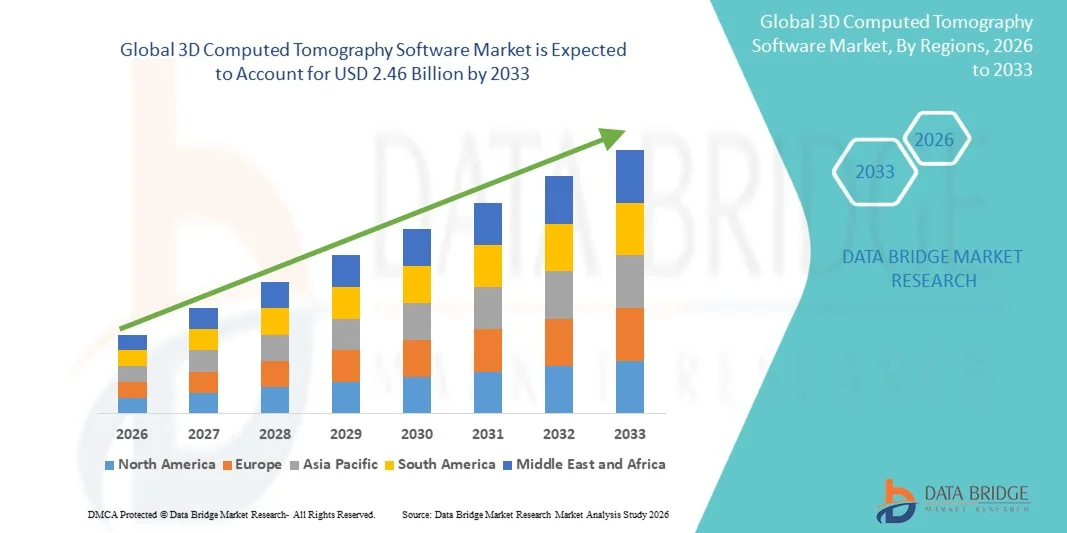
The 3D Computed Tomography Software Market was valued at USD 1.32 billion in 2025 and is projected to reach USD 2.46 billion by 2033, growing at a CAGR of 8.13% from 2026 to 2033. The Global 3D Computed Tomography (CT) Software market is experiencing steady growth driven by rising demand for advanced medical imaging solutions, increasing adoption of high-resolution diagnostic software, and expanding applications across oncology, cardiology, neurology, and orthopedic imaging. The growing need for precise 3D visualization and early disease detection is significantly enhancing the use of CT imaging software in hospitals, diagnostic centers, and research institutions.
The increasing prevalence of chronic diseases such as cancer, cardiovascular disorders, and musculoskeletal conditions, combined with a rising aging population globally, is driving higher demand for accurate and detailed diagnostic imaging. Healthcare providers are increasingly adopting 3D CT software to improve image reconstruction, enable better clinical decision-making, and support minimally invasive treatment planning. In addition, advancements in artificial intelligence (AI)-powered image processing, cloud-based imaging platforms, and real-time visualization tools are transforming diagnostic workflows, making CT analysis faster, more accurate, and more efficient.
Key Market Trends & Insights
- North America dominated the 3D Computed Tomography Software Market with the largest revenue share of 38.26% in 2025, supported by advanced healthcare IT infrastructure, high adoption of digital imaging solutions, strong presence of leading medical imaging software providers, and increasing demand for AI-powered diagnostic imaging. The region also benefits from high healthcare expenditure, widespread use of advanced CT imaging in hospitals, and strong integration of 3D visualization tools in clinical workflows.
- The Body Scanning Software segment dominated the market with a 64.2% share in 2025. This dominance is driven by strong adoption in hospitals, diagnostic centers, and imaging facilities for human anatomical analysis and disease detection.
- Asia-Pacific is expected to be the fastest-growing region at a CAGR of 8.3% from 2026 to 2033, fueled by rising healthcare investments, rapid expansion of diagnostic imaging centers, increasing burden of chronic diseases, and growing adoption of advanced CT imaging technologies across China, India, and Japan. Government initiatives improving healthcare accessibility and digital imaging infrastructure are further accelerating regional growth.
- The Research application segment is expected to register the fastest growth at a CAGR from 2026 to 2033, driven by increasing use of 3D CT software in biomedical research, drug development studies, anatomical modeling, and preclinical analysis. Rising collaboration between research institutes and medical technology companies is further boosting demand.
- The Hospital segment dominated the end-user category in revenue share in 2025, supported by high patient inflow, strong adoption of advanced imaging systems, and increasing integration of 3D CT software into hospital radiology departments. Hospitals continue to be the primary users of advanced diagnostic imaging platforms for clinical decision-making.
- Diagnostic Centers are projected to grow at a CAGR from 2026 to 2033, driven by rising demand for independent imaging services, increasing outsourcing of diagnostic procedures, and growing adoption of advanced 3D visualization software for faster and more accurate reporting.
Market Size & Forecast
- Global Market Value (2025): USD 1.32 Billion
- Expected Market Value (2033): USD 2.46 Billion
- Forecast CAGR (2026–2033): 8.13%
- Leading Region in 2025: North America
- Fastest Growing Region: Asia-Pacific
Report Scope and 3D Computed Tomography Software Market Segmentation
|
Attributes |
3D Computed Tomography Software Key Market Insights |
|
Segments Covered |
· By Types: Body Scanning Software and Animal Scanning Software · By Application: Human, Veterinary, and Research · By End User: Hospital, Diagnostic Center, Research, and Veterinary Clinic |
|
Countries Covered |
North America · U.S. · Canada · Mexico Europe · Germany · France · U.K. · Netherlands · Switzerland · Belgium · Russia · Italy · Spain · Turkey · Rest of Europe Asia-Pacific · China · Japan · India · South Korea · Singapore · Malaysia · Australia · Thailand · Indonesia · Philippines · Rest of Asia-Pacific Middle East and Africa · Saudi Arabia · U.A.E. · South Africa · Egypt · Israel · Rest of Middle East and Africa South America · Brazil · Argentina · Rest of South America |
|
Key Market Players |
• Siemens Healthineers (Germany) |
|
Market Opportunities |
· Expansion of AI-Powered Image Reconstruction and Diagnostic Automation · Rising Demand for Advanced 3D Visualization in Oncology and Chronic Disease Diagnosis · Growth of Cloud-Based Imaging Platforms and Integrated Healthcare IT Systems |
|
Value Added Data Infosets |
In addition to the insights on market scenarios such as market value, growth rate, segmentation, geographical coverage, and major players, the market reports curated by the Data Bridge Market Research also include in-depth expert analysis, geographically represented company-wise production and capacity, network layouts of distributors and partners, detailed and updated price trend analysis and deficit analysis of supply chain and demand. |
3D Computed Tomography Software Market Trends
Trend: Increasing Adoption of AI-Integrated 3D CT Imaging for Precision Diagnostics
Healthcare providers are increasingly adopting AI-powered 3D computed tomography software to enhance diagnostic accuracy, improve lesion detection, and enable faster clinical decision-making. These solutions are widely used in oncology, cardiology, neurology, and orthopedics to reconstruct high-resolution 3D anatomical models from CT scan data.
For instance, hospitals across the U.S. and Europe are integrating AI-assisted imaging platforms that reduce radiology reporting time by 20–35%, improving workflow efficiency in high-volume diagnostic centers. The growing shift toward precision medicine and early disease detection is significantly accelerating adoption of advanced 3D visualization software in clinical environments.
3D Computed Tomography Software Market Dynamics
Key Market Driver: Rising Demand for Advanced Diagnostic Imaging and Early Disease Detection The increasing global burden of chronic diseases such as cancer, cardiovascular disorders, and neurological conditions is driving demand for advanced imaging technologies, including 3D CT software. These systems enable radiologists to visualize complex anatomical structures, detect abnormalities at earlier stages, and improve treatment planning accuracy.
For instance, lung cancer remains one of the leading causes of cancer-related mortality globally, accounting for over 2 million new cases annually, which is driving strong demand for high-resolution CT imaging and 3D reconstruction software. Hospitals are increasingly investing in advanced imaging platforms that integrate CT data with AI-based diagnostic tools to improve clinical outcomes and reduce diagnostic errors.
Key Restraint/Challenge: High Cost of Advanced Imaging Infrastructure and Skilled Workforce Shortage
A major challenge in the global 3D CT software market is the high cost associated with advanced imaging systems, software integration, and IT infrastructure upgrades. Hospitals and diagnostic centers must invest in high-performance computing systems, PACS integration, and AI-enabled imaging tools, which significantly increases capital expenditure.
In addition, there is a shortage of skilled radiologists and imaging specialists capable of interpreting advanced 3D CT datasets, particularly in emerging economies. This skills gap limits the full utilization of advanced imaging software and slows adoption in cost-sensitive healthcare systems.
Key Market Opportunity: Integration of AI, Cloud-Based Imaging, and Remote Diagnostics
The integration of artificial intelligence, cloud computing, and remote imaging platforms presents a major growth opportunity for the 3D CT software market. Cloud-based radiology systems allow real-time sharing of 3D imaging data between hospitals, specialists, and diagnostic centers, improving access to expert interpretation.
For instance, teleradiology adoption has increased significantly, with some healthcare systems reporting 30–50% of imaging workloads being reviewed remotely in high-demand regions. AI-enabled cloud imaging platforms are also being used to support automated anomaly detection, improving efficiency in rural and underserved healthcare areas. In addition, increasing investment in digital healthcare infrastructure across Asia-Pacific and the Middle East is expanding access to advanced CT imaging solutions, supporting long-term market growth.
3D Computed Tomography Software Market Scope
The 3D Computed Tomography Software market is segmented on the basis of Types, Application, and End User.
- By Types
On the basis of types, the 3D Computed Tomography Software Market is segmented into Body Scanning Software and Animal Scanning Software. The Body Scanning Software segment dominated the market with a 64.2% share in 2025. This dominance is driven by strong adoption in hospitals, diagnostic centers, and imaging facilities for human anatomical analysis and disease detection. Increasing demand for early diagnosis of cancer, orthopedic, and cardiovascular disorders is significantly supporting growth. The segment benefits from widespread integration with AI-based reconstruction tools and advanced visualization systems. Growing prevalence of chronic diseases is further accelerating demand globally. Expanding healthcare infrastructure and digital imaging adoption are strengthening market penetration. High clinical accuracy and regulatory acceptance are further supporting adoption in developed markets. Increasing use in surgical planning and trauma assessment is boosting utilization. Strong reimbursement policies in developed economies are reinforcing market dominance.
The Animal Scanning Software segment is expected to be the fastest growing with a CAGR of 7.4% from 2026 to 2033. Growth is driven by rising pet healthcare expenditure and increasing adoption of veterinary diagnostic imaging. Expanding livestock health monitoring programs are further supporting demand. Increasing use in veterinary surgery planning and disease detection is boosting adoption. Growing application in preclinical and academic research is accelerating usage. Rising awareness of animal health diagnostics is supporting market expansion. Technological advancements in imaging software automation are improving efficiency. Increasing veterinary clinic infrastructure in emerging markets is driving penetration. Expanding research into animal disease modeling is further supporting growth. Strong demand from pharmaceutical and biotechnology research is also contributing to expansion.
- By Application
On the basis of application, the 3D Computed Tomography Software Market is segmented into Human, Veterinary, and Research applications. The Human segment dominated the market with a 58.6% share in 2025. This is attributed to high usage in hospitals and diagnostic centers for disease detection and treatment planning. Rising prevalence of chronic diseases such as cardiovascular, neurological, and musculoskeletal disorders is driving demand. Integration with hospital information systems and PACS is improving workflow efficiency. Increasing use of AI-enabled diagnostic imaging is enhancing clinical accuracy. Growing adoption of precision medicine is supporting advanced imaging requirements. Government healthcare investments are further strengthening infrastructure. Rising demand for early diagnosis and preventive healthcare is boosting utilization. Expanding hospital networks globally are reinforcing segment dominance.
The Research segment is expected to be the fastest growing with a CAGR of 7.6% from 2026 to 2033. Growth is driven by increasing use in biomedical imaging and drug discovery applications. Expanding pharmaceutical and biotechnology research investments are supporting adoption. Rising focus on preclinical studies and experimental imaging is boosting demand. Academic institutions are increasingly integrating 3D CT software for advanced research. Growing applications in molecular and anatomical studies are accelerating usage. Increasing government funding for life sciences research is further supporting expansion. AI-based imaging analysis tools are improving research efficiency. Rising demand for personalized medicine research is driving adoption. Expanding use in disease modeling and simulation studies is further contributing to growth.
- By End User
On the basis of end user, the 3D Computed Tomography Software Market is segmented into Hospitals, Diagnostic Centers, Research Institutes, and Veterinary Clinics. The Hospital segment dominated the market with a 41.8% share in 2025. This is due to high patient inflow and widespread adoption of advanced imaging technologies. Hospitals are increasingly using 3D CT software for emergency diagnosis and surgical planning. Integration with AI-powered imaging systems is improving diagnostic speed and accuracy. Expansion of hospital digital infrastructure is supporting adoption. Government healthcare modernization programs are boosting deployment. Increasing burden of chronic diseases is driving imaging demand. Strong reimbursement systems are supporting usage in developed countries. Hospitals remain the primary point of care for advanced diagnostics globally.
The Veterinary Clinics segment is expected to be the fastest growing with a CAGR of 7.8% from 2026 to 2033. Growth is driven by rising pet ownership and increasing spending on animal healthcare. Expanding veterinary diagnostic infrastructure is supporting adoption. Increasing use of advanced imaging in animal surgery planning is boosting demand. Growing awareness of veterinary preventive care is accelerating usage. Expansion of specialized veterinary hospitals is further supporting growth. Rising livestock disease monitoring programs are contributing to demand. Increasing adoption in rural veterinary care facilities is expanding reach. Technological advancements in veterinary imaging software are improving efficiency. Growing integration with digital veterinary systems is further accelerating adoption.
3D Computed Tomography Software Market Regional Analysis
North America dominated the 3D Computed Tomography Software Market and accounted for the largest revenue share of 38.26% in 2025, supported by advanced healthcare IT infrastructure, high adoption of digital imaging solutions, strong presence of leading medical imaging software providers, and increasing demand for AI-powered diagnostic imaging. The region benefits from high healthcare expenditure, widespread availability of advanced CT imaging systems in hospitals and diagnostic centers, and strong integration of 3D visualization tools in clinical workflows. Rising prevalence of chronic diseases such as cancer, cardiovascular disorders, and neurological conditions continues to drive demand for advanced diagnostic imaging solutions across the region.
U.S. 3D Computed Tomography Software Market Insight
The U.S. 3D Computed Tomography Software market is witnessing strong growth due to rising incidence of chronic diseases, increasing demand for early and accurate diagnosis, and rapid adoption of AI-enabled medical imaging solutions. The country’s advanced healthcare ecosystem, strong presence of medical imaging software developers, and widespread deployment of CT imaging in hospitals and diagnostic centers are driving market expansion. In addition, growing focus on precision medicine and value-based healthcare is accelerating adoption of advanced 3D CT visualization tools in clinical decision-making.
Europe 3D Computed Tomography Software Market Insight
The Europe 3D Computed Tomography Software market remains a major contributor to global revenue, driven by strong public healthcare systems, increasing healthcare digitalization, and rising demand for advanced diagnostic imaging solutions. The region benefits from high adoption of CT imaging in oncology, cardiology, and neurology applications. Increasing investments in hospital digital infrastructure and integration of AI-based imaging tools are further enhancing diagnostic accuracy and workflow efficiency across healthcare facilities.
U.K. 3D Computed Tomography Software Market Insight
The U.K. 3D Computed Tomography Software market is experiencing steady growth, supported by modernization of the National Health Service (NHS), increasing adoption of digital radiology systems, and growing demand for faster diagnostic turnaround times. Hospitals and diagnostic centers are increasingly integrating 3D CT visualization tools to improve reporting accuracy and reduce radiology workload. Rising focus on early disease detection and imaging-driven clinical pathways is further supporting market growth.
Germany 3D Computed Tomography Software Market Insight
The Germany 3D Computed Tomography Software market is expanding steadily due to strong healthcare infrastructure, advanced diagnostic capabilities, and increasing use of imaging technologies in hospital-based care. The country’s emphasis on precision diagnostics, combined with high adoption of CT imaging in oncology and orthopedic applications, is driving market growth. Continuous upgrades in hospital imaging systems and integration of AI-assisted diagnostic tools are further strengthening adoption.
Asia-Pacific 3D Computed Tomography Software Market Insight
The Asia-Pacific 3D Computed Tomography Software market is expected to witness rapid growth, driven by rising healthcare investments, expanding diagnostic imaging infrastructure, and increasing burden of chronic diseases. Countries such as China, India, and Japan are significantly investing in hospital modernization and advanced imaging technologies. Government initiatives aimed at improving healthcare access and strengthening diagnostic capabilities are further accelerating regional market expansion.
Japan 3D Computed Tomography Software Market Insight
The Japan 3D Computed Tomography Software market is witnessing consistent growth due to its aging population, high prevalence of chronic diseases, and strong healthcare technology adoption. Hospitals and diagnostic centers are increasingly deploying advanced CT imaging systems integrated with 3D visualization software for improved diagnostic accuracy. The country’s focus on early disease detection and advanced medical imaging innovation is further supporting market growth.
China 3D Computed Tomography Software Market Insight
The China 3D Computed Tomography Software market is growing rapidly due to expanding healthcare infrastructure, increasing diagnostic imaging demand, and rising prevalence of chronic diseases. Government healthcare reforms, expansion of hospital networks, and growing adoption of AI-based imaging solutions are significantly supporting market development. Increased investment in medical technology and digital healthcare systems is positioning China as a key growth market globally.
3D Computed Tomography Software Market Share
The 3D Computed Tomography Software industry is primarily led by well-established companies, including:
- Siemens Healthineers (Germany)
- GE HealthCare (U.S.)
- Koninklijke Philips N.V. (Netherlands)
- Canon Medical Systems Corporation (Japan)
- FUJIFILM Holdings Corporation (Japan)
- Carestream Health (U.S.)
- Agfa-Gevaert Group (Belgium)
- Terarecon, Inc. (U.S.)
- Vital Images (Canon Medical subsidiary) (U.S.)
- Synopsys (U.S.)
- Brainlab AG (Germany)
- Ziosoft Inc. (Japan/U.S.)
- Toshiba Medical Systems (now Canon Medical) (Japan)
- Quibim (Spain)
- Median Technologies (France)
- Sectra AB (Sweden)
- Visage Imaging (Pro Medicus) (Australia)
- MIM Software Inc. (U.S.)
- Riverain Technologies (U.S.)
- ContextVision AB (Sweden)
Latest Developments in 3D Computed Tomography Software Market
- In July 2021, GE HealthCare announced the integration of artificial intelligence capabilities from Spectronic Medical into its imaging software ecosystem. This development enhanced 3D medical imaging workflows by improving automated image reconstruction and analysis capabilities, supporting radiologists in faster and more accurate interpretation of CT datasets, particularly in oncology and cardiology applications
- In June 2021, Materialise released an updated version of its Mimics Innovation Suite (Version 24.0), expanding advanced 3D medical image processing capabilities for CT and MRI datasets. The upgraded platform enhanced segmentation accuracy, anatomical modeling, and 3D reconstruction workflows used in hospitals, research institutes, and surgical planning applications, strengthening its position in the global 3D CT visualization software market
- In October 2021, Synopsys updated its Simpleware ScanIP software (S-2021.06 release), improving 3D CT image segmentation, modeling, and simulation integration capabilities. The update enhanced medical and scientific CT data processing workflows, enabling more precise conversion of CT scan data into 3D computational models used in biomedical research, material science, and engineering applications
- In February 2023, GE HealthCare completed its spin-off from General Electric and became an independent company, strengthening its focus on AI-powered imaging and advanced diagnostic software solutions. This strategic move accelerated investments in digital imaging platforms, including 3D CT reconstruction, cloud-based imaging workflows, and AI-assisted diagnostic tools, improving scalability and innovation in medical imaging software solutions
- In October 2022, GE HealthCare launched the Omni Legend digital PET/CT system with advanced imaging software capabilities for enhanced diagnostic precision. The system incorporated advanced reconstruction and visualization software, improving image clarity, workflow efficiency, and AI-assisted interpretation in oncology and cardiovascular diagnostics
- In March 2024, research advancements in CT-RATE and CT-CLIP AI foundation models demonstrated the growing role of deep learning in 3D CT imaging software development. These AI-driven models enabled large-scale analysis of 3D CT datasets for multi-abnormality detection and automated radiology reporting, significantly improving diagnostic accuracy and reducing interpretation time in clinical environments.

- Interactive Data Analysis Dashboard
- Company Analysis Dashboard for high growth potential opportunities
- Research Analyst Access for customization & queries
- Competitor Analysis with Interactive dashboard
- Latest News, Updates & Trend analysis
- Harness the Power of Benchmark Analysis for Comprehensive Competitor Tracking
Data collection and base year analysis are done using data collection modules with large sample sizes. The stage includes obtaining market information or related data through various sources and strategies. It includes examining and planning all the data acquired from the past in advance. It likewise envelops the examination of information inconsistencies seen across different information sources. The market data is analysed and estimated using market statistical and coherent models. Also, market share analysis and key trend analysis are the major success factors in the market report. To know more, please request an analyst call or drop down your inquiry.
The key research methodology used by DBMR research team is data triangulation which involves data mining, analysis of the impact of data variables on the market and primary (industry expert) validation. Data models include Vendor Positioning Grid, Market Time Line Analysis, Market Overview and Guide, Company Positioning Grid, Patent Analysis, Pricing Analysis, Company Market Share Analysis, Standards of Measurement, Global versus Regional and Vendor Share Analysis. To know more about the research methodology, drop in an inquiry to speak to our industry experts.
Data Bridge Market Research is a leader in advanced formative research. We take pride in servicing our existing and new customers with data and analysis that match and suits their goal. The report can be customized to include price trend analysis of target brands understanding the market for additional countries (ask for the list of countries), clinical trial results data, literature review, refurbished market and product base analysis. Market analysis of target competitors can be analyzed from technology-based analysis to market portfolio strategies. We can add as many competitors that you require data about in the format and data style you are looking for. Our team of analysts can also provide you data in crude raw excel files pivot tables (Fact book) or can assist you in creating presentations from the data sets available in the report.













