


3D Motion Capture Market Size
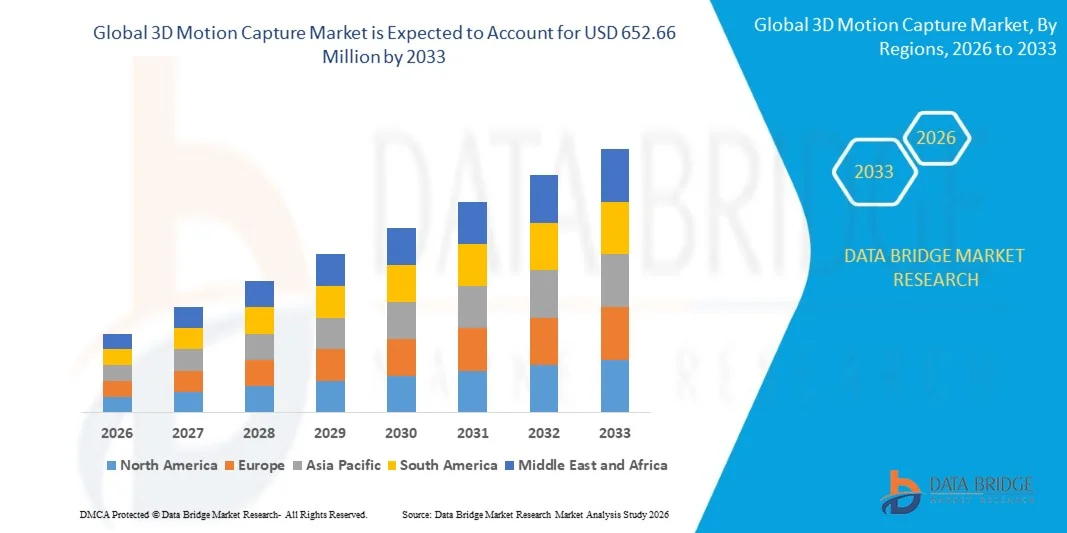
- The global 3D motion capture market size was valued at USD 276.56 million in 2025 and is expected to reach USD 652.66 million by 2033, at a CAGR of 11.33% during the forecast period
- The market growth is largely fueled by the rising adoption of advanced animation, simulation, and virtual production technologies across media, entertainment, gaming, healthcare, and industrial sectors, leading to increased demand for high-precision motion tracking solutions
- Furthermore, continuous technological advancements in optical, inertial, and markerless motion capture systems are enhancing accuracy, reducing latency, and improving real-time data processing capabilities. These converging factors are significantly accelerating the adoption of 3D motion capture systems across diverse end-use industries, thereby boosting overall market growth
3D Motion Capture Market Analysis
- 3D motion capture systems, which digitally record and analyze human movement using optical sensors, inertial devices, and software-based tracking solutions, are becoming essential tools in modern content creation, biomechanics research, and engineering simulation due to their ability to deliver highly accurate motion data and improve production efficiency
- The increasing demand for realistic digital content, coupled with expanding applications in medical rehabilitation, sports performance analysis, and virtual training environments, is further driving the adoption of 3D motion capture technologies across both commercial and research-driven industries
- North America dominated the 3D motion capture market with a share of 50.33% in 2025, due to strong adoption across media and entertainment, gaming, and advanced healthcare research applications
- Asia-Pacific is expected to be the fastest growing region in the 3D motion capture market during the forecast period due to rapid expansion of gaming, animation, and digital content industries in countries such as China, Japan, and India
- Optical 3D motion capture systems segment dominated the market with a market share of 71.74% in 2025, due to its high precision tracking capability and widespread adoption in film production and gaming industries. These systems rely on camera-based tracking that delivers highly accurate motion data, making them preferred for complex animation and visual effects workflows
Report Scope and 3D Motion Capture Market Segmentation
|
Attributes |
3D Motion Capture Key Market Insights |
|
Segments Covered |
|
|
Countries Covered |
North America · U.S. · Canada · Mexico Europe · Germany · France · U.K. · Netherlands · Switzerland · Belgium · Russia · Italy · Spain · Turkey · Rest of Europe Asia-Pacific · China · Japan · India · South Korea · Singapore · Malaysia · Australia · Thailand · Indonesia · Philippines · Rest of Asia-Pacific Middle East and Africa · Saudi Arabia · U.A.E. · South Africa · Egypt · Israel · Rest of Middle East and Africa South America · Brazil · Argentina · Rest of South America |
|
Key Market Players |
· Vicon Motion Systems Ltd. (U.K.) · Xsens (Netherlands) · NaturalPoint, Inc. (U.S.) · Phasespace (U.S.) · Noraxon USA. (U.S.) · Polhemus. (U.S.) · Simi Reality Motion Systems GmbH (Germany) · Rokoko Electronics (Denmark) · C-Motion, Inc. (U.S.) · Motek Entertainment (Netherlands) · Noitom Ltd. (China) · CyberGlove Systems Inc. (U.S.) · Dynamixyz. (France) · Qualisys AB (Sweden) · Motus Digital, LLC (U.S.) |
|
Market Opportunities |
· Expansion in Healthcare Rehabilitation and Sports Performance Analytics · Growth in Virtual Production and Metaverse Content Creation |
|
Value Added Data Infosets |
In addition to the insights on market scenarios such as market value, growth rate, segmentation, geographical coverage, and major players, the market reports curated by the Data Bridge Market Research also include in-depth expert analysis, geographically represented company-wise production and capacity, network layouts of distributors and partners, detailed and updated price trend analysis and deficit analysis of supply chain and demand. |
3D Motion Capture Market Trends
“Increasing Real-Time Markerless Motion Capture Adoption”
- A key trend in the 3D motion capture market is the rapid shift toward real-time markerless motion capture systems that eliminate the need for physical markers and allow faster production workflows across entertainment, sports, and virtual production environments. This transition is being driven by advancements in computer vision and AI-based pose estimation technologies that improve accuracy while reducing setup complexity
- For instance, Move.ai and DeepMotion provide markerless motion capture platforms that enable real-time animation capture using standard camera setups, which are increasingly used in game development pipelines and virtual production studios. These solutions are helping studios reduce dependency on traditional suit-based systems while maintaining high motion fidelity for digital characters
- The integration of motion capture technologies in gaming and film production pipelines is expanding as studios adopt real-time animation tools to accelerate content creation and improve character realism. Major production houses such as Industrial Light & Magic and Weta FX utilize advanced systems from providers such as Vicon and OptiTrack to deliver high-precision performance capture for blockbuster visual effects and character animation
- Biomechanics and sports performance analysis are increasingly adopting motion capture systems for gait analysis, injury prevention, and athletic performance optimization. Research institutions such as Stanford Human Performance Lab and clinical motion analysis centers use systems from Qualisys and Motion Analysis Corporation to generate accurate movement datasets for medical and sports science applications
- Cloud-based motion capture processing and AI-assisted animation reconstruction are gaining traction as studios shift toward remote and distributed production environments. Companies such as NVIDIA with Omniverse and Autodesk MotionBuilder ecosystems are enabling faster processing of motion data and seamless collaboration across global production teams
- The market is also witnessing growing convergence between motion capture and virtual reality environments where real-time avatar mapping and immersive simulations are becoming more common. This is strengthening demand for scalable, low-latency capture systems capable of supporting interactive digital experiences across gaming, simulation, and training applications
3D Motion Capture Market Dynamics
Driver
“Rising Demand from Gaming, Film, and Biomechanics Applications”
- The increasing demand for high-fidelity animation and realistic character movement in gaming, film production, and biomechanics research is driving the adoption of 3D motion capture technologies across multiple industries. These systems enable precise tracking of human motion and translation into digital environments, improving realism and production efficiency
- For instance, Epic Games integrates motion capture data into Unreal Engine workflows to support real-time character animation in game development and virtual production stages. Studios such as Sony Interactive Entertainment and Sony Santa Monica Studio rely on Vicon systems for performance capture in major titles that require detailed facial and body movement replication
- The film industry continues to expand its use of motion capture for creating lifelike digital characters and enhancing visual effects in high-budget productions. Companies such as Weta FX and Industrial Light & Magic use advanced optical and inertial motion capture systems to support complex character animation sequences in major cinematic franchises
- Biomechanics and healthcare research are increasingly dependent on motion capture systems for clinical motion analysis, rehabilitation monitoring, and prosthetics development. Organizations such as Mayo Clinic and university-based gait laboratories use Qualisys and Motion Analysis Corporation systems to study human movement patterns and improve medical treatment outcomes
- The continuous expansion of digital media production and interactive technologies is strengthening this driver by increasing reliance on accurate motion data for animation, simulation, and analysis workflows. This sustained demand across entertainment and scientific domains is positioning motion capture as a core enabling technology
Restraint/Challenge
“High System Cost and Complex Setup”
- The 3D motion capture market faces significant challenges due to the high cost of advanced motion capture systems and the complexity involved in deploying multi-camera and sensor-based setups. These systems require specialized hardware, controlled environments, and skilled operators, which increases overall implementation barriers for smaller studios and institutions
- For instance, Vicon motion capture systems and OptiTrack setups require extensive calibration processes and multi-camera synchronization to achieve high accuracy, making installation time-intensive and expensive for production environments. Similarly, Xsens inertial motion capture suits involve high-end wearable sensor integration that adds to acquisition and maintenance costs
- The requirement for dedicated studio spaces with controlled lighting and calibrated tracking environments further increases infrastructure investment needs. This limits adoption among independent developers and small research facilities that may lack the financial resources to build full-scale motion capture studios
- Processing large volumes of motion data also demands high-performance computing systems and specialized software pipelines, which add additional operational costs. These requirements increase dependency on advanced technical expertise for data cleaning, reconstruction, and animation integration workflows
- The combination of high capital expenditure and technical complexity continues to restrict broader accessibility of motion capture technology across emerging markets. This cost-intensive nature of deployment remains a key barrier to widespread adoption despite increasing demand for real-time and high-accuracy motion capture solutions
3D Motion Capture Market Scope
The market is segmented on the basis of system, type, and application.
- By System
On the basis of system, the 3D Motion Capture market is segmented into optical 3D motion capture systems and non-optical 3D motion capture systems. The optical 3D motion capture systems segment dominated the market with the largest revenue share of 71.74% in 2025, driven by its high precision tracking capability and widespread adoption in film production and gaming industries. These systems rely on camera-based tracking that delivers highly accurate motion data, making them preferred for complex animation and visual effects workflows. The strong demand from media and entertainment studios supports continued dominance due to superior realism in motion reconstruction. Integration with advanced rendering pipelines and real-time processing further strengthens its adoption. The segment remains central to high-budget production environments requiring detailed motion accuracy.
The non-optical 3D motion capture systems segment is anticipated to witness the fastest growth rate from 2026 to 2033, driven by increasing demand for portable and markerless motion tracking solutions. These systems use inertial sensors and electromagnetic tracking, reducing dependency on controlled studio environments. For instance, companies such as Xsens are advancing wearable inertial motion capture solutions for sports analytics and biomechanics research. The flexibility of deployment in outdoor and real-world environments supports broader adoption across healthcare and industrial applications. Reduced setup complexity and lower operational constraints contribute to rising preference. Growth is further supported by advancements in AI-based motion reconstruction techniques.
- By Type
On the basis of type, the 3D Motion Capture market is segmented into hardware, software, and services. The hardware segment dominated the market with the largest revenue share in 2025, driven by strong demand for cameras, sensors, suits, and tracking devices essential for motion capture setups. High investment in professional-grade equipment by studios and research institutions supports this dominance. The need for precise data acquisition systems in animation and biomechanical analysis reinforces hardware adoption. Continuous innovation in sensor accuracy and miniaturization enhances system performance. Expansion of virtual production studios further strengthens hardware demand across global markets.
The software segment is anticipated to witness the fastest growth rate from 2026 to 2033, driven by increasing adoption of AI-powered motion analysis, animation tools, and real-time processing platforms. Software solutions enable enhanced data interpretation, reducing dependency on complex hardware calibration. For instance, companies such as Vicon are integrating advanced software platforms for real-time motion visualization and editing. Rising demand for cloud-based motion capture processing supports scalability and remote collaboration. Increasing use of simulation-based training in medical and engineering fields further accelerates growth. Continuous improvements in algorithm efficiency enhance motion reconstruction accuracy and usability.
- By Application
On the basis of application, the 3D Motion Capture market is segmented into media and entertainment, biomechanical research and medical, engineering, design, industrial applications, education, and others. The media and entertainment segment dominated the market with the largest revenue share in 2025, driven by extensive use in film production, gaming, and animation studios. High demand for realistic character animation and visual effects supports strong adoption of motion capture technologies. Large-scale production houses rely on motion capture to reduce animation time and improve visual realism. Integration with virtual production environments further strengthens its dominance. Expanding gaming content development continues to reinforce segment leadership.
The biomechanical research and medical segment is anticipated to witness the fastest growth rate from 2026 to 2033, driven by increasing use of motion capture in rehabilitation, gait analysis, and surgical training. These systems enable precise human movement analysis for clinical diagnosis and treatment planning. For instance, companies such as Qualisys provide motion capture solutions used in orthopedic research and sports injury assessment. Rising focus on personalized rehabilitation programs supports wider adoption in healthcare institutions. Growing investment in medical simulation technologies further accelerates usage. Advancements in markerless tracking improve accessibility in clinical environments.
3D Motion Capture Market Regional Analysis
- North America dominated the 3D motion capture market with the largest revenue share of 50.33% in 2025, driven by strong adoption across media and entertainment, gaming, and advanced healthcare research applications
- The region benefits from early integration of motion capture technologies in film production and virtual content creation. Consumers and enterprises in the region highly value high-precision animation, real-time motion tracking, and advanced simulation capabilities enabled by these systems
- Strong presence of leading technology providers and research institutions further strengthens market adoption. Increasing investment in virtual production studios and sports analytics also supports sustained demand across commercial and academic use cases
U.S. 3D Motion Capture Market Insight
The U.S. 3D motion capture market captured the largest revenue share in North America in 2025, driven by rapid expansion of Hollywood production, gaming studios, and biomechanics research facilities. The country shows strong adoption of advanced motion capture systems for visual effects, character animation, and performance analysis. Demand is further supported by integration of motion capture in sports performance tracking and rehabilitation programs. Strong R&D capabilities and early adoption of AI-based motion analysis tools continue to enhance market growth. Increasing collaboration between entertainment studios and technology providers is accelerating innovation in real-time motion capture workflows.
Europe 3D Motion Capture Market Insight
The Europe 3D motion capture market is projected to expand at a steady CAGR during the forecast period, driven by increasing adoption in film production, engineering design, and medical research applications. The region benefits from strong demand for high-quality animation and simulation technologies across multiple industries. European users value precision-driven motion tracking solutions for both industrial and healthcare applications. Rising investment in digital content creation and virtual training environments further supports market expansion. Growth is also supported by increasing use of motion capture in academic research and rehabilitation programs.
U.K. 3D Motion Capture Market Insight
The U.K. 3D motion capture market is expected to grow at a notable CAGR during the forecast period, driven by strong presence of film production studios, gaming companies, and academic research institutions. The country demonstrates increasing use of motion capture in visual effects production and character animation. Demand is further supported by adoption in sports science and biomechanical analysis applications. The U.K.’s strong creative industry ecosystem continues to encourage technological integration in digital content creation. Expanding investment in immersive media and virtual production environments further supports market growth.
Germany 3D Motion Capture Market Insight
The Germany 3D motion capture market is anticipated to expand at a considerable CAGR during the forecast period, driven by rising adoption in engineering design, industrial simulation, and healthcare applications. The country’s strong focus on precision engineering supports the use of motion capture in product design and testing environments. Increasing demand for advanced biomechanical research tools also contributes to market growth. Germany’s emphasis on innovation and industrial automation encourages integration of motion tracking technologies. Growing use in academic and research institutions further strengthens market adoption.
Asia-Pacific 3D Motion Capture Market Insight
The Asia-Pacific 3D motion capture market is poised to grow at the fastest CAGR from 2026 to 2033, driven by rapid expansion of gaming, animation, and digital content industries in countries such as China, Japan, and India. Increasing urbanization and rising investment in entertainment technologies are accelerating adoption of motion capture systems. The region is also witnessing growing use in healthcare, education, and industrial training applications. Expanding digital infrastructure and affordability of advanced motion capture solutions support wider market penetration. Strong manufacturing capabilities for hardware components further enhance regional growth momentum.
Japan 3D Motion Capture Market Insight
The Japan 3D motion capture market is gaining momentum due to strong technological advancement, high adoption of robotics, and growing demand for animation and gaming content. The country shows increasing use of motion capture in film production, character animation, and healthcare rehabilitation systems. Demand is further driven by integration with robotics and human movement analysis technologies. Japan’s aging population is also supporting adoption in medical and physical therapy applications. Strong focus on precision and automation continues to support market expansion across industries.
China 3D Motion Capture Market Insight
The China 3D motion capture market accounted for the largest revenue share in Asia-Pacific in 2025, driven by rapid growth in gaming, animation, and smart entertainment industries. Strong investments in digital media production and virtual content creation are supporting market expansion. The country benefits from large-scale adoption in education, industrial simulation, and sports analytics applications. Increasing development of smart cities and digital infrastructure is further driving demand. Availability of cost-effective motion capture solutions from domestic manufacturers is also accelerating widespread adoption.
3D Motion Capture Market Share
The 3D motion capture industry is primarily led by well-established companies, including:
- Vicon Motion Systems Ltd. (U.K.)
- Xsens (Netherlands)
- NaturalPoint, Inc. (U.S.)
- Phasespace (U.S.)
- Noraxon USA. (U.S.)
- Polhemus. (U.S.)
- Simi Reality Motion Systems GmbH (Germany)
- Rokoko Electronics (Denmark)
- C-Motion, Inc. (U.S.)
- Motek Entertainment (Netherlands)
- Noitom Ltd. (China)
- CyberGlove Systems Inc. (U.S.)
- Dynamixyz. (France)
- Qualisys AB (Sweden)
- Motus Digital, LLC (U.S.)
Latest Developments in Global 3D Motion Capture Market
- In January 2026, Vicon partnered with Amazon Web Services to introduce a cloud-native motion capture processing stack, significantly reducing skeletal-animation render time by nearly 60% for distributed production teams. This advancement is expected to accelerate remote collaboration in virtual production pipelines, enabling studios to process large motion datasets in real time without heavy on-premises infrastructure. It strengthens the shift toward cloud-based post-production workflows in film, gaming, and simulation industries. The development also lowers latency in global studio coordination, improving efficiency in multi-location projects. Overall, it reinforces cloud adoption as a core enabler of scalable motion capture ecosystems
- In December 2025, Xsens received U.S. FDA 510(k) clearance for MVN Analyze Pro as a Class II medical device, enabling its use in clinical gait analysis and rehabilitation programs with potential Medicare reimbursement support. This milestone is expected to expand motion capture adoption in healthcare by improving accessibility in diagnostic and therapeutic applications. Hospitals and research institutions can now integrate validated inertial motion tracking into standard clinical workflows. The approval also strengthens confidence in wearable motion capture systems for regulated medical environments. It is likely to drive increased investment in biomechanics-focused motion analytics solutions
- In November 2025, Sony allocated USD 120 million to expand its Culver City motion capture facility with 64 Vicon Vantage V16 cameras to support advanced virtual production pipelines. This expansion enhances high-fidelity character capture capabilities for large-scale film and television production. It is expected to improve production efficiency by enabling real-time rendering and reduced post-production timelines. The investment also reflects growing demand for immersive content creation in entertainment studios. It further positions motion capture as a core infrastructure component in next-generation filmmaking ecosystems
- In October 2025, Qualisys launched a subscription-based motion capture service offering eight-camera systems at USD 3,500 per month, targeting academic laboratories and independent production houses. This model reduces the upfront capital barrier traditionally associated with motion capture technology adoption. It is expected to significantly expand access among smaller institutions and emerging content creators. The subscription approach supports broader use in education, biomechanics research, and experimental media projects. It also indicates a shift toward service-based monetization models in the motion capture industry
- In September 2025, Epic Games expanded its Unreal Engine ecosystem through enhanced integration with major motion capture vendors, enabling near real-time streaming of captured motion data into virtual production environments. This development improves synchronization between capture hardware and rendering engines, reducing latency in animation workflows. It is expected to accelerate adoption of real-time production techniques in gaming and film industries. The integration also enhances creative flexibility for developers by enabling instant visualization of character motion. Overall, it strengthens the convergence of game engines and motion capture technologies in immersive content creation pipelines

- Interactive Data Analysis Dashboard
- Company Analysis Dashboard for high growth potential opportunities
- Research Analyst Access for customization & queries
- Competitor Analysis with Interactive dashboard
- Latest News, Updates & Trend analysis
- Harness the Power of Benchmark Analysis for Comprehensive Competitor Tracking
Global 3d Motion Capture Market, Supply Chain Analysis and Ecosystem Framework
To support market growth and help clients navigate the impact of geopolitical shifts, DBMR has integrated in-depth supply chain analysis into its Global 3d Motion Capture Market research reports. This addition empowers clients to respond effectively to global changes affecting their industries. The supply chain analysis section includes detailed insights such as Global 3d Motion Capture Market consumption and production by country, price trend analysis, the impact of tariffs and geopolitical developments, and import and export trends by country and HSN code. It also highlights major suppliers with data on production capacity and company profiles, as well as key importers and exporters. In addition to research, DBMR offers specialized supply chain consulting services backed by over a decade of experience, providing solutions like supplier discovery, supplier risk assessment, price trend analysis, impact evaluation of inflation and trade route changes, and comprehensive market trend analysis.
Data collection and base year analysis are done using data collection modules with large sample sizes. The stage includes obtaining market information or related data through various sources and strategies. It includes examining and planning all the data acquired from the past in advance. It likewise envelops the examination of information inconsistencies seen across different information sources. The market data is analysed and estimated using market statistical and coherent models. Also, market share analysis and key trend analysis are the major success factors in the market report. To know more, please request an analyst call or drop down your inquiry.
The key research methodology used by DBMR research team is data triangulation which involves data mining, analysis of the impact of data variables on the market and primary (industry expert) validation. Data models include Vendor Positioning Grid, Market Time Line Analysis, Market Overview and Guide, Company Positioning Grid, Patent Analysis, Pricing Analysis, Company Market Share Analysis, Standards of Measurement, Global versus Regional and Vendor Share Analysis. To know more about the research methodology, drop in an inquiry to speak to our industry experts.
Data Bridge Market Research is a leader in advanced formative research. We take pride in servicing our existing and new customers with data and analysis that match and suits their goal. The report can be customized to include price trend analysis of target brands understanding the market for additional countries (ask for the list of countries), clinical trial results data, literature review, refurbished market and product base analysis. Market analysis of target competitors can be analyzed from technology-based analysis to market portfolio strategies. We can add as many competitors that you require data about in the format and data style you are looking for. Our team of analysts can also provide you data in crude raw excel files pivot tables (Fact book) or can assist you in creating presentations from the data sets available in the report.













