


What is the 3D NAND Flash Memory Market Size and Growth Rate?
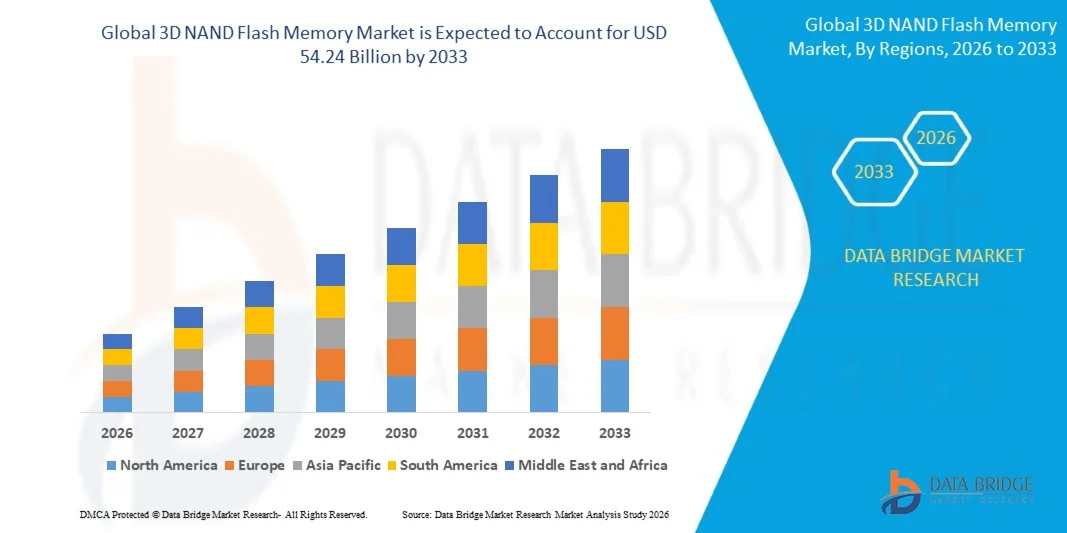
- As per Data Bridge Market Research Analysis the global 3D NAND flash memory market was valued at USD 30.1 billion in 2025 and is projected to reach USD 54.24 billion by 2033, growing at a CAGR of 21.70% from 2026 to 2033.
- The market is witnessing growth driven by increasing demand for high-capacity data storage, rising adoption of smartphones and consumer electronics, growing data-center infrastructure, and increasing requirements for high-performance and energy-efficient memory solutions. 3D NAND Flash Memory is widely used in smartphones, solid-state drives (SSDs), laptops, tablets, enterprise storage systems, and data centers, supporting its continued adoption across consumer and commercial applications.
- Increasing adoption of cloud computing, artificial intelligence, machine learning, and data-intensive applications is creating further growth opportunities. The expansion of hyperscale data centers, rising demand for enterprise SSDs, increasing storage requirements, and advancements in NAND layer technology are supporting market development across consumer electronics, automotive, enterprise storage, and data-center applications.
Market Size & Forecast
- Market Value (2025): USD 30.1 billion
- Expected Market Value (2033): USD 54.24 Million
- Forecast CAGR (2026–2033): 21.70%
- Leading Region in 2025: Asia-Pacific
- Fastest Growing Region: Asia-Pacific
What are the Major Takeaways of the 3D NAND Flash Memory Market?
- Asia pacific dominated the global 3D NAND flash memory market with share of 23.13% in 2025, supported by the strong presence of major semiconductor manufacturers, extensive NAND fabrication capacity, and high demand for smartphones, SSDS, laptops, data centers, and other electronic devices. The region includes major 3d NAND manufacturing hubs such as South Korea, Japan, China, And Taiwan.
- Asia pacific is expected to witness strong growth in the global 3D NAND flash memory market during the forecast period with CAGR of 5.35%, supported by expanding semiconductor manufacturing capacity, increasing data-center investments, rising ai workloads, and growing demand for high-capacity storage solutions. The concentration of leading NAND manufacturers and supporting semiconductor ecosystems is further contributing to regional market development.
- Triple-level cell (TLC) represented the leading cell-type segment of the global 3D NAND flash memory market with share of 54.23% in 2025, supported by its balance of storage density, performance, and cost, along with widespread adoption in smartphones, SSDS, laptops, and other consumer and enterprise storage applications. Current NAND-market data also identifies TLC as the leading cell type.
- Solid-state drive (SSD) represented a major application segment of the global 3D NAND flash memory market with share of 23.13% in 2025, supported by increasing demand for high-speed, compact, and energy-efficient storage across consumer electronics, enterprise systems, cloud infrastructure, and data centers. Enterprise SSD applications are also showing strong growth as organizations expand flash-based storage infrastructure.
- Consumer electronics represented a leading end-user segment of the global 3D NAND flash memory market with share of 32.12% in 2025, supported by increasing adoption of smartphones, tablets, laptops, gaming devices, and other connected electronics requiring high-capacity and high-performance storage. Growing adoption of ai-enabled devices and high-resolution multimedia applications is further supporting demand.
Report Scope 3D NAND Flash Memory Market Segmentation
|
Attributes |
3D NAND Flash Memory Market Key Market Insights |
|
Segments Covered |
|
|
Countries Covered |
North America
Europe
Asia-Pacific
Middle East and Africa
South America
|
|
Key Market Players |
|
|
Market Opportunities |
|
|
Value Added Data Infosets |
In addition to the insights on market scenarios such as market value, growth rate, segmentation, geographical coverage, and major players, the market reports curated by the Data Bridge Market Research also include in-depth expert analysis, geographically represented company-wise production and capacity, network layouts of distributors and partners, detailed and updated price trend analysis and deficit analysis of supply chain and demand. |
What is the Key Trend in the 3D NAND Flash Memory Market?
- Increasing adoption of high-layer 3D NAND technology for AI and enterprise storage is emerging as a key trend in the market. NAND manufacturers are increasingly increasing the number of vertically stacked memory layers while adopting TLC and QLC architectures to deliver higher storage density, improved cost efficiency, and greater capacity within a smaller footprint. This development is particularly relevant to AI data centers and enterprise SSDs, where large volumes of data must be stored and accessed efficiently. The shift toward higher-layer 3D NAND is also supporting the development of high-capacity SSD solutions designed for AI training, inference, cloud computing, and hyperscale data-center applications.
- For instance, on August 4, 2026, Samsung Electronics unveiled its V10 BV-NAND technology at Future of Memory and Storage (FMS) 2026, featuring more than 400 layers and wafer-bonding technology. Samsung stated that the architecture increases memory density by 58% compared with its previous V9 generation while improving performance and power efficiency. The company positioned the technology for high-capacity NAND applications supporting future AI systems and data-center infrastructure.
- The company described the technology as the world's first implementation exceeding 300 layers using QLC, highlighting the industry's movement toward higher-layer structures and greater storage density. The product was developed with applications including high-capacity SSDs and AI and data-center storage in mind.
- This trend is expected to remain important as AI workloads increase demand for high-capacity enterprise SSDs. TrendForce reported that strong AI-server demand contributed to a substantial increase in NAND Flash supplier revenue in 1Q 2026, while products featuring 200 or more layers were expected to become mainstream by the end of 2026.
What are the Key Drivers of the 3D NAND Flash Memory Market?
- The 3D NAND Flash Memory market is experiencing a shift toward higher-layer, high-density NAND architectures to address the growing storage requirements of AI training, inference, cloud computing, and hyperscale data centers. Manufacturers are increasing NAND layer counts while improving bit density, data-transfer speeds, power efficiency, and reliability.
- This development is enabling higher-capacity enterprise SSDs while helping data centers manage increasing data volumes and power constraints. Samsung’s latest V-NAND developments illustrate this trend, with the company focusing on higher-density architectures and AI-optimized storage solutions.
- For instance, on July 8, 2026, Samsung Electronics announced mass production of its PM1763 enterprise SSD, based on 9th-generation V-NAND and designed for next-generation AI and high-performance computing servers. The SSD is available in capacities up to 16 TB and uses PCIe 6.0 technology, demonstrating the increasing integration of advanced 3D NAND into AI-focused enterprise storage infrastructure.
- The incorporates more than 400 word lines and delivers more than 58% higher bit density than the previous generation, alongside improved I/O performance and power efficiency. The technology is being developed for high-capacity storage applications, including 128 TB SSDs and next-generation PCIe Gen7 SSDs.
Which Factors are Challenging the Growth of the 3D NAND Flash Memory Market?
- The increasing number of NAND layers is creating challenges related to manufacturing complexity, process control, yield management, and capital expenditure. As manufacturers move toward higher-layer architectures, maintaining performance, reliability, and production yields becomes more difficult.
- Physical and architectural scaling limitations are also emerging as important technical constraints for further increasing storage density and energy efficiency.
- Fluctuations in NAND Flash demand and production capacity can place pressure on pricing and manufacturers' margins.
- For instance, on March 21, 2025, Reuters reported that Micron's outlook was affected by oversupply and falling prices in the consumer NAND Flash market, with high inventories and weaker end-market demand contributing to margin pressure.
- Transitioning to higher-layer 3D NAND technologies requires substantial investment in fabrication equipment, process development, and production infrastructure.
- At the same time, manufacturers must manage older-node capacity while migrating toward advanced architectures, creating additional cost and utilization pressures. Industry reports in 2025 indicated that Samsung, SK hynix, Kioxia, SanDisk, and Micron were adjusting NAND production in response to changing supply-demand conditions.
How is the 3D NAND Flash Memory Market Segmented?
The market is segmented on the basis of type, application, and end use.
- By Type
On the basis of type, the global 3D NAND flash memory market is segmented into Single-level Cell, Multi-level Cell, and Triple-level Cell. The Triple-level Cell (TLC) segment is expected to dominate the market with market share of 43.13% in 2025, supported by its high storage density, cost efficiency, and widespread adoption across consumer storage applications. TLC technology stores three bits per memory cell, enabling manufacturers to provide higher-capacity storage at a lower cost per gigabyte, making it suitable for smartphones, tablets, laptops, PCs, and solid-state storage solutions.
The Multi-level Cell (MLC) segment is expected to witness significant demand with CAGR of 5.43% in 2026 to 2033, supported by its balance between storage capacity, performance, endurance, and cost. MLC 3D NAND is used across laptops, PCs, enterprise storage, and other applications where higher endurance and performance are required compared with TLC.
- By Application
On the basis of application, the global 3D NAND flash memory market is segmented into Camera, Laptops & PCs, and Smartphones & Tablets. The Smartphones & Tablets segment represents a significant application area with market share of 23.13%, supported by increasing demand for higher storage capacities, faster data access, and compact memory solutions in mobile devices. The growing use of high-resolution cameras, multimedia applications, artificial intelligence features, and data-intensive mobile applications is further supporting demand for 3D NAND flash memory.
The Laptops & PCs segment is also expected to witness strong growth forecast period of 3.24% of 2026 to 2033, as solid-state storage continues to replace traditional hard disk drives and users demand faster boot times, improved application performance, and higher storage capacities.
- By End Use
On the basis of end use, the global 3D NAND flash memory market is segmented into Automotive, Consumer Electronics, Enterprise, and Healthcare. The Consumer Electronics segment is expected to account for a major share of 32.13% in 2025, driven by widespread adoption of 3D NAND in smartphones, tablets, laptops, PCs, cameras, gaming systems, and other connected devices. The increasing requirement for high-capacity and energy-efficient storage is supporting its adoption across consumer electronics.
The Enterprise segment is expected to register substantial growth as data centers and enterprise storage systems increasingly deploy high-capacity solid-state storage for cloud computing forecast period of 6.12% of 2026 to 2033, artificial intelligence, analytics, and other data-intensive workloads. Healthcare applications are also adopting 3D NAND for medical imaging, diagnostic equipment, and digital data storage, while automotive applications are expanding with connected vehicles, infotainment, ADAS, and in-vehicle data storage.
Which Region Holds the Largest Share of the 3D NAND Flash Memory Market?
- Asia Pacific dominated the global 3D NAND flash memory market share 23.13% in 2025, supported by the region's concentration of leading 3D NAND manufacturing capacity, particularly across South Korea, Japan, and China. Samsung Electronics and SK hynix in South Korea, Kioxia and Sandisk in Japan, and YMTC in China have strengthened the region's position through advanced NAND fabrication, increasing layer counts, and capacity expansion.
- Asia Pacific is expected to witness the fastest growth in the global 3D NAND flash memory market during the forecast period CAGR of 5.35% in 2026 to 2033, driven by continued investment in advanced 3D NAND fabrication, increasing adoption of high-capacity SSDs, and rising storage requirements from AI and data-intensive applications.
U.S. 3D NAND Flash Memory Market Insight
The U.S. 3D NAND Flash Memory Market is supported by strong demand for high-capacity storage across data centers, enterprise computing, consumer electronics, and advanced automotive systems. Increasing investments in artificial intelligence, cloud computing, and hyperscale data-center infrastructure are driving demand for high-performance SSDs and advanced NAND storage. The presence of major technology companies and semiconductor ecosystem participants is further supporting market development. Growing adoption of AI-enabled applications, data-intensive workloads, and connected devices is expected to increase requirements for faster, higher-density, and energy-efficient 3D NAND Flash Memory solutions.
Europe 3D NAND Flash Memory Market Insight
Europe’s 3D NAND Flash Memory Market is supported by increasing demand for high-capacity storage across automotive, enterprise, healthcare, and industrial applications. Growing adoption of electric and connected vehicles is increasing the need for reliable onboard data storage, while expanding cloud computing, edge computing, and data-center infrastructure is supporting demand for enterprise SSDs. Countries such as Germany, the U.K., France, and the Netherlands are contributing through advanced automotive manufacturing, digital infrastructure, and industrial technology adoption. Increasing use of AI-driven applications and data-intensive workloads is further creating opportunities for advanced 3D NAND-based storage solutions.
U.K. 3D NAND Flash Memory Market Insight
The U.K. 3D NAND Flash Memory Market is supported by increasing demand for high-capacity and high-performance data storage across data centers, enterprise computing, consumer electronics, and automotive applications. Growing adoption of cloud computing, artificial intelligence, and data-intensive applications is increasing demand for SSD-based storage solutions incorporating 3D NAND technology. The expansion of hyperscale and enterprise data-center infrastructure is further supporting market development. In addition, rising demand for smartphones, laptops, connected devices, and advanced automotive electronics is creating opportunities for higher-density NAND solutions with improved performance, energy efficiency, and storage capacity.
Germany 3D NAND Flash Memory Market Insight
Germany’s 3D NAND Flash Memory market is supported by the country’s strong semiconductor ecosystem, advanced automotive industry, and growing demand for high-performance storage solutions. Increasing adoption of connected vehicles, advanced driver-assistance systems, industrial automation, and smart manufacturing is generating demand for reliable, high-capacity memory. The expansion of data centers, cloud computing, artificial intelligence, and enterprise storage is further supporting 3D NAND adoption. In addition, Germany’s established electronics and industrial technology base provides opportunities for 3D NAND applications across automotive, consumer electronics, industrial systems, and healthcare equipment.
Asia-Pacific 3D NAND Flash Memory Market Insight
Asia-Pacific is a major regional market for 3D NAND Flash Memory, supported by strong semiconductor manufacturing capabilities and the presence of leading memory producers across South Korea, Japan, China, and Taiwan. Growing demand for smartphones, laptops, tablets, enterprise SSDs, and consumer electronics is increasing regional consumption of high-density memory solutions. The expansion of cloud computing, artificial intelligence, and data-center infrastructure is further supporting demand for advanced NAND storage. Continued investments in higher-layer NAND technologies, fabrication capacity, and advanced memory architectures are expected to strengthen the region's market position.
Japan 3D NAND Flash Memory Market Insight
Japan is a significant market for 3D NAND Flash Memory, supported by its advanced semiconductor manufacturing ecosystem and the strong presence of Kioxia and Sandisk. The country is strengthening its NAND production capabilities through investments in advanced manufacturing infrastructure. In July 2026, Kioxia and Sandisk began production of 10th-generation 3D flash memory at the Kitakami Plant in Iwate Prefecture, targeting growing demand for high-capacity storage and AI applications. In August 2026, the companies also announced planned investments exceeding USD 31 billion in Japan through 2032 to expand flash-memory manufacturing infrastructure.
China 3D NAND Flash Memory Market Insight
China’s 3D NAND Flash Memory market is expanding as domestic semiconductor manufacturing, data-center infrastructure, cloud computing, and consumer electronics continue to increase demand for high-capacity storage. Growing adoption of smartphones, laptops, enterprise SSDs, and connected devices is supporting consumption of advanced NAND solutions. Domestic manufacturers are also investing in higher-layer 3D NAND technologies to strengthen local memory production capabilities and reduce dependence on imported semiconductor components. Increasing AI workloads and data-intensive applications are further creating opportunities for high-density storage, while technological complexity, substantial capital requirements, and competition from established global memory manufacturers remain key market considerations.
Which are the Top Companies in 3D NAND Flash Memory Market?
The 3D NAND Flash Memory market industry is primarily led by well-established companies, including:
- Toyota Material Handling, Inc. (U.S.)
- Jungheinrich AG (Germany)
- KION Group AG (Germany)
- Crown Equipment Corporation (U.S.)
- Hyster-Yale Materials Handling, Inc. (U.S.)
- TLD Group (France)
- Motrec International Inc. (Canada)
- Taylor-Dunn Manufacturing (U.S.)
- Clark Material Handling Company (U.S.)
- JBT Corporation (U.S.)
- Linde Material Handling GmbH (Germany)
- Eagle Tugs (U.S.)
- Bradshaw Electric Vehicles (U.K.)
- Simai S.p.A. (Italy)
- Alke' S.r.l. (Italy)
What are Latest Developments in 3D NAND Flash Memory Market?
- In February 2025, Kioxia and Sandisk unveiled a new 3D flash memory technology at ISSCC 2025, achieving a 4.8 Gb/s NAND interface speed through CBA technology, Toggle DDR6.0, SCA, and PI-LTT technologies.
- In October 2025, SK hynix presented its AIN Family of NAND storage solutions at the OCP Global Summit 2025. The portfolio includes products optimized for performance, bandwidth, and density to address increasing storage requirements from AI inference and data-intensive workloads.
- In July 2026, Kioxia and Sandisk announced the start of production of their 10th-generation 3D flash memory at Fab2 of the Kitakami Plant in Japan. The companies are scaling production to address growing NAND demand and continue their long-term joint development and manufacturing partnership.
- In August 2026, the companies unveiled their 10th-generation QLC 3D flash memory, featuring a 332-layer architecture and more than 37 Gb/mm² bit density. The technology is designed for AI infrastructure, cloud platforms, hyperscale data centers, and enterprise storage.
- In July 2026, SK hynix disclosed its CTI technology for 176-layer 3D NAND, reporting reductions in cell interference and improvements in charge retention and cell size. The technology is being developed toward higher-density and more reliable NAND applications.
- In May 2026, Yangtze Memory Technologies Co. (YMTC), China's major 3D NAND manufacturer, began pre-IPO regulatory guidance with Citic Securities, marking a step toward a potential domestic listing. The development comes as YMTC continues expanding its position in China's NAND flash industry.

- Interactive Data Analysis Dashboard
- Company Analysis Dashboard for high growth potential opportunities
- Research Analyst Access for customization & queries
- Competitor Analysis with Interactive dashboard
- Latest News, Updates & Trend analysis
- Harness the Power of Benchmark Analysis for Comprehensive Competitor Tracking
Global 3d Nand Flash Memory Market, Supply Chain Analysis and Ecosystem Framework
To support market growth and help clients navigate the impact of geopolitical shifts, DBMR has integrated in-depth supply chain analysis into its Global 3d Nand Flash Memory Market research reports. This addition empowers clients to respond effectively to global changes affecting their industries. The supply chain analysis section includes detailed insights such as Global 3d Nand Flash Memory Market consumption and production by country, price trend analysis, the impact of tariffs and geopolitical developments, and import and export trends by country and HSN code. It also highlights major suppliers with data on production capacity and company profiles, as well as key importers and exporters. In addition to research, DBMR offers specialized supply chain consulting services backed by over a decade of experience, providing solutions like supplier discovery, supplier risk assessment, price trend analysis, impact evaluation of inflation and trade route changes, and comprehensive market trend analysis.
Data collection and base year analysis are done using data collection modules with large sample sizes. The stage includes obtaining market information or related data through various sources and strategies. It includes examining and planning all the data acquired from the past in advance. It likewise envelops the examination of information inconsistencies seen across different information sources. The market data is analysed and estimated using market statistical and coherent models. Also, market share analysis and key trend analysis are the major success factors in the market report. To know more, please request an analyst call or drop down your inquiry.
The key research methodology used by DBMR research team is data triangulation which involves data mining, analysis of the impact of data variables on the market and primary (industry expert) validation. Data models include Vendor Positioning Grid, Market Time Line Analysis, Market Overview and Guide, Company Positioning Grid, Patent Analysis, Pricing Analysis, Company Market Share Analysis, Standards of Measurement, Global versus Regional and Vendor Share Analysis. To know more about the research methodology, drop in an inquiry to speak to our industry experts.
Data Bridge Market Research is a leader in advanced formative research. We take pride in servicing our existing and new customers with data and analysis that match and suits their goal. The report can be customized to include price trend analysis of target brands understanding the market for additional countries (ask for the list of countries), clinical trial results data, literature review, refurbished market and product base analysis. Market analysis of target competitors can be analyzed from technology-based analysis to market portfolio strategies. We can add as many competitors that you require data about in the format and data style you are looking for. Our team of analysts can also provide you data in crude raw excel files pivot tables (Fact book) or can assist you in creating presentations from the data sets available in the report.













