


3D Printed Wearable Market: Convenience Goes Smart Market Size
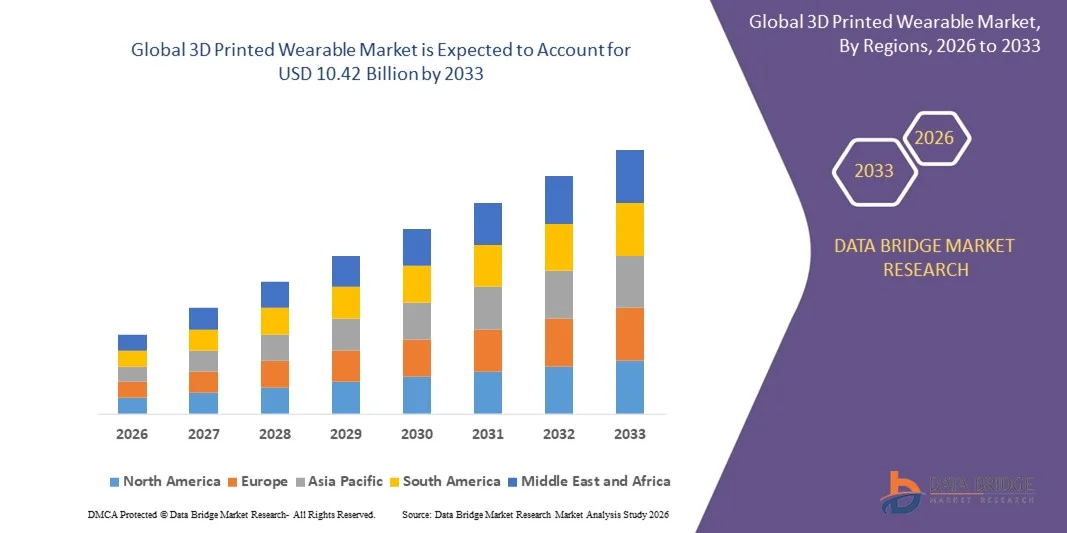
- The global 3D printed wearable market: convenience goes smart market size was valued at USD 5.22 billion in 2025 and is expected to reach USD 10.42 billion by 2033, at a CAGR of 9.03% during the forecast period
- The market growth is largely fueled by the increasing adoption of 3D printing technologies in fashion, footwear, accessories, and wearable electronics, enabling personalized, lightweight, and ergonomically designed products for consumers across various age groups and lifestyles
- Furthermore, rising consumer demand for customizable, functional, and aesthetically appealing wearables is establishing 3D printed wearables as a preferred choice in both mass-market and premium segments. These converging factors are accelerating the uptake of 3D printed wearable solutions, thereby significantly boosting the industry's growth
3D Printed Wearable Market: Convenience Goes Smart Market Analysis
- 3D printed wearables, including clothing, footwear, accessories, and smart devices, are becoming essential components of modern consumer lifestyles due to their enhanced customization, comfort, and integration with wearable electronics
- The escalating demand for 3D printed wearables is primarily fueled by technological advancements in additive manufacturing, growing interest in sustainable and zero-waste fashion, and increasing consumer preference for personalized and innovative wearable products
- North America dominated 3D printed wearable market: convenience goes smart market with a share of over 40% in 2025, due to increasing demand for personalized fashion, technologically advanced wearables, and early adoption of innovative consumer products
- Asia-Pacific is expected to be the fastest growing region in the 3D printed wearable market: convenience goes smart market during the forecast period due to rising urbanization, increasing disposable incomes, and rapid adoption of fashion and technology innovations in countries such as China, Japan, and India
- Premium segment dominated the market with a market share of 46.2% in 2025, due to the high adoption of customized and technologically advanced wearable items. Premium 3D printed wearables often feature exclusive designs, innovative materials, and enhanced functionality, which appeal to consumers seeking luxury and uniqueness. The segment also benefits from collaborations with designer brands and fashion houses, offering limited-edition collections that command higher pricing. Rising awareness of sustainable and zero-waste manufacturing processes further reinforces the preference for premium 3D printed wearables
Report Scope and 3D Printed Wearable Market: Convenience Goes Smart Market Segmentation
|
Attributes |
3D Printed Wearable Market: Convenience Goes Smart Key Market Insights |
|
Segments Covered |
|
|
Countries Covered |
North America
Europe
Asia-Pacific
Middle East and Africa
South America
|
|
Key Market Players |
|
|
Market Opportunities |
|
|
Value Added Data Infosets |
In addition to the insights on market scenarios such as market value, growth rate, segmentation, geographical coverage, and major players, the market reports curated by the Data Bridge Market Research also include in-depth expert analysis, pricing analysis, brand share analysis, consumer survey, demography analysis, supply chain analysis, value chain analysis, raw material/consumables overview, vendor selection criteria, PESTLE Analysis, Porter Analysis, and regulatory framework. |
3D Printed Wearable Market: Convenience Goes Smart Market Trends
Rising Adoption of Personalized and Customized 3D Printed Wearables
- A significant trend in the 3D printed wearable market is the increasing adoption of personalized and customized wearables across clothing, footwear, jewellery, and accessories, driven by consumer demand for unique, ergonomic, and aesthetically appealing products. This trend is elevating 3D printed wearables as key components for both fashion-forward and functional consumer applications
- For instance, companies such as Carbon and 3D Systems offer customizable 3D printed footwear and accessories that allow consumers to select designs, materials, and sizes tailored to their preferences. Such personalized offerings are enhancing user engagement and driving broader adoption of 3D printed wearable solutions
- The integration of advanced materials and smart technologies in wearables is expanding functionality, enabling garments and accessories that combine style with utility, such as embedded sensors or adaptive fit designs. This is positioning 3D printed wearables as innovative lifestyle products that meet evolving consumer expectations
- Fashion brands and technology providers are increasingly collaborating to launch limited-edition and high-performance 3D printed wearables, which are gaining traction among early adopters and premium consumers. These collaborations are promoting brand visibility and highlighting the versatility of additive manufacturing in consumer products
- Industries focusing on healthcare and sports are exploring 3D printed wearables for applications such as prosthetics, orthotics, and performance-enhancing accessories. This is shaping a growing preference for products that provide both functional benefits and design customization
- The market is witnessing robust growth in online and e-commerce channels where 3D printed wearables are showcased and sold directly to consumers. This rising digital adoption is reinforcing the transition toward highly personalized, innovative, and accessible wearable solutions across global markets
3D Printed Wearable Market: Convenience Goes Smart Market Dynamics
Driver
Growing Consumer Demand for Functional and Aesthetic Wearables
- The increasing preference for wearable products that combine style, comfort, and technological functionality is driving the growth of the 3D printed wearable market. Consumers are seeking customized designs, lightweight materials, and smart features that enhance lifestyle and performance
- For instance, companies such as Fitbit and Xiaomi offer smart wearables that incorporate 3D printed elements to improve ergonomics and personalization. These offerings increase adoption rates and open new opportunities in fitness, healthcare, and fashion applications
- The rising interest in sustainable and zero-waste production is encouraging consumers to prefer 3D printed wearables over traditionally manufactured products. This demand for eco-conscious solutions is fostering innovation in materials and manufacturing processes
- Advancements in additive manufacturing technologies are enabling faster, more precise, and scalable production of customized wearables. This is allowing brands to efficiently meet growing consumer expectations for both premium and mass-market products
- The market is benefiting from collaborations between fashion designers, sports brands, and technology providers, which are creating innovative wearable solutions that appeal to diverse consumer segments. These partnerships are reinforcing the adoption of 3D printed wearables globally
Restraint/Challenge
High Production Costs and Material Limitations
- The 3D printed wearable market faces challenges due to the high costs associated with advanced additive manufacturing technologies and specialized materials. These factors increase overall product pricing and limit widespread adoption among cost-sensitive consumers
- For instance, companies such as MakerBot and Carbon require high-grade polymers and metals for precision printing, which elevates material expenses and operational costs. These constraints can impact profit margins and market scalability
- Producing high-quality, durable, and functional 3D printed wearables demands stringent quality control standards and skilled labor. These requirements extend production timelines and add complexity to the supply chain
- Limited availability of specialized materials, such as flexible polymers or smart textiles, can restrict innovation and constrain manufacturers’ ability to scale product lines. This limitation also affects product diversity across different wearable categories
- The market continues to face challenges in balancing the demand for highly customized and technologically advanced wearables with cost-effective production. Addressing these hurdles is critical for sustaining growth and expanding adoption across global consumer segments
3D Printed Wearable Market: Convenience Goes Smart Market Scope
The market is segmented on the basis of product type, price, consumer orientation, and distribution channel.
- By Product Type
On the basis of product type, the 3D printed wearable market is segmented into clothes, watches, footwear, jewellery, accessories, and other miscellaneous products. The clothes segment dominated the market with the largest revenue share of 38.5% in 2025, driven by the growing consumer preference for customized, lightweight, and ergonomically designed apparel. 3D printing technology allows designers to create intricate patterns and adaptive sizing, making clothes highly appealing for both fashion-forward consumers and athletes. The segment also benefits from the integration of smart textiles and sustainable materials, further enhancing its attractiveness. Rising collaborations between fashion brands and 3D printing technology providers have also contributed to the strong adoption of 3D printed clothing solutions in the market.
The jewellery segment is expected to witness the fastest growth rate of 23.4% from 2026 to 2033, fueled by increasing demand for personalized and intricate designs that traditional manufacturing cannot easily achieve. For instance, companies such as Shapeways offer consumers the ability to create customized rings, bracelets, and necklaces using 3D printing, which drives adoption. 3D printed jewellery provides high precision, reduced material waste, and the ability to experiment with complex geometries, making it highly attractive for both designers and end-users. The rising popularity of unique, limited-edition wearable pieces in luxury markets also supports growth, along with advances in durable, lightweight printing materials.
- By Price
On the basis of price, the 3D printed wearable market is segmented into premium and mass. The premium segment dominated the market with the largest revenue share of 46.2% in 2025, driven by the high adoption of customized and technologically advanced wearable items. Premium 3D printed wearables often feature exclusive designs, innovative materials, and enhanced functionality, which appeal to consumers seeking luxury and uniqueness. The segment also benefits from collaborations with designer brands and fashion houses, offering limited-edition collections that command higher pricing. Rising awareness of sustainable and zero-waste manufacturing processes further reinforces the preference for premium 3D printed wearables.
The mass segment is expected to witness the fastest growth rate of 19.8% from 2026 to 2033, fueled by increasing consumer awareness and accessibility of affordable 3D printing technologies. For instance, companies such as XYZprinting provide cost-effective 3D printed watches and accessories targeted at budget-conscious consumers. Mass adoption is further supported by online marketplaces and social media platforms showcasing customizable products. The segment also benefits from simplified printing processes and more affordable raw materials, making it easier for mainstream consumers to access 3D printed wearables.
- By Consumer Orientation
On the basis of consumer orientation, the 3D printed wearable market is segmented into men, women, children, and unisex. The women’s segment dominated the market with the largest revenue share of 42.7% in 2025, driven by the higher adoption of fashion-forward wearables, jewellery, and accessories. Women consumers often seek personalized designs, intricate patterns, and limited-edition items that are efficiently produced through 3D printing technologies. The segment benefits from collaborations between designers and 3D printing providers to deliver bespoke wearable solutions. Rising interest in sustainable and lightweight fashion products also contributes to the strong demand within this segment.
The unisex segment is expected to witness the fastest growth rate of 20.5% from 2026 to 2033, fueled by increasing demand for gender-neutral designs in wearable fashion. For instance, brands such as Ministry of Supply are offering 3D printed shoes and apparel designed to cater to all genders. Unisex products provide flexibility in sizing and style customization, appealing to a broader consumer base. The growing trend of shared fashion experiences and multifunctional wearables also supports rapid adoption, along with advancements in adaptive and inclusive designs.
- By Distribution Channel
On the basis of distribution channel, the 3D printed wearable market is segmented into online and offline. The online segment dominated the market with the largest revenue share in 2025, driven by the convenience of e-commerce platforms and direct-to-consumer customization options. Online channels allow consumers to personalize designs, select materials, and preview products virtually before purchase, enhancing engagement and satisfaction. The segment also benefits from global reach and faster delivery options, which appeal to tech-savvy and fashion-conscious consumers. Partnerships between 3D printing service providers and online marketplaces further enhance accessibility and adoption rates.
The offline segment is expected to witness the fastest growth rate of 18.9% from 2026 to 2033, fueled by the increasing integration of experiential retail stores showcasing 3D printed wearables. For instance, companies such as Materialise have established showrooms where consumers can interact with and customize products in-person. Offline channels provide opportunities for hands-on experience, tactile material evaluation, and immediate product acquisition. The segment also benefits from growing adoption in boutique stores and pop-up shops that focus on high-end fashion and personalized wearables.
3D Printed Wearable Market: Convenience Goes Smart Market Regional Analysis
- North America dominated the 3D printed wearable market: convenience goes smart market with the largest revenue share of over 40% in 2025, driven by increasing demand for personalized fashion, technologically advanced wearables, and early adoption of innovative consumer products
- Consumers in the region highly value customization, comfort, and the integration of 3D printed wearables with lifestyle and smart accessories
- This widespread adoption is further supported by high disposable incomes, tech-savvy populations, and growing interest in sustainable and lightweight fashion solutions, establishing 3D printed wearables as a preferred choice for both everyday and premium applications
U.S. 3D Printed Wearable Market: Convenience Goes Smart Market Insight
The U.S. 3D printed wearable market captured the largest revenue share in 2025 within North America, fueled by the growing preference for personalized clothing, footwear, and accessories. Consumers are increasingly seeking unique designs, lightweight materials, and functional products produced through 3D printing technologies. The rising trend of online customization platforms and collaborations with fashion and tech brands further propels market growth. In addition, the integration of 3D printed wearables with wearable electronics and smart devices enhances convenience and functionality, driving adoption across both mass and premium segments.
Europe 3D Printed Wearable Market: Convenience Goes Smart Market Insight
The Europe 3D printed wearable market is projected to expand at a substantial CAGR during the forecast period, primarily driven by growing fashion consciousness, sustainability awareness, and technological adoption in countries such as Germany, the U.K., and France. Consumers are attracted to the personalization, efficiency, and innovative designs enabled by 3D printing. The region is witnessing strong adoption across retail, e-commerce, and premium fashion sectors, supported by collaborations between 3D printing providers and established brands. Increasing urbanization, coupled with rising disposable incomes and demand for unique wearable designs, is fostering market growth.
U.K. 3D Printed Wearable Market: Convenience Goes Smart Market Insight
The U.K. 3D printed wearable market is anticipated to grow at a noteworthy CAGR during the forecast period, driven by high adoption of custom-designed wearables, interest in sustainable fashion, and digital-savvy consumers. The rise in e-commerce platforms offering personalized 3D printed clothing and accessories is further boosting market expansion. Consumers’ inclination towards unique designs and technologically advanced products supports strong demand. The combination of fashion innovation, consumer convenience, and brand collaborations is expected to sustain growth in the U.K. market.
Germany 3D Printed Wearable Market: Convenience Goes Smart Market Insight
The Germany 3D printed wearable market is expected to expand at a considerable CAGR during the forecast period, fueled by increasing awareness of sustainable materials, technological adoption, and the demand for ergonomic and customized wearables. Germany’s focus on innovation, premium fashion, and eco-conscious consumer behavior promotes adoption, particularly in clothing, footwear, and accessories. The integration of 3D printing with smart textiles and wearable technology is gaining momentum, providing functional and stylish solutions for residential, commercial, and professional applications.
Asia-Pacific 3D Printed Wearable Market: Convenience Goes Smart Market Insight
The Asia-Pacific 3D printed wearable market is poised to grow at the fastest CAGR during the forecast period of 2026 to 2033, driven by rising urbanization, increasing disposable incomes, and rapid adoption of fashion and technology innovations in countries such as China, Japan, and India. The region’s growing inclination towards customization, supported by government initiatives promoting technology adoption, is driving demand for 3D printed wearables. Furthermore, APAC emerging as a manufacturing hub for 3D printing materials and solutions is enhancing affordability and accessibility, expanding the consumer base for both premium and mass segments.
Japan 3D Printed Wearable Market: Convenience Goes Smart Market Insight
The Japan 3D printed wearable market is gaining momentum due to the country’s high-tech culture, emphasis on innovation, and increasing demand for personalized, functional wearables. Consumers are attracted to lightweight, ergonomic, and aesthetically designed products suitable for everyday use. The integration of 3D printed wearables with electronics and smart accessories, combined with rising awareness of sustainable fashion practices, is fueling market growth. The aging population also drives demand for easier-to-use and adaptive wearable solutions in residential and commercial applications.
China 3D Printed Wearable Market: Convenience Goes Smart Market Insight
The China 3D printed wearable market accounted for the largest revenue share in Asia-Pacific in 2025, attributed to the expanding middle class, technological adoption, and rapid urbanization. Consumers are increasingly adopting 3D printed clothing, footwear, and accessories for customization, fashion, and functionality. The push towards smart fashion, availability of affordable 3D printing solutions, and strong domestic manufacturers are key factors propelling market growth. The country’s e-commerce penetration and increasing interest in personalized consumer products further support the adoption of 3D printed wearables across mass and premium segments.
3D Printed Wearable Market: Convenience Goes Smart Market Share
The 3D printed wearable market: convenience goes smart industry is primarily led by well-established companies, including:
- Samsung Electronics (South Korea)
- Garmin Ltd. (Switzerland)
- Huawei Technologies Co., Ltd. (China)
- Apple Inc. (U.S.)
- Sony Corporation (Japan)
- HTC Corporation (Taiwan)
- Fitbit, Inc. (U.S.)
- Xiaomi Global Community (China)
- ADIDAS AG (Germany)
- Nike, Inc. (U.S.)
- New Balance (U.S.)
- MakerBot Industries, LLC (U.S.)
- Makerarm.com (U.S.)
- LG Electronics (South Korea)
- Motorola Solutions, Inc. (U.S.)
- Fossil Group, Inc. (U.S.)
- Google LLC (U.S.)
- Polar Electro (Finland)
- Withings (France)
- Michael Kors (U.S.)
- CASIO AMERICA, INC. (U.S.)
- TomTom International BV (Netherlands)
- Under Armour, Inc. (U.S.)
Latest Developments in Global 3D Printed Wearable Market: Convenience Goes Smart Market
- In September 2025, 3D Systems launched a new line of customizable smart wearables targeting the fitness market. This development is expected to significantly impact the consumer health and wellness segment of the 3D printed wearable market, as it introduces highly personalized and technology-integrated products. By offering smart wearables that combine fitness tracking with customizable design, 3D Systems strengthens its position in a rapidly growing niche where health-conscious consumers demand both functionality and personalization. This move is likely to enhance user engagement, create new revenue streams, and drive further adoption of 3D printed wearables in lifestyle and fitness applications
- In August 2025, Stratasys announced a strategic collaboration with a leading healthcare provider to develop 3D printed prosthetics tailored to individual patient anatomy. This initiative is poised to transform the medical 3D printing sector by enabling highly customized, patient-specific solutions that improve comfort, functionality, and outcomes. Stratasys’s focus on healthcare applications demonstrates the company’s commitment to expanding its footprint beyond traditional industrial and consumer products, potentially driving innovation in prosthetics and orthotics. This development strengthens its market leadership and positions the company at the forefront of the intersection of healthcare and advanced 3D printing technology
- In July 2025, Carbon expanded its partnership with a prominent fashion retailer to produce limited-edition 3D printed accessories. This collaboration is set to influence the fashion and luxury 3D printed wearable segment by introducing exclusive, innovative products that appeal to niche consumer markets. By combining advanced manufacturing techniques with fashion, Carbon enhances brand visibility, promotes consumer engagement, and creates a perception of innovation and exclusivity. This move reinforces the market potential for designer-focused 3D printed wearables and highlights the growing intersection of technology and fashion
- In January 2024, researchers at Texas A&M University developed a 3D-printed electronic skin (E-skin) capable of sensing touch, temperature, and pressure, mimicking the properties of human skin. This breakthrough is expected to have a substantial impact on the wearable technology and robotics markets, as it enables more advanced human-machine interactions and sensory functionalities. The use of nanoengineered hydrogels to create flexible, responsive materials opens avenues for smart wearables, prosthetics, and robotics that require real-time feedback and adaptability. This innovation could accelerate the adoption of advanced sensory 3D printed materials in both healthcare and consumer electronics applications
- In December 2023, Evonik and the LEHVOSS Group announced a partnership in the industrial 3D printing sector, focusing on the development of specialized polymer formulations. LEHVOSS will produce 3D printing materials using Evonik's PA613 polymer chemistry, marketed under its LUVOSINT product brand. This collaboration is expected to influence the industrial 3D printing materials market by expanding the availability of high-performance, application-specific polymers. By offering tailored formulations for additive manufacturing, the partnership enhances the capabilities of manufacturers to produce complex, durable, and lightweight parts, driving broader adoption of 3D printing in industrial and commercial applications

- Interactive Data Analysis Dashboard
- Company Analysis Dashboard for high growth potential opportunities
- Research Analyst Access for customization & queries
- Competitor Analysis with Interactive dashboard
- Latest News, Updates & Trend analysis
- Harness the Power of Benchmark Analysis for Comprehensive Competitor Tracking
Data collection and base year analysis are done using data collection modules with large sample sizes. The stage includes obtaining market information or related data through various sources and strategies. It includes examining and planning all the data acquired from the past in advance. It likewise envelops the examination of information inconsistencies seen across different information sources. The market data is analysed and estimated using market statistical and coherent models. Also, market share analysis and key trend analysis are the major success factors in the market report. To know more, please request an analyst call or drop down your inquiry.
The key research methodology used by DBMR research team is data triangulation which involves data mining, analysis of the impact of data variables on the market and primary (industry expert) validation. Data models include Vendor Positioning Grid, Market Time Line Analysis, Market Overview and Guide, Company Positioning Grid, Patent Analysis, Pricing Analysis, Company Market Share Analysis, Standards of Measurement, Global versus Regional and Vendor Share Analysis. To know more about the research methodology, drop in an inquiry to speak to our industry experts.
Data Bridge Market Research is a leader in advanced formative research. We take pride in servicing our existing and new customers with data and analysis that match and suits their goal. The report can be customized to include price trend analysis of target brands understanding the market for additional countries (ask for the list of countries), clinical trial results data, literature review, refurbished market and product base analysis. Market analysis of target competitors can be analyzed from technology-based analysis to market portfolio strategies. We can add as many competitors that you require data about in the format and data style you are looking for. Our team of analysts can also provide you data in crude raw excel files pivot tables (Fact book) or can assist you in creating presentations from the data sets available in the report.













