


What is the 3D Printing Construction Market Size and Overview?
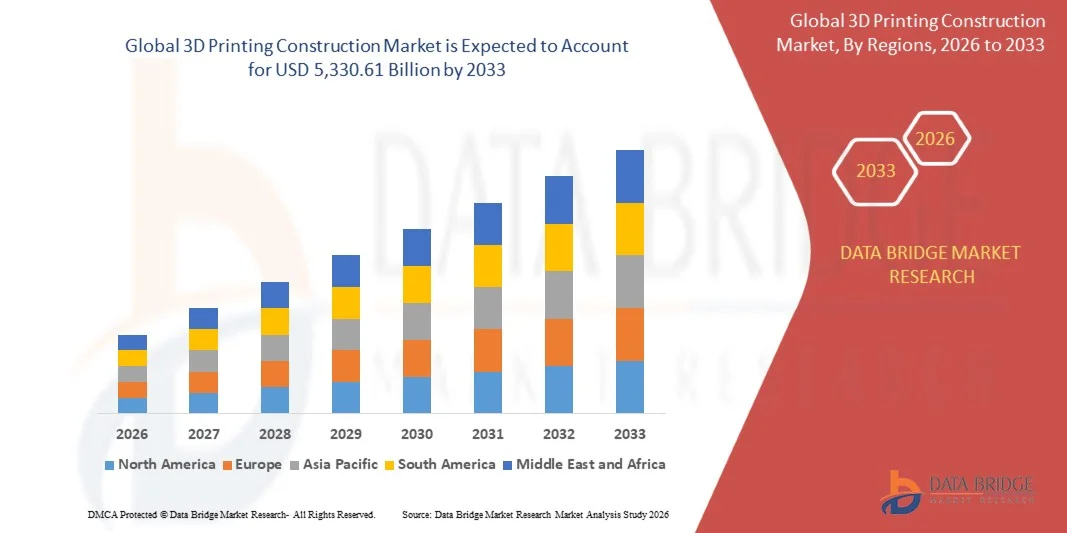
As per Data Bridge Market Research Analysis the 3D Printing Construction Market was valued at USD 1.78 billion in 2025 and is projected to reach USD 5,330.61 billion by 2033, growing at a CAGR of 171.97% from 2026 to 2033. The market is witnessing unprecedented growth driven by increasing demand for faster and cost-efficient construction methods, rising labor shortages in the construction industry, and growing adoption of advanced digital fabrication technologies. Construction companies and government agencies are increasingly exploring 3D printing solutions to accelerate project timelines, reduce material waste, and improve overall construction efficiency.
The growing need for affordable housing, sustainable building practices, and infrastructure development is encouraging the adoption of large-scale 3D printing technologies across residential, commercial, and industrial projects. Automated construction systems are increasingly replacing conventional building processes in many applications, enabling rapid structure fabrication with reduced labor requirements and enhanced design flexibility. In addition, advancements in printable concrete materials, robotic construction systems, and Building Information Modeling (BIM) integration are expanding the use of 3D printing across modern construction projects, providing cost-effective, precise, and environmentally sustainable building solutions.
Key Market Trends & Insights
- North America dominated the 3D printing construction market with the largest revenue share of 38.7% in 2025, supported by early adoption of advanced construction technologies, strong presence of leading market players, increasing investments in affordable housing projects, and growing demand for sustainable and cost-efficient building solutions.
- Asia-Pacific is expected to be the fastest-growing region, recording a CAGR of 178.5% from 2026 to 2033. Growth is driven by rapid urbanization, rising infrastructure development activities, increasing government support for advanced construction technologies, and growing demand for affordable housing across emerging economies.
- The Concrete segment held the largest market revenue share of approximately 67.9% in 2025 driven by its extensive use in residential housing, commercial buildings, bridges, and infrastructure projects. Concrete remains the preferred material due to its cost-effectiveness, structural strength, compatibility with large-scale 3D printers, and ability to significantly reduce construction time and material waste compared to traditional building methods.
- The Metal segment is projected to register the fastest growth at a CAGR of 184.5% from 2026 to 2033, driven by increasing adoption in advanced infrastructure projects, industrial facilities, and aerospace-related construction applications. Growing investments in high-performance structural components and complex architectural designs are accelerating segment expansion.
- The Big Area Additive Manufacturing (BAAM) segment held the largest market revenue share of approximately 31.6% in 2025 driven by its suitability for large-scale construction projects, high deposition rates, and ability to fabricate structural elements efficiently. BAAM technology is increasingly utilized in commercial and residential construction where rapid production and scalability are critical.
- The Wire Arc Additive Manufacturing (WAAM) segment is projected to register the fastest growth at a CAGR of 189.2% from 2026 to 2033, driven by rising demand for metal-based structural components, infrastructure elements, and customized construction applications requiring high strength and design flexibility.
- The Residential segment held the largest market revenue share of approximately 43.8% in 2025 driven by increasing demand for affordable housing, rapid urbanization, and growing adoption of automated construction technologies. Governments and private developers are increasingly utilizing 3D printing solutions to address housing shortages while reducing construction costs and project timelines.
- The Space (Extra-terrestrial) segment is projected to register the fastest growth at a CAGR of 201.4% from 2026 to 2033, driven by increasing investments from space agencies and private aerospace companies exploring lunar and Martian habitat construction using additive manufacturing technologies and in-situ resource utilization techniques.
- The Buildings segment held the largest market revenue share of approximately 48.5% in 2025 driven by growing deployment of 3D printing technologies in residential homes, commercial facilities, office structures, and public infrastructure developments. The ability to reduce labor dependency and construction duration is supporting widespread adoption across building projects.
- The Bridges segment is projected to register the fastest growth at a CAGR of 176.8% from 2026 to 2033, driven by increasing pilot infrastructure projects, government-funded innovation programs, and advancements in large-scale concrete printing systems capable of producing complex bridge structures with reduced material consumption.
- The Functional Models segment held the largest market revenue share of approximately 41.2% in 2025 driven by increasing utilization of 3D printing for producing load-bearing structures, architectural components, and fully operational construction elements. The growing emphasis on real-world deployment and performance validation is supporting segment dominance.
- The Tooling segment is projected to register the fastest growth at a CAGR of 178.6% from 2026 to 2033, driven by rising demand for customized molds, formworks, fixtures, and specialized construction tools that improve manufacturing precision and reduce project development timelines.
Market Size & Forecast
- Global Market Value (2025): USD 1.78 Billion
- Expected Market Value (2033): USD 5,330.61 Billion
- Forecast CAGR (2026–2033): 171.97%
- Leading Region in 2025: North America
- Fastest Growing Region: Asia-Pacific
Report Scope and 3D Printing Construction Market Segmentation
|
Attributes |
3D Printing Construction Key Market Insights |
|
Segments Covered |
|
|
Countries Covered |
North America
Europe
Asia-Pacific
Middle East and Africa
South America
|
|
Key Market Players |
• Yingchuang Building Technique (China) |
|
Market Opportunities |
• Expansion Of Affordable Housing Construction Projects • Increasing Government Investment In Sustainable Infrastructure Development |
|
Value Added Data Infosets |
In addition to the insights on market scenarios such as market value, growth rate, segmentation, geographical coverage, and major players, the market reports curated by the Data Bridge Market Research also include import export analysis, production capacity overview, production consumption analysis, price trend analysis, climate change scenario, supply chain analysis, value chain analysis, raw material/consumables overview, vendor selection criteria, PESTLE Analysis, Porter Analysis, and regulatory framework. |
What is the Key Trend in the 3D Printing Construction Market?
Trend: Adoption Of Automated And Sustainable Construction Technologies
Increasing demand for faster, cost-efficient, and environmentally sustainable construction methods across residential, commercial, and infrastructure sectors is accelerating adoption of 3D printing technologies. Traditional construction methods often face challenges related to labor shortages, material wastage, project delays, and rising construction costs, encouraging developers and governments to explore automated building solutions capable of improving productivity and resource efficiency.
In modern construction projects, companies are increasingly utilizing large-scale 3D printers, For instance for affordable housing developments, modular buildings, and public infrastructure projects, to reduce construction time while maintaining structural quality. Leading firms such as ICON and COBOD have successfully demonstrated 3D-printed residential structures that can be completed in significantly fewer days compared to conventional building methods. In 2025, several housing projects across the U.S. and Europe reported construction time reductions of nearly 50–70% through automated concrete printing technologies.
The rapid expansion of urban populations and increasing housing demand are also driving interest in scalable construction solutions capable of delivering structures with minimal labor requirements. In addition, government agencies and sustainability-focused developers continue to support 3D printing technologies because of their ability to reduce material waste and carbon emissions. Growing industry validation through large-scale pilot projects in 2025 demonstrated material waste reductions of approximately 30–60% compared to conventional concrete construction processes.
3D Printing Construction Market Dynamics
Key Market Driver: Rising Demand For Affordable And Rapid Construction Solutions
Construction industries worldwide are facing increasing pressure to deliver housing and infrastructure projects faster while controlling costs and addressing labor shortages. Rapid urbanization, population growth, and increasing housing deficits are creating strong demand for technologies capable of accelerating project completion without compromising structural performance.
Construction companies and government agencies are increasingly deploying 3D printing technologies to construct residential buildings, emergency shelters, schools, and commercial facilities with reduced labor requirements and shorter project timelines. For instance, 3D-printed housing developments in the U.S., Mexico, and the Middle East have demonstrated the ability to complete structural components within 24–72 hours, significantly reducing overall construction durations.
Similarly, infrastructure developers are exploring automated printing systems for bridges, pedestrian pathways, and public facilities to improve efficiency and reduce project costs. Real-world projects completed in Europe and Asia during 2024 demonstrated labor cost reductions of approximately 40–60% compared to traditional construction methods in selected applications.
Key Restraint/Challenge: High Initial Investment And Regulatory Uncertainty
Despite strong growth potential, the market faces challenges associated with high capital investment requirements and limited regulatory standardization. Large-scale construction printers, specialized materials, and supporting software infrastructure require significant upfront expenditure, creating barriers for small and medium-sized construction firms.
In addition, building codes and construction regulations in many countries have not yet fully adapted to 3D-printed structures, creating approval delays and compliance challenges for developers. Limited availability of skilled operators and technical expertise further constrains widespread implementation, particularly in developing economies.
Industry assessments indicate that industrial-scale construction 3D printing systems can require investments exceeding several hundred thousand dollars per installation, while permitting and certification processes can extend project timelines in regions lacking dedicated regulatory frameworks for additive construction technologies.
Key Market Opportunity: Expansion Of Smart Cities And Sustainable Infrastructure Development
Growing investments in smart city projects, sustainable housing initiatives, and next-generation infrastructure development are creating substantial opportunities for 3D printing construction technologies. Governments and private developers are increasingly seeking low-waste, energy-efficient, and digitally enabled construction methods capable of supporting long-term urban development goals.
Construction companies are increasingly integrating 3D printing systems, For instance for affordable housing projects, modular construction, and disaster-relief structures, to improve efficiency while reducing environmental impact. In addition, advancements in printable concrete formulations, recycled construction materials, and robotic automation are improving structural performance and expanding commercial viability across diverse construction applications.
In addition, increasing adoption of Building Information Modeling (BIM), AI-driven design optimization, and automated construction workflows is enhancing project precision and scalability across North America, Europe, and Asia-Pacific. Large-scale 3D-printed housing projects completed during 2025 reported construction cost reductions of approximately 20–40% and material utilization improvements exceeding 30% compared to conventional building techniques, highlighting significant future growth opportunities for the market.
How is the 3D Printing Construction Market Segmented?
The market is segmented on the basis of printing material, printing technology, end-use industry, construction, and application.
- By Printing Material
On the basis of printing material, the market is segmented into Concrete, Plastics, Metal, Ceramics, and Others. The Concrete segment held the largest market revenue share of approximately 67.9% in 2025 driven by its extensive use in residential housing, commercial buildings, bridges, and infrastructure projects. Concrete remains the preferred material due to its cost-effectiveness, structural strength, compatibility with large-scale 3D printers, and ability to significantly reduce construction time and material waste compared to traditional building methods.
The Metal segment is projected to register the fastest growth at a CAGR of 184.5% from 2026 to 2033, driven by increasing adoption in advanced infrastructure projects, industrial facilities, and aerospace-related construction applications. Growing investments in high-performance structural components and complex architectural designs are accelerating segment expansion.
- By Printing Technology
On the basis of printing technology, the market is segmented into Fused Deposition Modeling (FDM), Wire Arc Additive Manufacturing (WAAM), Big Area Additive Manufacturing (BAAM), Stereolithography (SLA), Selective Laser Sintering (SLS), Selective Laser Melting (SLM), and Others. The Big Area Additive Manufacturing (BAAM) segment held the largest market revenue share of approximately 31.6% in 2025 driven by its suitability for large-scale construction projects, high deposition rates, and ability to fabricate structural elements efficiently. BAAM technology is increasingly utilized in commercial and residential construction where rapid production and scalability are critical.
The Wire Arc Additive Manufacturing (WAAM) segment is projected to register the fastest growth at a CAGR of 189.2% from 2026 to 2033, driven by rising demand for metal-based structural components, infrastructure elements, and customized construction applications requiring high strength and design flexibility.
- By End-Use Industry
On the basis of end-use industry, the market is segmented into Commercial, Residential, Industrial, and Space (Extra-terrestrial). The Residential segment held the largest market revenue share of approximately 43.8% in 2025 driven by increasing demand for affordable housing, rapid urbanization, and growing adoption of automated construction technologies. Governments and private developers are increasingly utilizing 3D printing solutions to address housing shortages while reducing construction costs and project timelines.
The Space (Extra-terrestrial) segment is projected to register the fastest growth at a CAGR of 201.4% from 2026 to 2033, driven by increasing investments from space agencies and private aerospace companies exploring lunar and Martian habitat construction using additive manufacturing technologies and in-situ resource utilization techniques.
- By Construction
On the basis of construction, the market is segmented into Buildings, Bridges, Walls, Domes, Beams, Girders, Viaducts, Sound Barriers, Abutments, Balconies, Elements for Tunnels, and Others. The Buildings segment held the largest market revenue share of approximately 48.5% in 2025 driven by growing deployment of 3D printing technologies in residential homes, commercial facilities, office structures, and public infrastructure developments. The ability to reduce labor dependency and construction duration is supporting widespread adoption across building projects.
The Bridges segment is projected to register the fastest growth at a CAGR of 176.8% from 2026 to 2033, driven by increasing pilot infrastructure projects, government-funded innovation programs, and advancements in large-scale concrete printing systems capable of producing complex bridge structures with reduced material consumption.
- By Application
On the basis of application, the market is segmented into Concept Models, Visual Arts, Tooling, Functional Models, and Others. The Functional Models segment held the largest market revenue share of approximately 41.2% in 2025 driven by increasing utilization of 3D printing for producing load-bearing structures, architectural components, and fully operational construction elements. The growing emphasis on real-world deployment and performance validation is supporting segment dominance.
The Tooling segment is projected to register the fastest growth at a CAGR of 178.6% from 2026 to 2033, driven by rising demand for customized molds, formworks, fixtures, and specialized construction tools that improve manufacturing precision and reduce project development timelines.
Which Region Holds the Largest Share of the 3D Printing Construction Market?
North America 3D Printing Construction Market Insight
North America dominated the 3D printing construction market with the largest revenue share of 38.7% in 2025, supported by early adoption of advanced construction technologies, increasing investments in affordable housing projects, and strong presence of leading 3D printing construction companies. The region benefits from high construction automation adoption, favorable funding for infrastructure innovation, and growing demand for sustainable building solutions. Increasing deployment of large-scale concrete printing systems across residential and commercial developments is further strengthening market growth throughout North America.
U.S. 3D Printing Construction Market Insight
The U.S. 3D printing construction market captured the largest revenue share in 2025 within North America, fueled by rising housing shortages, labor constraints in the construction industry, and strong investments in innovative building technologies. Construction companies are increasingly utilizing automated printing systems to reduce project timelines and material waste while improving cost efficiency. The growing adoption of 3D-printed homes, commercial structures, and disaster-relief housing, combined with increasing government and private sector support for sustainable construction, is significantly contributing to market expansion.
Europe 3D Printing Construction Market Insight
The Europe 3D printing construction market is expected to witness the fastest growth rate from 2026 to 2033, primarily driven by stringent sustainability regulations and increasing demand for low-carbon construction solutions. The region is actively adopting additive manufacturing technologies to reduce material waste, improve energy efficiency, and address labor shortages. European construction firms are increasingly incorporating 3D printing into residential, commercial, and infrastructure projects, while government initiatives promoting green building practices continue to accelerate technology adoption across the region.
U.K. 3D Printing Construction Market Insight
The U.K. 3D printing construction market is expected to witness the fastest growth rate from 2026 to 2033, driven by rising investments in affordable housing, smart city developments, and sustainable infrastructure projects. The country's growing focus on construction innovation and digital transformation is encouraging adoption of automated building technologies. In addition, increasing efforts to reduce construction waste and carbon emissions are supporting the implementation of 3D printing systems across residential and commercial building projects.
Germany 3D Printing Construction Market Insight
The Germany 3D printing construction market is expected to witness the fastest growth rate from 2026 to 2033, fueled by the country's strong engineering capabilities, advanced manufacturing ecosystem, and commitment to sustainable development. Germany has emerged as a leading adopter of automated construction technologies, with growing utilization of 3D printing for residential buildings, industrial facilities, and public infrastructure projects. The integration of digital design tools and advanced concrete printing technologies is further enhancing market growth across the country.
Asia-Pacific 3D Printing Construction Market Insight
The Asia-Pacific 3D printing construction market is expected to witness the fastest growth rate from 2026 to 2033, supported by rapid urbanization, growing infrastructure investments, and increasing demand for affordable housing across countries such as China, Japan, India, and Singapore. Governments throughout the region are actively supporting advanced construction technologies to improve building efficiency and address rising urban population requirements. Furthermore, expanding construction activities and increasing adoption of digital building methods are creating significant growth opportunities for market participants.
Japan 3D Printing Construction Market Insight
The Japan 3D printing construction market is expected to witness the fastest growth rate from 2026 to 2033 due to the country's technological leadership, aging construction workforce, and growing demand for automated building solutions. Japanese construction companies are increasingly exploring additive manufacturing technologies to improve productivity, reduce labor dependency, and accelerate project completion. The integration of robotics, artificial intelligence, and advanced construction materials is further supporting market development across residential and infrastructure applications.
China 3D Printing Construction Market Insight
The China 3D printing construction market accounted for the largest market revenue share in Asia-Pacific in 2025, attributed to the country's massive construction industry, rapid urbanization, and strong government support for advanced manufacturing technologies. China is one of the leading adopters of large-scale construction printing systems, utilizing the technology for residential buildings, public infrastructure, and commercial developments. The growing emphasis on affordable housing, smart city initiatives, and sustainable construction practices, combined with the presence of major domestic technology providers, continues to propel market growth across the country.
Which are the Top Companies in 3D Printing Construction Market?
The 3D Printing Construction industry is primarily led by well-established companies, including:
- Yingchuang Building Technique (China)
- XtreeE (France)
- Apis Cor (Russia)
- Monolite UK (UK)
- CSP Group srl (Italy)
- CyBe Construction (Netherlands)
- Sika (Switzerland)
- MX3D (Netherlands)
- Contour Crafting Corporation (California)
- COBOD International A/S (Denmark)
- ICON Technology, Inc (US)
- Constructions-3D (Germany)
- AI build ltd, (UK)
- Imprimere Ag (Germany)
- Skanska (Sweden)
- Tracxn Technologies Limited (India)
What are Latest Developments in 3D Printing Construction Market?
- In June 2025, West Japan Railway Company and Serendix, Product Launch/Project Completion, completed the world's first 3D-printed railway station structure in Japan within seven days. The development demonstrated the ability of additive construction technologies to significantly reduce construction time, labor dependency, and operational disruption. This achievement is expected to accelerate the adoption of 3D printing across transportation infrastructure projects and strengthen confidence in large-scale commercial deployment.
- In February 2025, U.S. Army, Infrastructure Development, inaugurated three 3D-printed barracks at Fort Bliss, each capable of accommodating up to 56 soldiers. The project showcased the viability of additive manufacturing for rapid military infrastructure development while reducing construction timelines and material consumption. The initiative is expected to expand the use of 3D printing technologies in defense and public infrastructure applications globally.
- In March 2024, ICON Technology, Inc., Product Launch, introduced a comprehensive portfolio of advanced construction technologies including a next-generation robotic printer for multi-story buildings, low-carbon construction materials, AI-powered architectural tools, and a digital design catalog. The launch aims to automate construction processes, improve sustainability, and reduce housing costs. This development strengthens the commercialization of large-scale 3D printing and supports broader adoption of affordable housing solutions worldwide.
- In October 2024, Apis Cor, Strategic Initiative, launched a contractor training program focused on advanced 3D construction printing technologies. The initiative is designed to develop a skilled workforce, expand technology adoption, and support the implementation of additive manufacturing in construction projects. The program is expected to improve market penetration and accelerate industry-wide acceptance of 3D printing construction methods.
- In June 2023, XtreeE, Expansion, announced the deployment of three new connected 3D printing units through partners in Switzerland, the U.S., and Japan, increasing its global network to 12 operational units. The expansion supports the company's objective of creating a large-scale distributed manufacturing network for customized construction components. This development is expected to enhance production efficiency and strengthen global accessibility of 3D-printed building solutions.
- In September 2022, Mighty Buildings, Funding, secured USD 10 million in investment to expand manufacturing capacity and accelerate production of 3D-printed housing solutions. The funding is intended to support facility expansion, product innovation, and increased output to meet growing demand for affordable and sustainable homes. This investment reflects rising investor confidence in additive construction technologies and supports long-term market growth

- Interactive Data Analysis Dashboard
- Company Analysis Dashboard for high growth potential opportunities
- Research Analyst Access for customization & queries
- Competitor Analysis with Interactive dashboard
- Latest News, Updates & Trend analysis
- Harness the Power of Benchmark Analysis for Comprehensive Competitor Tracking
Global 3d Printing Construction Market, Supply Chain Analysis and Ecosystem Framework
To support market growth and help clients navigate the impact of geopolitical shifts, DBMR has integrated in-depth supply chain analysis into its Global 3d Printing Construction Market research reports. This addition empowers clients to respond effectively to global changes affecting their industries. The supply chain analysis section includes detailed insights such as Global 3d Printing Construction Market consumption and production by country, price trend analysis, the impact of tariffs and geopolitical developments, and import and export trends by country and HSN code. It also highlights major suppliers with data on production capacity and company profiles, as well as key importers and exporters. In addition to research, DBMR offers specialized supply chain consulting services backed by over a decade of experience, providing solutions like supplier discovery, supplier risk assessment, price trend analysis, impact evaluation of inflation and trade route changes, and comprehensive market trend analysis.
Data collection and base year analysis are done using data collection modules with large sample sizes. The stage includes obtaining market information or related data through various sources and strategies. It includes examining and planning all the data acquired from the past in advance. It likewise envelops the examination of information inconsistencies seen across different information sources. The market data is analysed and estimated using market statistical and coherent models. Also, market share analysis and key trend analysis are the major success factors in the market report. To know more, please request an analyst call or drop down your inquiry.
The key research methodology used by DBMR research team is data triangulation which involves data mining, analysis of the impact of data variables on the market and primary (industry expert) validation. Data models include Vendor Positioning Grid, Market Time Line Analysis, Market Overview and Guide, Company Positioning Grid, Patent Analysis, Pricing Analysis, Company Market Share Analysis, Standards of Measurement, Global versus Regional and Vendor Share Analysis. To know more about the research methodology, drop in an inquiry to speak to our industry experts.
Data Bridge Market Research is a leader in advanced formative research. We take pride in servicing our existing and new customers with data and analysis that match and suits their goal. The report can be customized to include price trend analysis of target brands understanding the market for additional countries (ask for the list of countries), clinical trial results data, literature review, refurbished market and product base analysis. Market analysis of target competitors can be analyzed from technology-based analysis to market portfolio strategies. We can add as many competitors that you require data about in the format and data style you are looking for. Our team of analysts can also provide you data in crude raw excel files pivot tables (Fact book) or can assist you in creating presentations from the data sets available in the report.













