


4D Bioprinting for Tissue Engineering Market Size
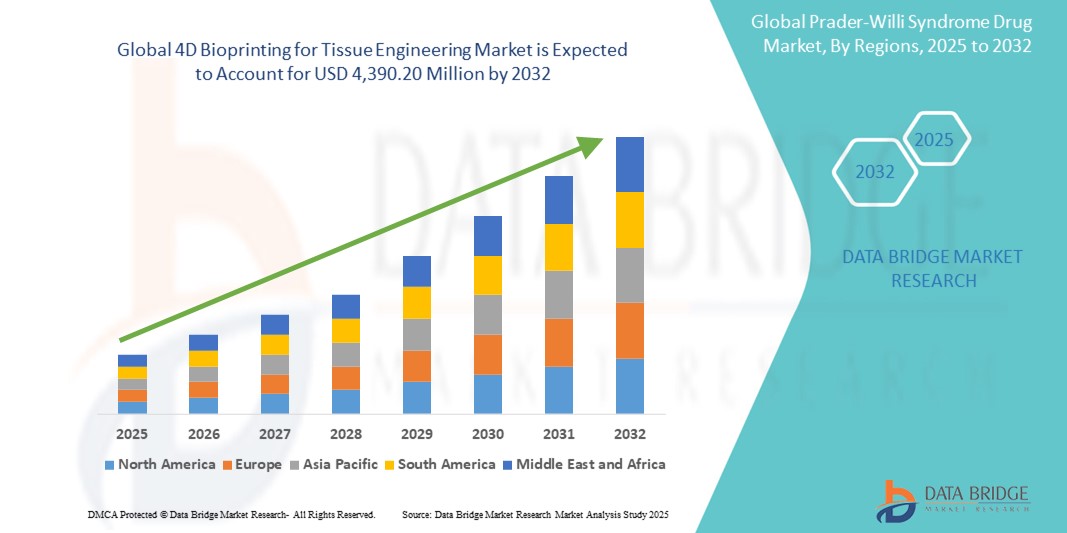
- The global 4D bioprinting for tissue engineering market size was valued at USD 544.9 million in 2024 and is expected to reach USD 4,390.20 million by 2032, at a CAGR of 29.80% during the forecast period
- The market growth for 4D bioprinting for tissue engineering is largely fueled by significant technological advancements in biomaterials and printing methodologies, enabling the creation of dynamic, functional tissues that can respond to external stimuli. This progress is leading to increased innovation in regenerative medicine and personalized healthcare
- Furthermore, rising global demand for organ transplants and personalized treatment solutions is establishing 4D bioprinting as a crucial modern approach. The increasing prevalence of chronic diseases and the persistent shortage of donor organs are converging factors that are accelerating the uptake of 4D bioprinting for tissue engineering solutions, thereby significantly boosting the industry's growth
4D Bioprinting for Tissue Engineering Market Analysis
- Tissue engineering, involving the application of biological, chemical, and engineering principles to create functional tissues and organs, is becoming an increasingly vital component of modern regenerative medicine and biotechnology. This is due to its promise in addressing the critical shortage of donor organs, improving treatment outcomes for various diseases, and offering personalized therapeutic solutions.
- The escalating demand for tissue engineering solutions is primarily fueled by the growing global prevalence of chronic diseases such as cardiovascular disorders, musculoskeletal conditions, and diabetes, coupled with an aging population that requires advanced regenerative treatments and organ repair. Furthermore, advancements in 3D bioprinting, biomaterials, and stem cell research are significantly propelling market expansion
- North America dominates the 4D bioprinting for tissue engineering market with the largest revenue share of 40.01% in 2024, driven by a growing demand for advanced regenerative medicine solutions and increased awareness of the potential of patient-specific tissue engineering
- Asia-Pacific is expected to be the fastest-growing region in the Tissue Engineering market during the forecast period. This rapid growth is attributed to increasing healthcare expenditure, a large and growing patient pool, improving healthcare infrastructure, rising awareness about advanced treatments, and growing government support for regenerative medicine research and development in emerging economies
- Tissue engineering segment dominates the Global 4D bioprinting for tissue engineering market with 62.6% of the market share in 2024, driven by the urgent need to address organ shortages, the demand for complex, functional tissues that can integrate seamlessly with the body, and the potential for creating dynamic constructs that can mature, self-assemble, or respond to stimuli in vivo
Report Scope and 4D Bioprinting for Tissue Engineering Market Segmentation
|
Attributes |
4D Bioprinting for Tissue Engineering Key Market Insights |
|
Segments Covered |
|
|
Countries Covered |
North America
Europe
Asia-Pacific
Middle East and Africa
South America
|
|
Key Market Players |
|
|
Market Opportunities |
|
|
Value Added Data Infosets |
In addition to the insights on market scenarios such as market value, growth rate, segmentation, geographical coverage, and major players, the market reports curated by the Data Bridge Market Research also include in-depth expert analysis, pricing analysis, brand share analysis, consumer survey, demography analysis, supply chain analysis, value chain analysis, raw material/consumables overview, vendor selection criteria, PESTLE Analysis, Porter Analysis, and regulatory framework. |
4D Bioprinting for Tissue Engineering Market Trends
“Enhanced Control and Efficiency Through AI and Automation in 4D Bioprinting for Tissue Engineering”
- A significant and accelerating trend in the global 4D bioprinting for tissue engineering market is the deepening integration with artificial intelligence (AI) and advanced automation. This fusion of technologies is significantly enhancing the precision, efficiency, and overall control over the complex bioprinting processes
- For instance, AI-driven algorithms are being developed to optimize critical bioprinting parameters, such as print speed, bioink viscosity, and nozzle temperature, in real-time. This allows for the creation of more accurate and consistent tissue constructs. Similarly, machine learning models can be trained on vast datasets of material properties and cellular responses to predict how 4D bioprinted structures will change shape and integrate within a biological environment, offering a "discreet" solution for material selection and design optimization
- AI integration in 4D bioprinting enables features such as learning optimal print paths to minimize material waste and improve structural integrity, and providing more intelligent alerts based on real-time monitoring of the printing process. For instance, some advanced bioprinting systems utilize AI to improve cell viability during printing by adjusting parameters on the fly, and can send intelligent alerts if unusual bioink flow or cell degradation is detected. Furthermore, automation capabilities offer researchers and clinicians the ease of hands-free operation, allowing them to initiate complex print jobs or monitor progress remotely
- The seamless integration of 4D bioprinting systems with AI-powered analytical platforms facilitates centralized control over various aspects of the tissue engineering workflow. Through a single interface, users can manage their bioprinting parameters alongside real-time cell imaging, bioreactor conditions, and post-printing maturation processes, creating a unified and automated biofabrication experience
- This trend towards more intelligent, intuitive, and interconnected bioprinting systems is fundamentally reshaping expectations for tissue engineering research and therapeutic applications. Consequently, companies are developing AI-enabled 4D bioprinters with features such as automatic calibration based on bioink characteristics and predictive modeling of construct functionality
- The demand for 4D bioprinting solutions that offer seamless AI and automation integration is growing rapidly across both research and clinical sectors, as researchers and clinicians increasingly prioritize precision, reproducibility, and comprehensive control over complex biological fabrication processes
4D Bioprinting for Tissue Engineering Market Dynamics
Driver
“Growing Need Due to Advancements in Regenerative Medicine and Personalized Healthcare”
- The increasing understanding of biological processes and the accelerating demand for more effective treatments for tissue damage and organ failure are significant drivers for the heightened demand for 4D bioprinting in tissue engineering
- For instance, ongoing research into complex organ systems and the development of sophisticated biomaterials that can respond to physiological cues are leading to breakthroughs in creating functional tissues. Such advancements by key research institutions and biotechnology companies are expected to drive the 4D bioprinting for tissue engineering industry growth in the forecast period
- As researchers and clinicians become more aware of the limitations of static 3D printed constructs and seek enhanced biomimicry for therapeutic applications, 4D bioprinting offers advanced features such as dynamic shape-changing capabilities, controlled drug release, and adaptive mechanical properties, providing a compelling upgrade over traditional tissue engineering approaches
- Furthermore, the growing popularity of personalized medicine and the desire for patient-specific solutions are making 4D bioprinting an integral component of these systems, offering seamless integration with patient data and sophisticated design software
- The convenience of creating constructs that can mature and integrate effectively within the body, the potential for reduced immune rejection, and the ability to tailor tissue constructs precisely to individual patient needs are key factors propelling the adoption of 4D bioprinting in both research and clinical sectors. The trend towards advanced biofabrication techniques and the increasing availability of sophisticated bioinks further contribute to market growth
Restraint/Challenge
“Concerns Regarding Regulatory Hurdles and High Development Costs”
- Concerns surrounding the complex regulatory pathways for novel medical devices and tissue-engineered products, including 4D bioprinted constructs, pose a significant challenge to broader market penetration. As 4D bioprinting involves living cells and dynamic materials, it requires rigorous testing and validation to ensure safety and efficacy, raising anxieties among manufacturers and potential adopters about the lengthy and costly approval processes
- For instance, high-profile reports of the extensive clinical trials and regulatory scrutiny required for any new regenerative medicine product have made some companies hesitant to invest heavily in 4D bioprinting solutions without clear guidelines
- Addressing these regulatory concerns through standardized protocols, clearer guidelines for stimuli-responsive materials, and collaborative efforts between regulatory bodies and industry players is crucial for building trust and accelerating market entry
- While prices are gradually decreasing with technological advancements and increased production, the perceived premium for this cutting-edge technology can still hinder widespread adoption, especially for those who do not see an immediate need for the advanced dynamic features offered
4D Bioprinting for Tissue Engineering Market Scope
The market is segmented on the basis of type of technology, application area and end user.
By Type of Technology
On the basis of type of technology, the 4D bioprinting for tissue engineering market is segmented into extrusion-based technology, laser-based technology, inkjet-based technology, and others.
Extrusion-based Technology held the largest market share in 2024. This dominance is driven by its versatility in handling a wide range of bioinks, including high-viscosity materials and cell-laden hydrogels, making it well-suited for creating complex tissue constructs. Its relative simplicity and cost-effectiveness compared to other methods also contribute to its widespread adoption in research and early-stage development.
Laser-based technology is expected to witness significant growth, fueled by its high precision and resolution, which are critical for fabricating intricate micro-architectures within tissues. This technology is particularly valuable for applications requiring fine control over cell placement and scaffold geometry.Inkjet-based Technology is also projected to see substantial growth, driven by its ability to print cells and biomolecules with high speed and precision, offering advantages for creating cellular patterns and gradients within tissue constructs.
By Application Area
On the basis of application area, the 4D bioprinting for tissue engineering market is segmented into Tissue Engineering, Drug Delivery and Patient-Specific Implants.
Tissue engineering held the largest market revenue share of 62.6% in 2024 in the global 4D bioprinting for tissue engineering market. This dominance is driven by the increasing demand for functional tissue constructs for regenerative medicine, particularly in areas such as skin, bone, and cartilage repair. Advances in bioprinting technology enable the precise and reproducible fabrication of tissues with intricate structural and functional properties, which are essential for both in vitro models and potential clinical applications.
Patient-specific implants are anticipated to witness the fastest growth rate from 2025 to 2032, driven by the increasing demand for customized solutions in orthopedic, dental, and craniofacial surgeries. As 3D printing and 4D bioprinting technologies advance, the ability to create implants tailored to an individual’s unique anatomical structure is revolutionizing surgical precision and patient outcomes. The growing trend towards personalized medicine and the desire for implants that reduce the risk of complications, improve functionality, and enhance recovery times are key factors fueling the growth of this segment.
By End User
On the basis of end user, the 4D bioprinting for tissue engineering market is segmented into pharmaceutical and biotechnology companies, academic research and development, and other end-users. Academic research and development accounted dominated the largest market revenue share in 2024, driven by the ongoing fundamental research into new bioinks, bioprinting techniques, and the development of novel tissue models. Universities and research institutions are at the forefront of exploring the full potential of 4D bioprinting.
Pharmaceutical and biotechnology companies are expected to witness the fastest CAGR from 2025 to 2032. This growth is driven by the increasing recognition of 4D bioprinting's potential to create more accurate and physiologically relevant in vitro models for drug screening, toxicity testing, and disease mechanisms. This can accelerate drug discovery and reduce the need for animal testing.
4D Bioprinting for tissue engineering market Regional Analysis
- North America dominates the 4D bioprinting for tissue engineering market with the largest revenue share of 40.01% in 2024, driven by a growing demand for advanced regenerative medicine solutions and increased awareness of the potential of patient-specific tissue engineering
- Researchers, clinicians, and pharmaceutical companies in the region highly value the dynamic capabilities, enhanced biomimicry, and seamless integration offered by 4D bioprinting with existing research and clinical workflows
- This widespread adoption is further supported by significant government funding for biomedical research, a technologically advanced healthcare infrastructure, and the growing preference for personalized treatment approaches, establishing 4D bioprinting as a favored solution for both academic research and commercial applications
U.S. 4D Bioprinting for Tissue Engineering Market Insight
The U.S. 4D bioprinting for tissue engineering market captured the largest revenue share of 78.1% in 2024 within North America, fueled by the swift advancements in regenerative medicine and the expanding trend of personalized healthcare. Researchers and clinicians are increasingly prioritizing the development of functional, patient-specific tissues through intelligent, dynamic bioprinting systems. The growing preference for complex in vitro models, combined with robust demand for advanced material science and automated biomanufacturing, further propels the 4D Bioprinting for tissue engineering industry. Moreover, the increasing integration of sophisticated AI, machine learning, and automation tools is significantly contributing to the market's expansion.
Europe 4D Bioprinting for Tissue Engineering Market Insight
The Europe 4D bioprinting for tissue engineering market is projected to expand at a substantial CAGR throughout the forecast period, primarily driven by strong governmental support for biomedical research and the escalating need for innovative solutions in organ transplantation and disease modeling. The increase in aging populations, coupled with the demand for advanced therapies, is fostering the adoption of 4D bioprinting. European researchers and pharmaceutical companies are also drawn to the precision and biomimicry these technologies offer. The region is experiencing significant growth across academic research, pharmaceutical R&D, and early-stage clinical applications, with 4D bioprinting being incorporated into both new research initiatives and therapeutic development projects.
U.K. 4D Bioprinting for Tissue Engineering Market Insight
The U.K. 4D bioprinting for tissue engineering market is anticipated to grow at a noteworthy CAGR during the forecast period, driven by the escalating trend of advanced biomedical research and a desire for heightened accuracy and functionality in engineered tissues. In addition, concerns regarding chronic diseases and the need for new treatment modalities are encouraging both academic institutions and biotech companies to choose dynamic tissue engineering solutions. The U.K.'s embrace of cutting-edge biotechnology, alongside its robust research infrastructure, is expected to continue to stimulate market growth.
Germany 4D Bioprinting for Tissue Engineering Market Insight
The Germany 4D bioprinting for tissue engineering market is expected to expand at a considerable CAGR during the forecast period, fueled by increasing awareness of advanced regenerative therapies and the demand for technologically advanced, high-quality tissue engineering solutions. Germany’s well-developed research infrastructure, combined with its emphasis on innovation and stringent quality standards, promotes the adoption of 4D bioprinting, particularly in academic research and pharmaceutical development. The integration of 4D bioprinting with advanced bio-functionalization techniques is also becoming increasingly prevalent, with a strong preference for secure, ethical, and highly reproducible solutions aligning with local research and clinical expectations.
Asia-Pacific 4D Bioprinting for Tissue Engineering Market Insight
The Asia-Pacific 4D bioprinting for tissue engineering market is poised to grow at the fastest CAGR of 21.4% during the forecast period of 2025 to 2032, driven by increasing investments in healthcare infrastructure, rising disposable incomes, and rapid technological advancements in countries such as China, Japan, and India. The region's growing inclination towards advanced medical technologies, supported by government initiatives promoting biotech innovation, is driving the adoption of 4D bioprinting. Furthermore, as APAC emerges as a prominent hub for biomedical manufacturing and research, the accessibility and affordability of 4D bioprinting technologies are expanding to a wider research and clinical base.
Japan 4D Bioprinting for Tissue Engineering Market Insight
The Japan 4D bioprinting for tissue engineering market is gaining momentum due to the country’s high-tech research culture, rapid advancements in biomaterials, and demand for sophisticated medical solutions. The Japanese market places a significant emphasis on precision and innovation in healthcare, and the adoption of 4D bioprinting is driven by the increasing number of cutting-edge research projects and collaborative efforts with industry. The integration of 4D bioprinting with other advanced biomedical technologies, such as imaging systems and robotics, is fueling growth. Moreover, Japan's emphasis on personalized medicine and addressing the needs of an aging population is likely to spur demand for more effective and custom-designed tissue engineering solutions.
China 4D Bioprinting for Tissue Engineering Market Insight
The China 4D bioprinting for tissue engineering market accounted for the largest market revenue share in Asia Pacific in 2024, attributed to the country's expanding investments in biomedical research, rapid development of its healthcare sector, and high rates of technological adoption. China stands as one of the largest markets for medical technology innovation, and 4D bioprinting is becoming increasingly popular in academic institutions, biotechnology companies, and emerging clinical settings. The push towards advanced biofabrication capabilities and the availability of increasingly sophisticated and affordable 4D bioprinting for tissue engineering options, alongside strong domestic manufacturers and research institutions, are key factors propelling the market in China.
4D Bioprinting for Tissue Engineering Market Share
The 4D bioprinting for tissue engineering industry is primarily led by well-established companies, including:
- Zimmer Biomet (U.S.)
- Stryker (U.S.)
- Integra LifeSciences Corporation (U.S.)
- Organogenesis Inc (U.S.)
- AbbVie Inc. (U.S.)
- BD (U.S.)
- B. Braun SE (Germany)
- Smith+Nephew (U.K.)
- Medtronic (Ireland)
- Baxter (U.S.)
- MiMedx Group, Inc. (U.S.)
- Tissue Regenix (U.K.)
- Vericel Corporation (U.S.)
- BioTissue (U.S.)
- CollPlant Biotechnologies Ltd. (Israel)
Latest Developments in Global 4D Bioprinting for Tissue Engineering Market
- In July 2023, Queen's University Belfast created personalized "4D-printed smart implants" for breast cancer management. These multipurpose implants are designed to change size to better fit within the breast cavity, allowing for greater personalization and potentially improving aesthetic and confidence outcomes for patients
- In June 2023, Zortrax announced the development of 4D printing technology in cooperation with the European Space Agency (ESA). This initiative involves using their M300 Dual FDM printer and a modified Z-SUITE to 3D print structures from shape memory polymers and electrically conductive materials for space applications. This expands the reach of 4D printing beyond biomedical fields
- In February 2023, Dimension Inx closed a USD 12 million Series A funding round led by Prime Movers Lab. This significant investment is aimed at accelerating the development of their pipeline of regenerative therapeutics, including tissue and organ implants, and scaling their manufacturing capabilities. The company also announced FDA 510(k) clearance for CMFlex, their first 3D-printed regenerative bone graft product.

- Interactive Data Analysis Dashboard
- Company Analysis Dashboard for high growth potential opportunities
- Research Analyst Access for customization & queries
- Competitor Analysis with Interactive dashboard
- Latest News, Updates & Trend analysis
- Harness the Power of Benchmark Analysis for Comprehensive Competitor Tracking
Data collection and base year analysis are done using data collection modules with large sample sizes. The stage includes obtaining market information or related data through various sources and strategies. It includes examining and planning all the data acquired from the past in advance. It likewise envelops the examination of information inconsistencies seen across different information sources. The market data is analysed and estimated using market statistical and coherent models. Also, market share analysis and key trend analysis are the major success factors in the market report. To know more, please request an analyst call or drop down your inquiry.
The key research methodology used by DBMR research team is data triangulation which involves data mining, analysis of the impact of data variables on the market and primary (industry expert) validation. Data models include Vendor Positioning Grid, Market Time Line Analysis, Market Overview and Guide, Company Positioning Grid, Patent Analysis, Pricing Analysis, Company Market Share Analysis, Standards of Measurement, Global versus Regional and Vendor Share Analysis. To know more about the research methodology, drop in an inquiry to speak to our industry experts.
Data Bridge Market Research is a leader in advanced formative research. We take pride in servicing our existing and new customers with data and analysis that match and suits their goal. The report can be customized to include price trend analysis of target brands understanding the market for additional countries (ask for the list of countries), clinical trial results data, literature review, refurbished market and product base analysis. Market analysis of target competitors can be analyzed from technology-based analysis to market portfolio strategies. We can add as many competitors that you require data about in the format and data style you are looking for. Our team of analysts can also provide you data in crude raw excel files pivot tables (Fact book) or can assist you in creating presentations from the data sets available in the report.













