


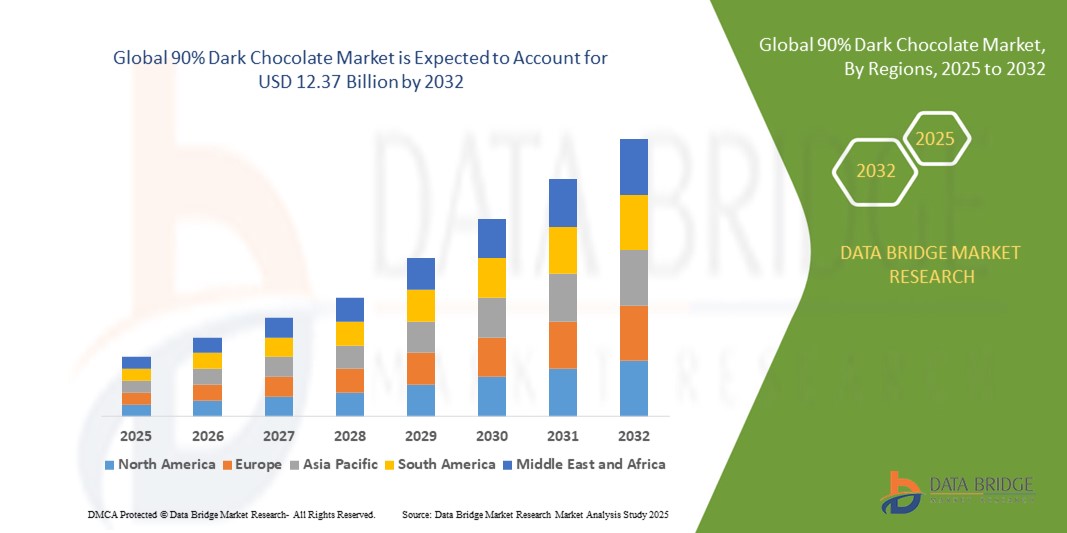
90% Dark Chocolate Market Size
- The global 90% dark chocolate market size was valued at USD 8.76 billion in 2024 and is expected to reach USD 12.37 billion by 2032, at a CAGR of 4.4% during the forecast period
- The market growth is largely fueled by the increasing consumer shift toward healthier indulgence options, with rising awareness of the health benefits associated with high-cocoa chocolate, including antioxidants, improved heart health, and reduced sugar intake. The growing demand for premium, low-sugar confectionery is positioning 90% dark chocolate as a preferred choice among health-conscious consumers across developed and emerging markets
- Furthermore, the surge in ethical and sustainable consumption is driving the adoption of 90% dark chocolate, as consumers increasingly value organic, Fairtrade-certified, and ethically sourced cocoa products. These converging factors are accelerating the uptake of high-cocoa dark chocolate, thereby significantly boosting the industry’s growth
90% Dark Chocolate Market Analysis
- 90% dark chocolate is a high-cocoa-content product that offers consumers an intense flavor profile with minimal sugar, appealing to those seeking both indulgence and functional health benefits. It is available across diverse formats, including bars, chips, bites, and blocks, catering to both retail consumption and food service applications
- The escalating demand for 90% dark chocolate is primarily fueled by rising health consciousness, a shift toward premium and artisanal chocolate products, and the growing popularity of plant-based and clean-label offerings. This trend is further supported by expanding retail penetration, strong e-commerce growth, and the continuous innovation of global and regional chocolate manufacturers
- Europe dominated the 90% dark chocolate market with a share of 48.39% in 2024, due to a strong tradition of premium chocolate consumption and consumer preference for high-cocoa, low-sugar varieties
- Asia-Pacific is expected to be the fastest growing region in the 90% dark chocolate market during the forecast period due to rapid urbanization, rising disposable incomes, and expanding awareness of healthier snacking options
- Solid segment dominated the market with a market share of 73% in 2024, due to its widespread consumer preference for ready-to-eat formats such as bars, blocks, and bites. Solid dark chocolate is convenient, portable, and offers longer shelf life compared to liquid formats, making it the most common choice for both daily indulgence and gifting. Established traditions of chocolate consumption in solid form, along with strong brand positioning of premium 90% dark chocolate bars, further reinforce this dominance. In addition, the availability of diverse pack sizes and attractive retail presentation contributes to its continued popularity among health-conscious consumers
Report Scope and 90% Dark Chocolate Market Segmentation
|
Attributes |
90% Dark Chocolate Key Market Insights |
|
Segments Covered |
|
|
Countries Covered |
North America
Europe
Asia-Pacific
Middle East and Africa
South America
|
|
Key Market Players |
|
|
Market Opportunities |
|
|
Value Added Data Infosets |
In addition to the insights on market scenarios such as market value, growth rate, segmentation, geographical coverage, and major players, the market reports curated by the Data Bridge Market Research also include in-depth expert analysis, pricing analysis, brand share analysis, consumer survey, demography analysis, supply chain analysis, value chain analysis, raw material/consumables overview, vendor selection criteria, PESTLE Analysis, Porter Analysis, and regulatory framework. |
90% Dark Chocolate Market Trends
Increasing Awareness of Ethical Sourcing and Sustainability
- The market for 90% dark chocolate is increasingly shaped by consumer awareness of ethical sourcing and sustainability practices. With rising concerns regarding fair trade, child labor, and environmental impact in cocoa farming, consumers are actively seeking brands that emphasize transparent supply chains and responsible sourcing
- For instance, Lindt & Sprüngli and Tony’s Chocolonely highlight their commitment to sustainable cocoa sourcing, ensuring traceability and fair payment systems for cocoa farmers. Similarly, Mondelez International’s Cocoa Life program invests in sustainable agriculture practices and community development to strengthen brand trust while aligning with ethical consumption values
- The trend is driven by growing environmental and social consciousness, particularly among premium chocolate buyers who associate sustainability with superior product value
- Certifications such as Fairtrade, Rainforest Alliance, and UTZ are increasingly influencing purchasing decisions, especially in developed markets
- In addition, sustainability-driven innovation in packaging—such as recyclable, compostable, or minimal-material solutions—is further reinforcing consumer trust. Many premium brands now pair ethical cocoa sourcing with eco-friendly packaging to advance their value proposition in the high-end chocolate category
- In summary, growing awareness of ethical sourcing and sustainability is redefining the positioning of 90% dark chocolate as not just a gourmet indulgence, but also a socially responsible and environmentally conscious purchase choice
90% Dark Chocolate Market Dynamics
Driver
Rising Demand for Gourmet and Artisan Chocolates
- The surging demand for gourmet and artisan chocolates is a major driver of growth in the 90% dark chocolate segment. Discerning consumers are increasingly drawn to products that offer authenticity, craftmanship, and premium taste experiences beyond mass-market varieties
- For instance, artisanal chocolatiers such as Valrhona and Domori specialize in high-cocoa-content chocolates with unique flavor profiles, attracting audiences seeking exclusivity and premium indulgence. Their emphasis on quality, origin-specific cocoa beans, and artisanal production processes strengthens appeal among gourmet consumers
- The expansion of specialty retail outlets, high-end cafes, and e-commerce platforms has made artisan dark chocolate more accessible, while gifting culture continues to fuel premium chocolate sales globally. Consumers view 90% dark chocolate as both a luxury product and a health-conscious indulgence due to its high antioxidant content and limited sugar
- In addition, culinary professionals and chefs increasingly use 90% dark chocolate in fine dining desserts and food pairings, further reinforcing its premium image. These factors are broadening the penetration of gourmet dark chocolate into both consumer and professional segments
- Overall, the preference for high-quality artisanal and gourmet products is directly driving the expansion of the 90% dark chocolate market, positioning it as a sophisticated indulgence for global consumers
Restraint/Challenge
High Cocoa Prices and Supply Chain Issues
- One of the most significant challenges for the 90% dark chocolate market is the volatility of cocoa prices and supply chain uncertainties. As cocoa is the primary raw material, price fluctuations directly impact production costs and profit margins for manufacturers, particularly in the high-cocoa-content segment
- For instance, West African countries such as Côte d’Ivoire and Ghana account for the majority of global cocoa supply, but political instability, adverse weather conditions, and farming inefficiencies often disrupt supply. These factors lead to unpredictable price surges and create significant cost pressure for manufacturers of premium chocolate
- In addition, global supply chain disruptions—ranging from logistics bottlenecks to rising transportation costs—have further complicated sourcing and delivery of raw cocoa. Smaller artisan producers are particularly affected, as they lack the scale to absorb rising input costs compared to multinational players
- The cost burden is often passed on to consumers through higher retail prices, which risks limiting demand for premium-priced 90% dark chocolate in price-sensitive regions. Market competition among brands also restricts the ability to pass on full cost increases, sharpening profitability pressures
- As a result, high cocoa prices and ongoing supply chain challenges remain structural restraints for the market. Addressing these risks will require diversified sourcing, long-term contracts with farmers, and investments in sustainable agriculture to stabilize supply and preserve market growth potential
90% Dark Chocolate Market Scope
The market is segmented on the basis of product type, packaging type, distribution channel, end-user, form, and consumer age group.
- By Product Type
On the basis of product type, the 90% dark chocolate market is segmented into organic and conventional. The conventional segment dominated the largest revenue share in 2024, primarily due to its wide availability and affordability across mainstream retail channels. Consumers often prefer conventional 90% dark chocolate because of its consistent taste profile, longer shelf life, and cost-effectiveness compared to organic variants. Strong global demand from established brands that mass-produce conventional dark chocolates continues to support this dominance, particularly in developed markets where brand loyalty is high.
The organic segment is expected to witness the fastest growth from 2025 to 2032, driven by rising consumer preference for clean-label, sustainable, and ethically sourced chocolate products. Increasing awareness about the health benefits of minimally processed cocoa and the demand for chemical-free farming practices are fueling organic adoption. Premium positioning of organic chocolates, coupled with higher disposable incomes and willingness to pay for healthier indulgence, is further accelerating growth, particularly in North America and Europe.
- By Packaging Type
On the basis of packaging type, the 90% dark chocolate market is segmented into bars, chips, bites, and blocks. The bars segment held the largest market revenue share in 2024, as chocolate bars remain the most traditional and widely recognized format for consumption. Their convenience, portability, and established acceptance in both retail and gifting segments make them a consistent choice for consumers worldwide. Leading chocolate manufacturers primarily launch new 90% dark chocolate products in bar formats, which further reinforces their market dominance.
The chips segment is anticipated to register the fastest growth from 2025 to 2032, supported by the booming home-baking trend and growing use of dark chocolate chips in confectionery and desserts. Consumers are increasingly experimenting with healthier baking ingredients, and 90% dark chocolate chips are gaining popularity for their rich cocoa flavor and reduced sugar content. The rise of online recipe-sharing platforms and specialty bakeries incorporating high-cocoa chips in cookies and pastries is further driving demand.
- By Distribution Channel
On the basis of distribution channel, the 90% dark chocolate market is segmented into supermarkets/hypermarkets, specialty stores, online retail, and convenience stores. Supermarkets/hypermarkets dominated the largest revenue share in 2024, owing to their extensive product assortments, attractive shelf placements, and consumer trust in established retail networks. Bulk purchasing options, promotional discounts, and in-store tastings further enhance consumer preference for this channel. Established brands rely heavily on supermarkets to build visibility and brand recall among mass consumers.
Online retail is projected to witness the fastest growth between 2025 and 2032, driven by the rising trend of e-commerce shopping and direct-to-consumer sales models. Increasing digital literacy, smartphone penetration, and doorstep delivery convenience are boosting online chocolate purchases. Specialty dark chocolate brands are also leveraging online channels to target niche health-conscious consumers, offering subscription boxes, limited-edition variants, and personalized packaging, which is fueling rapid growth in this segment.
- By End-User
On the basis of end-user, the 90% dark chocolate market is segmented into retail consumers and the food service industry. Retail consumers accounted for the largest revenue share in 2024, as individual consumption for indulgence, gifting, and health benefits continues to dominate sales volumes. Growing interest in high-cocoa chocolates as a source of antioxidants and a low-sugar alternative to regular sweets makes it a preferred choice among health-conscious buyers. The availability of diverse retail pack sizes also supports retail consumer dominance.
The food service industry is expected to record the fastest growth from 2025 to 2032, fueled by the incorporation of 90% dark chocolate in premium desserts, beverages, and gourmet recipes across restaurants, cafés, and bakeries. The trend of artisanal and craft chocolate creations has accelerated demand within this segment. As hospitality operators increasingly focus on offering healthier indulgent menu options, the demand for high-cocoa dark chocolate as a key ingredient is rising significantly.
- By Form
On the basis of form, the 90% dark chocolate market is segmented into solid and liquid. The solid form dominated the largest revenue share of 73% in 2024, driven by its widespread consumer preference for ready-to-eat formats such as bars, blocks, and bites. Solid dark chocolate is convenient, portable, and offers longer shelf life compared to liquid formats, making it the most common choice for both daily indulgence and gifting. Established traditions of chocolate consumption in solid form, along with strong brand positioning of premium 90% dark chocolate bars, further reinforce this dominance. In addition, the availability of diverse pack sizes and attractive retail presentation contributes to its continued popularity among health-conscious consumers.
The liquid form is anticipated to witness the fastest growth rate from 2025 to 2032, driven by increasing demand for liquid chocolate in sauces, beverages, and dessert toppings. Food manufacturers are innovating with liquid dark chocolate for ready-to-drink cocoa beverages and premium toppings, appealing to both household and commercial users. The growing café culture and indulgent beverage trend worldwide are expected to accelerate the use of liquid 90% dark chocolate in the coming years.
- By Consumer Age Group
On the basis of consumer age group, the 90% dark chocolate market is segmented into children, adults, and seniors. Adults dominated the market share in 2024, as this group is more health-conscious and inclined toward premium, low-sugar chocolate options. Adults often perceive 90% dark chocolate as both an indulgence and a functional food, balancing taste with health benefits such as improved heart health and antioxidants. Strong marketing by premium brands targeting adult lifestyles has further cemented this dominance.
The seniors segment is projected to experience the fastest growth between 2025 and 2032, supported by the rising awareness of the potential cognitive and cardiovascular benefits of consuming high-cocoa dark chocolate. Seniors are increasingly turning to dark chocolate as a healthier alternative to sugary treats, encouraged by its association with improved memory and mood regulation. The expansion of functional chocolate offerings tailored to senior health needs is expected to further support growth in this category.
90% Dark Chocolate Market Regional Analysis
- Europe dominated the 90% dark chocolate market with the largest revenue share of 48.39% in 2024, driven by a strong tradition of premium chocolate consumption and consumer preference for high-cocoa, low-sugar varieties
- The region’s established artisanal chocolate culture, combined with a growing awareness of health benefits linked to dark chocolate, supports sustained demand. European consumers are highly inclined toward ethical sourcing and sustainable production, making certifications such as Fairtrade and organic key drivers in shaping purchasing decisions
- Robust retail networks, coupled with rising innovation in premium and specialty chocolate segments, further cement Europe’s leadership in the market
U.K. 90% Dark Chocolate Market Insight
The U.K. market is expected to grow steadily during the forecast period, driven by the increasing popularity of premium, high-cocoa chocolates among health-conscious consumers. The rising demand for low-sugar indulgence, coupled with the strong presence of specialty chocolate brands, is fueling adoption. The U.K.’s thriving e-commerce ecosystem also supports online retail expansion, enabling broader access to niche and premium chocolate products, particularly those marketed as organic or ethically sourced.
Germany 90% Dark Chocolate Market Insight
The Germany market is anticipated to expand at a notable CAGR during the forecast period, supported by strong consumer preference for high-quality, sustainably sourced chocolate. Germany’s long-standing tradition in chocolate manufacturing, combined with its emphasis on innovation in flavors and formats, positions it as a key contributor within Europe. Health-conscious consumers in Germany are increasingly shifting toward higher cocoa content, with 90% dark chocolate perceived as both a premium indulgence and a functional food.
North America 90% Dark Chocolate Market Insight
The North America market captured a significant revenue share in 2024, fueled by the growing consumer inclination toward healthier indulgence and reduced sugar intake. The trend of plant-based diets, combined with a preference for antioxidant-rich foods, is boosting the demand for 90% dark chocolate. Retailers and specialty stores are expanding premium product assortments, while marketing campaigns highlight the health and wellness benefits of high-cocoa chocolates, strengthening adoption across the U.S. and Canada.
U.S. 90% Dark Chocolate Market Insight
The U.S. dominated the North America market with a revenue share in 2024, driven by strong consumer awareness of dark chocolate’s health benefits and the rising popularity of artisanal and craft chocolate brands. Increasing demand for ethically sourced and organic offerings, combined with the expansion of premium retail chains and online platforms, continues to fuel growth. The country’s rising fitness and wellness culture has further positioned 90% dark chocolate as a desirable alternative to conventional sweets.
Asia-Pacific 90% Dark Chocolate Market Insight
The Asia-Pacific market is projected to grow at the fastest CAGR from 2025 to 2032, driven by rapid urbanization, rising disposable incomes, and expanding awareness of healthier snacking options. Countries such as Japan, China, and India are witnessing a surge in demand for premium chocolates, supported by the rising middle class and the growing gifting culture. Expanding retail penetration and e-commerce platforms are increasing accessibility to premium imported brands, while local manufacturers are introducing high-cocoa chocolate variants to cater to health-conscious consumers.
China 90% Dark Chocolate Market Insight
China accounted for the largest share within Asia-Pacific in 2024, supported by a rapidly expanding middle-class population, urban lifestyle shifts, and increasing exposure to Western chocolate consumption trends. The market is witnessing strong growth in premium and imported chocolate products, with younger consumers driving demand for healthier, low-sugar indulgence. E-commerce channels and cross-border retail platforms are accelerating the availability of international 90% dark chocolate brands in China.
Japan 90% Dark Chocolate Market Insight
Japan is emerging as a key growth market within Asia-Pacific, fueled by its deep-rooted culture of innovation in food and strong consumer openness to premium indulgence products. Japanese consumers are increasingly seeking high-cocoa chocolate for its health benefits, particularly linked to heart health and cognitive well-being. The country’s aging population is also contributing to rising consumption, with seniors adopting 90% dark chocolate as part of a healthier dietary routine.
90% Dark Chocolate Market Share
The 90% dark chocolate industry is primarily led by well-established companies, including:
- Cemoi Chocolatier (France)
- Republica del Cacao (Ecuador)
- Nestlé S.A. (Switzerland)
- Mars, Incorporated (U.S.)
- Guittard Chocolate Co. (U.S.)
- Ghirardelli Chocolate Co. (U.S.)
- Valrhona Inc. (France)
- Barry Callebaut AG (Switzerland)
- Alpezzi Chocolate
- Kerry Group Plc (Ireland)
- Olam International Ltd. (Singapore)
- Tcho Ventures Inc. (U.S.)
- The Hershey Company (U.S.)
- Cargill, Incorporated (U.S.)
- Blommer Chocolate Company (U.S.)
- Ferrero International S.A. (Italy)
Latest Developments in Global 90% Dark Chocolate Market
- In December 2023, chocolate giant Lindt partnered with German cocoa-free brand ChoViva to introduce a limited-edition vegan chocolate bar for Veganuary. With only 1,000 units of the Soft & Creamy Hazelnut bars produced, the launch highlighted Lindt’s growing focus on sustainability and plant-based indulgence. This move signals a rising trend of premium brands experimenting with vegan alternatives, which is expected to strengthen consumer interest in ethical and innovative chocolate offerings, including high-cocoa dark chocolates
- In September 2023, Mondelez International expanded its Green & Black’s portfolio by unveiling new premium dark chocolate variants with higher cocoa percentages, including products approaching the 90% mark. The launch targeted consumers shifting toward bold, intense flavors and healthier chocolate alternatives. This expansion reinforced the mainstream acceptance of high-cocoa chocolates, paving the way for wider market penetration of 90% dark chocolate
- In June 2022, Barry Callebaut introduced its “Second Generation” chocolate, which uses a new processing method to naturally preserve more cocoa flavor and nutrients while reducing sugar content. The innovation directly supports the demand for high-cocoa chocolates such as 90% dark, as it enhances flavor intensity and health benefits without additional sweeteners. This advancement is expected to set a new benchmark for premium dark chocolate manufacturing, influencing global brand formulations
- In February 2022, Nestlé launched its first 100% plant-based KitKat in several European markets, marking its entry into the vegan chocolate space with a product close in spirit to high-cocoa dark chocolate. Though positioned as vegan, the innovation reflects broader consumer demand for ethical, healthier, and intense chocolate experiences. This shift indirectly boosts the visibility and acceptance of 90% dark chocolate as a premium, functional indulgence
- In April 2021, SkinnyDipped launched low-sugar chocolate bars and peanut butter cups, containing up to 79% less sugar than leading brands and crafted without stevia or sugar alcohols. Marketed as more delicious than traditional options, the products reflected the brand’s strategy to meet rising consumer demand for better-for-you snacking. This development accelerated the positioning of 90% dark chocolate as a desirable option for health-conscious buyers seeking low-sugar indulgence

- Interactive Data Analysis Dashboard
- Company Analysis Dashboard for high growth potential opportunities
- Research Analyst Access for customization & queries
- Competitor Analysis with Interactive dashboard
- Latest News, Updates & Trend analysis
- Harness the Power of Benchmark Analysis for Comprehensive Competitor Tracking
Global 90 Dark Chocolate Market, Supply Chain Analysis and Ecosystem Framework
To support market growth and help clients navigate the impact of geopolitical shifts, DBMR has integrated in-depth supply chain analysis into its Global 90 Dark Chocolate Market research reports. This addition empowers clients to respond effectively to global changes affecting their industries. The supply chain analysis section includes detailed insights such as Global 90 Dark Chocolate Market consumption and production by country, price trend analysis, the impact of tariffs and geopolitical developments, and import and export trends by country and HSN code. It also highlights major suppliers with data on production capacity and company profiles, as well as key importers and exporters. In addition to research, DBMR offers specialized supply chain consulting services backed by over a decade of experience, providing solutions like supplier discovery, supplier risk assessment, price trend analysis, impact evaluation of inflation and trade route changes, and comprehensive market trend analysis.
Data collection and base year analysis are done using data collection modules with large sample sizes. The stage includes obtaining market information or related data through various sources and strategies. It includes examining and planning all the data acquired from the past in advance. It likewise envelops the examination of information inconsistencies seen across different information sources. The market data is analysed and estimated using market statistical and coherent models. Also, market share analysis and key trend analysis are the major success factors in the market report. To know more, please request an analyst call or drop down your inquiry.
The key research methodology used by DBMR research team is data triangulation which involves data mining, analysis of the impact of data variables on the market and primary (industry expert) validation. Data models include Vendor Positioning Grid, Market Time Line Analysis, Market Overview and Guide, Company Positioning Grid, Patent Analysis, Pricing Analysis, Company Market Share Analysis, Standards of Measurement, Global versus Regional and Vendor Share Analysis. To know more about the research methodology, drop in an inquiry to speak to our industry experts.
Data Bridge Market Research is a leader in advanced formative research. We take pride in servicing our existing and new customers with data and analysis that match and suits their goal. The report can be customized to include price trend analysis of target brands understanding the market for additional countries (ask for the list of countries), clinical trial results data, literature review, refurbished market and product base analysis. Market analysis of target competitors can be analyzed from technology-based analysis to market portfolio strategies. We can add as many competitors that you require data about in the format and data style you are looking for. Our team of analysts can also provide you data in crude raw excel files pivot tables (Fact book) or can assist you in creating presentations from the data sets available in the report.













