


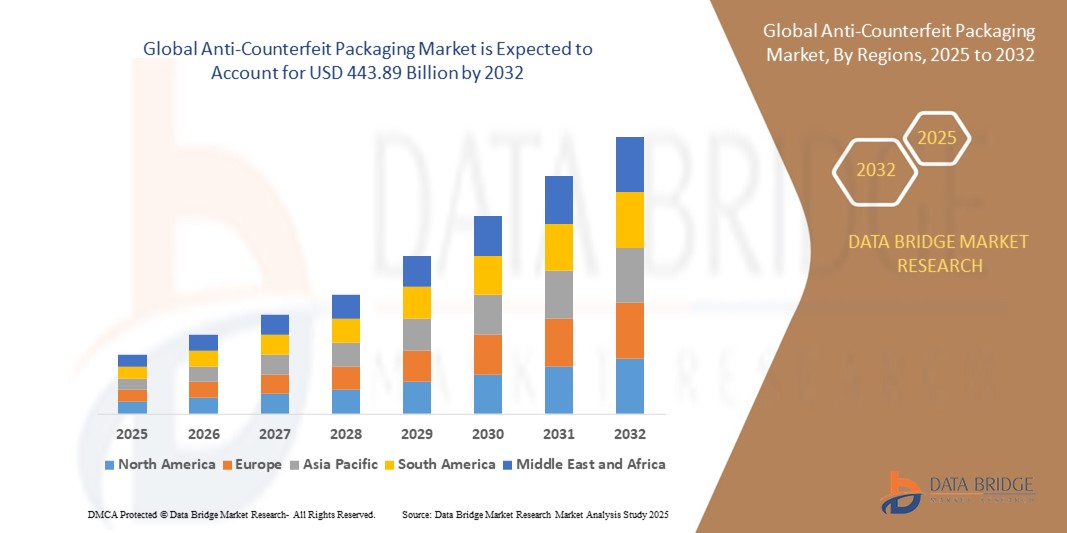
Anti-Counterfeit Packaging Market Size
- The global Anti-counterfeit Packaging market size was valued at USD 169.35 billion in 2024 and is expected to reach USD 443.89 billion by 2032, at a CAGR of 20.10% during the forecast period
- This growth is primarily driven by increased regulatory pressure, brand protection initiatives, and the rising incidence of counterfeiting, especially across the pharmaceutical, food & beverage, and electronics sectors
- In addition, technological advancements such as RFID, barcoding, security inks, and holograms are being rapidly adopted to ensure product authenticity and integrity, fueling market expansion significantly
Anti-Counterfeit Packaging Market Analysis
- Anti-Counterfeit Packaging, offering electronic or digital access control for doors and gates, are increasingly vital components of modern home security and automation systems in both residential and commercial settings due to their enhanced convenience, remote access capabilities, and seamless integration with smart home ecosystems
- The escalating demand for anti-counterfeit packaging is primarily fueled by the widespread adoption of smart home technologies, growing security concerns among consumers, and a rising preference for the convenience of keyless entry
- North America dominates the anti-counterfeit packaging market with a revenue share of 43.31% in 2024, driven by strict regulatory mandates and increasing incidences of product counterfeiting across various industries
- Asia-Pacific is forecasted to grow at the fastest CAGR of 24.25% from 2025 to 2032, fueled by economic expansion, rising awareness, and government initiatives across China, India, and Southeast Asia
- The RFID segment dominated with the largest market revenue share of 48.26% in 2024, driven by its superior tracking capabilities, real-time inventory monitoring, and widespread adoption across various industries to enhance supply chain transparency
Report Scope and Anti-Counterfeit Packaging Market Segmentation
|
Attributes |
Anti-Counterfeit Packaging Key Market Insights |
|
Segments Covered |
|
|
Countries Covered |
North America
Europe
Asia-Pacific
Middle East and Africa
South America
|
|
Key Market Players |
|
|
Market Opportunities |
|
|
Value Added Data Infosets |
In addition to the insights on market scenarios such as market value, growth rate, segmentation, geographical coverage, and major players, the market reports curated by the Data Bridge Market Research also include in-depth expert analysis, pricing analysis, brand share analysis, consumer survey, demography analysis, supply chain analysis, value chain analysis, raw material/consumables overview, vendor selection criteria, PESTLE Analysis, Porter Analysis, and regulatory framework. |
Anti-Counterfeit Packaging Market Trends
“Rising Adoption of Track-and-Trace and Blockchain Technologies”
- A prominent trend shaping the global anti-counterfeit packaging market is the increasing incorporation of track-and-trace systems and blockchain technologies to ensure transparency, security, and authenticity across supply chains. These technologies are enhancing real-time monitoring and verification, making it significantly more difficult for counterfeit products to penetrate the market
- For instance, companies such as SICPA HOLDING SA are deploying blockchain-backed ink and trackable codes, allowing end-users to instantly authenticate products using mobile apps. Similarly, UbiQD Inc., in partnership with SICPA, utilizes quantum dot technology for high-security inks with unique optical properties
- Blockchain solutions provide tamper-proof records of product origins, shipping, and transactions, giving manufacturers and consumers greater confidence in product authenticity. These decentralized systems also help regulatory authorities track non-compliant or counterfeit goods
- The adoption of these technologies is particularly strong in pharmaceuticals, food & beverage, and luxury goods, where consumer safety and brand trust are paramount
- As digital supply chain integration grows, manufacturers across industries are expected to invest more in blockchain-enabled anti-counterfeit packaging solutions to meet both regulatory compliance and consumer expectations
- This shift toward data-driven, transparent packaging systems is redefining how industries combat counterfeiting and safeguard their products globally
Anti-Counterfeit Packaging Market Dynamics
Driver
“Increased Regulatory Pressure and Brand Protection Initiatives”
- Stringent global regulations and growing pressure on manufacturers to protect brand integrity and consumer safety are significantly driving the demand for anti-counterfeit packaging solutions. As counterfeit incidents grow in volume and sophistication, industries are prioritizing robust packaging solutions to detect and deter illicit products
- For instance, in November 2022, Holostik India launched Optashield, a high-security holographic solution that displays two distinct colors from different angles, offering a simple yet effective anti-counterfeit mechanism
- Governments worldwide, including the U.S. FDA and the European Medicines Agency, have implemented serialization mandates for pharmaceuticals, requiring unique identifiers on packaging for traceability. These measures are encouraging companies to adopt security labels, tamper-evident seals, and authentication technologies
- Furthermore, industries such as automotive, electronics, and cosmetics are increasingly deploying anti-counterfeit packaging to safeguard intellectual property and ensure consumer trust
- With rising e-commerce penetration, where counterfeit risks are higher due to decentralized logistics, manufacturers are strengthening packaging strategies as a critical layer of defense against fakes
- As regulatory and consumer expectations continue to evolve, companies across sectors are making anti-counterfeit packaging a strategic imperative, accelerating market expansion globally
Restraint/Challenge
“High Costs and Technological Integration Barriers”
- Despite growing demand, the widespread adoption of anti-counterfeit packaging faces challenges such as high implementation costs and integration complexity for small-to-medium enterprises. Advanced technologies such as RFID tags, holograms, and blockchain can be capital-intensive to deploy at scale
- For instance, brands looking to implement serialized QR-code authentication may face significant investment in software, printing infrastructure, and staff training, which can be prohibitive, especially in cost-sensitive markets
- In addition, seamless integration of these solutions into existing packaging and logistics operations remains a challenge. Companies lacking in-house tech capabilities may experience longer implementation times and dependency on third-party vendors
- Compatibility issues with legacy systems, limited digital literacy in some regions, and concerns about ROI further limit market penetration, particularly in developing countries or within fragmented supply chains
- To overcome these hurdles, vendors are developing modular and scalable solutions, offering cost-effective authentication tools that are easier to adopt for smaller enterprises. Partnerships and industry alliances are also helping spread adoption
- Addressing these cost and integration barriers will be essential to unlocking the full growth potential of anti-counterfeit packaging solutions and ensuring global market reach
Anti-Counterfeit Packaging Market Scope
The market is segmented on the basis of technology, packaging format, and end-use.
• By Technology
On the basis of technology, the anti-counterfeit packaging market is segmented into RFID, Security Inks and Coatings, Security Seals, Holograms, Mass Encryption, Barcode, and Mass Serialization. The RFID segment dominated with the largest market revenue share of 48.26% in 2024, driven by its superior tracking capabilities, real-time inventory monitoring, and widespread adoption across various industries to enhance supply chain transparency. RFID provides unique item-level identification, reducing the risks associated with counterfeiting and diversion.
The Mass Serialization segment is expected to witness the fastest CAGR from 2025 to 2032, driven by tightening global regulations, especially in the pharmaceutical and food sectors. Serialization allows products to be uniquely identified and traced throughout the supply chain, improving recall efficiency and consumer safety while meeting regulatory compliance standards.
• By Packaging Format
On the basis of packaging format, the anti-counterfeit packaging market is segmented into Bottles and Jars, Vials and Ampoules, Blisters, Trays, Pouches and Sachets, and Others. The Blisters segment held the largest market revenue share in 2024, attributed to their wide usage in the pharmaceutical and healthcare industries for unit-dose packaging and their effectiveness in tamper-evidence and protection. The structured format of blister packs enhances product integrity and visibility, making counterfeiting more difficult.
The Pouches and Sachets segment is projected to witness the fastest CAGR from 2025 to 2032, due to increasing applications in the food, cosmetics, and nutraceuticals sectors. Their lightweight, flexible, and customizable nature makes them ideal for incorporating anti-counterfeit features such as QR codes, holograms, or barcodes, enhancing both security and consumer engagement.
• By End-Use
On the basis of end-use, the anti-counterfeit packaging market is segmented into Food and Beverage, Healthcare, Automotive, Personal Care and Cosmetics, Electrical and Electronics, and Other Industrial. The Healthcare segment accounted for the largest market revenue share of 27.22% in 2024, owing to strict regulatory requirements, high risk of counterfeiting in pharmaceuticals, and the need to maintain drug integrity across global supply chains. Anti-counterfeit solutions in this sector are crucial to ensuring patient safety and brand protection.
The Food and Beverage segment is expected to witness the fastest CAGR from 2025 to 2032, supported by rising concerns over food fraud, increasing consumer demand for transparency, and global expansion of food trade. Brands are increasingly implementing tamper-evident and track-and-trace technologies to ensure product authenticity and build consumer trust.
Anti-Counterfeit Packaging Market Regional Analysis
- North America dominates the anti-counterfeit packaging market with a revenue share of 43.31% in 2024, driven by strict regulatory mandates and increasing incidences of product counterfeiting across various industries
- The region benefits from strong government initiatives aimed at supply chain transparency and product traceability, especially in pharmaceuticals and food & beverages
- The growth is further supported by the presence of major technology providers, advanced infrastructure, and a rising demand for secure packaging across e-commerce and retail sectors
U.S. Anti-Counterfeit Packaging Market Insight
The U.S. dominates the North American region with 81% market share in 2024, driven by its robust pharmaceutical industry and the early adoption of track-and-trace technologies. Heightened consumer awareness and legal enforcement of serialization in medical products have significantly contributed to market growth. Continued investments in R&D and the presence of key players offering cutting-edge authentication technologies further reinforce the U.S. market's leadership.
Europe Anti-Counterfeit Packaging Market Insight
Europe is projected to grow at a steady CAGR during the forecast period, owing to stringent regulations such as the EU Falsified Medicines Directive (FMD) and increasing counterfeit risks in high-value goods. The regional demand is influenced by compliance-focused industries such as healthcare, cosmetics, and wine & spirits. A growing focus on sustainability and eco-friendly authentication technologies is also gaining traction in this market.
U.K. Anti-Counterfeit Packaging Market Insight
The U.K. is anticipated to witness strong growth due to increased e-commerce activity and high consumer concern over authenticity in retail products. Regulatory frameworks and initiatives promoting digital product verification tools are driving the adoption of anti-counterfeit solutions. Rising investments by packaging manufacturers in the U.K. are fostering innovation in smart labeling and tamper-evident solutions.
Germany Anti-Counterfeit Packaging Market Insight
Germany is expected to register significant growth, backed by technological advancements and the strong presence of the automotive and pharmaceutical industries. The German market emphasizes traceability, product integrity, and data security, all of which align with the increasing demand for anti-counterfeiting technologies. Innovation hubs and strategic partnerships among domestic firms are also propelling market development.
Asia-Pacific Anti-Counterfeit Packaging Market Insight
Asia-Pacific is forecasted to grow at the fastest CAGR of 24.25% from 2025 to 2032, fueled by economic expansion, rising awareness, and government initiatives across China, India, and Southeast Asia. Rapid industrialization, growing middle-class income, and the surge in counterfeit incidents across consumer goods are major growth drivers. The region is also emerging as a production base for low-cost anti-counterfeit solutions, thereby enhancing affordability and adoption.
China Anti-Counterfeit Packaging Market Insight
China holds the largest revenue share in the Asia-Pacific region, propelled by massive manufacturing activities, government crackdowns on fake goods, and high digital adoption. Growth is supported by national serialization mandates in the pharmaceutical industry and a strong focus on consumer protection in luxury and retail markets. Local firms are innovating rapidly with QR code, blockchain, and AI-powered packaging technologies to serve domestic and global markets.
Japan Anti-Counterfeit Packaging Market Insight
Japan is witnessing steady growth due to its technologically advanced infrastructure, aging population, and preference for secure and traceable packaging. The integration of IoT-enabled anti-counterfeit systems is gaining popularity, especially in healthcare and electronics sectors. Increasing collaborations between packaging companies and tech firms are enhancing the market’s capability to tackle counterfeit threats through smart packaging innovations.
Anti-Counterfeit Packaging Market Share
The anti-counterfeit packaging industry is primarily led by well-established companies, including:
- Avery Dennison Corporation (U.S.)
- 3M (U.S.)
- CCL Industries (Canada)
- DuPont (U.S.)
- Zebra Technologies Corp. (U.S.)
- SATO Corporation (Japan)
- AlpVision (U.S.)
- Tageos (France)
- Identiv, Inc. (U.S.)
- GlobeRanger (U.S.)
- HID Global Corporation (U.S.)
- ASSA ABLOY (Sweden)
- RFID Global Solution (U.S.)
- Checkpoint Systems, Inc. (U.S.)
- SICPA HOLDING SA (Switzerland)
- 3D AG (Switzerland)
- Impinj, Inc. (U.S.)
Latest Developments in Global Anti-Counterfeit Packaging Market
- In November 2022, Holostik India unveiled Optashield, a cutting-edge anti-counterfeiting solution, at the Label India Expo 2022. This advanced product features custom holographic technology that displays two distinct colors when viewed from different angles, enhancing product authentication security. This launch reinforces Holostik’s commitment to innovation in tamper-proof packaging technologies
- In September 2022, UbiQD, Inc., a nanotechnology firm based in New Mexico, and SICPA HOLDING SA, a Swiss leader in security inks, expanded their strategic partnership to develop anti-counterfeit security inks. The initiative leverages UbiQD's quantum dot technology, which offers high-efficiency photoluminescence across a broad color spectrum. This collaboration strengthens both companies' positions in next-generation optical authentication
- In June 2022, Exxon Mobil Corporation introduced a revamped Mobil Super lubricant product line featuring QR-code-based anti-counterfeit packaging. The initiative enables consumers to verify product authenticity through smartphone scanning, aiming to curb counterfeit lubricant sales. This move reflects ExxonMobil’s proactive approach toward consumer trust and brand protection
- In September 2021, Systech announced the expansion of its UniSecure platform into the food and beverage sector during its participation at AIPIA. Known for traceability and anti-counterfeiting in the pharmaceutical space, the platform now targets broader industry applications. This extension highlights Systech’s adaptability in securing diverse global supply chains
- In February 2021, Covectra launched an upgraded version of its StellaGuard solution, a smart label and mobile authentication system. The technology empowers brands, retailers, and consumers to validate and track items such as pharmaceuticals in real-time using mobile devices. This update strengthens Covectra’s mission to combat counterfeiting through user-friendly tech innovation

- Interactive Data Analysis Dashboard
- Company Analysis Dashboard for high growth potential opportunities
- Research Analyst Access for customization & queries
- Competitor Analysis with Interactive dashboard
- Latest News, Updates & Trend analysis
- Harness the Power of Benchmark Analysis for Comprehensive Competitor Tracking
Global Anti Counterfeit Packaging Market, Supply Chain Analysis and Ecosystem Framework
To support market growth and help clients navigate the impact of geopolitical shifts, DBMR has integrated in-depth supply chain analysis into its Global Anti Counterfeit Packaging Market research reports. This addition empowers clients to respond effectively to global changes affecting their industries. The supply chain analysis section includes detailed insights such as Global Anti Counterfeit Packaging Market consumption and production by country, price trend analysis, the impact of tariffs and geopolitical developments, and import and export trends by country and HSN code. It also highlights major suppliers with data on production capacity and company profiles, as well as key importers and exporters. In addition to research, DBMR offers specialized supply chain consulting services backed by over a decade of experience, providing solutions like supplier discovery, supplier risk assessment, price trend analysis, impact evaluation of inflation and trade route changes, and comprehensive market trend analysis.
Data collection and base year analysis are done using data collection modules with large sample sizes. The stage includes obtaining market information or related data through various sources and strategies. It includes examining and planning all the data acquired from the past in advance. It likewise envelops the examination of information inconsistencies seen across different information sources. The market data is analysed and estimated using market statistical and coherent models. Also, market share analysis and key trend analysis are the major success factors in the market report. To know more, please request an analyst call or drop down your inquiry.
The key research methodology used by DBMR research team is data triangulation which involves data mining, analysis of the impact of data variables on the market and primary (industry expert) validation. Data models include Vendor Positioning Grid, Market Time Line Analysis, Market Overview and Guide, Company Positioning Grid, Patent Analysis, Pricing Analysis, Company Market Share Analysis, Standards of Measurement, Global versus Regional and Vendor Share Analysis. To know more about the research methodology, drop in an inquiry to speak to our industry experts.
Data Bridge Market Research is a leader in advanced formative research. We take pride in servicing our existing and new customers with data and analysis that match and suits their goal. The report can be customized to include price trend analysis of target brands understanding the market for additional countries (ask for the list of countries), clinical trial results data, literature review, refurbished market and product base analysis. Market analysis of target competitors can be analyzed from technology-based analysis to market portfolio strategies. We can add as many competitors that you require data about in the format and data style you are looking for. Our team of analysts can also provide you data in crude raw excel files pivot tables (Fact book) or can assist you in creating presentations from the data sets available in the report.













