


What is the Access Control Systems Market Size and Growth Rate?
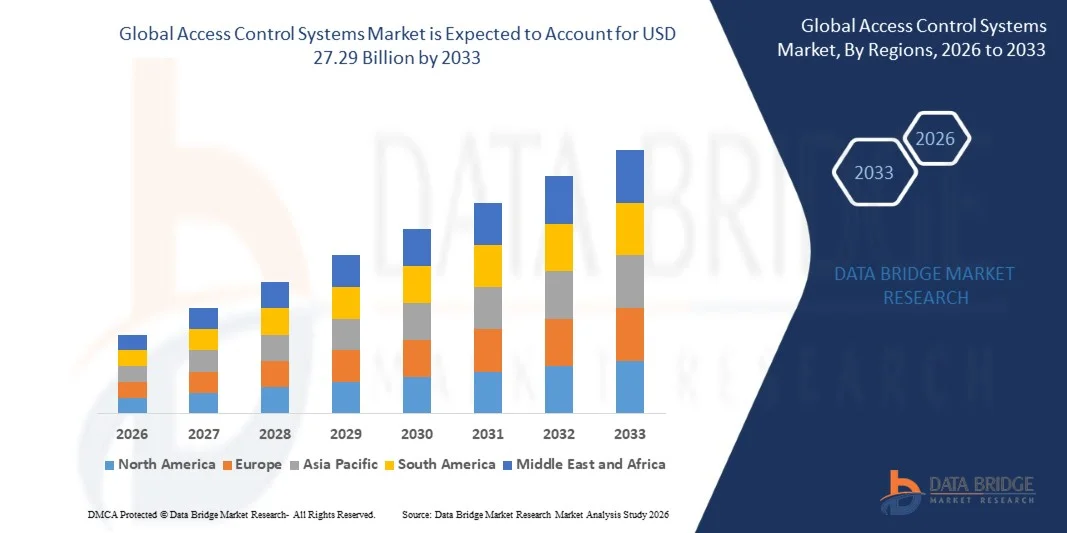
- As per Data Bridge Market Research analysis, the access control systems market was valued at USD 13.80 billion in 2025 and is projected to reach USD 27.29 billion by 2033, growing at a CAGR of 8.90% from 2026 to 2033.
- The market is experiencing consistent growth driven by rising concerns regarding physical security, increasing adoption of digital access control technologies, and growing demand for advanced identity authentication systems across commercial, industrial, government, and residential sectors.
- The increasing incidents of unauthorized access, data breaches, workplace security threats, and cyber-physical security risks, combined with the growing need for centralized security management, are compelling enterprises, government institutions, healthcare facilities, and transportation hubs to deploy advanced access control systems. Biometric authentication systems, mobile-based access control platforms, and cloud-integrated security solutions are increasingly replacing traditional lock-and-key mechanisms, offering enhanced security, centralized management, operational efficiency, and seamless user authentication across modern infrastructure environments.
Market Size & Forecast
- Global Market Value (2025): USD 13.80 Billion
- Expected Market Value (2033): USD 27.29 Billion
- Forecast CAGR (2026–2033): 8.90%
- Leading Region in 2025: North America
- Fastest Growing Region: Asia Pacific
What are the Major Takeaways of the Access Control Systems Market?
- North America dominated the access control systems market with the largest revenue share of 38.0% in 2025, supported by advanced security infrastructure, stringent regulatory requirements, and strong adoption of biometric, cloud-based, and multi-factor access control solutions.
- Asia-Pacific is expected to be the fastest-growing region at a CAGR of 10.1% from 2026 to 2033, fueled by rapid urbanization, smart city initiatives, expanding commercial infrastructure, and rising investments in digital security technologies across China, India, Japan, and Southeast Asia.
- The hardware segment led the market with a 60% share in 2025, driven by the essential role of readers, electronic locks, controllers, and other physical devices in access control deployments.
- Software are the fastest-growing component type, projected to register a CAGR of 10.5%, reflecting the surge in demand for centralized access management, cloud connectivity, analytics, and integration with broader security platforms.
- The card-based credential systems segment dominated the credential technology category with a 45% revenue share in 2025, led by its established installed base and broad compatibility with existing access control infrastructure.
- Networked wired systems accounted for 40% of the market share in 2025, preferred by reliable connectivity and established use across enterprise and security-sensitive facilities.
- The hybrid software deployment segment is the fastest-growing deployment mode category, with a CAGR of 8.4%, driven by organizations seeking to combine cloud-based capabilities with existing on-premise infrastructure.
Report Scope and Access Control Systems Market Segmentation
|
Attributes |
Access Control Systems Key Market Insights |
|
Segments Covered |
|
|
Countries Covered |
North America
Europe
Asia-Pacific
Middle East and Africa
South America
|
|
Key Market Players |
|
|
Market Opportunities |
|
|
Value Added Data Infosets |
In addition to the market insights such as market value, growth rate, market segments, geographical coverage, market players, and market scenario, the market report curated by the Data Bridge Market Research team includes in-depth expert analysis, import/export analysis, pricing analysis, production consumption analysis, and pestle analysis. |
What is the Key Trend in the Access Control Systems Market?
- Organizations are increasingly adopting mobile credentials, biometrics, and software-driven access platforms to improve security, convenience, and centralized management across workplaces, campuses, commercial facilities, government environments, and critical infrastructure sites.
- For instance, in February 2025, HID reported that 61% of security leaders identified mobile credential proliferation as a top trend, while 35% of respondents were already using biometric technology and 13% planned adoption across their organizations worldwide.
- Unified security platforms are enabling organizations to connect access control with video surveillance, intrusion detection, analytics, and identity management.
- Cloud-managed access control is increasingly supporting scalable administration, remote monitoring, and modernization of existing physical security infrastructure across distributed facilities and multi-site enterprise operations with centralized administration capabilities.
- For instance, in February 2025, Genetec introduced Cloudlink 210, a cloud-managed appliance supporting video management, access control, and intrusion detection while bridging on-premises systems with cloud environments for more flexible security management.
- As organizations prioritize seamless authentication, interoperability, and centralized security operations, adoption of mobile, biometric, AI-enabled, and cloud-connected access control technologies is expected to accelerate across modern physical security environments globally, supporting more integrated and responsive security management.
What are the Key Drivers of the Access Control Systems Market?
- The increasing need to protect workplaces, critical infrastructure, healthcare facilities, and sensitive assets from unauthorized entry is significantly increasing demand for advanced access control systems with stronger identity verification and centralized security management and connected buildings and campuses.
- For instance, in February 2025, HID reported that 73% of security leaders prioritized software-driven unified solutions, while 73% considered unifying multiple security data sources important for improving security operations globally today.
- Organizations are integrating access control with video surveillance, intrusion detection, identity management, and analytics to improve situational awareness, automate security workflows, and strengthen facility protection across complex sites.
- For instance, in April 2025, HID introduced new access technologies including mobile access, multi-factor authentication readers, and device-management capabilities designed to support integrated, contactless, and software-driven security environments.
- As organizations increasingly converge physical and digital security, access control systems will remain essential for strengthening identity verification, improving operational efficiency, and enabling centralized security management across increasingly connected facilities.
What Factors are Challenging the Growth of the Access Control Systems Market?
- Advanced access control systems can require investment in hardware upgrades, software integration, cybersecurity protection, biometric infrastructure, and maintenance, creating financial barriers for smaller organizations and legacy facilities.
- For instance, In March 2024, SecurityWeek reported that vulnerabilities in building access-control products had remained unpatched for years, including a flaw that had been exploited in the wild, highlighting the security risks associated with digitally connected access systems.
- Integration with existing on-premises equipment can complicate modernization, while limited budgets and insufficient technical resources may delay migration toward cloud-based and software-driven access management solutions.
- Privacy, compliance, cybersecurity, and integration requirements can continue to restrict adoption, particularly where biometric data is processed or legacy systems require extensive upgrades.
- For instance, in January 2024, the Association for Smarter Homes & Buildings reported that access control decision-makers were facing internal barriers including lack of budget, uncertainty over ROI, upgrade challenges, and communication-infrastructure requirements.
- These challenges increase deployment complexity and recurring costs, slowing adoption among organizations despite growing demand for stronger access security. The U.K. Information Commissioner's Office also provides specific requirements for using biometric data for access control, reflecting the compliance considerations surrounding biometric deployments
How is the Access Control Systems Market Segmented?
The access control systems market is segmented on the basis of component, credential technology, system configuration, deployment mode, application, and sales channel.
- By Component
On the basis of component, the access control systems market is segmented into hardware, software, and services. The hardware segment dominated the market with 60% share in 2025, owing to the essential role of readers, electronic locks, controllers, and other physical devices in access control deployments. Hardware represents the physical foundation of access control infrastructure across commercial buildings, industrial facilities, government properties, and other secured environments. Organizations require compatible hardware even when upgrading software or moving toward cloud-based management platforms. Replacement of conventional locks and legacy readers with intelligent electronic devices is also supporting demand. Increasing adoption of biometric readers and smart locking technologies is further expanding the range of hardware deployed across facilities.
The software segment is projected to register the fastest growth at a CAGR of 10.5% during forecast period, driven by increasing demand for centralized access management, cloud connectivity, analytics, and integration with broader security platforms. Software enables organizations to manage identities, permissions, authentication policies, and access records through centralized interfaces. Increasing adoption of cloud-based access control is creating additional demand for software-defined security management. Integration with video surveillance, visitor management, identity management, and building automation is further expanding software functionality. Organizations are also seeking real-time monitoring and automated reporting across multiple facilities. The growing shift from hardware-centric systems toward intelligent and connected security ecosystems is expected to support rapid software adoption.
- By Credential Technology
On the basis of credential technology, the access control systems market is segmented into card-based credential systems, mobile-credential systems, biometric credential systems, keypad-based systems, and QR code and barcode credential systems. The card-based credential systems segment dominated the market with 45% share in 2025, owing to its established installed base and broad compatibility with existing access control infrastructure. Card-based credentials are widely deployed across offices, educational institutions, healthcare facilities, government buildings, and industrial locations. Organizations can conveniently issue, deactivate, replace, and manage credentials for large numbers of users. The technology also benefits from established reader infrastructure and standardized credential-management processes.
The mobile-credential systems segment is projected to register the fastest growth at CAGR of 8.0% during forecast period, driven by increasing smartphone adoption and growing demand for convenient, contactless authentication. Mobile credentials allow users to access secured locations through smartphones using technologies such as Bluetooth and NFC. Organizations can remotely issue, modify, or revoke mobile credentials, reducing dependence on physical access cards. Integration with cloud-based access management platforms is further improving the scalability of mobile credential systems. Increasing adoption of digital identity technologies is also supporting their use across workplaces, commercial buildings, and other facilities. The growing preference for touchless authentication and digitally managed credentials is accelerating deployment.
- By System Configuration
On the basis of system configuration, the access control systems market is segmented into standalone offline systems, networked wired systems, networked wireless systems, and hybrid wired-wireless systems. The networked wired systems segment dominated the market with 40% share in 2025, supported by reliable connectivity and established use across enterprise and security-sensitive facilities. Wired configurations provide stable communication between access readers, controllers, locks, and centralized management systems. They are widely suited to facilities requiring continuous and dependable access monitoring. Government buildings, industrial sites, commercial properties, and other large facilities commonly use networked infrastructure for centralized security management. Wired systems can also be integrated with surveillance, intrusion detection, and alarm systems.
The hybrid wired-wireless systems segment is projected to register the fastest growth at a CAGR of 9.5% during forecast period, driven by demand for flexible access control architectures that combine wired reliability with wireless installation flexibility. Hybrid systems allow organizations to extend security coverage into locations where installing new cabling may be difficult or costly. They can also support gradual modernization of existing access control infrastructure. Multi-building facilities can use different connectivity approaches according to individual site requirements. Increasing adoption of smart-building technologies is creating additional demand for adaptable network configurations. Hybrid architectures also provide greater scalability when organizations expand their facilities or modify security requirements.
- By Deployment Mode
On the basis of deployment mode, the access control systems market is segmented into on-premise software, hosted software, multi-tenant cloud software, and hybrid software deployment. The hosted software segment dominated the market with 52% share in 2025, supported by increasing demand for remotely managed access control platforms. Hosted deployment enables organizations to manage access systems without maintaining all application infrastructure locally. It provides centralized management capabilities while supporting remote administration across distributed facilities. Organizations can also benefit from simplified software maintenance and system updates. The model is particularly suitable for organizations seeking to modernize access control without completely replacing their existing infrastructure. Increasing demand for remotely accessible security management is further supporting hosted deployments.
The hybrid software deployment segment is projected to register the fastest growth at a CAGR of 8.4% during forecast period, driven by organizations seeking to combine cloud-based capabilities with existing on-premise infrastructure. Hybrid deployment enables organizations to retain local control over sensitive access data while using cloud-based functionality for selected applications. This approach is particularly relevant for enterprises operating across multiple locations with different technology and security requirements. Organizations can gradually migrate legacy systems instead of undertaking complete infrastructure replacement. Hybrid architectures can also support integration between existing access control hardware and modern cloud applications. Increasing concerns regarding data control and cybersecurity are encouraging organizations to adopt flexible deployment models.
- By Application
On the basis of application, the access control systems market is segmented into commercial facilities, industrial facilities, residential facilities, government and defense facilities, healthcare and life-sciences facilities, educational facilities, transportation and logistics infrastructure, and public and community facilities. The commercial facilities segment dominated the market with 31% share in 2025, driven by extensive deployment across offices, retail properties, hospitality facilities, financial institutions, and other commercial buildings. Businesses increasingly require controlled entry to protect employees, visitors, equipment, and sensitive areas. Access control systems are also being integrated with video surveillance, visitor management, and building automation technologies. The expansion of smart-office environments is creating additional demand for digitally managed access solutions. Commercial properties also frequently require systems that can manage large numbers of users and access permissions.
The healthcare and life-sciences facilities segment is projected to register the fastest growth at a CAGR of 8.4% during forecast period, supported by increasing requirements for controlled access to sensitive healthcare environments. Hospitals, laboratories, pharmaceutical facilities, and research centers require restricted access to pharmacies, laboratories, operating areas, storage locations, and other sensitive spaces. Advanced access control technologies can help healthcare organizations manage user permissions and maintain detailed access records. Increasing development of smart hospitals and digitally connected healthcare facilities is supporting integration with broader security systems. Biometric and contactless technologies are also gaining importance in healthcare environments. Growing security and compliance requirements are encouraging healthcare institutions to modernize legacy access systems.
- By Sales Channel
On the basis of sales channel, the access control systems market is segmented into OEM direct sales, distributor and reseller sales, system-integrator-led sales, contractor-led sales, service-provider-led sales, and online sales. The system-integrator-led sales segment dominated the market with 35% share in 2025, owing to the increasing complexity of modern access control deployments. System integrators can combine access control with video surveillance, intrusion detection, identity management, and building automation systems. Large enterprises and government facilities often require customized architectures that require specialized design and implementation expertise. Integrators can also provide installation, configuration, interoperability, and ongoing technical support. Their ability to coordinate multiple technologies reduces complexity for organizations undertaking large security projects.
The online sales segment is projected to register the fastest growth at a CAGR of 11% during forecast period, driven by increasing digital procurement and growing availability of standardized access control products through online platforms. Online channels allow buyers to compare product specifications and technology options more conveniently. Small and medium-sized organizations can use digital channels to procure readers, electronic locks, controllers, and related equipment without extensive procurement processes. Growth in cloud-managed and plug-and-play access solutions is further supporting online purchasing. Manufacturers and distributors are also expanding their digital sales presence to reach a broader customer base. Increasing adoption of e-commerce across business procurement is improving accessibility to security products.
Which Region Holds the Largest Share of the Access Control Systems Market?
- North America dominated the access control systems market with the largest revenue share of 38.0% in 2025, supported by advanced security infrastructure, stringent regulatory requirements, and strong adoption of biometric, cloud-based, and multi-factor access control solutions.
- The region also benefits from stringent security requirements, established enterprise infrastructure, and the presence of major access control technology providers. Increasing adoption of mobile credentials, AI-enabled authentication, and integrated physical security platforms continues to strengthen North America's leadership position in the global market.
U.S. Access Control Systems Market Insight
The U.S. access control systems market is witnessing strong growth due to rising investments in advanced security infrastructure, identity management, and integrated physical security technologies. The country’s mature commercial, government, healthcare, and critical infrastructure sectors, along with increasing adoption of biometric, mobile-credential, and cloud-based access control systems, is driving demand across diverse applications. In addition, growing emphasis on facility security, cybersecurity, and controlled access to sensitive environments is accelerating system adoption across enterprises and public institutions.
Asia-Pacific Access Control Systems Market Insight
The Asia-Pacific access control systems market is expected to witness rapid growth, driven by increasing urbanization, expanding commercial infrastructure, and rising investments in smart-building and security technologies across countries such as China, India, and Japan. Growing awareness regarding advanced security solutions, rising adoption of biometric and mobile authentication technologies, and increasing demand for scalable access management systems are supporting regional market expansion. In addition, the growing development of data centers, transportation infrastructure, manufacturing facilities, and smart cities is accelerating access control adoption across commercial and industrial sectors.
Japan Access Control Systems Market Insight
The Japan access control systems market is witnessing consistent growth due to rising investments in advanced security technologies, smart-building infrastructure, and automated facility management. Commercial buildings, industrial facilities, healthcare institutions, and transportation infrastructure are increasingly adopting sophisticated access control systems for identity verification, restricted-area management, and facility security. Moreover, increasing integration of biometric authentication, mobile credentials, and connected security platforms is further contributing to market growth.
China Access Control Systems Market Insight
The China access control systems market is growing rapidly, driven by increasing urbanization, expanding commercial and industrial infrastructure, and rising investments in smart-city and digital security initiatives. Growing adoption of biometric authentication, facial recognition, mobile credentials, and cloud-based access management platforms across commercial, government, and industrial sectors is significantly boosting market demand. In addition, rising investments in intelligent buildings, transportation infrastructure, data centers, and critical facilities are accelerating modernization of access control systems, positioning China as one of the fastest-growing markets for access control technologies globally.
U.K. Access Control Systems Market Insight
The U.K. access control systems market is experiencing steady growth, supported by rising adoption of advanced security technologies across commercial facilities, government buildings, healthcare institutions, and transportation infrastructure. Increasing investments in smart-building infrastructure and growing demand for centralized, contactless, and cloud-enabled access management solutions are contributing to market growth. Furthermore, integration of biometric authentication, mobile credentials, and connected security platforms is improving security management and operational efficiency, positioning the U.K. as a key market for access control systems.
Germany Access Control Systems Market Insight
The Germany access control systems market is expanding steadily due to the country’s strong industrial base, advanced infrastructure, and increasing adoption of connected security technologies. Manufacturing companies, commercial facilities, government institutions, and research organizations are increasingly utilizing access control systems for identity management, facility protection, and restricted-area security. Continuous advancements in biometric authentication, cloud-based management, and integrated security platforms, along with growing focus on protecting critical infrastructure and industrial facilities, are further driving market growth in Germany.
Which are the Top Companies in Access Control Systems Market?
The access control systems industry is primarily led by well-established companies, including:
- ASSA ABLOY AB (Sweden)
- Allegion plc (Ireland)
- dormakaba Holding AG (Switzerland)
- Johnson Controls, Inc. (U.S.)
- Honeywell International Inc. (U.S.)
- Robert Bosch GmbH (Germany)
- Thales (France)
- NEC Corporation (Japan)
- Schneider Electric (France)
- Zhejiang Dahua Technology Co., Ltd. (China)
- Hangzhou Hikvision Digital Technology Co., Ltd. (China)
- Hanwha Vision Corporation (South Korea)
- ANVIZ (China)
- Matrix Comsec Pvt. Ltd. (India)
- ButterflyMX, Inc. (U.S.)
- Gallagher Group Limited (New Zealand)
- Suprema Inc. (South Korea)
- Paxton Ltd (U.K.)
- FERMAX ELECTRÓNICA, S.A.U. (Spain)
- Identiv, Inc. (U.S.)
What are Latest Developments in Access Control Systems Market?
- In April 2025, HID Global introduced its latest access control innovations at ISC West 2025, including new Signo and OMNIKEY readers, HID Mobile Access, FARGO printers, and integration-service software. The developments focused on supporting mobile-first security, seamless integrations, and more secure access experiences, highlighting the industry's shift toward connected and digitally managed access control solutions.
- In January 2025, ASSA ABLOY announced the acquisition of 3millID Corporation and Third Millennium Systems, expanding its portfolio of physical access control readers and credential technologies in the U.S. and U.K. The transaction was intended to strengthen the company's access control offering and broaden its technology portfolio in physical security
- In June 2024, Mercury Security and HID announced the next-generation Mercury MP Controllers, designed to provide enhanced flexibility and security for new access control installations and legacy system upgrades. The controllers support integration with access control technologies, elevator control, building automation, IoT applications, and third-party solutions through an open architecture approach.
- In November 2023, ASSA ABLOY launched the SMARTair access control system in Switzerland, providing a compact, modular, and scalable solution designed for flexible security applications. The system supports wireless installation, multiple configuration options, and integration capabilities, enabling modern access management without extensive wiring requirements.
- In August 2021, HID Global announced that its HID Aero and HID Mercury controller product lines and HID Signo Readers had completed testing and verification under the Security Industry Association's OSDP Verified Program. The verification strengthened interoperability and security capabilities for access control devices using the OSDP communications standard.

- Interactive Data Analysis Dashboard
- Company Analysis Dashboard for high growth potential opportunities
- Research Analyst Access for customization & queries
- Competitor Analysis with Interactive dashboard
- Latest News, Updates & Trend analysis
- Harness the Power of Benchmark Analysis for Comprehensive Competitor Tracking
Data collection and base year analysis are done using data collection modules with large sample sizes. The stage includes obtaining market information or related data through various sources and strategies. It includes examining and planning all the data acquired from the past in advance. It likewise envelops the examination of information inconsistencies seen across different information sources. The market data is analysed and estimated using market statistical and coherent models. Also, market share analysis and key trend analysis are the major success factors in the market report. To know more, please request an analyst call or drop down your inquiry.
The key research methodology used by DBMR research team is data triangulation which involves data mining, analysis of the impact of data variables on the market and primary (industry expert) validation. Data models include Vendor Positioning Grid, Market Time Line Analysis, Market Overview and Guide, Company Positioning Grid, Patent Analysis, Pricing Analysis, Company Market Share Analysis, Standards of Measurement, Global versus Regional and Vendor Share Analysis. To know more about the research methodology, drop in an inquiry to speak to our industry experts.
Data Bridge Market Research is a leader in advanced formative research. We take pride in servicing our existing and new customers with data and analysis that match and suits their goal. The report can be customized to include price trend analysis of target brands understanding the market for additional countries (ask for the list of countries), clinical trial results data, literature review, refurbished market and product base analysis. Market analysis of target competitors can be analyzed from technology-based analysis to market portfolio strategies. We can add as many competitors that you require data about in the format and data style you are looking for. Our team of analysts can also provide you data in crude raw excel files pivot tables (Fact book) or can assist you in creating presentations from the data sets available in the report.












