


Access Systems Market Overview
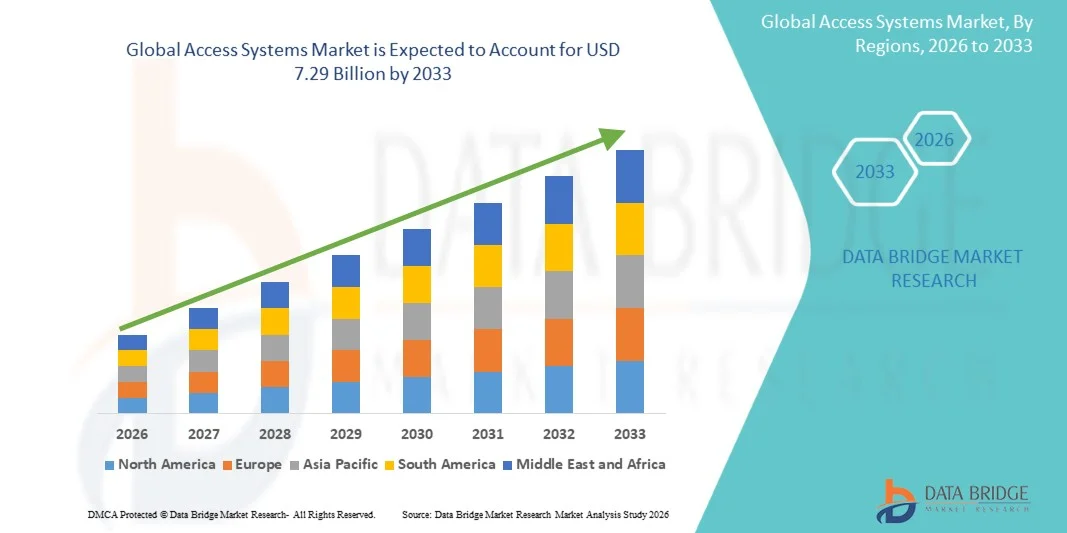
The Access Systems Market was valued at USD 3.94 billion in 2025 and is projected to reach USD 7.29 billion by 2033, growing at a CAGR of 8.00% from 2026 to 2033. The market is experiencing consistent growth driven by rising concerns regarding physical security, increasing adoption of digital access control technologies, and growing demand for advanced identity authentication systems across commercial, industrial, government, and residential sectors. Rapid advancements in biometric authentication, cloud-based access management platforms, and AI-enabled security analytics are further accelerating market expansion globally.
Increasing incidents of unauthorized access, data breaches, workplace security threats, and cyber-physical security risks are compelling organizations, government institutions, healthcare facilities, and transportation hubs to deploy advanced Access Systems for secure entry management and real-time monitoring. Biometric authentication systems, mobile-based access control platforms, and cloud-integrated security solutions are increasingly replacing traditional lock-and-key mechanisms in many industries, offering enhanced security, centralized management, operational efficiency, and seamless user authentication across modern infrastructure environments.
Key Market Trends & Insights
- North America dominated the Access Systems Market with the largest revenue share of 35.42% in 2025, supported by strong adoption of advanced security infrastructure, increasing deployment of biometric authentication technologies, and rising investments in smart building and enterprise security solutions across commercial, government, and industrial sectors.
- The Biometric Access Systems segment led the market with a 39.18% share in 2025, driven by increasing demand for highly secure authentication technologies, growing adoption of fingerprint, facial recognition, and iris scanning systems, and rising concerns regarding unauthorized access and identity theft across enterprises and public infrastructure.
- Asia-Pacific is expected to be the fastest-growing region at a CAGR of 8.1% from 2026 to 2033, fueled by rapid urbanization, expanding smart city projects, increasing infrastructure development, and growing adoption of digital security technologies across China, India, Japan, and Southeast Asia.
- Mobile-Based Access Systems are projected to be the fastest-growing type segment, registering a CAGR of 8.4% from 2026 to 2033, reflecting the growing demand for smartphone-enabled authentication, cloud-based access management, and contactless entry solutions across corporate offices, residential complexes, and healthcare facilities.
- The Commercial Buildings segment dominated the end user category with a 36.74% revenue share in 2025, supported by increasing deployment of integrated access control systems across offices, shopping malls, hospitality facilities, data centers, and smart commercial infrastructure to improve operational security and centralized monitoring.
- Cloud-Based Access Management platforms accounted for 57.26% of the market in 2025, preferred by enterprises and facility operators due to scalability, remote accessibility, centralized monitoring capabilities, and seamless integration with AI-powered security analytics and IoT-connected infrastructure.
- The Multi-Factor Authentication Systems segment is expected to witness the fastest growth with a CAGR of 8.0% from 2026 to 2033, driven by increasing cybersecurity concerns, rising adoption of zero-trust security frameworks, and growing demand for layered authentication technologies across banking, healthcare, government, and enterprise environments.
- The Card-Based Access Systems segment dominated the market with a share of 34.82% in 2025 due to its widespread adoption across commercial buildings, educational institutions, industrial facilities, and healthcare organizations for secure and cost-effective identity verification
Market Size & Forecast
- Global Market Value (2025): USD 3.94 Billion
- Expected Market Value (2033): USD 7.29 Billion
- Forecast CAGR (2026–2033): 8.00%
- Leading Region in 2025: North America
- Fastest Growing Region: Asia-Pacific
Report Scope and Access Systems Market Segmentation
|
Attributes |
Access Systems Key Market Insights |
|
Segments Covered |
|
|
Countries Covered |
North America · U.S. · Canada · Mexico Europe · Germany · France · U.K. · Netherlands · Switzerland · Belgium · Russia · Italy · Spain · Turkey · Rest of Europe Asia-Pacific · China · Japan · India · South Korea · Singapore · Malaysia · Australia · Thailand · Indonesia · Philippines · Rest of Asia-Pacific Middle East and Africa · Saudi Arabia · U.A.E. · South Africa · Egypt · Israel · Rest of Middle East and Africa South America · Brazil · Argentina · Rest of South America |
|
Key Market Players |
• Johnson Controls International plc (Ireland) |
|
Market Opportunities |
· Expansion of Cloud-Based and Mobile Access Control Platforms · Growing Integration of AI, Biometrics, and Multi-Factor Authentication Technologies · Rising Smart Building and Smart City Infrastructure Development |
|
Value Added Data Infosets |
In addition to the insights on market scenarios such as market value, growth rate, segmentation, geographical coverage, and major players, the market reports curated by the Data Bridge Market Research also include in-depth expert analysis, geographically represented company-wise production and capacity, network layouts of distributors and partners, detailed and updated price trend analysis and deficit analysis of supply chain and demand. |
Access Systems Market Trends
Trend: Rising Adoption of Biometric and Contactless Access Control Technologies
Organizations across commercial buildings, healthcare facilities, airports, government institutions, and industrial sites are increasingly adopting advanced Access Systems to improve security, streamline identity authentication, and reduce unauthorized entry risks. The growing preference for touchless authentication technologies such as facial recognition, iris scanning, palm-vein recognition, and mobile-based access credentials is significantly transforming modern access control infrastructure. Businesses are increasingly integrating cloud-connected access systems with AI-enabled surveillance, IoT platforms, and centralized security management software to enhance operational efficiency and real-time monitoring capabilities.
In addition, increasing concerns regarding workplace security, cyber threats, and identity fraud are accelerating the deployment of multi-factor authentication systems across enterprises and critical infrastructure facilities. Smart buildings and smart city projects are further driving demand for intelligent access management solutions integrated with remote monitoring and automated visitor management systems. According to industry security studies, biometric authentication adoption across enterprise security systems has increased significantly over the past few years due to higher accuracy, convenience, and reduced dependency on physical credentials. Furthermore, the increasing adoption of mobile access control solutions using NFC, Bluetooth, and QR-code technologies is improving user convenience while supporting secure, contactless entry management across healthcare, education, hospitality, and transportation sectors globally.
Access Systems Market Dynamics
Key Market Driver: Increasing Demand for Advanced Security and Identity Management Solutions
The rising need for enhanced physical security, identity authentication, and real-time access monitoring is significantly driving demand for Access Systems worldwide. Commercial enterprises, government organizations, healthcare facilities, educational institutions, and industrial plants are increasingly deploying card-based access systems, biometric authentication platforms, and cloud-managed access control solutions to strengthen security infrastructure and prevent unauthorized access incidents.
The increasing frequency of workplace security breaches, cyber-physical attacks, and identity theft incidents is accelerating investments in integrated access management systems capable of real-time authentication and centralized security administration. In addition, strict regulatory compliance requirements related to workplace safety, data protection, and critical infrastructure security are encouraging organizations to implement advanced multi-factor authentication and AI-powered surveillance-integrated access platforms. The growing expansion of smart offices, connected buildings, and digital infrastructure modernization initiatives across North America, Europe, Asia-Pacific, and the Middle East is further supporting strong market growth. Rising adoption of IoT-enabled security ecosystems and cloud-based security management platforms is also improving scalability, operational efficiency, and remote access management capabilities globally.
Key Restraint/Challenge: High Deployment Costs and Data Privacy Concerns
A significant restraint in the Access Systems Market is the high implementation and maintenance cost associated with advanced biometric authentication systems, AI-powered surveillance integration, and enterprise-grade cloud security infrastructure. Modern access systems require substantial investments in hardware devices, software platforms, network integration, cybersecurity protection, and continuous system upgrades, creating financial challenges for small and medium-sized enterprises.
In addition, growing concerns regarding biometric data privacy, cybersecurity vulnerabilities, and unauthorized data access continue to create regulatory and operational challenges for organizations deploying cloud-connected access systems. Compliance with stringent privacy regulations such as GDPR in Europe and various cybersecurity standards across global markets increases implementation complexity and operational costs. Furthermore, system integration challenges, compatibility issues with legacy infrastructure, and increasing sophistication of cyberattacks targeting connected security systems may restrict adoption among cost-sensitive organizations and developing regions. For instance, several enterprises continue to rely on conventional access control systems due to concerns regarding biometric data storage, cybersecurity risks, and higher deployment expenses associated with AI-enabled access management solutions.
Key Market Opportunity: Expansion of Smart Buildings and AI-Integrated Security Ecosystems
The rapid expansion of smart building infrastructure, IoT-enabled security networks, and AI-integrated surveillance ecosystems presents a significant growth opportunity for the Access Systems Market. Organizations are increasingly adopting intelligent access control platforms integrated with facial recognition, behavioral analytics, cloud connectivity, and automated visitor management systems to enhance security efficiency and operational automation.
AI-powered access systems capable of real-time anomaly detection, predictive threat analysis, and adaptive authentication are gaining strong traction across airports, banking institutions, healthcare facilities, manufacturing plants, and government facilities. In addition, increasing investments in smart cities, digital infrastructure modernization, and connected transportation systems are creating substantial demand for scalable and interoperable access management platforms. The growing adoption of mobile credentials, cloud-managed security services, and remote identity verification technologies is further improving flexibility and user convenience across enterprise environments. Moreover, advancements in edge computing, AI-driven analytics, and biometric authentication technologies are expected to accelerate innovation and long-term market expansion across both developed and emerging economies globally.
Access Systems Market Scope
The Access Systems market is segmented on the basis of type and end user.
- By Type
On the basis of type, the Access Systems Market is segmented into card-based access systems, biometric access systems, mobile-based access systems, keypad & PIN-based access systems, and multi-factor authentication systems. The Card-Based Access Systems segment dominated the market with a share of 34.82% in 2025 due to its widespread adoption across commercial buildings, educational institutions, industrial facilities, and healthcare organizations for secure and cost-effective identity verification. These systems offer centralized access management, ease of deployment, scalability, and compatibility with existing building security infrastructure, making them highly preferred among enterprises and government organizations. Increasing investments in smart office infrastructure, rising workplace security concerns, and growing adoption of RFID- and NFC-enabled smart cards are further supporting segment growth. In addition, card-based systems provide efficient employee attendance tracking, visitor management, and access monitoring capabilities, enhancing operational efficiency across organizations. The growing integration of cloud-connected access control platforms and real-time monitoring software is also improving system flexibility and security performance. Furthermore, increasing demand for secure authentication technologies across banking, transportation, and educational sectors continues to reinforce the leading position of the card-based access systems segment globally.
The Biometric Access Systems segment is expected to witness the fastest CAGR of 9.1% from 2026 to 2033, driven by the increasing demand for advanced identity authentication and touchless security solutions across commercial, government, healthcare, and transportation sectors. Biometric technologies such as facial recognition, fingerprint scanning, iris recognition, and palm-vein authentication are increasingly being adopted to enhance security accuracy and eliminate risks associated with stolen or duplicated access credentials. Rising concerns regarding cybersecurity threats, identity fraud, and unauthorized access incidents are accelerating deployment of AI-enabled biometric access platforms globally. In addition, growing investments in smart cities, connected infrastructure, and digital workplace transformation initiatives are supporting widespread adoption of intelligent biometric systems. Integration of cloud computing, AI-powered analytics, and IoT-enabled monitoring systems is further enhancing real-time threat detection and access management efficiency. Furthermore, increasing preference for contactless authentication solutions following growing awareness regarding hygiene and infection prevention is expected to significantly accelerate segment growth during the forecast period.
- By End User
On the basis of end user, the Access Systems Market is segmented into commercial buildings, government & defense, healthcare facilities, industrial & manufacturing sites, residential buildings, transportation & logistics, and educational institutions. The Commercial Buildings segment dominated the market with a share of 31.64% in 2025 due to the increasing deployment of advanced access control systems across offices, IT parks, retail complexes, hospitality facilities, and mixed-use commercial infrastructure. Organizations are increasingly adopting smart access management systems integrated with cloud connectivity, mobile credentials, and AI-powered surveillance platforms to improve workplace security and operational efficiency. Rising concerns regarding unauthorized access, employee safety, visitor management, and data security are further accelerating adoption across commercial enterprises globally. In addition, the expansion of smart building projects and growing investments in intelligent building automation systems are strengthening demand for integrated access control solutions. Commercial facilities increasingly require scalable and centralized security management platforms capable of supporting multi-site operations and remote monitoring functionalities. Furthermore, increasing regulatory compliance requirements related to workplace security and data protection are reinforcing the dominance of the commercial buildings segment in the Access Systems Market.
The Healthcare Facilities segment is projected to register the fastest CAGR of 8.8% from 2026 to 2033, driven by rising investments in healthcare infrastructure modernization, increasing adoption of digital hospital management systems, and growing focus on patient data security and controlled access management. Hospitals, diagnostic laboratories, specialty clinics, and pharmaceutical facilities are increasingly deploying biometric authentication systems, mobile-based access solutions, and multi-factor authentication technologies to protect sensitive medical records, restricted treatment zones, and pharmaceutical storage areas. The growing prevalence of cyberattacks targeting healthcare infrastructure is accelerating demand for highly secure and AI-enabled access management systems. In addition, increasing implementation of contactless access technologies and automated visitor management platforms is improving operational efficiency and infection control practices within healthcare environments. Government regulations regarding healthcare data privacy and hospital security compliance are also encouraging healthcare providers to adopt advanced access control systems. Furthermore, rapid expansion of smart hospitals, telehealth infrastructure, and connected healthcare ecosystems is expected to create strong long-term growth opportunities for access system providers across the healthcare sector globally.
Access Systems Market Regional Analysis
North America dominated the Access Systems market and accounted for the largest revenue share of 35.42% in 2025, supported by strong adoption of advanced security infrastructure, increasing deployment of biometric authentication technologies, and rising investments in smart building and enterprise security solutions across commercial, government, and industrial sectors. The region also benefits from high awareness regarding workplace security, increasing implementation of cloud-based access control systems, and strong regulatory compliance standards related to identity verification and data protection. Growing integration of AI-enabled surveillance platforms, IoT-connected security ecosystems, and mobile-based authentication technologies is further strengthening North America’s leadership position in the global market.
U.S. Access Systems Market Insight
The U.S. Access Systems market is witnessing strong growth due to increasing investments in enterprise security modernization, rising adoption of biometric authentication platforms, and growing demand for cloud-managed access control systems across commercial buildings, healthcare facilities, and government institutions. The country’s strong cybersecurity infrastructure, expanding smart office ecosystem, and increasing implementation of AI-powered surveillance and identity verification technologies are significantly driving market demand. In addition, rising concerns regarding workplace security, unauthorized access prevention, and critical infrastructure protection are accelerating adoption of advanced access management systems across multiple industries.
Europe Access Systems Market Insight
The Europe Access Systems market remains a major contributor to global revenue, driven by strict data protection regulations, increasing adoption of smart building technologies, and rising demand for advanced identity authentication systems across commercial and public infrastructure. Organizations across the region are increasingly deploying biometric access systems, mobile credentials, and AI-enabled surveillance-integrated security platforms to enhance operational safety and regulatory compliance. In addition, growing investments in digital infrastructure modernization, transportation security systems, and connected building management solutions continue to support market expansion throughout Europe.
U.K. Access Systems Market Insight
The U.K. Access Systems market is experiencing steady growth, supported by increasing adoption of cloud-based access control systems, rising investments in commercial building security, and growing implementation of biometric identity management solutions across enterprises and government facilities. The country’s strong focus on cybersecurity, smart office transformation, and workplace safety compliance is significantly contributing to market growth. Furthermore, integration of AI-powered analytics, facial recognition technologies, and mobile-enabled authentication platforms is improving access management efficiency and strengthening the U.K.’s position as a key innovation hub in the Access Systems industry.
Germany Access Systems Market Insight
The Germany Access Systems market is expanding steadily due to the country’s advanced industrial infrastructure, increasing deployment of smart manufacturing technologies, and growing demand for secure identity verification systems across commercial and industrial sectors. Manufacturing facilities, research institutions, and enterprise organizations are increasingly utilizing biometric access platforms and AI-integrated security systems to strengthen operational security and workforce management capabilities. Continuous advancements in IoT-enabled building automation, cloud-connected surveillance systems, and cybersecurity infrastructure are further driving market growth in Germany.
Asia-Pacific Access Systems Market Insight
The Asia-Pacific Access Systems market is expected to witness rapid growth, driven by rapid urbanization, expanding smart city projects, increasing infrastructure development, and growing adoption of digital security technologies across China, India, Japan, and Southeast Asia. Rising investments in commercial real estate, transportation infrastructure, and intelligent building management systems are significantly increasing demand for advanced access control platforms across the region. In addition, growing awareness regarding cybersecurity, workplace safety, and identity authentication is accelerating adoption of biometric, mobile-based, and cloud-managed access systems across government, healthcare, and industrial sectors.
Japan Access Systems Market Insight
The Japan Access Systems market is witnessing consistent growth due to increasing investments in smart infrastructure, rising adoption of biometric authentication technologies, and strong demand for advanced security management systems across commercial and transportation sectors. Enterprises, financial institutions, and public infrastructure facilities are increasingly implementing AI-powered access control systems and touchless authentication technologies to improve security efficiency and operational automation. Moreover, the country’s strong focus on technological innovation, digital transformation, and smart city development is further contributing to market growth.
China Access Systems Market Insight
The China Access Systems market is growing rapidly, driven by rapid urbanization, expanding smart city initiatives, and increasing government investments in intelligent security infrastructure. Growing deployment of facial recognition systems, AI-enabled surveillance platforms, and cloud-based access management technologies across commercial buildings, transportation hubs, and industrial facilities is significantly boosting market demand. In addition, rising awareness regarding cybersecurity protection, increasing implementation of digital identity verification systems, and strong growth in commercial infrastructure development are positioning China as one of the fastest-growing markets for Access Systems globally.
Access Systems Market Share
The Access Systems industry is primarily led by well-established companies, including:
- Johnson Controls International plc (Ireland)
- Honeywell International Inc. (U.S.)
- ASSA ABLOY AB (Sweden)
- Dormakaba Holding AG (Switzerland)
- Allegion plc (Ireland)
- Bosch Security Systems GmbH (Germany)
- Nedap N.V. (Netherlands)
- HID Global Corporation (U.S.)
- Thales Group (France)
- Identiv, Inc. (U.S.)
- Axis Communications AB (Sweden)
- AMAG Technology (U.S.)
- Suprema Inc. (South Korea)
- SALTO Systems S.L. (Spain)
- Gallagher Group Limited (New Zealand)
- Genetec Inc. (Canada)
- Brivo Inc. (U.S.)
- LenelS2 (U.S.)
- Avigilon Corporation (Canada)
- Schneider Electric SE (France)
- Cisco Systems, Inc. (U.S.)
- Siemens AG (Germany)
- ZKTeco Co., Ltd. (China)
- IDEMIA (France)
- Paxton Access Ltd. (U.K.)
- Kisi Inc. (U.S.)
- Openpath Security Inc. (U.S.)
- Matrix Comsec Pvt. Ltd. (India)
- Godrej Security Solutions (India)
- Hanwha Vision Co., Ltd. (South Korea)
- Fujitsu Limited (Japan)
- Dahua Technology Co., Ltd. (China)
- Hikvision Digital Technology Co., Ltd. (China)
- NEC Corporation (Japan)
- ADT Inc. (U.S.)
Latest Developments in Access Systems Market
- In January 2021, ASSA ABLOY announced the acquisition of Janam Technologies, a U.S.-based provider of mobile computers and access control solutions. The acquisition strengthened ASSA ABLOY’s position in identity management, mobile credentialing, and enterprise access technologies, supporting the growing demand for integrated physical and digital security platforms globally.
- In September 2021, Allegion plc launched the Schlage Control smart lock solution with advanced mobile credential compatibility and cloud-based access management capabilities. The development enhanced remote access control and smart building integration for commercial and multifamily residential applications, reflecting the growing adoption of connected security infrastructure.
- In February 2022, dormakaba Holding AG expanded its electronic access control portfolio by introducing cloud-enabled biometric and mobile access solutions designed for smart commercial buildings and healthcare facilities. The launch supported increasing demand for touchless authentication and IoT-enabled security management systems across enterprise environments.
- In October 2022, Johnson Controls International plc introduced enhanced OpenBlue access management solutions integrating AI-powered analytics, mobile credentials, and cloud-based building security controls. The development aimed to improve real-time monitoring, operational efficiency, and cybersecurity across commercial and industrial facilities worldwide.
- In April 2023, HID Global expanded its biometric access control offerings with new facial recognition and mobile credential technologies designed for enterprise security and smart building applications. The launch strengthened the company’s focus on frictionless authentication, secure identity verification, and integrated physical-digital access ecosystems.
- In September 2024, ASSA ABLOY acquired smart lock technology company Level Lock to strengthen its smart residential access systems portfolio. The acquisition enhanced ASSA ABLOY’s capabilities in connected home security, digital key technologies, and Matter-compatible smart lock solutions, supporting the growing trend toward intelligent access management systems.
- In January 2025, ASSA ABLOY acquired Uhlmann & Zacher GmbH, a Germany-based supplier of electronic access control handles, knobs, and security software solutions. The acquisition expanded the company’s electronic access control portfolio and strengthened its position in integrated smart access technologies for commercial and institutional applications.
- In January 2025, ASSA ABLOY also acquired InVue, a U.S.-based provider of connected asset protection and access control solutions. The acquisition enhanced ASSA ABLOY’s capabilities in intelligent retail security, enterprise access management, and connected physical security systems across global markets.
- In March 2025, HID Global announced strategic expansion of its facial biometrics and mobile credential business operations to support enterprise adoption of passwordless authentication and advanced biometric access systems. The company highlighted growing investments in facial recognition, RFID technologies, and mobile-based identity verification solutions for commercial security applications.

- Interactive Data Analysis Dashboard
- Company Analysis Dashboard for high growth potential opportunities
- Research Analyst Access for customization & queries
- Competitor Analysis with Interactive dashboard
- Latest News, Updates & Trend analysis
- Harness the Power of Benchmark Analysis for Comprehensive Competitor Tracking
Data collection and base year analysis are done using data collection modules with large sample sizes. The stage includes obtaining market information or related data through various sources and strategies. It includes examining and planning all the data acquired from the past in advance. It likewise envelops the examination of information inconsistencies seen across different information sources. The market data is analysed and estimated using market statistical and coherent models. Also, market share analysis and key trend analysis are the major success factors in the market report. To know more, please request an analyst call or drop down your inquiry.
The key research methodology used by DBMR research team is data triangulation which involves data mining, analysis of the impact of data variables on the market and primary (industry expert) validation. Data models include Vendor Positioning Grid, Market Time Line Analysis, Market Overview and Guide, Company Positioning Grid, Patent Analysis, Pricing Analysis, Company Market Share Analysis, Standards of Measurement, Global versus Regional and Vendor Share Analysis. To know more about the research methodology, drop in an inquiry to speak to our industry experts.
Data Bridge Market Research is a leader in advanced formative research. We take pride in servicing our existing and new customers with data and analysis that match and suits their goal. The report can be customized to include price trend analysis of target brands understanding the market for additional countries (ask for the list of countries), clinical trial results data, literature review, refurbished market and product base analysis. Market analysis of target competitors can be analyzed from technology-based analysis to market portfolio strategies. We can add as many competitors that you require data about in the format and data style you are looking for. Our team of analysts can also provide you data in crude raw excel files pivot tables (Fact book) or can assist you in creating presentations from the data sets available in the report.













