What is the Global Acetic Acid for Animal Feed Market Size and Growth Rate?
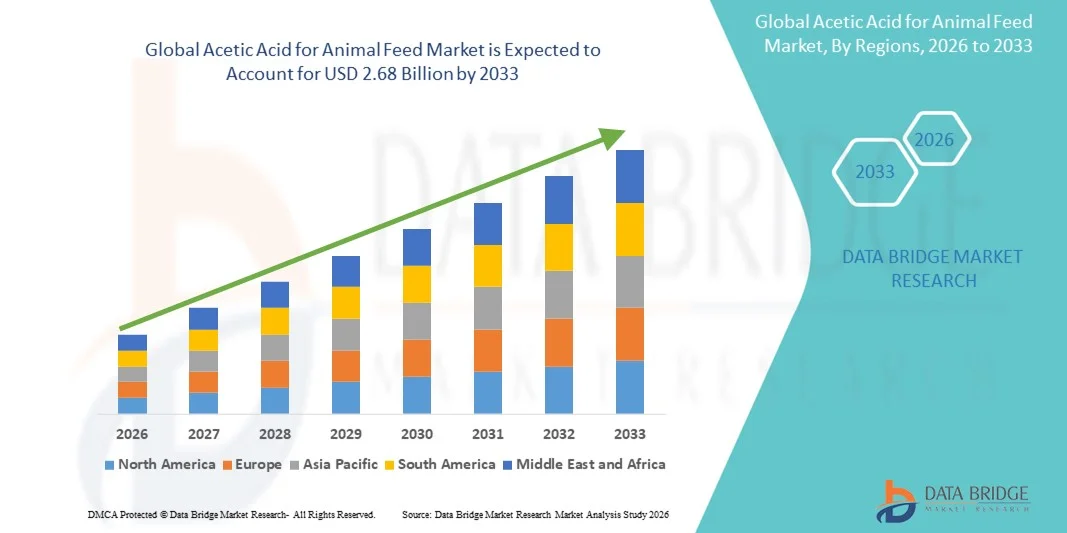
- As per Data Bridge Market Research analysis that the global acetic acid for animal feed market size was valued at USD 1.84 billion in 2025 and is expected to reach USD 2.68 billion by 2033, at a CAGR of 4.80% during the forecast period
- The market growth is largely fueled by the increasing demand for safe and effective feed additives in livestock and poultry production, leading to enhanced animal health, growth performance, and feed efficiency
- Furthermore, rising adoption of acetic acid–based feed solutions by feed manufacturers and integrators is strengthening its position as a preferred additive for microbial control and gut health in both intensive and commercial livestock operations. These factors are driving the widespread incorporation of acetic acid in animal feed, thereby significantly boosting the industry's growth
What are the Major Takeaways of Acetic Acid for Animal Feed Market?
- Acetic acid, as a feed additive, plays a crucial role in improving nutrient digestibility, controlling pathogenic bacteria, and preserving feed quality, making it an essential component in modern animal nutrition strategies
- The escalating demand for acetic acid in animal feed is primarily fueled by the growing livestock population, increasing awareness of animal health and performance, and rising need for sustainable and high-quality feed solutions
- Asia-Pacific dominated the acetic acid for animal feed market with a share of 69% in 2025, due to expanding livestock and poultry production, increasing adoption of feed additives, and a strong presence of chemical manufacturing hubs
- North America is expected to be the fastest growing region in the acetic acid for animal feed market during the forecast period due to rising demand for livestock and poultry feed additives, advancements in feed formulation technologies, and increasing adoption of acidified feed solutions
- Liquid segment dominated the market with a market share of 62.5% in 2025, due to its easy incorporation into feed mixes and uniform distribution in animal diets. Liquid acetic acid allows precise dosage adjustment, which is essential for maximizing feed efficiency and animal growth performance. Its popularity is also supported by compatibility with automated feed blending systems and minimal processing requirements. In addition, liquid forms reduce storage space and handling complexity for large-scale feed manufacturers, reinforcing its market dominanc
Report Scope and Acetic Acid for Animal Feed Market Segmentation
|
Attributes |
Acetic Acid for Animal Feed Key Market Insights |
|
Segments Covered |
|
|
Countries Covered |
North America
Europe
Asia-Pacific
Middle East and Africa
South America
|
|
Key Market Players |
|
|
Market Opportunities |
|
|
Value Added Data Infosets |
In addition to the insights on market scenarios such as market value, growth rate, segmentation, geographical coverage, and major players, the market reports curated by the Data Bridge Market Research also include import export analysis, production capacity overview, production consumption analysis, price trend analysis, climate change scenario, supply chain analysis, value chain analysis, raw material/consumables overview, vendor selection criteria, PESTLE Analysis, Porter Analysis, and regulatory framework. |
Acetic Acid for Animal Feed Market Trends
Rising Adoption of Acetic Acid as a Gut Health and Feed Preservation Solution
- The acetic acid market for animal feed is expanding as more livestock producers adopt it due to its multifunctional benefits in enhancing gut health and preserving feed quality. Acetic acid acts as an antimicrobial agent, reducing feed spoilage caused by bacteria and molds, thereby extending shelf life and improving nutrient retention. Concurrently, its role in promoting intestinal health supports better digestion and nutrient absorption, directly impacting livestock growth performance and disease resistance. These advantages are increasingly recognized in intensified animal farming systems across diverse geographies
- For instance, Purac and Celanese Corporation have launched specialized acetic acid formulations targeting poultry and swine feed applications, incorporating technological improvements for controlled release and compatibility with other feed additives. Collaborative research with animal nutritionists links these products to improved feed conversion ratios and reduced veterinary costs
- Rising consumer preference for antibiotic-free animal products is fostering demand for natural and organic feed preservatives such as acetic acid, especially in the poultry and dairy sectors. This is part of broader industry trends toward clean-label additives and sustainable livestock management
- Adoption is also facilitated by acetic acid’s cost-effectiveness and regulatory acceptance as a safe preservative and feed acidifier, which aligns well with modern feed manufacturing practices designed to reduce waste and maintain feed hygiene under varying storage and climatic conditions
- The trend toward integrated feed additive formulations that combine acetic acid with other organic acids, enzymes, and probiotics furthers its appeal by amplifying overall efficacy and supporting holistic animal health management strategies
- Collectively, these factors position acetic acid as a critical solution in the evolving animal feed sector focused on productivity, safety, and regulatory compliance
Acetic Acid for Animal Feed Market Dynamics
Driver
Growing Demand for Safe and Efficient Feed Additives in Livestock and Poultry
- The surge in global consumption of animal protein and the intensification of livestock and poultry farming drive the demand for effective and safe feed additives that ensure feed stability, animal performance, and health. Acetic acid’s antimicrobial and acidifying properties support this demand by improving feed preservation and intestinal microflora balance, crucial for high-performing production systems
- For instance, market leaders such as Celanese and Perstorp Group highlight increased adoption of acetic acid-based preservatives in developing countries where expanding poultry and dairy sectors require cost-effective solutions for feed quality management. These companies invest in product innovation to enhance ease of application and compatibility with feed formulations
- The demand for antibiotic alternatives is another important growth factor, with acetic acid being integrated into feed to reduce reliance on growth-promoting antibiotics while maintaining animal health standards. This is supported by global regulatory pressures and consumer awareness around antimicrobial resistance
- Increasing investments in improving feed supply chain hygiene and shelf life, particularly in regions with tropical and humid climates, further stimulate the need for acetic acid preservatives to combat spoilage and mycotoxin formation
- The expanding use of pre-mixed feed additives incorporating organic acids offers a convenient approach for large-scale feed producers and commercial farms, enhancing operational efficiency and product consistency across livestock production systems
Restraint/Challenge
Regulatory Compliance and Safety Standards Across Different Regions
- Navigating regulatory compliance and safety standards for the use of acetic acid as a feed additive presents complex challenges due to varying rules, labeling requirements, and permissible concentration limits across countries and regions. Producers and feed manufacturers must continuously adapt formulations and documentation to meet diverse safety assessments and import regulations
- For instance, the European Food Safety Authority (EFSA) and the U.S. Food and Drug Administration (FDA) have distinct approval processes and usage guidelines for acetic acid in animal feed. Compliance with Maximum Residue Levels (MRLs) and feed additive registrations requires robust product testing and reporting protocols
- Some developing markets may lack harmonized regulatory frameworks, creating additional uncertainty for global suppliers seeking market entry and continuity. Delays in regulatory approvals or changes in safety standards can disrupt supply chains and increase costs related to compliance monitoring and reformulation
- Traceability and documentation demands under increasing food safety and antimicrobial stewardship programs require significant investment in quality management systems, lab certifications, and digital recordkeeping. These factors contribute to cost pressures and operational complexity for manufacturers and distributors
- Addressing these challenges requires proactive regulatory engagement, robust safety data generation, and flexible product portfolios capable of adaptation to region-specific standards. Balancing innovation with stringent safety compliance will be vital for sustaining growth in the competitive acetic acid for animal feed market
How is the Acetic Acid for Animal Feed Market Segmented?
The market is segmented on the basis of type, manufacturing process, form, and application.
- By Analysis Type
On the basis of analysis type, the Acetic Acid for Animal Feed market is segmented into Feedstocks Analysis and Raw Material Analysis. The Feedstocks Analysis segment dominated the market with the largest revenue share in 2025, driven by its critical role in determining the quality and efficacy of acetic acid in animal nutrition. Feedstocks analysis allows manufacturers to optimize production processes and ensure consistent composition, which is crucial for livestock health and feed efficiency. Moreover, this segment benefits from increasing focus on sustainable and high-quality feed ingredients, leading to wider adoption across commercial feed production. The availability of advanced analytical techniques and growing regulatory emphasis on feed safety further bolster demand for feedstocks analysis.
The Raw Material Analysis segment is expected to witness the fastest growth rate from 2026 to 2033, fueled by rising demand for precise monitoring of raw material quality to maintain production efficiency and animal health standards. Raw material analysis enables producers to detect impurities and variations in composition, minimizing production risks. Its increasing adoption is driven by the need for traceability and compliance with stringent quality norms in both developed and emerging markets.
- By Manufacturing Process
On the basis of manufacturing process, the market is segmented into Synthetic Route and Biological Route. The Synthetic Route segment dominated the market with the largest revenue share in 2025, attributed to its high production efficiency, scalability, and cost-effectiveness for large-scale acetic acid supply. Manufacturers prefer synthetic methods due to established technology, predictable yields, and compatibility with modern feed formulations. Furthermore, the synthetic route provides consistent product purity, which is critical for feed applications where precise nutrient levels are required. The process also allows integration with industrial chemical production systems, supporting operational efficiency and supply chain stability.
The Biological Route segment is anticipated to register the fastest growth from 2026 to 2033, driven by increasing consumer preference for naturally derived and environmentally friendly feed additives. Biological processes, including fermentation-based methods, are gaining traction due to their lower environmental footprint and suitability for organic feed production. Advancements in biotechnology and microbial strain optimization further enhance yield and reliability, expanding the adoption of the biological route across animal feed manufacturers globally.
- By Form
On the basis of form, the market is segmented into Liquid and Solid. The Liquid segment dominated the market with the largest revenue share of 62.5% in 2025, due to its easy incorporation into feed mixes and uniform distribution in animal diets. Liquid acetic acid allows precise dosage adjustment, which is essential for maximizing feed efficiency and animal growth performance. Its popularity is also supported by compatibility with automated feed blending systems and minimal processing requirements. In addition, liquid forms reduce storage space and handling complexity for large-scale feed manufacturers, reinforcing its market dominance.
The Solid segment is projected to witness the fastest CAGR from 2026 to 2033, driven by growing demand for powdered or granulated acetic acid in specialized feed formulations. Solid forms offer extended shelf life, ease of transport, and controlled release in feed products. Emerging applications in premixes and concentrated nutrient blends are further fueling growth, supported by innovations in encapsulation and stabilization technologies.
- By Application
On the basis of application, the market is segmented into Vinyl Acetate Monomer, Terephthalic Acid, Acetic Anhydride, Acetate Esters, Ketene, Monochloroacetic, Textiles, Dimethylacetamide, and Others. The Acetate Esters segment dominated the market with the largest revenue share in 2025, driven by its widespread use as a key additive in animal feed for enhancing nutrient absorption and feed preservation. Acetate esters offer multifunctional benefits, including pH regulation, improved digestibility, and antimicrobial properties, making them highly preferred among feed manufacturers. The segment also benefits from technological advancements in formulation, enabling stable incorporation into diverse feed types.
The Monochloroacetic segment is expected to witness the fastest growth rate from 2026 to 2033, fueled by increasing demand for specialty feed additives and performance-enhancing compounds in animal nutrition. Its role in promoting metabolic efficiency and supporting gut health drives adoption in intensive livestock farming. Emerging markets are witnessing rising awareness of feed quality and additive benefits, further contributing to the accelerated growth of monochloroacetic applications.
Acetic Acid for Animal Feed Market Regional Analysis
- Asia-Pacific dominated the acetic acid for animal feed market with the largest revenue share of 69% in 2025, driven by expanding livestock and poultry production, increasing adoption of feed additives, and a strong presence of chemical manufacturing hubs
- The region’s cost-effective production landscape, rising investments in feed-grade chemical manufacturing, and growing exports of acetic acid-based feed solutions are accelerating market expansion
- The availability of skilled labor, favorable government policies, and rapid industrialization across developing economies are contributing to increased consumption of acetic acid in both poultry and livestock feed applications
China Acetic Acid for Animal Feed Market Insight
China held the largest share in the Asia-Pacific acetic acid market in 2025, owing to its leadership in animal husbandry and feed additive production. The country’s strong industrial base, supportive policies for chemical and feed industries, and extensive export capabilities for feed-grade chemicals are major growth drivers. Demand is further strengthened by rising investments in biological feed solutions and increasing domestic meat and poultry consumption.
India Acetic Acid for Animal Feed Market Insight
India is witnessing the fastest growth in the Asia-Pacific region, fueled by a rapidly expanding poultry sector, rising livestock population, and increasing production of processed feed. Government initiatives promoting animal nutrition and feed additive adoption, along with growing investments in feed-grade chemical manufacturing, are driving market expansion. In addition, rising export opportunities for high-quality feed products and improving cold chain infrastructure are supporting demand.
Europe Acetic Acid for Animal Feed Market Insight
The Europe market is expanding steadily, supported by stringent quality standards for feed additives, growing demand for sustainable feed solutions, and investments in high-purity acetic acid production. The region emphasizes compliance, animal health, and eco-friendly manufacturing practices, particularly in countries with large livestock industries. The rising adoption of organic and fortified feed formulations is further enhancing market growth.
Germany Acetic Acid for Animal Feed Market Insight
Germany’s market is driven by its leadership in livestock nutrition, strong chemical manufacturing heritage, and export-oriented feed additive production. Well-established R&D networks and partnerships between universities and feed manufacturers foster continuous innovation in feed-grade acetic acid. Demand is particularly strong for use in poultry, swine, and cattle feed formulations.
U.K. Acetic Acid for Animal Feed Market Insight
The U.K. market is supported by a mature animal husbandry industry, focus on sustainable and high-quality feed production, and increasing demand for feed-grade chemicals. Investments in R&D, collaborations between feed producers and chemical suppliers, and growing interest in fortified feed solutions are driving market growth. The country continues to play a significant role in specialty feed additive consumption.
North America Acetic Acid for Animal Feed Market Insight
North America is projected to grow at the fastest CAGR from 2026 to 2033, driven by rising demand for livestock and poultry feed additives, advancements in feed formulation technologies, and increasing adoption of acidified feed solutions. Strong focus on animal health, nutrition efficiency, and integration of feed additives into large-scale farming operations are boosting demand.
U.S. Acetic Acid for Animal Feed Market Insight
The U.S. accounted for the largest share in the North America market in 2025, underpinned by its expansive livestock and poultry industry, strong R&D infrastructure for feed solutions, and significant investment in feed-grade chemical production. Focus on innovation, regulatory compliance, and sustainable feed practices is encouraging the use of acetic acid in animal nutrition. Presence of key players and a mature supply chain further solidify the U.S.’s leading position in the region.
Which are the Top Companies in Acetic Acid for Animal Feed Market?
The acetic acid for animal feed industry is primarily led by well-established companies, including:
- Eastman Chemical Company (U.S.)
- BP (U.K.)
- LyondellBasell Industries Holdings B.V. (Netherlands)
- Celanese Corporation (U.S.)
- GNFC Limited (India)
- HELM AG (Germany)
- Pentoky Organy (Poland)
- Dow (U.S.)
- Ashok Alco‑Chem Limited (AACL) (India)
- DAICEL Corporation (Japan)
- Mitsubishi Chemical Corporation (Japan)
- PetroChina Company Limited (China)
- SABIC (Saudi Arabia)
- SHOWA DENKO K.K. (Japan)
- China Petroleum & Chemical Corporation (China)
- Sekab (Sweden)
- Wacker Chemie AG (Germany)
- Jiangsu SOPO (Group) Co., Ltd. (China)
- Kingboard Holdings Limited (Hong Kong)
- BASF SE (Germany)

- Interactive Data Analysis Dashboard
- Company Analysis Dashboard for high growth potential opportunities
- Research Analyst Access for customization & queries
- Competitor Analysis with Interactive dashboard
- Latest News, Updates & Trend analysis
- Harness the Power of Benchmark Analysis for Comprehensive Competitor Tracking
Data collection and base year analysis are done using data collection modules with large sample sizes. The stage includes obtaining market information or related data through various sources and strategies. It includes examining and planning all the data acquired from the past in advance. It likewise envelops the examination of information inconsistencies seen across different information sources. The market data is analysed and estimated using market statistical and coherent models. Also, market share analysis and key trend analysis are the major success factors in the market report. To know more, please request an analyst call or drop down your inquiry.
The key research methodology used by DBMR research team is data triangulation which involves data mining, analysis of the impact of data variables on the market and primary (industry expert) validation. Data models include Vendor Positioning Grid, Market Time Line Analysis, Market Overview and Guide, Company Positioning Grid, Patent Analysis, Pricing Analysis, Company Market Share Analysis, Standards of Measurement, Global versus Regional and Vendor Share Analysis. To know more about the research methodology, drop in an inquiry to speak to our industry experts.
Data Bridge Market Research is a leader in advanced formative research. We take pride in servicing our existing and new customers with data and analysis that match and suits their goal. The report can be customized to include price trend analysis of target brands understanding the market for additional countries (ask for the list of countries), clinical trial results data, literature review, refurbished market and product base analysis. Market analysis of target competitors can be analyzed from technology-based analysis to market portfolio strategies. We can add as many competitors that you require data about in the format and data style you are looking for. Our team of analysts can also provide you data in crude raw excel files pivot tables (Fact book) or can assist you in creating presentations from the data sets available in the report.