


What is the Global Acoustic Insulation Market Size and Growth Rate?
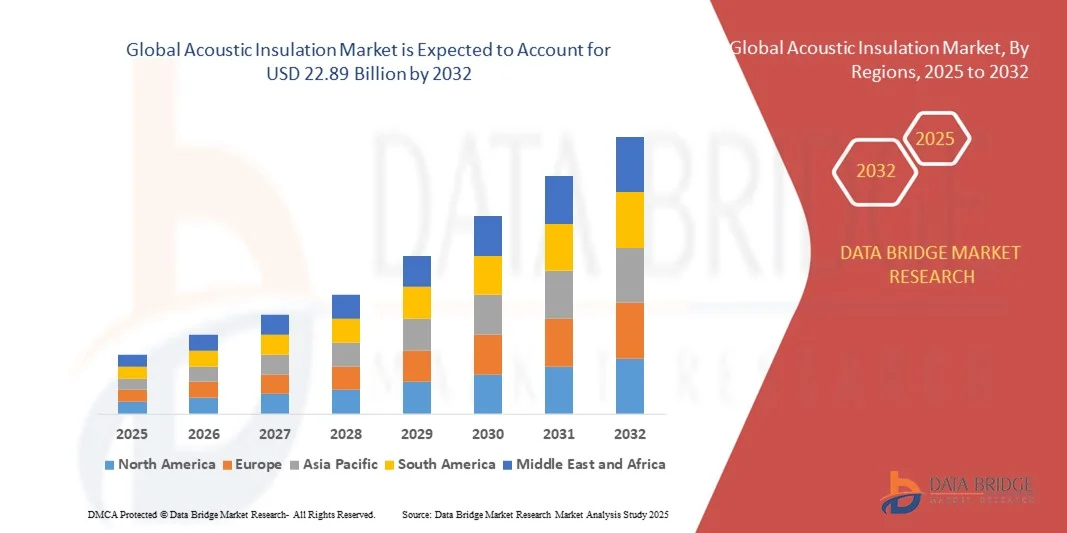
- The global acoustic insulation market size was valued at USD 15.72 billion in 2024 and is expected to reach USD 22.89 billion by 2032, at a CAGR of 4.81% during the forecast period
- Rise in demand for acoustic insulation owing to the rising prevalence of noise pollution coupled with growing incidences of health issues is the root cause fuelling up the market growth rate
- Rising industrialization coupled with growth and expansion of various end user verticals especially in the developing economies will also directly and positively impact the growth rate of the market
What are the Major Takeaways of Acoustic Insulation Market?
- Growth in the building and construction activities, rising popularity of sound absorption materials in the entertainment industry and strident regulations imposed by the government on industries in regards to noise pollution will further carve the way for the growth of the market
- However, high costs associated with the materials will pose a major challenge to the growth of the market. Fluctuations in the prices of raw materials will dampen the market growth rate
- Asia-Pacific dominated the acoustic insulation market with the largest revenue share of 43.5% in 2024, driven by rapid urbanization, strong infrastructure development, and growing industrialization across major economies such as China, Japan, and India
- The North America acoustic insulation market is projected to grow at the fastest CAGR of 12.7% from 2025 to 2032, driven by rising awareness about energy efficiency, sustainability, and noise control across residential and industrial sectors
- The Mineral Wool segment dominated the market with the largest revenue share of 47.6% in 2024, owing to its excellent fire resistance, thermal insulation, and superior sound absorption properties
Report Scope and Acoustic Insulation Market Segmentation
|
Attributes |
Acoustic Insulation Key Market Insights |
|
Segments Covered |
|
|
Countries Covered |
North America
Europe
Asia-Pacific
Middle East and Africa
South America
|
|
Key Market Players |
|
|
Market Opportunities |
|
|
Value Added Data Infosets |
In addition to the insights on market scenarios such as market value, growth rate, segmentation, geographical coverage, and major players, the market reports curated by the Data Bridge Market Research also include in-depth expert analysis, pricing analysis, brand share analysis, consumer survey, demography analysis, supply chain analysis, value chain analysis, raw material/consumables overview, vendor selection criteria, PESTLE Analysis, Porter Analysis, and regulatory framework. |
What is the Key Trend in the Acoustic Insulation Market?
Integration of Sustainable and Smart Acoustic Materials
- A major trend in the global acoustic insulation market is the integration of eco-friendly materials with smart technologies, driven by growing environmental awareness and advancements in building automation. Manufacturers are developing sustainable insulation solutions that reduce carbon footprints while enhancing acoustic performance in modern constructions
- For instance, Rockwool Group launched its next-generation stone wool insulation designed to offer superior sound absorption and energy efficiency, meeting global green building standards such as LEED and BREEAM
- The use of recycled materials, bio-based foams, and smart acoustic systems equipped with sensors for monitoring noise levels is increasing, enabling real-time adjustments in building acoustics. These innovations are particularly gaining traction in smart cities and commercial infrastructure
- This trend is reshaping the construction and automotive sectors, as sustainable acoustic materials improve indoor comfort and align with global initiatives to reduce carbon emissions and energy consumption
What are the Key Drivers of Acoustic Insulation Market?
- The rising emphasis on energy efficiency, noise reduction, and environmental sustainability is a major driver of the acoustic insulation market. Stringent building codes and growing consumer preference for quiet and comfortable living environments are accelerating demand
- For instance, in May 2024, Knauf Insulation introduced a low-carbon footprint acoustic product line for residential and commercial buildings in Europe, designed to meet evolving regulatory standards and consumer expectations for eco-conscious construction
- Expanding urbanization, increasing construction of green buildings, and rising awareness about health impacts of noise pollution are further propelling market growth. The adoption of acoustic insulation in automotive, industrial, and HVAC applications is also increasing, driven by noise control regulations and performance enhancement needs
- Moreover, government initiatives promoting energy-efficient and sustainable infrastructure are significantly supporting the expansion of the global acoustic insulation market
Which Factor is Challenging the Growth of the Acoustic Insulation Market?
- The high cost of advanced materials and installation complexity remain significant challenges for widespread adoption of acoustic insulation solutions, particularly in cost-sensitive markets. Specialized products such as composite foams and multilayer barriers often require skilled labor and higher investment
- For instance, small construction firms in developing economies face challenges in adopting advanced insulation technologies due to cost constraints and lack of awareness about long-term benefits
- In addition, limited recyclability of certain synthetic materials and fluctuating raw material prices pose sustainability and economic hurdles. Addressing these issues requires innovation in low-cost, recyclable acoustic materials and the development of efficient installation techniques
- Manufacturers focusing on cost reduction, product standardization, and circular economy practices are expected to overcome these challenges and strengthen the long-term growth trajectory of the acoustic insulation market
How is the Acoustic Insulation Market Segmented?
The market is segmented on the basis of type, end user industry, and form.
- By Type
On the basis of type, the acoustic insulation market is segmented into Mineral Wool, Foamed Plastics, and Others. The Mineral Wool segment dominated the market with the largest revenue share of 47.6% in 2024, owing to its excellent fire resistance, thermal insulation, and superior sound absorption properties. It is widely used in both residential and commercial construction due to its ability to reduce airborne noise and improve energy efficiency. In addition, its non-combustible nature makes it ideal for applications requiring high fire safety standards.
The Foamed Plastics segment is projected to witness the fastest growth rate from 2025 to 2032, driven by increasing demand for lightweight and cost-effective insulation materials in the automotive and industrial sectors. Foamed plastics, such as polyurethane and polystyrene, offer versatile application flexibility and high acoustic performance, making them suitable for modern noise-control solutions across diverse industries.
- By End User Industry
Based on end user industry, the acoustic insulation market is segmented into Building and Construction, Transportation, Manufacturing and Processing, and Others. The Building and Construction segment held the largest market revenue share of 52.3% in 2024, attributed to stringent noise control regulations, rising urbanization, and growing awareness of occupant comfort in residential and commercial spaces. Acoustic insulation materials are extensively used in walls, floors, and ceilings to enhance indoor sound quality and energy efficiency.
The Transportation segment is expected to register the fastest CAGR from 2025 to 2032, fueled by the growing demand for noise reduction in automobiles, aircraft, and railways. Manufacturers are increasingly integrating advanced insulation materials in vehicles to minimize cabin noise, improve passenger comfort, and comply with regulatory noise emission standards. The rising production of electric vehicles further supports the segment’s growth trajectory.
- By Form
On the basis of form, the acoustic insulation market is categorized into Blankets, Batts, Panels, and Others. The Blankets segment dominated the market with the largest revenue share of 41.8% in 2024, owing to their ease of installation, flexibility, and cost-effectiveness in large-scale construction projects. Acoustic blankets are preferred in both new and retrofit buildings due to their superior sound absorption, thermal insulation, and adaptability for various wall and ceiling structures.
The Panels segment is anticipated to witness the fastest CAGR from 2025 to 2032, driven by their aesthetic appeal and effectiveness in industrial, commercial, and institutional environments. Acoustic panels provide high sound absorption performance while enhancing interior design, making them popular in offices, auditoriums, and recording studios. Increasing demand for modular and decorative soundproofing solutions is further propelling the growth of this segment.
Which Region Holds the Largest Share of the Acoustic Insulation Market?
- Asia-Pacific dominated the acoustic insulation market with the largest revenue share of 43.5% in 2024, driven by rapid urbanization, strong infrastructure development, and growing industrialization across major economies such as China, Japan, and India. The region’s expanding construction sector and government initiatives promoting energy-efficient and sustainable buildings have significantly increased the adoption of acoustic insulation materials
- Consumers and businesses in Asia-Pacific are increasingly prioritizing comfort and soundproofing solutions in residential, commercial, and transportation applications. The rise in disposable income, coupled with an increasing awareness of noise pollution’s health impacts, further supports this trend
- This widespread adoption is bolstered by supportive regulatory frameworks, foreign investments in infrastructure, and the expansion of manufacturing facilities, making Asia-Pacific the global leader in acoustic insulation consumption and production.
China Acoustic Insulation Market Insight
The China acoustic insulation market accounted for the largest revenue share of 58% in 2024 within Asia-Pacific, driven by the country’s massive construction industry and strong push towards sustainable urban development. Rising noise levels in densely populated cities and strict energy-efficiency standards have accelerated the use of advanced insulation materials. Moreover, China’s position as a leading manufacturing hub ensures cost-effective production and widespread availability of innovative products such as mineral wool and foamed plastic insulation. Increasing adoption across residential, industrial, and automotive sectors is further reinforcing China’s dominant market position.
Japan Acoustic Insulation Market Insight
The Japan acoustic insulation market is expanding steadily, fueled by technological innovation and a growing focus on comfort and sustainability in urban housing. Japan’s dense population centers and high building standards are driving demand for advanced noise-control solutions. In addition, the growing integration of acoustic insulation in transportation and public infrastructure projects supports market growth. The country’s emphasis on modern, eco-friendly materials and architectural efficiency ensures continued investment in high-performance insulation systems.
India Acoustic Insulation Market Insight
The India acoustic insulation market is witnessing rapid growth, driven by increased urbanization, rising middle-class income, and expanding real estate development. Government programs promoting smart cities and sustainable housing have accelerated the adoption of noise-reducing and thermally efficient materials. Growing awareness of workplace and residential comfort, along with stricter construction norms, is fostering demand for mineral wool and foamed plastic insulation. Domestic manufacturers are increasingly focusing on cost-effective, eco-friendly products tailored to India’s climatic and industrial needs.
Which Region is the Fastest Growing Region in the Acoustic Insulation Market?
The North America acoustic insulation market is projected to grow at the fastest CAGR of 12.7% from 2025 to 2032, driven by rising awareness about energy efficiency, sustainability, and noise control across residential and industrial sectors. The growing trend of retrofitting older buildings with advanced insulation materials and the increasing emphasis on green building certifications are fueling market expansion. Furthermore, stringent regulations by organizations such as ASHRAE and EPA are pushing industries to adopt eco-friendly and efficient acoustic materials. Advancements in building design, coupled with the adoption of lightweight, high-performance insulation products, position North America as a key growth hub in the coming decade.
U.S. Acoustic Insulation Market Insight
The U.S. acoustic insulation market captured the largest share of 79% in 2024 within North America, driven by the strong presence of leading manufacturers, extensive construction activity, and growing focus on soundproofing in residential and commercial spaces. In addition, rising demand for sustainable materials and innovation in product design are shaping market dynamics. Increasing government support for energy-efficient infrastructure and consumer preference for quieter, more comfortable living environments are expected to sustain the market’s rapid growth trajectory.
Which are the Top Companies in Acoustic Insulation Market?
The acoustic insulation industry is primarily led by well-established companies, including:
- BASF SE (Germany)
- Dow (U.S.)
- Covestro AG (Germany)
- Huntsman International LLC. (U.S.)
- Saint-Gobain Group (France)
- Lapolla Industries, Inc. (U.S.)
- SAFCO Foam Insulation (U.S.)
- CAJUN FOAM INSULATION (U.S.)
- EnergyGuard Foam Insulators, LP (U.S.)
- Insulation Northwest (U.S.)
- PUFF INC (U.S.)
- Pittsburgh Foam Insulation (U.S.)
- Owens Corning. (U.S.)
- Recticel (Belgium)
- Armacell (Germany)
- Kingspan Group (Ireland)
- Johns Manville. (U.S.)
- Berkshire Hathaway Inc. (U.S.)
- ISOTHANE LTD (U.K.)
- Evonik Industries AG (Germany)
What are the Recent Developments in Global Acoustic Insulation Market?
- In April 2025, Knauf Insulation expanded its Performance+ portfolio by launching new pipe and pipe & tank fiberglass insulation lines. These formaldehyde-free products are the first to receive both Asthma & Allergy Friendly Certification and Verified Healthier Air designation, reflecting the company’s commitment to healthier and more sustainable insulation solutions. This expansion strengthens Knauf’s position in the global acoustic insulation market through innovation and product diversification
- In December 2024, ROCKWOOL announced a USD 100 million investment to establish a new production line in Mississippi, dedicated to industrial insulation products. This initiative aims to cater to the rising demand from the process industry across the Gulf of Mexico region. The investment reinforces ROCKWOOL’s strategic focus on expanding its industrial footprint and meeting growing insulation requirements in North America
- In July 2022, Rockwool International introduced its innovative NyRock stone wool technology in the U.K., acclaimed as the lowest lambda stone wool insulation available in the region. Manufactured using a patented process, NyRock achieves a thermal conductivity of 0.032 W/mK, offering exceptional insulation performance even in thinner constructions. This launch underscores Rockwool’s commitment to high-efficiency and sustainable insulation technologies
- In January 2022, Owens Corning announced the expansion of its glass fiber insulation production capacity in India to meet the increasing demand for acoustic insulation products. This initiative supports the region’s growing infrastructure and construction sectors. The expansion enhances Owens Corning’s manufacturing capabilities and strengthens its presence in the fast-growing Asia-Pacific market
- In December 2021, BASF SE revealed the development of a new generation of open-cell foam designed for acoustic applications across industries such as automotive and construction. The foam provides superior sound absorption and improved performance efficiency. This innovation highlights BASF’s ongoing efforts to deliver advanced materials that enhance noise control and comfort in diverse applications

- Interactive Data Analysis Dashboard
- Company Analysis Dashboard for high growth potential opportunities
- Research Analyst Access for customization & queries
- Competitor Analysis with Interactive dashboard
- Latest News, Updates & Trend analysis
- Harness the Power of Benchmark Analysis for Comprehensive Competitor Tracking
Global Acoustic Insulation Market, Supply Chain Analysis and Ecosystem Framework
To support market growth and help clients navigate the impact of geopolitical shifts, DBMR has integrated in-depth supply chain analysis into its Global Acoustic Insulation Market research reports. This addition empowers clients to respond effectively to global changes affecting their industries. The supply chain analysis section includes detailed insights such as Global Acoustic Insulation Market consumption and production by country, price trend analysis, the impact of tariffs and geopolitical developments, and import and export trends by country and HSN code. It also highlights major suppliers with data on production capacity and company profiles, as well as key importers and exporters. In addition to research, DBMR offers specialized supply chain consulting services backed by over a decade of experience, providing solutions like supplier discovery, supplier risk assessment, price trend analysis, impact evaluation of inflation and trade route changes, and comprehensive market trend analysis.
Data collection and base year analysis are done using data collection modules with large sample sizes. The stage includes obtaining market information or related data through various sources and strategies. It includes examining and planning all the data acquired from the past in advance. It likewise envelops the examination of information inconsistencies seen across different information sources. The market data is analysed and estimated using market statistical and coherent models. Also, market share analysis and key trend analysis are the major success factors in the market report. To know more, please request an analyst call or drop down your inquiry.
The key research methodology used by DBMR research team is data triangulation which involves data mining, analysis of the impact of data variables on the market and primary (industry expert) validation. Data models include Vendor Positioning Grid, Market Time Line Analysis, Market Overview and Guide, Company Positioning Grid, Patent Analysis, Pricing Analysis, Company Market Share Analysis, Standards of Measurement, Global versus Regional and Vendor Share Analysis. To know more about the research methodology, drop in an inquiry to speak to our industry experts.
Data Bridge Market Research is a leader in advanced formative research. We take pride in servicing our existing and new customers with data and analysis that match and suits their goal. The report can be customized to include price trend analysis of target brands understanding the market for additional countries (ask for the list of countries), clinical trial results data, literature review, refurbished market and product base analysis. Market analysis of target competitors can be analyzed from technology-based analysis to market portfolio strategies. We can add as many competitors that you require data about in the format and data style you are looking for. Our team of analysts can also provide you data in crude raw excel files pivot tables (Fact book) or can assist you in creating presentations from the data sets available in the report.













