


Acoustic Sensor Market Overview
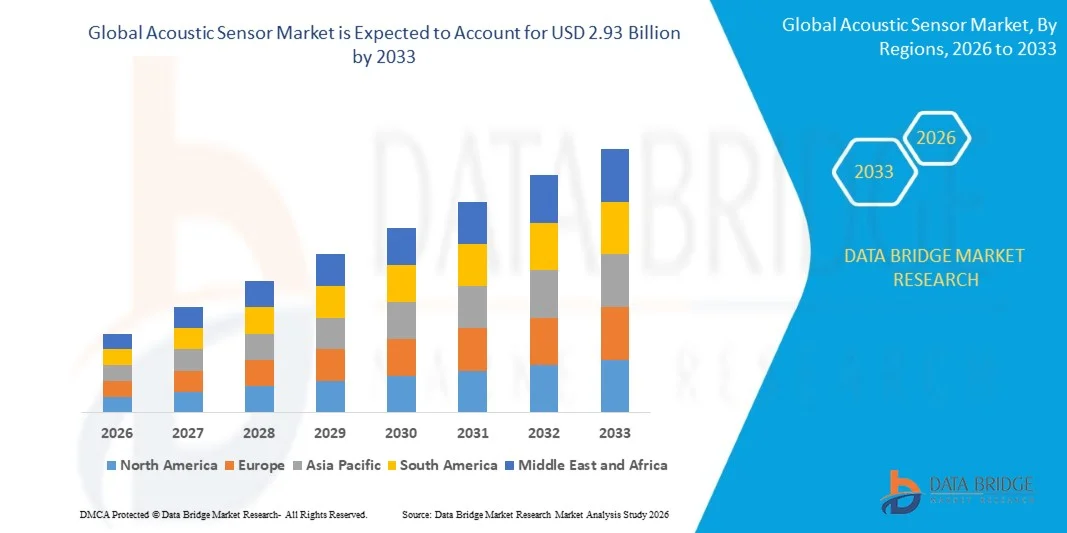
As per Data Bridge Market Research Analysis the acoustic sensor market was valued at USD 1.19 billion in 2025 and is projected to reach USD 2.93 billion by 2033, growing at a CAGR of 11.84% from 2026 to 2033. The market is witnessing robust growth, driven by the increasing adoption of acoustic sensors across automotive, industrial automation, aerospace & defense, healthcare, and consumer electronics applications. The growing demand for wireless sensing technologies, predictive maintenance solutions, structural health monitoring, and condition-based monitoring is accelerating the deployment of acoustic sensors capable of delivering accurate, real-time data in harsh operating environments. In addition, the rapid expansion of Industry 4.0, smart manufacturing, connected vehicles, and Internet of Things (IoT) ecosystems is further supporting market growth.
Furthermore, continuous investments in intelligent transportation systems, industrial digitalization, smart healthcare infrastructure, and advanced defense technologies are creating significant opportunities for market participants. Technological advancements in surface acoustic wave (SAW) and bulk acoustic wave (BAW) sensor technologies, along with innovations in piezoelectric materials such as quartz, lithium tantalate, lithium niobate, aluminium nitride, and silicon carbide, are improving sensor sensitivity, durability, wireless communication capabilities, and operational reliability. In addition, the increasing focus on energy-efficient monitoring systems, predictive asset management, and high-performance sensing solutions is enabling manufacturers to strengthen their product portfolios and address the growing demand for acoustic sensors across automotive, aerospace & defense, consumer electronics, healthcare, industrial, and other end-use sectors.
Market Size & Forecast
- Market Value (2025): 1.19 Billion
- Expected Market Value (2033): USD 2.93 Billion
- Forecast CAGR (2026–2033): 11.84%
- Leading Region in 2025: Asia-Pacific
- Fastest Growing Region: North America
Key Market Trends & Insights
- Asia-Pacific dominated the acoustic sensor market with the largest revenue share of 40.2% revenue share in 2025, supported by its strong electronics and semiconductor manufacturing ecosystem, expanding automotive production, and increasing adoption of industrial automation technologies.
- North America acoustic sensor market is expected to witness the fastest growth rate from 2026 to 2033, supported by increasing adoption of industrial automation, predictive maintenance technologies, and Industrial Internet of Things (IIoT) solutions across manufacturing, oil & gas, aerospace & defense, and healthcare industries.
- The quartz segment dominated the market in 2025 owing to its excellent piezoelectric properties, high frequency stability, low signal loss, and widespread adoption in Surface Acoustic Wave (SAW) devices, resonators, oscillators, and industrial sensing applications. Its superior reliability, cost-effectiveness, and stable performance under varying environmental conditions continue to support its leading position across automotive, industrial, telecommunications, and consumer electronics applications.
- The aluminium nitride segment is expected to witness the fastest growth during the forecast period 2026 to 2033, driven by increasing demand for high-frequency Bulk Acoustic Wave (BAW) devices, 5G communication infrastructure, RF filters, electric vehicles, and advanced consumer electronics. Its high thermal conductivity, excellent electromechanical coupling, compatibility with semiconductor manufacturing processes, and superior performance in harsh operating environments are expected to further accelerate segment growth as next-generation wireless communication and miniaturized electronic devices continue to expand.
- The wireless segment held the largest market revenue share of approximately 48.72% in 2025 driven by its growing adoption across industrial automation, predictive maintenance, structural health monitoring, automotive systems, and smart infrastructure applications. Wireless acoustic sensors offer flexible deployment, eliminate extensive cabling requirements, reduce installation and maintenance costs, and enable real-time remote monitoring of critical assets. The rapid expansion of Industry 4.0, Industrial Internet of Things (IIoT), smart factories, and connected industrial ecosystems, coupled with advancements in low-power wireless communication technologies such as Bluetooth Low Energy (BLE), Wi-Fi, LoRaWAN, and 5G, has further accelerated the adoption of wireless acoustic sensing solutions across industrial and commercial applications.
- The wired segment is expected to witness the fastest growth during the forecast period from 2026 to 2033 driven by its high reliability, low latency, and stable data transmission in mission-critical applications such as aerospace & defense, industrial process control, power generation, and manufacturing facilities. Wired acoustic sensors provide uninterrupted signal transmission with minimal interference, making them well suited for environments requiring continuous, high-precision monitoring and compliance with stringent operational standards.
Report Scope and Acoustic Sensor Market Segmentation
|
Attributes |
Acoustic Sensor Key Market Insights |
|
Segments Covered |
|
|
Countries Covered |
North America
Europe
Asia-Pacific
Middle East and Africa
South America
|
|
Key Market Players |
|
|
Market Opportunities |
|
|
Value Added Data Infosets |
In addition to the insights on market scenarios such as market value, growth rate, segmentation, geographical coverage, and major players, the market reports curated by the Data Bridge Market Research also include in-depth expert analysis, geographically represented company-wise production and capacity, network layouts of distributors and partners, detailed and updated price trend analysis and deficit analysis of supply chain and demand. |
Acoustic Sensor Market Trend
Trend: Adoption of Wireless Acoustic Sensors and Advanced SAW/BAW Technologies Across Industrial Automation and Smart Connected Devices
The acoustic sensor market is experiencing robust growth as industries increasingly adopt wireless acoustic sensors and advanced Surface Acoustic Wave (SAW) and Bulk Acoustic Wave (BAW) technologies for predictive maintenance, industrial automation, automotive electronics, healthcare, and consumer electronics. Their compact size, high sensitivity, and ability to support real-time, battery-free sensing make them increasingly attractive for next-generation connected applications.
Growing investments in Industry 4.0, Industrial Internet of Things (IIoT), 5G communication networks, and electric vehicles are accelerating the deployment of acoustic sensing technologies. Rising demand for predictive diagnostics, structural health monitoring, remote asset management, and smart manufacturing is further driving the adoption of high-performance SAW and BAW sensors across industrial and commercial sectors.
For Instance, In July 2025, Murata Manufacturing Co., Ltd. announced the world's first mass-produced XBAR acoustic wave filter, integrating its SAW expertise with XBAR technology acquired through Resonant Inc. The new filter delivers high attenuation, low insertion loss, and wider bandwidth for 5G, Wi-Fi 6E, Wi-Fi 7, and future 6G wireless applications, highlighting ongoing innovation in advanced acoustic wave technologies.
The continued evolution of wireless acoustic sensing and advanced SAW/BAW technologies is expected to strengthen market growth by enabling more accurate, energy-efficient, and reliable sensing solutions across industrial, automotive, healthcare, and consumer electronics applications.
Acoustic Sensor Market Dynamics
Key Market Driver: Rising Adoption of Intelligent Acoustic Sensing Technologies Across Industrial Automation and Smart Devices
The acoustic sensor market is experiencing significant growth due to the increasing deployment of intelligent sensing technologies across industrial automation, automotive, healthcare, and consumer electronics applications. The rapid adoption of Industry 4.0, Industrial Internet of Things (IIoT), and predictive maintenance solutions is accelerating demand for acoustic sensors capable of delivering real-time condition monitoring, structural health monitoring, and asset performance optimization. Furthermore, the expansion of electric vehicles, smart manufacturing facilities, and next-generation wireless communication infrastructure is driving the adoption of Surface Acoustic Wave (SAW) and Bulk Acoustic Wave (BAW) technologies, enabling higher sensing accuracy, reliability, and operational efficiency in demanding environments.
For Instance, In January 2025 Bosch Sensortec's showcase of AI-enabled sensor technologies at CES 2025, where the company introduced intelligent sensor solutions integrating MEMS technology with embedded AI and software to deliver real-time, low-power, and highly accurate sensing capabilities for consumer electronics, wearables, smart homes, robotics, and IoT applications. This development reflects the industry's growing focus on intelligent edge sensing, miniaturization, and next-generation connected devices.
The increasing adoption of intelligent acoustic sensing technologies, supported by advancements in wireless connectivity, AI-enabled sensing, and Industry 4.0 initiatives, is expected to accelerate the deployment of acoustic sensors across industrial, automotive, healthcare, and consumer electronics applications, driving sustained market growth over the forecast period.
Key Restraint/Challenge: Increasing Design Complexity and Stringent Performance Requirements for Next-Generation Acoustic Sensors
The acoustic sensor market faces significant challenges due to the increasing complexity of developing high-performance acoustic sensing solutions capable of meeting stringent requirements for sensitivity, frequency stability, miniaturization, and power efficiency. Manufacturers must optimize Surface Acoustic Wave (SAW) and Bulk Acoustic Wave (BAW) technologies to operate across multiple frequency bands while minimizing signal interference and maintaining long-term reliability in automotive, industrial automation, healthcare, and wireless communication applications. In addition, the need to integrate advanced acoustic sensing technologies into compact electronic devices without compromising performance or cost competitiveness continues to present a major challenge for industry participants.
For Instance, In October 2025, Qorvo's introduction of next-generation ultra-wideband BAW filters for 5G applications, where the company highlighted the growing complexity of RF front-end design as mobile devices must support an increasing number of frequency bands while reducing interference and maintaining high signal integrity. These developments demonstrate the significant engineering challenges associated with advancing acoustic wave technologies for next-generation wireless and.
The increasing design complexity and stringent performance requirements for next-generation acoustic sensors are expected to remain key challenges for manufacturers, driving the need for continuous innovation in sensor materials, miniaturization, and RF design while balancing performance, reliability, and cost-effectiveness.
Key Market Opportunity: Expanding Adoption of Acoustic Sensors in Smart Infrastructure, Industrial Automation, and Predictive Maintenance
The rapid digital transformation of industrial operations and infrastructure is creating significant growth opportunities for the acoustic sensor market. Increasing adoption of Industry 4.0, Industrial Internet of Things (IIoT), and predictive maintenance solutions is driving demand for acoustic sensors capable of real-time equipment diagnostics, leak detection, structural health monitoring, and machine condition monitoring. In addition, growing investments in smart factories, energy infrastructure, transportation systems, and autonomous industrial operations are encouraging the deployment of intelligent acoustic sensing technologies that improve operational reliability, reduce maintenance costs, and enhance workplace safety. The integration of wireless connectivity, artificial intelligence, and cloud-based analytics is further expanding the commercial potential of advanced acoustic sensor solutions across multiple industries.
For instance, in May 2025, Emerson expanded its industrial condition monitoring portfolio by introducing the AMS Wireless Vibration Monitor, which combines vibration and acoustic diagnostics to continuously monitor rotating equipment and detect early-stage mechanical faults. The solution enables predictive maintenance through wireless monitoring and advanced analytics, helping industrial facilities improve asset reliability, minimize unplanned downtime, and optimize maintenance operations. This development reflects the growing market opportunity for intelligent acoustic sensing technologies in industrial automation and connected asset management.
The growing adoption of acoustic sensors for predictive maintenance, smart infrastructure, and industrial automation is expected to create substantial market opportunities, supported by continued investments in wireless monitoring, AI-enabled analytics, and connected industrial ecosystems.
Acoustic Sensor Market Scope
The acoustic sensor market is segmented on the basis of material, type, wave type, parameters, and application.
- By Material
On the basis of material, the acoustic sensor market is segmented into quartz, lithium tantalate, lithium niobate, gallium arsenide, silicon carbide, langasite, zinc oxide, aluminium nitride, lead zirconium titanate, and polyvinylidene fluoride. The quartz segment dominated the market in 2025 owing to its excellent piezoelectric properties, high frequency stability, low signal loss, and widespread adoption in Surface Acoustic Wave (SAW) devices, resonators, oscillators, and industrial sensing applications. Its superior reliability, cost-effectiveness, and stable performance under varying environmental conditions continue to support its leading position across automotive, industrial, telecommunications, and consumer electronics applications.
The aluminium nitride segment is expected to witness the fastest growth during the forecast period 2026 to 2033, driven by increasing demand for high-frequency Bulk Acoustic Wave (BAW) devices, 5G communication infrastructure, RF filters, electric vehicles, and advanced consumer electronics. Its high thermal conductivity, excellent electromechanical coupling, compatibility with semiconductor manufacturing processes, and superior performance in harsh operating environments are expected to further accelerate segment growth as next-generation wireless communication and miniaturized electronic devices continue to expand.
- By Type
On the basis of type, the acoustic sensor market is segmented into wired and wireless. The wireless segment held the largest market revenue share of approximately 48.72% in 2025 driven by its growing adoption across industrial automation, predictive maintenance, structural health monitoring, automotive systems, and smart infrastructure applications. Wireless acoustic sensors offer flexible deployment, eliminate extensive cabling requirements, reduce installation and maintenance costs, and enable real-time remote monitoring of critical assets. The rapid expansion of Industry 4.0, Industrial Internet of Things (IIoT), smart factories, and connected industrial ecosystems, coupled with advancements in low-power wireless communication technologies such as Bluetooth Low Energy (BLE), Wi-Fi, LoRaWAN, and 5G, has further accelerated the adoption of wireless acoustic sensing solutions across industrial and commercial applications.
The wired segment is expected to witness the fastest growth during the forecast period from 2026 to 2033 driven by its high reliability, low latency, and stable data transmission in mission-critical applications such as aerospace & defense, industrial process control, power generation, and manufacturing facilities. Wired acoustic sensors provide uninterrupted signal transmission with minimal interference, making them well suited for environments requiring continuous, high-precision monitoring and compliance with stringent operational standards.
- By Wave Type
On the basis of wave type, the acoustic sensor market is segmented into surface wave and bulk wave. The surface wave segment held the largest market revenue share of approximately 55.80% in 2025 driven by its widespread use in wireless communication systems, automotive electronics, industrial sensing, and consumer electronic devices. Surface Acoustic Wave (SAW) sensors offer high sensitivity, compact size, excellent frequency stability, and cost-effective manufacturing, making them the preferred choice for applications such as pressure, temperature, torque, and chemical sensing, as well as RF filtering in smartphones, IoT devices, and other wireless communication equipment.
The bulk wave segment is expected to witness the fastest growth during the forecast period from 2026 to 2033 driven by the increasing deployment of high-frequency communication technologies, including 5G, Wi-Fi 6E, and emerging 6G networks. Bulk Acoustic Wave (BAW) sensors provide superior performance at higher frequencies, improved signal quality, lower insertion loss, and enhanced power handling capabilities, making them increasingly suitable for next-generation wireless infrastructure, advanced automotive electronics, aerospace & defense systems, and high-performance industrial applications.
- By Parameters
On the basis of parameters, the acoustic sensor market is segmented into pressure, temperature, mass, torque, humidity, viscosity, chemical vapour, and others. The temperature segment held the largest market revenue share of approximately 31.42% in 2025 driven by its extensive adoption across industrial automation, automotive, aerospace & defense, healthcare, and energy applications for continuous equipment monitoring and process control. Temperature acoustic sensors offer high measurement accuracy, long-term stability, and reliable performance in harsh operating environments, making them widely used in predictive maintenance, industrial monitoring systems, battery thermal management, and critical infrastructure applications.
The pressure segment is expected to witness the fastest growth during the forecast period from 2026 to 2033, registering a CAGR of 9.21%, driven by the increasing deployment of acoustic sensors in electric vehicles, industrial process automation, oil & gas facilities, smart manufacturing, and healthcare devices. Growing demand for real-time pressure monitoring, enhanced operational safety, predictive maintenance, and advanced condition monitoring solutions, along with the expanding adoption of Industrial Internet of Things (IIoT) technologies, is expected to further accelerate the segment's growth across diverse end-use industries.
- By Application
On the basis of application, the acoustic sensor market is segmented into automotive, aerospace & defense, consumer electronics, healthcare, industrial, and others.The automotive segment held the largest market revenue share of approximately 29.13% in 2025 driven by the increasing integration of acoustic sensors in advanced driver assistance systems (ADAS), engine condition monitoring, predictive maintenance, tire pressure monitoring, and electric vehicles. The growing production of connected and autonomous vehicles, coupled with rising demand for enhanced vehicle safety, reliability, and performance, continues to support the segment's leading position. Furthermore, the increasing adoption of noise, vibration, and harshness (NVH) monitoring technologies and acoustic-based diagnostics in modern vehicles is further driving the demand for acoustic sensors across the automotive industry.
The healthcare segment is expected to witness the fastest growth during the forecast period from 2026 to 2033, registering a CAGR of 9.57%, driven by the increasing adoption of wearable medical devices, remote patient monitoring systems, diagnostic equipment, and smart healthcare technologies. Advancements in miniaturized acoustic sensing technologies, rising investments in digital healthcare infrastructure, and growing demand for non-invasive monitoring solutions are expected to further accelerate the segment's growth throughout the forecast period.
Acoustic Sensor Market Regional Analysis
Asia-Pacific Acoustic Sensor Market Insight
Asia-Pacific dominated the acoustic sensor market with the largest revenue share of 40.2% revenue share in 2025, supported by its strong electronics and semiconductor manufacturing ecosystem, expanding automotive production, and increasing adoption of industrial automation technologies. Countries such as China, Japan, South Korea, and India continue to drive regional demand through growing investments in electric vehicles (EVs), Industry 4.0, consumer electronics, and wireless communication infrastructure. The increasing deployment of Surface Acoustic Wave (SAW) and Bulk Acoustic Wave (BAW) technologies for automotive, industrial, and telecommunications applications is further strengthening Asia-Pacific's leadership in the market.
China Acoustic Sensor Market Insight
The China dominated the acoustic sensor market with the largest revenue share in 2025, supported by the country's position as the world's largest electronics manufacturing hub and its expanding automotive and semiconductor industries. Government initiatives promoting intelligent manufacturing, digital transformation, and domestic semiconductor production are accelerating the adoption of acoustic sensors across industrial automation, consumer electronics, and connected vehicle applications. Furthermore, continued investments in 5G infrastructure, smart factories, and electric vehicles are creating sustained demand for advanced acoustic sensing technologies.
Japan Acoustic Sensor Market Insight
The Japan acoustic sensor market is expected to witness the fastest growth rate from 2026 to 2033 due to the country's leadership in precision electronics, automotive innovation, and advanced sensor manufacturing. Japanese manufacturers continue to invest in high-performance Surface Acoustic Wave (SAW) and Bulk Acoustic Wave (BAW) technologies to support next-generation wireless communication, automotive electronics, and industrial automation. Growing demand for predictive maintenance solutions, smart manufacturing systems, and miniaturized electronic devices is further supporting market expansion.
North America Acoustic Sensor Market Insight
The North America acoustic sensor market is expected to witness the fastest growth rate from 2026 to 2033, supported by increasing adoption of industrial automation, predictive maintenance technologies, and Industrial Internet of Things (IIoT) solutions across manufacturing, oil & gas, aerospace & defense, and healthcare industries. The region is also benefiting from growing investments in advanced wireless communication technologies, connected vehicles, and smart infrastructure, which continue to accelerate the deployment of Surface Acoustic Wave (SAW) and Bulk Acoustic Wave (BAW) sensor technologies.
U.S. Acoustic Sensor Market Insight
The U.S. acoustic sensor market is expected to witness the fastest growth rate from 2026 to 2033 due to increasing investments in smart manufacturing, industrial digitalization, and advanced sensing technologies. Rising demand for predictive maintenance, structural health monitoring, aerospace applications, medical devices, and connected industrial systems is supporting market expansion. Furthermore, continued investments in semiconductor manufacturing, electric vehicles, and next-generation wireless communication infrastructure are creating favorable opportunities for acoustic sensor manufacturers.
Europe Acoustic Sensor Market Insight
The Europe acoustic sensor market is expected to witness the fastest growth rate from 2026 to 2033, supported by the region's strong automotive manufacturing base, advanced industrial automation sector, and increasing investments in Industry 4.0 technologies. Growing deployment of acoustic sensors for predictive maintenance, machinery condition monitoring, and smart manufacturing applications, coupled with rising demand from aerospace & defense and healthcare industries, continues to drive regional market growth.
Germany Acoustic Sensor Market Insight
The Germany acoustic sensor market is expected to witness the fastest growth rate from 2026 to 2033 due to the country's leadership in industrial automation, automotive engineering, and precision manufacturing. Increasing adoption of Industry 4.0 technologies, factory automation, predictive maintenance solutions, and intelligent sensing systems is supporting demand for acoustic sensors across manufacturing, automotive, and machinery applications. Growing investments in digital manufacturing and advanced industrial equipment are expected to further strengthen market growth.
U.K. Acoustic Sensor Market Insight
The U.K. acoustic sensor market is expected to witness the fastest growth rate from 2026 to 2033, driven by the country's increasing investments in Industry 4.0, advanced manufacturing, aerospace & defense, automotive innovation, and digital healthcare. The adoption of acoustic sensors is expanding across predictive maintenance, industrial asset monitoring, structural health monitoring, and smart infrastructure projects as industries prioritize operational efficiency, equipment reliability, and workplace safety.
Acoustic Sensor Market Share
The Acoustic Sensor Market Analysis is primarily led by well-established companies, including:
- Murata Manufacturing Co., Ltd. (Japan)
- TDK Corporation (Japan)
- KYOCERA Corporation (Japan)
- Honeywell International Inc. (U.S.)
- Microchip Technology Inc. (U.S.)
- Siemens AG (Germany)
- TE Connectivity(Ireland)
- Bosch Sensortec GmbH (Germany)
- Qualcomm Technologies, Inc. (U.S.)
- Broadcom(U.S.)
- Qorvo, Inc. (U.S.)
- API Technologies Corp. (U.S.)
- Sensor Technology Ltd. (U.K.)
- H. Heinz Meßwiderstände GmbH (Germany)
- Hawk Measurement Systems(Australia)
- Pepperl+Fuchs SE (Germany)
- Emerson Electric Co. (U.S.)
- Baker Hughes Company (U.S.)
- Analog Devices, Inc. (U.S.)
- CTS Corporation (U.S.)
Latest Developments in Acoustic Sensor Market
- In October 2025, Murata Manufacturing announced plans to invest USD 200 million in establishing a new Bulk Acoustic Wave (BAW) filter manufacturing facility in Singapore to address the growing demand from emerging 6G communication infrastructure. The facility is expected to commence production in Q2 2026 with an annual manufacturing capacity of 500 million units, strengthening the company's position in next-generation wireless technologies.
- In September 2025, TDK Corporation expanded its Industrial Internet of Things (IIoT) capabilities through the acquisition of Germany-based SENSeOR SAS for EUR 120 million (USD 128 million). The acquisition enhances TDK's portfolio with advanced Surface Acoustic Wave (SAW) sensing technologies for harsh-environment monitoring while reinforcing its presence in the European industrial automation market.
- In August 2025, KYOCERA Corporation received U.S. FDA clearance for its biocompatible acoustic sensors designed for implantable medical devices. The approval enables the commercialization of these sensors for long-term cardiac monitoring and marks a significant advancement in the adoption of acoustic sensing technologies within regulated healthcare applications.
- In July 2025, Honeywell International secured a USD 45 million contract from the European Space Agency (ESA) to provide acoustic sensors for satellite structural health monitoring. Scheduled deliveries beginning in 2027 highlight the increasing utilization of acoustic sensing technologies to improve the safety, reliability, and performance of critical aerospace systems.

- Interactive Data Analysis Dashboard
- Company Analysis Dashboard for high growth potential opportunities
- Research Analyst Access for customization & queries
- Competitor Analysis with Interactive dashboard
- Latest News, Updates & Trend analysis
- Harness the Power of Benchmark Analysis for Comprehensive Competitor Tracking
Global Acoustic Sensor Market, Supply Chain Analysis and Ecosystem Framework
To support market growth and help clients navigate the impact of geopolitical shifts, DBMR has integrated in-depth supply chain analysis into its Global Acoustic Sensor Market research reports. This addition empowers clients to respond effectively to global changes affecting their industries. The supply chain analysis section includes detailed insights such as Global Acoustic Sensor Market consumption and production by country, price trend analysis, the impact of tariffs and geopolitical developments, and import and export trends by country and HSN code. It also highlights major suppliers with data on production capacity and company profiles, as well as key importers and exporters. In addition to research, DBMR offers specialized supply chain consulting services backed by over a decade of experience, providing solutions like supplier discovery, supplier risk assessment, price trend analysis, impact evaluation of inflation and trade route changes, and comprehensive market trend analysis.
Data collection and base year analysis are done using data collection modules with large sample sizes. The stage includes obtaining market information or related data through various sources and strategies. It includes examining and planning all the data acquired from the past in advance. It likewise envelops the examination of information inconsistencies seen across different information sources. The market data is analysed and estimated using market statistical and coherent models. Also, market share analysis and key trend analysis are the major success factors in the market report. To know more, please request an analyst call or drop down your inquiry.
The key research methodology used by DBMR research team is data triangulation which involves data mining, analysis of the impact of data variables on the market and primary (industry expert) validation. Data models include Vendor Positioning Grid, Market Time Line Analysis, Market Overview and Guide, Company Positioning Grid, Patent Analysis, Pricing Analysis, Company Market Share Analysis, Standards of Measurement, Global versus Regional and Vendor Share Analysis. To know more about the research methodology, drop in an inquiry to speak to our industry experts.
Data Bridge Market Research is a leader in advanced formative research. We take pride in servicing our existing and new customers with data and analysis that match and suits their goal. The report can be customized to include price trend analysis of target brands understanding the market for additional countries (ask for the list of countries), clinical trial results data, literature review, refurbished market and product base analysis. Market analysis of target competitors can be analyzed from technology-based analysis to market portfolio strategies. We can add as many competitors that you require data about in the format and data style you are looking for. Our team of analysts can also provide you data in crude raw excel files pivot tables (Fact book) or can assist you in creating presentations from the data sets available in the report.













