


What is the Acro-Pectoro-Renal Field Defect Market Size and Growth Rate?
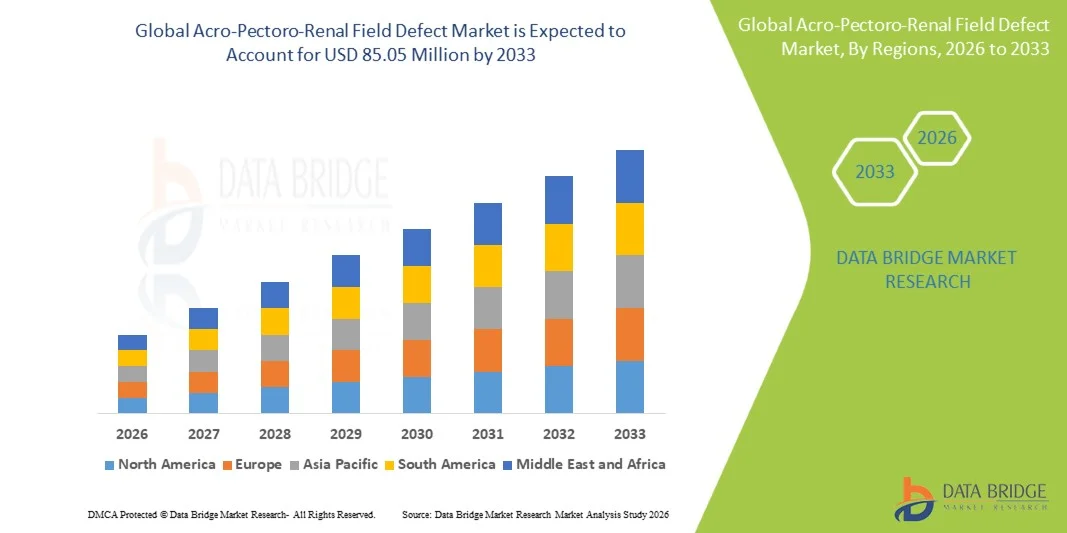
- As per Data Bridge Market Research analysis, the global Acro-Pectoro-Renal Field Defect market size was valued at USD 50.25 million in 2025and is expected to reach USD 85.05 million by 2033, at a CAGR of 6.8% during the forecast period
- The market growth is primarily driven by the rising identification of rare congenital syndromes, improved genetic screening technologies, and increasing clinical awareness among pediatric and genetic disorder specialists, leading to earlier diagnosis and better case documentation
- Furthermore, advancements in precision medicine, supportive surgical interventions, and expanding rare disease research initiatives are improving patient management and strengthening clinical attention toward such ultra-rare conditions, thereby contributing to the gradual development of this niche therapeutic area
Market Size & Forecast
- Global Market Value (2025): USD 50.25 million
- Expected Market Value (2033): USD 85.05 million
- Forecast CAGR (2026-2033): 6.8%
What are the Major Takeaways of Acro-Pectoro-Renal Field Defect Market?
- The Acro-Pectoro-Renal Field Defect is a rare congenital malformation involving limb, chest, and renal abnormalities, where clinical management and market development are primarily supported by advancements in diagnostic technologies enabling early detection and improved characterization of complex structural defects
- The increasing focus on rare disease identification, expansion of prenatal screening programs, and rising adoption of advanced imaging and genetic testing are key factors driving the demand for accurate and early diagnosis of this ultra-rare condition
- North America dominated the Acro-Pectoro-Renal Field Defect market with the largest revenue share of 46.7% in 2025, supported by advanced healthcare infrastructure, strong penetration of imaging and laboratory diagnostics, and the presence of specialized pediatric and genetic disorder centers, particularly in the U.S., driving improved detection and case reporting
- Asia-Pacific is expected to be the fastest growing region during the forecast period due to increasing healthcare investments, improving access to diagnostic technologies, rising awareness of congenital disorders, and expanding maternal-fetal health screening initiatives across emerging economies
- The imaging segment dominated the market in 2025 with a 52.4% share, driven by its critical role in identifying structural abnormalities in the chest, limbs, and kidneys, offering superior diagnostic accuracy and early detection capability compared to laboratory tests and biopsy procedures in clinical practice
Report Scope and Acro-Pectoro-Renal Field Defect Market Segmentation
|
Attributes |
Acro-Pectoro-Renal Field Defect Key Market Insights |
|
Segments Covered |
|
|
Countries Covered |
North America
Europe
Asia-Pacific
Middle East and Africa
South America
|
|
Key Market Players |
|
|
Market Opportunities |
|
|
Value Added Data Infosets |
In addition to the insights on market scenarios such as market value, growth rate, segmentation, geographical coverage, and major players, the market reports curated by the Data Bridge Market Research also include in-depth expert analysis, patient epidemiology, pipeline analysis, pricing analysis, and regulatory framework |
What is the Key Trend in the Acro-Pectoro-Renal Field Defect Market?
“Enhanced Precision in Rare Disease Detection Through Advanced Imaging and Genomics”
- A significant and emerging trend in the global Acro-Pectoro-Renal Field Defect market is the increasing reliance on high-resolution imaging and next-generation genomic sequencing to improve early detection and accurate characterization of complex congenital anomalies
- For instance, advanced fetal MRI and chromosomal microarray testing are being increasingly utilized in tertiary care centers to identify structural and genetic abnormalities associated with rare developmental syndromes
- Integration of imaging with molecular diagnostics enables clinicians to better understand multi-system involvement, improving diagnostic confidence and reducing misclassification of rare congenital conditions
- The convergence of radiology and genomics is facilitating more standardized diagnostic pathways, allowing earlier intervention planning and multidisciplinary case management in specialized hospitals
- This trend toward precision diagnostics and integrated evaluation frameworks is reshaping clinical expectations in rare disease identification, leading to improved case documentation and research interest
- The demand for combined imaging-genetic diagnostic approaches is steadily increasing across pediatric and genetic specialty centers as healthcare systems prioritize early and accurate detection of rare congenital disorders
- In addition, increasing use of AI-assisted imaging interpretation is enhancing diagnostic accuracy and enabling earlier recognition of subtle congenital abnormalities
Acro-Pectoro-Renal Field Defect Market Dynamics
Driver
“Increasing Demand Driven by Advancements in Rare Disease Screening and Diagnostic Awareness”
- The increasing recognition of rare congenital disorders and growing adoption of advanced prenatal and postnatal screening programs are key drivers supporting demand in the Acro-Pectoro-Renal Field Defect market
- For instance, expanded use of prenatal ultrasound and genetic testing panels in high-risk pregnancies is improving early identification of structural and developmental anomalies linked to rare syndromes
- As awareness among clinicians increases, more cases are being accurately diagnosed rather than remaining undetected or misclassified, contributing to market growth in diagnostic services
- Furthermore, rising investments in rare disease research and development are supporting improved understanding of congenital malformation syndromes and their clinical management pathways
- The growing integration of multidisciplinary care involving genetics, radiology, and pediatric surgery is enhancing diagnostic accuracy and strengthening healthcare system response
- Increasing availability of advanced diagnostic infrastructure in tertiary care hospitals is further accelerating adoption of specialized testing for rare congenital conditions
- Additionally, government-led rare disease initiatives and funding programs are improving access to diagnostic services and encouraging early screening adoption
- Moreover, rising collaboration between hospitals and academic research institutes is supporting faster identification and reporting of ultra-rare congenital cases
Restraint/Challenge
“Limited Clinical Awareness and High Diagnostic Complexity of Ultra-Rare Congenital Disorders”
- Limited clinical awareness and extremely low prevalence of Acro-Pectoro-Renal Field Defect pose significant challenges to early and accurate diagnosis across healthcare systems
- For instance, many cases remain undiagnosed or are misinterpreted due to overlapping symptoms with other congenital syndromes and lack of standardized diagnostic guidelines
- The high complexity of multi-system involvement requiring combined imaging, genetic, and clinical evaluation increases diagnostic burden and delays confirmation
- Furthermore, limited availability of specialized diagnostic infrastructure in developing regions restricts timely identification and appropriate clinical management of such rare conditions
- The absence of disease-specific therapeutic protocols further complicates clinical decision-making, reducing uniformity in treatment and monitoring approaches
- Addressing these challenges requires improved physician education, expanded rare disease registries, and stronger global collaboration in congenital disorder research and diagnostics
- Additionally, high cost of advanced genetic and imaging diagnostics limits accessibility in lower-income healthcare settings, further delaying diagnosis
- Moreover, insufficient long-term clinical data due to rarity of cases hampers development of standardized treatment and management guidelines
How is the Acro-Pectoro-Renal Field Defect Market Segmented?
The market is segmented on the basis of diagnosis, end-user, and distribution channel.
- By Diagnosis
On the basis of diagnosis, the Acro-Pectoro-Renal Field Defect market is segmented into laboratory test, imaging, and biopsy. The imaging segment dominated the market with the largest revenue share of 52.4% in 2025, driven by its critical role in identifying structural abnormalities in the limbs, chest, and kidneys associated with this congenital disorder. Imaging techniques such as ultrasound, MRI, and CT scans provide non-invasive, high-precision visualization, making them the primary diagnostic approach in suspected cases. Hospitals and specialty centers prefer imaging due to its ability to support early detection and comprehensive anatomical assessment in complex multi-system malformations. The increasing availability of advanced fetal and pediatric imaging further strengthens its dominance in clinical practice. Growing reliance on radiology-led diagnosis in rare congenital syndromes continues to support sustained demand for imaging-based evaluation. Additionally, integration of imaging with prenatal screening programs enhances early case identification, further consolidating its leading market position.
The laboratory test segment is expected to witness the fastest growth rate of 8% from 2026 to 2033, driven by increasing adoption of genetic testing and molecular diagnostics for rare congenital disorders. Laboratory tests help identify chromosomal abnormalities and gene-level mutations associated with developmental defects, improving diagnostic accuracy. Expanding use of next-generation sequencing (NGS) and chromosomal microarray analysis is significantly boosting demand for lab-based confirmation. Rising awareness among clinicians regarding genetic causes of syndromic malformations is accelerating test utilization. Increasing integration of laboratory diagnostics with imaging findings is enabling more precise disease classification. Additionally, declining costs of genomic testing are improving accessibility, particularly in tertiary care centers and research-driven hospitals.
- By End-User
On the basis of end-user, the market is segmented into hospitals, research institutes, and specialty clinics. The hospitals segment dominated the market with the largest revenue share of 60% in 2025, owing to their central role in diagnosis, treatment, and multidisciplinary management of rare congenital disorders. Hospitals are equipped with advanced imaging systems, genetic testing laboratories, and specialized pediatric departments required for accurate evaluation of complex syndromes. They serve as the first point of diagnosis for most congenital abnormalities, driving high patient inflow. Availability of integrated care teams including radiologists, geneticists, and pediatric surgeons strengthens hospital dominance. Government and private hospital investments in rare disease infrastructure further support this leadership position. Increasing hospital-based prenatal screening programs also contribute to early detection and higher diagnostic volumes.
The specialty clinics segment is expected to witness the fastest growth rate of 9% from 2026 to 2033, driven by increasing preference for focused rare disease and genetic disorder care centers. Specialty clinics provide targeted expertise in congenital anomaly diagnosis and long-term patient management. Rising establishment of dedicated genetic counseling and fetal medicine clinics is boosting segment expansion. Patients increasingly prefer these centers for second opinions and advanced diagnostic clarity. Growing collaboration between hospitals and specialty clinics is improving referral networks for rare disease cases. Additionally, improved accessibility and shorter diagnostic turnaround times are accelerating adoption of specialty clinic services.
- By Distribution Channel
On the basis of distribution channel, the market is segmented into hospital pharmacy, retail pharmacy, online pharmacies, and others. The hospital pharmacy segment dominated the market with the largest revenue share of 65% in 2025, as diagnosis and management of Acro-Pectoro-Renal Field Defect are primarily hospital-centric. Hospital pharmacies play a key role in dispensing supportive medications, post-surgical care drugs, and managing inpatient treatment protocols. Integration with hospital diagnostic systems ensures seamless coordination between diagnosis and therapy. High patient dependency on tertiary care centers reinforces hospital pharmacy dominance. Limited outpatient treatment options for this condition further strengthen hospital-based distribution. Additionally, centralized procurement in hospitals ensures standardized access to required medications and supportive therapies.
The online pharmacies segment is expected to witness the fastest growth rate of 10% from 2026 to 2033, driven by increasing digital healthcare adoption and improved access to rare disease support medications. Online platforms offer convenience for caregivers managing long-term supportive treatment requirements. Expanding telemedicine and e-prescription services are supporting online pharmacy integration. Growing awareness of digital health platforms in both developed and emerging regions is boosting adoption. Improved logistics and cold-chain capabilities are enhancing reliability of medication delivery. Additionally, increasing patient preference for home-based care and follow-up support is accelerating the shift toward online pharmaceutical channels.
Which Region Holds the Largest Share of the Acro-Pectoro-Renal Field Defect Market?
- North America dominated the Acro-Pectoro-Renal Field Defect market with the largest revenue share of 46.7% in 2025, supported by advanced healthcare infrastructure, strong penetration of imaging and laboratory diagnostics, and the presence of specialized pediatric and genetic disorder centers
- The region benefits from strong availability of specialized genetic testing, high-resolution imaging, and multidisciplinary pediatric care centers that support early and accurate diagnosis of complex congenital anomalies
- Increased awareness of rare congenital disorders among clinicians, along with strong research funding and established rare disease registries, further strengthens market leadership in the region. The presence of leading academic hospitals and advanced prenatal screening programs supports higher detection rates and detailed case documentation
U.S. Acro-Pectoro-Renal Field Defect Market Insight
The U.S. Acro-Pectoro-Renal Field Defect market captured the largest revenue share of 81% in North America in 2025, driven by advanced healthcare infrastructure and strong adoption of rare disease diagnostic technologies. The increasing use of high-resolution imaging and genomic sequencing is supporting early detection of complex congenital anomalies. Patients in the U.S. benefit from widespread access to specialized pediatric and genetic disorder centers, enabling accurate diagnosis and multidisciplinary care. Strong rare disease research funding and established clinical registries are further strengthening case identification and reporting. The growing integration of AI-assisted imaging and precision medicine approaches is improving diagnostic accuracy. Additionally, high healthcare expenditure and advanced prenatal screening programs continue to support market expansion.
Europe Acro-Pectoro-Renal Field Defect Market Insight
The Europe Acro-Pectoro-Renal Field Defect market is projected to expand at a substantial CAGR during the forecast period, primarily driven by strong rare disease frameworks and structured healthcare systems. Increasing adoption of prenatal screening and genetic counseling services is improving early detection of congenital malformation syndromes. Rising use of advanced imaging and molecular diagnostics in tertiary hospitals is enhancing diagnostic accuracy and clinical outcomes. Strong government support for rare disease research and participation in cross-border registries is improving disease documentation and awareness. Growing collaboration between academic institutions and healthcare providers is strengthening research activities in congenital disorders. Additionally, increasing clinician awareness of ultra-rare genetic conditions continues to support regional market growth.
U.K. Acro-Pectoro-Renal Field Defect Market Insight
The U.K. market is anticipated to grow at a noteworthy CAGR during the forecast period, driven by strong NHS-supported rare disease programs and increasing focus on early diagnosis. Expanding access to fetal imaging and genetic testing services is improving detection of congenital abnormalities. Rising awareness among healthcare professionals regarding rare developmental syndromes is contributing to higher diagnosis rates. Integration of centralized digital health systems is enabling better tracking and management of rare disease cases. Strong emphasis on maternal and prenatal healthcare is further supporting early intervention strategies. Additionally, increasing collaboration between hospitals and research institutions is accelerating clinical research and rare disease reporting.
Germany Acro-Pectoro-Renal Field Defect Market Insight
The Germany market is expected to expand at a considerable CAGR during the forecast period, fueled by advanced healthcare infrastructure and strong emphasis on diagnostic innovation. Increasing use of high-precision imaging technologies and genetic testing is enabling early identification of congenital abnormalities. The country’s focus on precision medicine and healthcare quality is strengthening rare disease diagnostic capabilities. Growing integration of hospital systems is improving coordination between radiology, genetics, and pediatric departments. Rising investment in rare disease research programs is enhancing understanding of complex syndromic conditions. Additionally, strong patient awareness and access to specialized care centers are supporting market growth.
Asia-Pacific Acro-Pectoro-Renal Field Defect Market Insight
The Asia-Pacific market is poised to grow at the fastest CAGR during the forecast period, driven by rising healthcare investments and improving access to diagnostic technologies. Increasing adoption of advanced imaging and genetic testing in countries such as China, Japan, and India is supporting early detection of rare congenital disorders. Government initiatives focused on maternal and child health screening programs are improving diagnosis rates. Expanding healthcare infrastructure and hospital networks are enhancing access to specialized care services. Growing collaboration between public and private healthcare sectors is strengthening rare disease identification and management. Additionally, rising awareness and urbanization are accelerating regional market expansion.
Japan Acro-Pectoro-Renal Field Defect Market Insight
The Japan market is gaining steady momentum due to its advanced healthcare system and strong emphasis on precision diagnostics. High adoption of genomic testing and advanced imaging technologies is improving detection of rare congenital abnormalities. The country’s technological innovation ecosystem is supporting integration of AI-based diagnostic tools in clinical workflows. Increasing presence of specialized hospitals and research institutions is strengthening rare disease management capabilities. Strong maternal healthcare programs and aging population dynamics are further supporting diagnostic demand. Continuous advancements in imaging and analytics are enhancing diagnostic accuracy for complex congenital cases.
India Acro-Pectoro-Renal Field Defect Market Insight
The India market accounted for a significant share in Asia-Pacific in 2025, driven by rapid urbanization and expanding healthcare access. Increasing availability of advanced imaging and genetic testing in urban hospitals is improving early diagnosis of congenital disorders. Government-led maternal and child health initiatives are supporting wider screening coverage across populations. Rising awareness among clinicians regarding rare genetic conditions is enhancing diagnostic rates. Growing affordability of diagnostic services is improving access in middle-income groups. Additionally, expansion of tertiary care hospitals and private diagnostic networks is strengthening the rare disease healthcare ecosystem in the country.
Which are the Top Companies in Acro-Pectoro-Renal Field Defect Market?
The Acro-Pectoro-Renal Field Defect industry is primarily led by well-established companies, including:
- Illumina, Inc. (U.S.)
- Thermo Fisher Scientific Inc. (U.S.)
- F. Hoffmann-La Roche Ltd (Switzerland)
- QIAGEN (Germany)
- Agilent Technologies, Inc. (U.S.)
- Bio-Rad Laboratories, Inc. (U.S.)
- Eurofins Scientific SE (Luxembourg)
- BGI Genomics Co., Ltd. (China)
- Natera, Inc. (U.S.)
- Myriad Genetics, Inc. (U.S.)
- Quest Diagnostics Incorporated (U.S.)
- ARUP Laboratories (U.S.)
- Blueprint Genetics Oy (Finland)
- PerkinElmer, Inc. (U.S.)
- Centogene N.V. (Germany)
- Invitae Corporation (U.S.)
- GeneDx (U.S.)
- Oxford Nanopore Technologies plc (U.K.)
- Color Health, Inc. (U.S.)
- Baylor Genetics (U.S.)
What are the Recent Developments in Global Acro-Pectoro-Renal Field Defect Market?
- In May 2024, A clinical case published in pediatric surgery literature documented an intrathoracic kidney combined with congenital diaphragmatic hernia, reinforcing the variability of renal involvement in field defect syndromes. The report highlighted the importance of advanced imaging in detecting atypical renal positioning and associated structural malformations
- In March 2023, A clinical case documented combined chest wall defects, limb anomalies, and renal abnormalities, reinforcing the syndrome’s classification as a multi-system developmental field defect. The study highlighted variability in presentation, including unilateral and bilateral involvement patterns
- In February 2023, A review highlighted that acro-pectoral-renal field defects often overlap with Poland syndrome and other congenital malformation syndromes, complicating diagnosis. The study emphasized that these conditions represent a broader embryonic developmental disruption spectrum
- In July 2022, A clinical report described a patient with Poland syndrome associated with horseshoe kidney and hydronephrosis, expanding known renal associations of acro-pectoral-renal field defects. The case reinforced the role of renal imaging in patients with chest wall malformations
- In August 2021, A pediatric case report described acro-renal syndrome as a polytopic developmental field defect involving limbs and urinary tract anomalies. It documented cases with ectrodactyly, syndactyly, and renal hypoplasia. The study reinforced that the condition is usually sporadic with variable expression

- Interactive Data Analysis Dashboard
- Company Analysis Dashboard for high growth potential opportunities
- Research Analyst Access for customization & queries
- Competitor Analysis with Interactive dashboard
- Latest News, Updates & Trend analysis
- Harness the Power of Benchmark Analysis for Comprehensive Competitor Tracking
Data collection and base year analysis are done using data collection modules with large sample sizes. The stage includes obtaining market information or related data through various sources and strategies. It includes examining and planning all the data acquired from the past in advance. It likewise envelops the examination of information inconsistencies seen across different information sources. The market data is analysed and estimated using market statistical and coherent models. Also, market share analysis and key trend analysis are the major success factors in the market report. To know more, please request an analyst call or drop down your inquiry.
The key research methodology used by DBMR research team is data triangulation which involves data mining, analysis of the impact of data variables on the market and primary (industry expert) validation. Data models include Vendor Positioning Grid, Market Time Line Analysis, Market Overview and Guide, Company Positioning Grid, Patent Analysis, Pricing Analysis, Company Market Share Analysis, Standards of Measurement, Global versus Regional and Vendor Share Analysis. To know more about the research methodology, drop in an inquiry to speak to our industry experts.
Data Bridge Market Research is a leader in advanced formative research. We take pride in servicing our existing and new customers with data and analysis that match and suits their goal. The report can be customized to include price trend analysis of target brands understanding the market for additional countries (ask for the list of countries), clinical trial results data, literature review, refurbished market and product base analysis. Market analysis of target competitors can be analyzed from technology-based analysis to market portfolio strategies. We can add as many competitors that you require data about in the format and data style you are looking for. Our team of analysts can also provide you data in crude raw excel files pivot tables (Fact book) or can assist you in creating presentations from the data sets available in the report.












