


What is Acrylic Resin Market Size and Overview ?
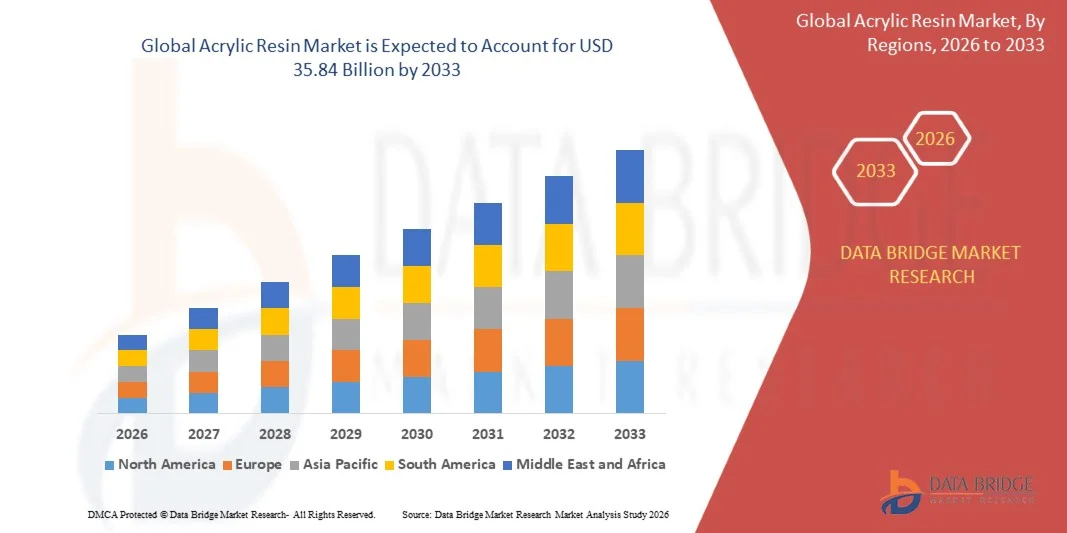
- The Acrylic Resin Market was valued at USD 22.49 billion in 2025 and is projected to reach USD 35.84 billion by 2033, growing at a CAGR of 6.00% from 2026 to 2033. The market is witnessing steady growth driven by rising demand for high-performance coatings, adhesives, and sealants across construction, automotive, and industrial applications. Increasing infrastructure development, expanding automotive production, and growing preference for durable and weather-resistant coating materials are further supporting market expansion.
- The rising adoption of acrylic resins in water-based coatings due to environmental regulations and VOC emission restrictions is significantly accelerating demand. In addition, their superior properties such as excellent transparency, UV resistance, and strong adhesion are making them highly preferred in paints, packaging, textiles, and construction materials, thereby strengthening their adoption across multiple end-use industries globally.
Market Size & Forecast
- Global Market Value (2025): USD 22.49 Billion
- Expected Market Value (2033): USD 35.84 Billion
- Forecast CAGR (2026–2033): 6.00%
- Leading Region in 2025: North America
- Fastest Growing Region: Asia-Pacific
Key Market Trends & Insights
- North America dominated the acrylic resin market with the largest revenue share of 32.6% in 2025, supported by strong demand from paints and coatings, construction, automotive refinishing, and industrial applications. The region benefits from advanced manufacturing infrastructure, high adoption of water-based coatings, and strict environmental regulations promoting low-VOC materials.
- Asia-Pacific acrylic resin market is expected to witness the fastest growth rate from 2026 to 2033, supported by rapid industrialization, expanding construction activities, and strong growth in automotive and packaging industries.
- The Acrylates segment held the largest market revenue share of approximately 48.6% in 2025 driven by its strong demand in coatings, adhesives, and sealants due to excellent weather resistance, durability, and flexibility. Acrylate-based resins are widely used in construction and automotive coatings where long-lasting performance and UV stability are critical requirements.
- The Hybrids segment is projected to register the fastest growth at a CAGR of 6.8% from 2026 to 2033, driven by increasing demand for enhanced performance materials combining the advantages of acrylates and methacrylates. Rising adoption in high-performance coatings and specialty industrial applications is accelerating segment expansion.
- The Solvent Based segment held the largest market revenue share of approximately 44.2% in 2025 driven by its superior adhesion, fast drying properties, and strong performance in industrial coatings and automotive refinishing applications. These resins are widely used in heavy-duty environments requiring high chemical and abrasion resistance.
- The Water Based segment is projected to register the fastest growth at a CAGR of 7.4% from 2026 to 2033, driven by stringent environmental regulations and increasing demand for low-VOC and eco-friendly coating solutions. Expanding adoption in construction paints, packaging, and consumer goods is further supporting segment growth.
- The Thermoplastic segment held the largest market revenue share of approximately 59.1% in 2025 driven by its ease of processing, recyclability, and wide application in coatings, adhesives, and plastics. These resins are preferred for applications requiring flexibility and reusability in manufacturing processes.
- The Thermosetting segment is projected to register the fastest growth at a CAGR of 6.5% from 2026 to 2033, driven by increasing demand for high-strength, heat-resistant, and chemically stable materials in industrial coatings and structural applications. Rising use in automotive and construction sectors is further accelerating adoption.
- The Paints and Coatings segment held the largest market revenue share of approximately 52.8% in 2025 driven by strong demand for decorative coatings, automotive refinishing, and industrial protective coatings. Increasing infrastructure development and rising preference for durable, weather-resistant surfaces are further strengthening segment dominance.
- The Adhesives segment is projected to register the fastest growth at a CAGR of 7.1% from 2026 to 2033, driven by expanding use in packaging, electronics, and construction industries. Rising demand for high-strength bonding solutions with improved flexibility and chemical resistance is accelerating segment expansion across multiple end-use sectors.
Report Scope and Acrylic Resin Market Segmentation
|
Attributes |
Acrylic Resin Key Market Insights |
|
Segments Covered |
|
|
Countries Covered |
North America
Europe
Asia-Pacific
Middle East and Africa
South America
|
|
Key Market Players |
|
|
Market Opportunities |
|
|
Value Added Data Infosets |
In addition to the insights on market scenarios such as market value, growth rate, segmentation, geographical coverage, and major players, the market reports curated by the Data Bridge Market Research also include import export analysis, production capacity overview, production consumption analysis, price trend analysis, climate change scenario, supply chain analysis, value chain analysis, raw material/consumables overview, vendor selection criteria, PESTLE Analysis, Porter Analysis, and regulatory framework. |
What is the Key Trend in Acrylic Resin Market ?
Trend: Growth In Water-Based Acrylic Resins And Low-VOC Coating Technologies
Increasing demand for environmentally friendly, durable, and high-performance coating materials across construction, automotive, packaging, and industrial sectors is significantly driving the shift toward water-based acrylic resins. Traditional solvent-based coatings emit higher volatile organic compounds, creating environmental and regulatory challenges, which is encouraging manufacturers to adopt low-VOC and waterborne acrylic resin systems with improved sustainability and safety profiles.
In modern construction applications, manufacturers are increasingly using acrylic resin-based coatings for exterior walls, flooring systems, and protective architectural finishes, such as in large infrastructure projects across Europe and Asia-Pacific, to enhance weather resistance, UV stability, and surface durability. In the automotive sector, acrylic resins are being widely used in clear coats and refinishing paints to improve gloss retention, scratch resistance, and long-term aesthetic performance while reducing environmental impact. In addition, industrial coatings for machinery, metal surfaces, and protective equipment are increasingly relying on acrylic-based formulations to improve corrosion resistance and chemical stability in harsh operating environments.
The rapid expansion of packaging materials, textiles, and adhesives is also increasing demand for acrylic resin-based emulsions and dispersions. In addition, waterborne acrylic coatings used in furniture, consumer goods, and electronics are gaining traction due to their fast drying time and improved environmental compliance. Growing industrial validation from large-scale coating applications in China and India in 2024, where water-based acrylic systems were increasingly adopted in construction and automotive refinishing sectors, has demonstrated improvement in environmental compliance efficiency by nearly 15–20% while maintaining high-performance coating durability.
Acrylic Resin Market Dynamics
Key Market Driver: Rising Demand For Low-VOC And High-Performance Coating Systems
Industries worldwide are increasingly shifting toward sustainable coating technologies due to stringent environmental regulations and rising demand for eco-friendly materials. Acrylic resins are widely used in water-based coatings, adhesives, and sealants, where low toxicity, durability, and weather resistance are critical performance requirements.
The construction and automotive industries are increasingly deploying acrylic resin-based coatings for architectural surfaces, vehicle refinishing, and protective industrial applications to enhance durability and reduce environmental impact. Automotive OEMs are adopting waterborne acrylic coatings to meet emission reduction targets while maintaining high gloss and corrosion resistance. For instance, large-scale automotive manufacturing facilities in Europe and North America reported significant reduction in VOC emissions after transitioning to water-based acrylic coating systems in 2024, improving regulatory compliance and operational sustainability.
Similarly, packaging and electronics industries are adopting acrylic resin emulsions for films, adhesives, and protective coatings due to their clarity, flexibility, and chemical resistance. Industrial coating applications in Asia-Pacific have demonstrated efficiency improvements of nearly 10–12% in surface durability and environmental compliance when using advanced acrylic resin formulations in high-humidity and high-temperature environments.
Key Restraint/Challenge: Raw Material Price Volatility And Performance Limitations In Extreme Conditions
The acrylic resin market faces challenges due to fluctuations in raw material prices such as acrylates and methacrylates, which directly impact production costs and profitability for manufacturers. Volatility in crude oil prices further affects feedstock availability, creating cost pressure across the supply chain.
In addition, while acrylic resins offer strong performance in general applications, they may show limitations in extreme temperature, chemical exposure, and high-load industrial environments compared to specialized resin systems. This restricts their adoption in certain heavy-duty applications where enhanced mechanical or thermal resistance is required.
Industrial assessments indicate that raw material price fluctuations in acrylate monomers have increased production cost variability by nearly 8–10% between 2022 and 2025, impacting pricing stability across downstream coating and adhesive markets.
Key Market Opportunity: Expansion In Sustainable Construction And Automotive Refinishing Applications
Rapid growth in sustainable construction practices and increasing demand for advanced automotive refinishing solutions present significant opportunities for acrylic resin manufacturers. Governments and industries are increasingly prioritizing green building materials and energy-efficient coatings, driving demand for low-emission resin system.
Acrylic resins are widely used in decorative paints, architectural coatings, and protective finishes for residential and commercial infrastructure, where long-term durability and aesthetic performance are essential. In automotive applications, demand for high-gloss, UV-resistant coatings is increasing due to rising vehicle production and growing consumer preference for premium finishes.
In addition, advancements in polymer chemistry and hybrid acrylic formulations are improving performance characteristics such as adhesion strength, weather resistance, and drying efficiency, opening opportunities across packaging, electronics, and industrial manufacturing sectors. Large-scale construction projects in China and India during 2025 reported coating lifespan improvements of nearly 12–18% when using advanced water-based acrylic resin systems under high-exposure environmental conditions.
Acrylic Resin Market Scope
The market is segmented on the basis of model, type, functionality, offering, and end-use application.
- By Type
On the basis of type, the acrylic resin market is segmented into Methacrylates, Acrylates, and Hybrids. The Acrylates segment held the largest market revenue share of approximately 48.6% in 2025 driven by its strong demand in coatings, adhesives, and sealants due to excellent weather resistance, durability, and flexibility. Acrylate-based resins are widely used in construction and automotive coatings where long-lasting performance and UV stability are critical requirements.
The Hybrids segment is projected to register the fastest growth at a CAGR of 6.8% from 2026 to 2033, driven by increasing demand for enhanced performance materials combining the advantages of acrylates and methacrylates. Rising adoption in high-performance coatings and specialty industrial applications is accelerating segment expansion.
- By Solvency
On the basis of solvency, the acrylic resin market is segmented into Water Based, Solvent Based, and Others. The Solvent Based segment held the largest market revenue share of approximately 44.2% in 2025 driven by its superior adhesion, fast drying properties, and strong performance in industrial coatings and automotive refinishing applications. These resins are widely used in heavy-duty environments requiring high chemical and abrasion resistance.
The Water Based segment is projected to register the fastest growth at a CAGR of 7.4% from 2026 to 2033, driven by stringent environmental regulations and increasing demand for low-VOC and eco-friendly coating solutions. Expanding adoption in construction paints, packaging, and consumer goods is further supporting segment growth.
- By Property
On the basis of property, the acrylic resin market is segmented into Thermoplastic and Thermosetting. The Thermoplastic segment held the largest market revenue share of approximately 59.1% in 2025 driven by its ease of processing, recyclability, and wide application in coatings, adhesives, and plastics. These resins are preferred for applications requiring flexibility and reusability in manufacturing processes.
The Thermosetting segment is projected to register the fastest growth at a CAGR of 6.5% from 2026 to 2033, driven by increasing demand for high-strength, heat-resistant, and chemically stable materials in industrial coatings and structural applications. Rising use in automotive and construction sectors is further accelerating adoption.
- By Application
On the basis of application, the acrylic resin market is segmented into Paints and Coatings, Construction, Medical, Paper and Paperboard, Textiles, Fibers and Adhesives. The Paints and Coatings segment held the largest market revenue share of approximately 52.8% in 2025 driven by strong demand for decorative coatings, automotive refinishing, and industrial protective coatings. Increasing infrastructure development and rising preference for durable, weather-resistant surfaces are further strengthening segment dominance.
The Adhesives segment is projected to register the fastest growth at a CAGR of 7.1% from 2026 to 2033, driven by expanding use in packaging, electronics, and construction industries. Rising demand for high-strength bonding solutions with improved flexibility and chemical resistance is accelerating segment expansion across multiple end-use sectors.
Acrylic Resin Market Regional Analysis
North America Acrylic Resin Market Insight
North America dominated the acrylic resin market with the largest revenue share of 32.6% in 2025, supported by strong demand from paints and coatings, construction, automotive refinishing, and industrial applications. The region benefits from advanced manufacturing infrastructure, high adoption of water-based coatings, and strict environmental regulations promoting low-VOC materials. Growing renovation activities, expanding automotive production, and rising demand for durable and weather-resistant coating systems are further strengthening market growth across residential, commercial, and industrial sectors.
U.S. Acrylic Resin Market Insight
The U.S. acrylic resin market captured the largest revenue share in North America in 2025, driven by high consumption in architectural coatings, automotive refinishing, and industrial adhesives. Increasing infrastructure modernization, strong construction spending, and rising demand for sustainable coating solutions are supporting market expansion. In addition, widespread adoption of water-based acrylic resins in compliance with environmental standards and growing preference for high-performance surface coatings are further accelerating growth.
Europe Acrylic Resin Market Insight
The Europe acrylic resin market is expected to witness the fastest growth rate from 2026 to 2033, primarily driven by stringent environmental regulations, rising demand for eco-friendly coatings, and increasing construction renovation activities. The region is experiencing strong adoption of water-based acrylic resins across automotive, architectural, and industrial applications. Growing emphasis on sustainability, energy-efficient buildings, and low-emission materials is further encouraging market expansion across residential and commercial infrastructure projects.
U.K. Acrylic Resin Market Insight
The U.K. acrylic resin market is expected to witness steady growth from 2026 to 2033, driven by rising demand for architectural coatings, construction refurbishment, and automotive refinishing applications. Increasing focus on sustainable building materials and low-VOC coatings is supporting the shift toward water-based acrylic resins. In addition, growing renovation activities and expanding use of advanced adhesive and coating systems in residential and commercial sectors are strengthening market growth.
Germany Acrylic Resin Market Insight
The Germany acrylic resin market is expected to witness strong growth from 2026 to 2033, fueled by its advanced automotive industry, robust construction sector, and strong focus on sustainable chemical solutions. Increasing adoption of high-performance coatings and water-based resins in industrial and automotive applications is supporting market expansion. Germany’s emphasis on energy-efficient materials and environmental compliance is further accelerating the shift toward eco-friendly acrylic resin formulations.
Asia-Pacific Acrylic Resin Market Insight
The Asia-Pacific acrylic resin market is expected to witness the fastest growth rate from 2026 to 2033, supported by rapid industrialization, expanding construction activities, and strong growth in automotive and packaging industries. Rising urbanization and infrastructure development in countries such as China, India, and Japan are significantly increasing demand for coatings, adhesives, and sealants. In addition, the region’s strong manufacturing base and cost-efficient production capabilities are further driving large-scale adoption of acrylic resins.
Japan Acrylic Resin Market Insight
The Japan acrylic resin market is expected to witness steady growth from 2026 to 2033 due to strong demand from automotive coatings, electronics, and high-performance industrial applications. The country’s focus on advanced materials, precision manufacturing, and sustainable coating technologies is supporting market expansion. Increasing use of water-based acrylic resins in automotive refinishing and construction coatings is further strengthening demand across end-use industries.
China Acrylic Resin Market Insight
The China acrylic resin market accounted for the largest revenue share in Asia-Pacific in 2025, driven by massive construction activities, strong automotive production, and rapid industrialization. The country’s expanding paints and coatings industry, along with growing demand for water-based and low-VOC formulations, is significantly supporting market growth. In addition, large-scale infrastructure development, urbanization, and strong domestic manufacturing capabilities are key factors driving acrylic resin consumption across multiple industries.
Acrylic Resin Market Share
The Acrylic Resin industry is primarily led by well-established companies, including:
- Cardolite Corporation (U.S.)
- BASF SE (Germany)
- Cardolite Corporation (U.S.)
- Kukdo Chemical Co., Ltd., (South Korea)
- Evonik Industries AG (Germany)
- Aditya Birla Group Chemicals (India)
- Mitsubishi Chemical Corporation (Japan),
- Arkema (France)
- Hexion (U.S.)
- Huntsman International LLC (U.S.)
- DuPont (U.S.)
- DAIKIN (Japan)
- Bostik (France)
- B. Fuller Company (U.S.)
- Sika AG (Switzerland)
- Freudenberg SE (Germany)
- DOW (U.S.)
- Solvay (Belgium)
- Air Products, Inc., (U.S.)
- Momentive (U.S.)
Latest Developments in Acrylic Resin Market
- In March 2025, Sumitomo Chemical announced the commercial launch of chemically recycled acrylic resins for electronics and automotive customers. This development focuses on integrating recycled feedstock into high-performance resin production, supporting circular economy initiatives. The move is expected to reduce dependency on virgin raw materials and strengthen sustainability trends, while encouraging wider adoption of recycled acrylic-based materials across advanced manufacturing industries.
- In July 2024, BASF secured ISCC+ certification across its global sites, enabling production of more than 60 acrylic products with low-PCF, zero-PCF, bio-based, and recycled variants. This certification enhances BASF’s sustainable product portfolio and ensures traceable, environmentally compliant supply chains. The development is expected to accelerate the shift toward low-carbon acrylic resin solutions and strengthen demand for eco-friendly coatings and adhesives in global markets.
- In March 2024, DIC Corporation’s subsidiary IDEAL CHEMI PLAST PRIVATE LTD. opened a new coating resin production facility in Supa Japanese Industrial Zone, Maharashtra. The facility tripled the company’s production capacity, enabling expansion across India, South Asia, and the Middle East. This development is expected to strengthen regional supply capabilities and support rising demand for high-performance coating resins in industrial and construction applications.
- In March 2021, BASF expanded its acrylic dispersions capacity at its Pasir Gudang facility in Malaysia, incorporating condensate stripping recovery technology. This initiative reduces freshwater consumption and wastewater generation while improving production efficiency. The expansion is expected to enhance BASF’s sustainability footprint and support growing demand for eco-efficient acrylic dispersions in coatings and construction applications.
- In February 2021, Arkema launched ENCOR 2793 functionalized pure acrylic binder for primers and renovation paints across multiple substrates including wood, plastics, and ceramics. The product offers improved adhesion and durability, supporting high-performance coating applications. This development is expected to expand Arkema’s presence in advanced coatings and strengthen demand for specialty acrylic binders in industrial and decorative markets.

- Interactive Data Analysis Dashboard
- Company Analysis Dashboard for high growth potential opportunities
- Research Analyst Access for customization & queries
- Competitor Analysis with Interactive dashboard
- Latest News, Updates & Trend analysis
- Harness the Power of Benchmark Analysis for Comprehensive Competitor Tracking
Global Acrylic Resin Market, Supply Chain Analysis and Ecosystem Framework
To support market growth and help clients navigate the impact of geopolitical shifts, DBMR has integrated in-depth supply chain analysis into its Global Acrylic Resin Market research reports. This addition empowers clients to respond effectively to global changes affecting their industries. The supply chain analysis section includes detailed insights such as Global Acrylic Resin Market consumption and production by country, price trend analysis, the impact of tariffs and geopolitical developments, and import and export trends by country and HSN code. It also highlights major suppliers with data on production capacity and company profiles, as well as key importers and exporters. In addition to research, DBMR offers specialized supply chain consulting services backed by over a decade of experience, providing solutions like supplier discovery, supplier risk assessment, price trend analysis, impact evaluation of inflation and trade route changes, and comprehensive market trend analysis.
Data collection and base year analysis are done using data collection modules with large sample sizes. The stage includes obtaining market information or related data through various sources and strategies. It includes examining and planning all the data acquired from the past in advance. It likewise envelops the examination of information inconsistencies seen across different information sources. The market data is analysed and estimated using market statistical and coherent models. Also, market share analysis and key trend analysis are the major success factors in the market report. To know more, please request an analyst call or drop down your inquiry.
The key research methodology used by DBMR research team is data triangulation which involves data mining, analysis of the impact of data variables on the market and primary (industry expert) validation. Data models include Vendor Positioning Grid, Market Time Line Analysis, Market Overview and Guide, Company Positioning Grid, Patent Analysis, Pricing Analysis, Company Market Share Analysis, Standards of Measurement, Global versus Regional and Vendor Share Analysis. To know more about the research methodology, drop in an inquiry to speak to our industry experts.
Data Bridge Market Research is a leader in advanced formative research. We take pride in servicing our existing and new customers with data and analysis that match and suits their goal. The report can be customized to include price trend analysis of target brands understanding the market for additional countries (ask for the list of countries), clinical trial results data, literature review, refurbished market and product base analysis. Market analysis of target competitors can be analyzed from technology-based analysis to market portfolio strategies. We can add as many competitors that you require data about in the format and data style you are looking for. Our team of analysts can also provide you data in crude raw excel files pivot tables (Fact book) or can assist you in creating presentations from the data sets available in the report.













