


Activated Alumina Market Analysis
The activated alumina market is experiencing significant growth due to its wide-ranging applications in water treatment, oil and gas processing, catalysis, and air drying. The increasing demand for clean water solutions, driven by rising industrialization and urbanization, has fueled the adoption of activated alumina as a highly effective adsorbent for removing fluoride, arsenic, and other contaminants from drinking water. In the oil and gas industry, activated alumina plays a crucial role in refining and natural gas dehydration, enhancing operational efficiency. In addition, advancements in adsorption technology have led to the development of high-performance alumina-based catalysts, improving petrochemical processing and emission control. With the growing shift toward renewable energy, activated alumina is also being integrated into lithium-ion battery production, ensuring moisture control and stability. The Asia-Pacific region dominates the market due to large-scale refining capacities, rapid industrial expansion, and significant government investments in water treatment infrastructure. Meanwhile, North America is witnessing rapid growth, driven by refinery expansion and stringent environmental regulations. The market's future is shaped by technological innovations and increased focus on sustainability and efficiency.
Activated Alumina Market Size
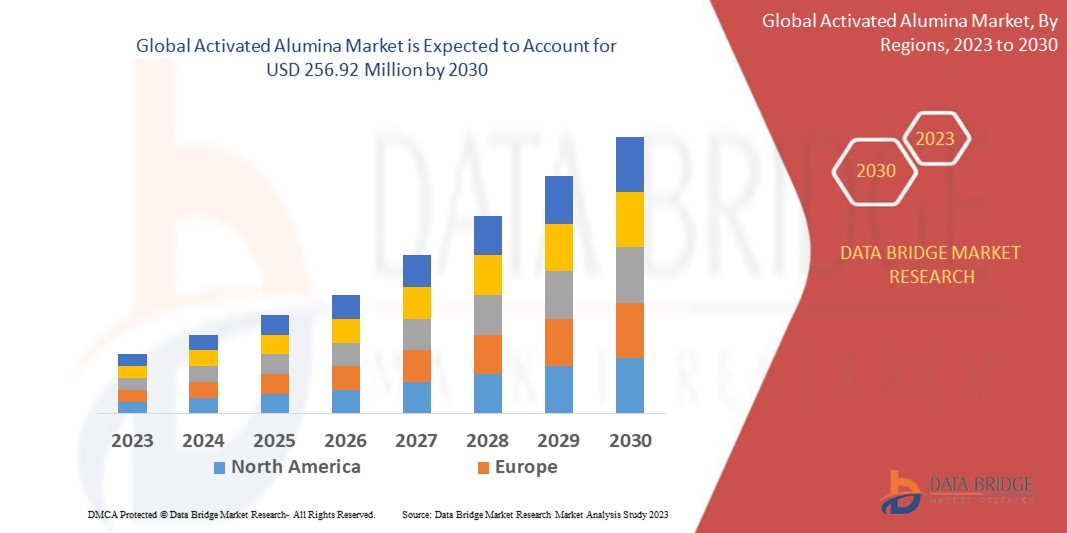
The global activated alumina market size was valued at USD 183.18 billion in 2024 and is projected to reach USD 287.58 billion by 2032, with a CAGR of 5.80 % during the forecast period of 2025 to 2032. In addition to the insights on market scenarios such as market value, growth rate, segmentation, geographical coverage, and major players, the market reports curated by the Data Bridge Market Research also include import export analysis, production capacity overview, production consumption analysis, price trend analysis, climate change scenario, supply chain analysis, value chain analysis, raw material/consumables overview, vendor selection criteria, PESTLE Analysis, Porter Analysis, and regulatory framework.
Activated Alumina Market Trends
“Increasing Adoption in Lithium-Ion Battery Production”
One key trend in the activated alumina market is its increasing adoption in lithium-ion battery production, driven by the growing demand for electric vehicles (EVs) and energy storage solutions. Activated alumina is widely used as a moisture adsorbent in battery manufacturing, ensuring optimal performance and longevity by preventing degradation caused by humidity and impurities. With the global push toward sustainable energy solutions, major battery manufacturers are integrating advanced alumina-based materials to enhance battery efficiency. For instance, Evonik Corporation announced the expansion of its fumed aluminum oxide production facility in Japan, specifically targeting the development of high-performance lithium-ion batteries. This shift aligns with the rising demand for EVs and clean energy technologies, further propelling the market. In addition, the Asia-Pacific region remains a dominant player due to its rapid industrial growth and government investments in renewable energy storage, reinforcing activated alumina’s role in next-generation battery technologies.
Report Scope and Activated Alumina Market Segmentation
|
Attributes |
Activated Alumina Key Market Insights |
|
Segments Covered |
|
|
Countries Covered |
U.S., Canada and Mexico in North America, Germany, France, U.K., Netherlands, Switzerland, Belgium, Russia, Italy, Spain, Turkey, Rest of Europe in Europe, China, Japan, India, South Korea, Singapore, Malaysia, Australia, Thailand, Indonesia, Philippines, Rest of Asia-Pacific (APAC) in the Asia-Pacific (APAC), Saudi Arabia, U.A.E., South Africa, Egypt, Israel, Rest of Middle East and Africa (MEA) as a part of Middle East and Africa (MEA), Brazil, Argentina and Rest of South America as part of South America |
|
Key Market Players |
BASF (Germany), Honeywell International Inc. (U.S.), Sumitomo Chemical Co., Ltd. (Japan), Evonik Corporation (U.S.), Axens (France), AGC Chemicals Americas, Inc. (U.S.), Sorbchem India Pvt Ltd. (India), Shandong Zhongxing New Material Technology Co., Ltd. (China), Luoyang Xinghua Chemical Co., Ltd. (China), HengYe Inc. (U.S.), J.M. Huber Corporation (U.S.), Garg Chemical Industries (India), Merck KGaA (Germany), and Baltimore Innovations Ltd (U.K.) |
|
Market Opportunities |
|
|
Value Added Data Infosets |
In addition to the insights on market scenarios such as market value, growth rate, segmentation, geographical coverage, and major players, the market reports curated by the Data Bridge Market Research also include import export analysis, production capacity overview, production consumption analysis, price trend analysis, climate change scenario, supply chain analysis, value chain analysis, raw material/consumables overview, vendor selection criteria, PESTLE Analysis, Porter Analysis, and regulatory framework. |
Activated Alumina Market Definition
Activated alumina is a highly porous and granular form of aluminum oxide (Al₂O₃) that exhibits strong adsorption properties, making it widely used for moisture removal, purification, and catalytic applications. It is produced by heating aluminum hydroxide to remove water content, resulting in a high-surface-area material with excellent porosity and thermal stability.
Activated Alumina Market Dynamics
Drivers
- Increasing Demand for Water Treatment Solutions
The rising need for clean and safe drinking water has significantly driven the activated alumina market, as it serves as an efficient adsorbent for removing harmful contaminants such as fluoride, arsenic, and lead from water supplies. Governments and organizations worldwide are investing in water purification infrastructure to combat water pollution and scarcity issues, particularly in regions where groundwater contamination is a serious concern. For instance, the World Health Organization (WHO) has established fluoride limits in drinking water, encouraging the widespread adoption of activated alumina-based filtration systems. Countries such as India and China, which have a high prevalence of fluoride contamination in groundwater, have implemented large-scale water treatment initiatives incorporating activated alumina. The growing global focus on safe drinking water access, supported by regulatory policies and rising public awareness, is fueling the expansion of the activated alumina market in the water treatment sector.
- Expanding Oil & Gas and Petrochemical Industries
The oil and gas industry is a major consumer of activated alumina, utilizing it for purification, refining, and natural gas dehydration processes. As global energy consumption continues to rise, the industry is witnessing increased refinery expansions and new exploration projects, further driving the demand for adsorbents and catalysts. In regions such as North America and the Middle East, large-scale liquefied natural gas (LNG) projects and petrochemical refinery expansions are creating significant opportunities for activated alumina in gas dehydration and sulfur removal applications. For instance, Saudi Aramco and other key players in the Middle East are investing in advanced gas treatment and refinery operations, where activated alumina is used to enhance process efficiency. In addition, stringent environmental regulations on gas emissions and hydrocarbon processing are pushing oil and gas companies to adopt high-performance adsorbents, further driving market demand.
Opportunities
- Growth in Catalyst Applications for Chemical and Industrial Processes
Activated alumina plays a vital role as a catalyst and catalyst support in various industrial processes, including hydrogenation, oxidation, and polymerization. The growing emphasis on energy-efficient production and environmentally friendly chemical processing has led to an increased demand for activated alumina-based catalysts. This is particularly noticeable in petrochemical refining, where activated alumina helps in cracking hydrocarbons and removing impurities from fuels. In addition, industries such as plastics manufacturing and pharmaceuticals are leveraging activated alumina catalysts to improve reaction efficiency while meeting stringent environmental regulations. For instance, chemical companies in Europe and North America are shifting towards low-emission industrial processes, further boosting demand for advanced catalyst materials. As sustainability and efficiency continue to be key market drivers, the application of activated alumina in industrial catalysis represents a significant growth opportunity for manufacturers in the chemical and energy sectors.
- Increasing Use in Lithium-Ion Battery Manufacturing
With the rising adoption of electric vehicles (EVs) and renewable energy storage systems, the demand for high-performance lithium-ion batteries has surged. Activated alumina is increasingly being used as a moisture adsorbent in lithium-ion battery production, preventing battery degradation caused by humidity and contaminants. This improves battery longevity, performance, and safety, making it a critical component in the evolving EV market. Leading companies such as Evonik are actively investing in alumina-based materials to enhance battery efficiency and durability. In addition, Asian countries, including China, Japan, and South Korea, which dominate lithium-ion battery manufacturing, are expanding production capacities, further driving demand for high-purity activated alumina. As governments worldwide push for clean energy solutions and electric mobility, the role of activated alumina in battery technology presents a lucrative market opportunity for material suppliers and manufacturers.
Restraints/Challenges
- High Production Costs
Activated alumina production requires intensive energy consumption and involves complex chemical processes, making manufacturing expensive. The cost of raw materials such as aluminum hydroxide and energy-intensive calcination processes significantly impact overall production expenses. For instance, fluctuations in bauxite and alumina prices directly affect the profitability of manufacturers, leading to price instability in the market. High production costs make it difficult for smaller manufacturers to compete, limiting market expansion.
- Competition from Alternative Materials
While activated alumina is widely used for adsorption, desiccation, and water treatment, it faces growing competition from alternative materials such as silica gel, zeolites, and polymer-based adsorbents. These substitutes often provide similar or superior performance at a lower cost, reducing the demand for activated alumina in certain applications. For instance, zeolites are preferred in some water purification processes due to their higher adsorption efficiency and selectivity. The increasing adoption of alternatives limits the growth potential of activated alumina.
This market report provides details of new recent developments, trade regulations, import-export analysis, production analysis, value chain optimization, market share, impact of domestic and localized market players, analyses opportunities in terms of emerging revenue pockets, changes in market regulations, strategic market growth analysis, market size, category market growths, application niches and dominance, product approvals, product launches, geographic expansions, technological innovations in the market. To gain more info on the market contact Data Bridge Market Research for an Analyst Brief, our team will help you take an informed market decision to achieve market growth.
Impact and Current Market Scenario of Raw Material Shortage and Shipping Delays
Data Bridge Market Research offers a high-level analysis of the market and delivers information by keeping in account the impact and current market environment of raw material shortage and shipping delays. This translates into assessing strategic possibilities, creating effective action plans, and assisting businesses in making important decisions. Apart from the standard report, we also offer in-depth analysis of the procurement level from forecasted shipping delays, distributor mapping by region, commodity analysis, production analysis, price mapping trends, sourcing, category performance analysis, supply chain risk management solutions, advanced benchmarking, and other services for procurement and strategic support.
Expected Impact of Economic Slowdown on the Pricing and Availability of Products
When economic activity slows, industries begin to suffer. The forecasted effects of the economic downturn on the pricing and accessibility of the products are taken into account in the market insight reports and intelligence services provided by DBMR. With this, our clients can typically keep one step ahead of their competitors, project their sales and revenue, and estimate their profit and loss expenditures.
Activated Alumina Market Scope
The market is segmented on the basis of function, form, application, and end-use. The growth amongst these segments will help you analyse meagre growth segments in the industries and provide the users with a valuable market overview and market insights to help them make strategic decisions for identifying core market applications.
Function
- Adsorption
- Catalysis
- Desiccation
Form
- Beads
- Powder
Application
- Catalyst
- Desiccant
- Fluoride Adsorbent
- Bio Ceramics
- Vacuum Systems Filtering Substance
- Medical Applications
- Drying Agent
- Vacuum Systems
End-Use
- Water Treatment
- Oil and Gas
- Plastics
- Healthcare
- Others
Activated Alumina Market Regional Analysis
The market is analysed and market size insights and trends are provided by country, function, form, application, and end-use as referenced above.
The countries covered in the market report are U.S., Canada and Mexico in North America, Germany, France, U.K., Netherlands, Switzerland, Belgium, Russia, Italy, Spain, Turkey, Rest of Europe in Europe, China, Japan, India, South Korea, Singapore, Malaysia, Australia, Thailand, Indonesia, Philippines, Rest of Asia-Pacific (APAC) in the Asia-Pacific (APAC), Saudi Arabia, U.A.E., South Africa, Egypt, Israel, Rest of Middle East and Africa (MEA) as a part of Middle East and Africa (MEA), Brazil, Argentina and Rest of South America as part of South America.
Asia-Pacific is projected to dominate the activated alumina market in terms of revenue growth and market share, driven by the presence of extensive refining capacities and a rising demand for freshwater supply. The region's rapid industrialization and urbanization have intensified the need for advanced water purification technologies, further propelling market expansion. In addition, government investments in water treatment infrastructure and stringent regulations on water quality management are fostering increased adoption of activated alumina. Moreover, the growing demand for natural gas processing and petrochemical applications in countries such as China, India, and Japan is significantly contributing to the market's upward trajectory.
North America is anticipated to be the fastest-growing region in the activated alumina market during the 2025-2032 forecast period, driven by rising production activities and expanding refinery operations. The increasing demand for clean energy solutions has led to significant investments in oil refining, petrochemical processing, and natural gas treatment, boosting the adoption of activated alumina in filtration and adsorption applications. In addition, the region's stringent environmental regulations regarding water purification and industrial emissions are further accelerating market growth. With major industry players investing in technological advancements and capacity expansion, North America is poised for rapid market development in the coming years.
The country section of the report also provides individual market impacting factors and changes in regulation in the market domestically that impacts the current and future trends of the market. Data points such as down-stream and upstream value chain analysis, technical trends and porter's five forces analysis, case studies are some of the pointers used to forecast the market scenario for individual countries. Also, the presence and availability of global brands and their challenges faced due to large or scarce competition from local and domestic brands, impact of domestic tariffs and trade routes are considered while providing forecast analysis of the country data.
Activated Alumina Market Share
The market competitive landscape provides details by competitor. Details included are company overview, company financials, revenue generated, market potential, investment in research and development, new market initiatives, global presence, production sites and facilities, production capacities, company strengths and weaknesses, product launch, product width and breadth, application dominance. The above data points provided are only related to the companies' focus related to market.
Activated Alumina Market Leaders Operating in the Market Are:
- BASF (Germany)
- Honeywell International Inc. (U.S.)
- Sumitomo Chemical Co., Ltd. (Japan)
- Evonik Corporation (U.S.)
- Axens (France)
- AGC Chemicals Americas, Inc. (U.S.)
- Sorbchem India Pvt Ltd. (India)
- Shandong Zhongxing New Material Technology Co., Ltd. (China)
- Luoyang Xinghua Chemical Co., Ltd. (China)
- HengYe Inc. (U.S.)
- J.M. Huber Corporation (U.S.)
- Garg Chemical Industries (India)
- Merck KGaA (Germany)
- Baltimore Innovations Ltd (U.K.)
Latest Developments in Activated Alumina Market
- In February 2023, Evonik announced the expansion of its fumed aluminum oxide production plant in Yokohama, Japan. The company plans to establish its first alumina production site in Asia, focusing on developing solutions for lithium-ion batteries used in electric vehicles. The facility is expected to be completed by 2025, supporting the growing demand for advanced battery materials
- In October 2022, Axens signed an Asset Sale Agreement (ASA) with Rio Tinto Alcan Canada to acquire its activated alumina business located in Brockville, Ontario, Canada. This acquisition presents growth opportunities in new global markets, strengthening Axens' position in the activated alumina sector
- In October 2021, Shell plc and BASF SE collaborated to evaluate, derisk, and deploy BASF's Sorbead adsorption technology. Unlike activated alumina or molecular sieves, Sorbead, an aluminosilicate gel material, regenerates at a lower temperature and exhibits resistance to acids and water. This technology ensures high-quality treated gas that meets strict pipeline and underground storage regulations while remaining glycol-free
- In September 2020, BASF SE expanded its selective hydrogenation catalyst offerings by introducing commercially proven alumina catalysts. These innovative catalysts offer enhanced tolerance to contaminants such as sulfur, owing to their higher Pd dispersion. The launch is expected to strengthen BASF SE's market presence and expand its penetration in the catalyst sector

- Interactive Data Analysis Dashboard
- Company Analysis Dashboard for high growth potential opportunities
- Research Analyst Access for customization & queries
- Competitor Analysis with Interactive dashboard
- Latest News, Updates & Trend analysis
- Harness the Power of Benchmark Analysis for Comprehensive Competitor Tracking
Global Activated Alumina Market, Supply Chain Analysis and Ecosystem Framework
To support market growth and help clients navigate the impact of geopolitical shifts, DBMR has integrated in-depth supply chain analysis into its Global Activated Alumina Market research reports. This addition empowers clients to respond effectively to global changes affecting their industries. The supply chain analysis section includes detailed insights such as Global Activated Alumina Market consumption and production by country, price trend analysis, the impact of tariffs and geopolitical developments, and import and export trends by country and HSN code. It also highlights major suppliers with data on production capacity and company profiles, as well as key importers and exporters. In addition to research, DBMR offers specialized supply chain consulting services backed by over a decade of experience, providing solutions like supplier discovery, supplier risk assessment, price trend analysis, impact evaluation of inflation and trade route changes, and comprehensive market trend analysis.
Data collection and base year analysis are done using data collection modules with large sample sizes. The stage includes obtaining market information or related data through various sources and strategies. It includes examining and planning all the data acquired from the past in advance. It likewise envelops the examination of information inconsistencies seen across different information sources. The market data is analysed and estimated using market statistical and coherent models. Also, market share analysis and key trend analysis are the major success factors in the market report. To know more, please request an analyst call or drop down your inquiry.
The key research methodology used by DBMR research team is data triangulation which involves data mining, analysis of the impact of data variables on the market and primary (industry expert) validation. Data models include Vendor Positioning Grid, Market Time Line Analysis, Market Overview and Guide, Company Positioning Grid, Patent Analysis, Pricing Analysis, Company Market Share Analysis, Standards of Measurement, Global versus Regional and Vendor Share Analysis. To know more about the research methodology, drop in an inquiry to speak to our industry experts.
Data Bridge Market Research is a leader in advanced formative research. We take pride in servicing our existing and new customers with data and analysis that match and suits their goal. The report can be customized to include price trend analysis of target brands understanding the market for additional countries (ask for the list of countries), clinical trial results data, literature review, refurbished market and product base analysis. Market analysis of target competitors can be analyzed from technology-based analysis to market portfolio strategies. We can add as many competitors that you require data about in the format and data style you are looking for. Our team of analysts can also provide you data in crude raw excel files pivot tables (Fact book) or can assist you in creating presentations from the data sets available in the report.













