


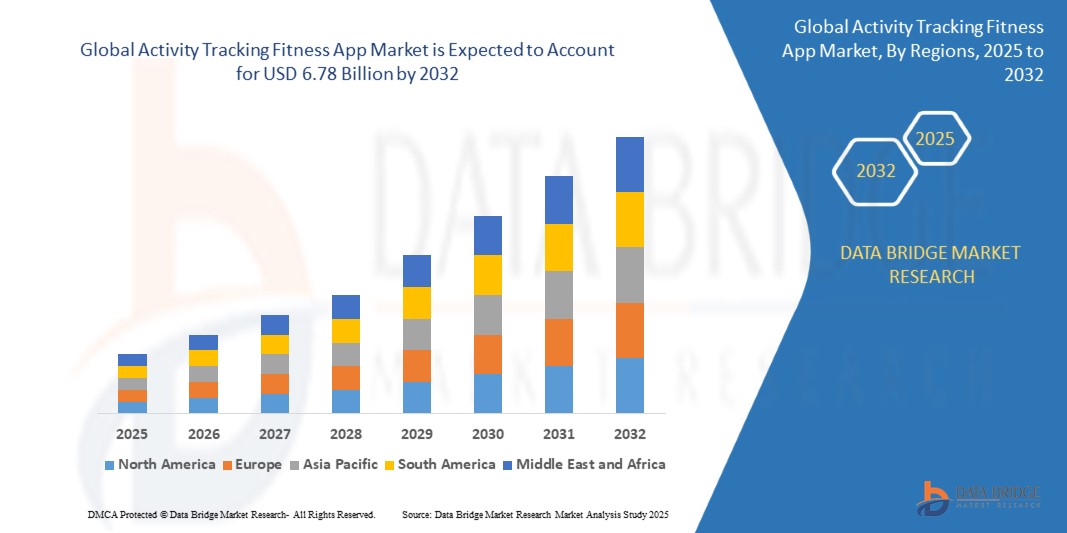
Activity Tracking Fitness App Market Size
- The global activity tracking fitness app market size was valued at USD 2.69 Billion in 2024 and is expected to reach USD 6.78 Billion by 2032, at a CAGR of 14.1% during the forecast period
- The growth of the global automotive intelligent park assist systems market is fueled by rising demand for advanced driver assistance systems (ADAS) and increasing emphasis on vehicle safety and convenience.
Activity Tracking Fitness App Market Analysis
The global activity tracking fitness app market is undergoing significant expansion as consumers across all demographics increasingly prioritize health, wellness, and digital self-monitoring. This growth is driven by a surge in fitness consciousness, rising prevalence of chronic lifestyle diseases, and growing adoption of smartphones, smartwatches, and wearable fitness devices. As a result, fitness tracking apps have become essential tools for tracking physical activity, calorie intake, heart rate, sleep patterns, and overall health metrics.
A primary driver of market growth is the rapid advancement in mobile and wearable technology. The integration of AI, machine learning, and real-time analytics enables personalized fitness plans, goal tracking, predictive insights, and motivational feedback. These capabilities not only improve user engagement but also allow apps to adapt dynamically to users' changing health and performance levels. Gamification, social connectivity, and data visualization are further enhancing user experience and retention.
The increasing emphasis on preventive healthcare, remote wellness monitoring, and self-managed fitness is also reshaping the market landscape. Fitness centers, personal trainers, and healthcare providers are collaborating with app developers to offer hybrid fitness solutions that blend virtual coaching with in-person services. In addition, employers are increasingly integrating fitness apps into corporate wellness programs to improve employee health and productivity, especially in the post-pandemic work-from-home era.
The market is seeing rapid growth in subscription-based models, with users willing to pay for access to advanced features such as live classes, customized nutrition guidance, mental wellness tracking, and community challenges. Freemium models are also widely used, offering basic features for free and encouraging in-app purchases or premium upgrades. Cloud storage and API-based integrations with wearable devices and third-party health platforms enhance the interoperability and utility of fitness tracking apps.
However, the market faces several challenges. These include data privacy and security concerns, especially related to sensitive health data shared via mobile platforms. Compliance with regulations such as HIPAA and GDPR is critical but often complex. Additionally, user engagement drop-off rates can be high if apps fail to maintain motivation and perceived value. Intense market competition and the saturation of generic apps also make differentiation and customer retention increasingly difficult.
Despite these challenges, the market outlook remains exceptionally promising. Factors such as rising smartphone penetration, the expansion of 5G networks, and increasing investments in digital health startups are expected to accelerate innovation and adoption. Governments and health organizations are promoting fitness tracking as part of national health strategies, creating new opportunities for app developers and healthcare partners.
As technological capabilities continue to evolve with voice assistants, AR/VR fitness experiences, and AI-powered coaching the Global Activity Tracking Fitness App Market is poised for sustained growth, greater personalization, and deeper integration into the broader digital health ecosystem.
Report Scope and Activity Tracking Fitness App Market Segmentation
|
Attributes |
Activity Tracking Fitness App Market Insights |
|
Segments Covered |
|
|
Countries Covered |
North America
Europe
Asia-Pacific
Middle East and Africa
South America
|
|
Key Market Players |
|
|
Market Opportunities |
|
|
Value Added Data Infosets |
In addition to the insights on market scenarios such as market value, growth rate, segmentation, geographical coverage, and major players, the market reports curated by the Data Bridge Market Research also include in-depth expert analysis, pricing analysis, brand share analysis, consumer survey, demography analysis, supply chain analysis, value chain analysis, raw material/consumables overview, vendor selection criteria, PESTLE Analysis, Porter Analysis, and regulatory framework. |
Activity Tracking Fitness App Market Trends
AI-powered personalization enhancing user engagement through customized workouts and health insights
- AI-powered personalization is playing a transformative role in the global activity tracking fitness app market by significantly enhancing user engagement. Modern fitness apps now go far beyond simply counting steps or logging workouts they actively analyze a wide range of user data such as activity levels, heart rate, sleep patterns, and even mood to create hyper-personalized fitness experiences. This is made possible through the integration of artificial intelligence (AI) and machine learning algorithms that continuously learn from user behavior and adapt accordingly.
- For example, based on a user’s performance trends, recovery times, and daily routines, AI can recommend specific workout types, intensity levels, and rest days that align with their individual fitness goals. If the user’s stress levels or sleep quality are poor, the app might suggest meditation or a low-impact routine instead of a high-intensity session. Over time, the AI system refines its suggestions to ensure the user stays motivated, avoids burnout, and sees consistent progress.
- This level of personalization not only improves results but also builds a deeper connection between the user and the app. People are more likely to stick with a fitness program when it feels tailored to their needs, leading to higher retention rates for app developers and better health outcomes for users. Furthermore, these intelligent features can foster a sense of accountability and encouragement, as users feel supported by a "virtual coach" that understands their journey.
Activity Tracking Fitness App Market Dynamics
Driver
Increasing health awareness among consumers
- The growing health awareness among consumers is one of the most influential drivers of the global activity tracking fitness app market. In recent years, individuals across all age groups and geographies have become more conscious of their physical and mental well-being, leading to a noticeable lifestyle shift toward healthier habits. This change has been largely fueled by the rising prevalence of chronic diseases such as obesity, diabetes, cardiovascular issues, and stress-related conditions, many of which are preventable or manageable through regular exercise and wellness routines.
- The COVID-19 pandemic further amplified this awareness, as people realized the importance of maintaining strong immunity, staying physically active, and managing stress effectively. With lockdowns limiting access to gyms and fitness centers, many turned to digital health solutions, particularly fitness apps, to stay active and monitor their health from home. This experience helped consumers understand that they could take greater control of their well-being with the help of technology conveniently, affordably, and consistently.
- Moreover, social media, health influencers, and government campaigns have all played a role in promoting healthy lifestyles. People are increasingly motivated by peer comparisons, fitness challenges, and visible progress tracking features that fitness apps provide in real time. From tracking daily steps and calories to managing sleep and hydration, these apps give users the tools they need to stay informed and accountable for their choices.
- As a result, fitness apps are no longer just for athletes or enthusiasts—they have entered the mainstream as everyday wellness companions. Whether it's a busy professional looking to squeeze in a 20-minute workout or a senior trying to monitor heart health, the desire for better living is encouraging consumers to adopt fitness apps as a practical solution. This widespread health awareness continues to drive growth in the market, as people seek proactive, tech-enabled ways to lead longer, healthier lives.
Restraint/Challenge
Growing concern over data privacy and security, a significant restraint for the activity tracking fitness app market.
- The growing concern over data privacy and security is a significant restraint for the activity tracking fitness app market, as these apps collect, process, and store a wide range of sensitive personal data. This includes users’ physical activity patterns, GPS location, heart rate, sleep quality, diet habits, and even mental health indicators. As users become more aware of how their personal information is handled, they are increasingly cautious about sharing data with digital platforms especially health-related ones.
- High-profile data breaches and misuse of consumer data in recent years have heightened public skepticism. Incidents involving the unauthorized sharing of user information, data leaks, or apps selling data to third parties without consent have caused serious backlash and legal consequences. This has led consumers to question the trustworthiness of fitness apps, particularly those that lack clear privacy policies or transparency about how user data is stored and used.
- In response, governments and regulators worldwide have introduced strict data protection laws, such as the General Data Protection Regulation (GDPR) in Europe and the California Consumer Privacy Act (CCPA) in the United States. These regulations require app developers to implement robust security measures, obtain explicit user consent, and provide users with control over their data. Ensuring compliance with such legislation adds technical and legal complexity for app developers, especially those operating across multiple regions with varying regulatory standards.
- Moreover, the challenge is not only in protecting data from external threats like hacking, but also in managing it responsibly within the app ecosystem. Many fitness apps integrate with third-party services, such as health insurers or wearable device manufacturers, increasing the risk of data leakage or misuse if proper safeguards are not in place.
- Overall, while users seek convenience and personalized health insights, their trust in the app depends on the perceived safety of their personal information. A lack of strong privacy protections can deter new users and prompt existing ones to abandon the platform, making data security a critical issue that can impact growth, adoption, and brand reputation in this highly competitive market.
Activity Tracking Fitness App Market Scope
The market is segmented on the basis of type, device, revenue model and End-user.
- By Type
The global activity tracking fitness app market, segmented by type into Activity Tracking, Exercise & Weight Loss, and Diet & Nutrition, reflects a comprehensive approach to personal wellness. The Activity Tracking segment focused on step counting, heart rate monitoring, sleep tracking, and general lifestyle metrics serves as the market’s backbone by offering users real-time health insights and daily motivation. The Exercise & Weight Loss category includes structured workout plans, training programs, and guided sessions aimed at fitness goals, making it a leading driver of app engagement and subscription revenue. Lastly, the Diet & Nutrition segment provides meal logging, calorie tracking, and personalized dietary plans, empowering users to manage their nutrition alongside physical activity. As consumers increasingly seek holistic health solutions, these segments collectively fuel demand for integrated apps that support lifestyle, fitness, and wellness objectives.
- By Device
The global activity tracking fitness app market, segmented by device into Smartphones, Tablets, and Wearable Devices, highlights the diverse range of platforms through which users engage with fitness and health tracking tools. Smartphones dominate the market due to their widespread adoption, high processing power, and compatibility with a wide array of fitness apps that offer real-time activity monitoring, personalized coaching, and social features. Tablets, while less commonly used for continuous tracking, are popular for viewing detailed analytics, following workout videos, and managing long-term health data due to their larger screens. Wearable devices—such as smartwatches and fitness bands play a critical role in real-time monitoring of physical activity, heart rate, sleep, and other biometric data. Their ability to sync seamlessly with apps on smartphones enhances user convenience and encourages continuous health engagement. As wearable technology becomes more sophisticated and integrated with mobile platforms, its contribution to the overall market is expected to grow significantly.
- By Revenue Model
The global activity tracking fitness app market, segmented by revenue model into Subscription-based, Freemium, Ad-supported, and One-time Purchase, reveals the diverse monetization strategies employed by app developers to reach and retain users. The subscription-based model dominates the market, offering users access to premium features such as personalized workout plans, nutrition coaching, and in-depth analytics through monthly or annual fees appealing to consumers seeking long-term health management tools. The freemium model allows users to access basic features at no cost while encouraging upgrades to unlock advanced capabilities, creating a broad user base and high conversion potential. Ad-supported apps provide free access in exchange for viewing advertisements, making fitness tools accessible to price-sensitive users while generating revenue through ad impressions and clicks. Lastly, the one-time purchase model appeals to users who prefer a fixed cost without recurring payments, though this model is gradually declining in popularity due to the rise of subscription services. Together, these models enable fitness app providers to cater to varying consumer preferences and optimize revenue generation in a competitive digital health landscape.
- By End-user
The global activity tracking fitness app market, segmented by end-user into Individual Consumers, Fitness Trainers, Healthcare Providers, and Corporate Wellness Programs, reflects the growing diversity of user needs in the digital health ecosystem. Individual consumers represent the largest segment, using fitness apps for personal health monitoring, workout tracking, goal setting, and lifestyle improvement. This group drives demand for user-friendly interfaces, personalized features, and integration with wearable devices. Fitness trainers use these apps to design custom training plans, monitor client progress, and communicate remotely, making digital platforms essential tools in modern personal training. Healthcare providers are increasingly adopting fitness apps to support preventive care, post-treatment recovery, and chronic disease management by tracking patient activity and encouraging adherence to health regimens. Meanwhile, corporate wellness programs are leveraging fitness apps to promote employee health, reduce healthcare costs, and enhance productivity through challenges, incentives, and performance tracking. As health and wellness become central to both personal and professional spheres, each of these end-user segments contributes significantly to the market's growth and evolution.
Activity Tracking Fitness App Market Regional Analysis
North America
North America holds a dominant position in the global activity tracking fitness app market, driven by high consumer awareness about health and wellness, widespread smartphone penetration, and the presence of major market players. North America leads the global activity tracking fitness app market, driven by high consumer health awareness, widespread smartphone and wearable adoption, and a mature fitness ecosystem. Consumers in the U.S. and Canada actively use apps to monitor workouts, track health metrics, and access personalized wellness experiences. Corporate wellness programs and health insurers are also incentivizing app use to promote healthier lifestyles and reduce healthcare costs. The presence of major technology and wearable brands ensures seamless integration, while advancements in AI-powered coaching and rich content libraries enhance user engagement and retention. As consumer demand for holistic, data-driven health solutions grows, North America is likely to remain a key growth region for fitness app innovation and adoption.
The United States, in particular, leads in app adoption, supported by a tech-savvy population and a strong culture of fitness. Corporate wellness programs and health insurance providers are also encouraging the use of fitness apps, further fueling market growth. Additionally, the integration of advanced technologies such as AI and wearable devices enhances user engagement and long-term retention in the region.
Europe
Europe shows steady growth in the activity tracking fitness app market, fueled by strong public awareness of wellness, rising rates of chronic disease, and supportive government initiatives that encourage digital health adoption. Countries such as Germany, the UK, and France boast high smartphone penetration and a growing preference for preventive healthcare, which helps boost app downloads and usage. Data privacy regulations like GDPR drive demand for secure, transparent platforms, steering consumers toward trusted providers. Increased integration with wearables and advanced features such as personalized workout plans and mental health tracking enhance user appeal. As European users seek holistic wellness solutions, developers are tailoring localized content and reliable user experiences to capitalize on this trend.
Asia Pacific
Asia-Pacific is the fastest-growing region in the activity tracking fitness app market, driven by expanding smartphone penetration, rising health awareness among millennials, and rapid urbanization. Countries like China, India, Japan, and South Korea are seeing a surge in fitness app adoption, fueled by government-backed digital health campaigns, burgeoning wearable markets, and demand for affordable wellness tools. Developers are responding with locally tailored features such as regional language support, culturally specific workout plans, and diet guides while partnerships with telecom providers and platforms extend app reach into semi-urban and rural areas. This mix of technological accessibility and cultural customization is positioning Asia-Pacific as a pivotal region for sustained fitness-tech growth and innovation.
Latin America
Latin America is emerging as a vibrant growth region for activity tracking fitness apps, driven by increasing smartphone penetration, growing health awareness among younger demographics, and expanding internet access. Countries like Brazil, Mexico, and Argentina are seeing rising downloads of fitness and wellness apps as consumers become more proactive about their health. Local developers are tailoring apps with features such as Spanish and Portuguese language support, culturally relevant workout routines, and integration with popular regional social platforms to improve engagement. While challenges like varying internet infrastructure and economic constraints exist, the region’s rapidly growing middle class and rising corporate wellness initiatives are fueling demand for accessible, mobile-first fitness solutions.
Middle East and Africa
The Middle East and Africa (MEA) market for activity tracking fitness apps is gaining momentum, particularly in urban centers like the UAE, Saudi Arabia, and South Africa. Rising disposable incomes, a growing focus on physical wellness, and government-led health initiatives are increasing app adoption within these regions. Younger, tech-savvy populations are gravitating toward digital fitness platforms to support personal health goals, aided by the spread of smartphones and wearables. However, market penetration is uneven, with challenges such as limited internet access, lower tech literacy, and cultural sensitivities slowing uptake in less developed areas. Despite these barriers, spurts of growth are being seen in corporate wellness programs and regional fitness communities, positioning MEA as an emerging frontier for health and wellness technology.
Activity Tracking Fitness App Market Share
The global activity tracking fitness app industry is primarily led by well-established companies, including:
- Google LLC (Fitbit)
- Apple Inc.
- Samsung Electronics Co., Ltd.
- Garmin Ltd.
- Nike, Inc.
- Adidas AG
- Under Armour, Inc. (MapMyFitness)
- MyFitnessPal, Inc.
- Strava, Inc.
- Huawei Technologies Co., Ltd.
- Xiaomi Corporation (Mi Fit)
- Azumio Inc.
- Endomondo (Under Armour)
- ASICS Corporation (Runkeeper)
- Jefit, Inc.
Latest Developments in Global Activity Tracking Fitness App Market
- In June 2025, Apple announced Workout Buddy in watchOS 26 an AI-powered fitness companion that delivers real-time motivational “pep talks” and personalized coaching during workouts, enhancing user engagement and consistency
- In May 2025, Huawei launched the Huawei Watch 5, featuring built-in AI-enabled health scanning with X-Tap sensor (heart rate, ECG, SpO₂, respiratory health) and up to 11-day battery life, offering advanced wearable health support
- In April 2025, Research unveiled PosePilot, an Edge-AI posture-correction system for exercises like yoga. Using real-time feedback hosted on wearables, it aims to improve form and reduce injury risk
- In June 2025, A study on smart sportswear with textile strain sensors demonstrated 92.3% accuracy in real-time exercise monitoring using deep learning, pointing to future integration of apparel-based fitness tracking

- Interactive Data Analysis Dashboard
- Company Analysis Dashboard for high growth potential opportunities
- Research Analyst Access for customization & queries
- Competitor Analysis with Interactive dashboard
- Latest News, Updates & Trend analysis
- Harness the Power of Benchmark Analysis for Comprehensive Competitor Tracking
Data collection and base year analysis are done using data collection modules with large sample sizes. The stage includes obtaining market information or related data through various sources and strategies. It includes examining and planning all the data acquired from the past in advance. It likewise envelops the examination of information inconsistencies seen across different information sources. The market data is analysed and estimated using market statistical and coherent models. Also, market share analysis and key trend analysis are the major success factors in the market report. To know more, please request an analyst call or drop down your inquiry.
The key research methodology used by DBMR research team is data triangulation which involves data mining, analysis of the impact of data variables on the market and primary (industry expert) validation. Data models include Vendor Positioning Grid, Market Time Line Analysis, Market Overview and Guide, Company Positioning Grid, Patent Analysis, Pricing Analysis, Company Market Share Analysis, Standards of Measurement, Global versus Regional and Vendor Share Analysis. To know more about the research methodology, drop in an inquiry to speak to our industry experts.
Data Bridge Market Research is a leader in advanced formative research. We take pride in servicing our existing and new customers with data and analysis that match and suits their goal. The report can be customized to include price trend analysis of target brands understanding the market for additional countries (ask for the list of countries), clinical trial results data, literature review, refurbished market and product base analysis. Market analysis of target competitors can be analyzed from technology-based analysis to market portfolio strategies. We can add as many competitors that you require data about in the format and data style you are looking for. Our team of analysts can also provide you data in crude raw excel files pivot tables (Fact book) or can assist you in creating presentations from the data sets available in the report.













