


What is the Adaptive Headlights Market Size and Growth Rate ?
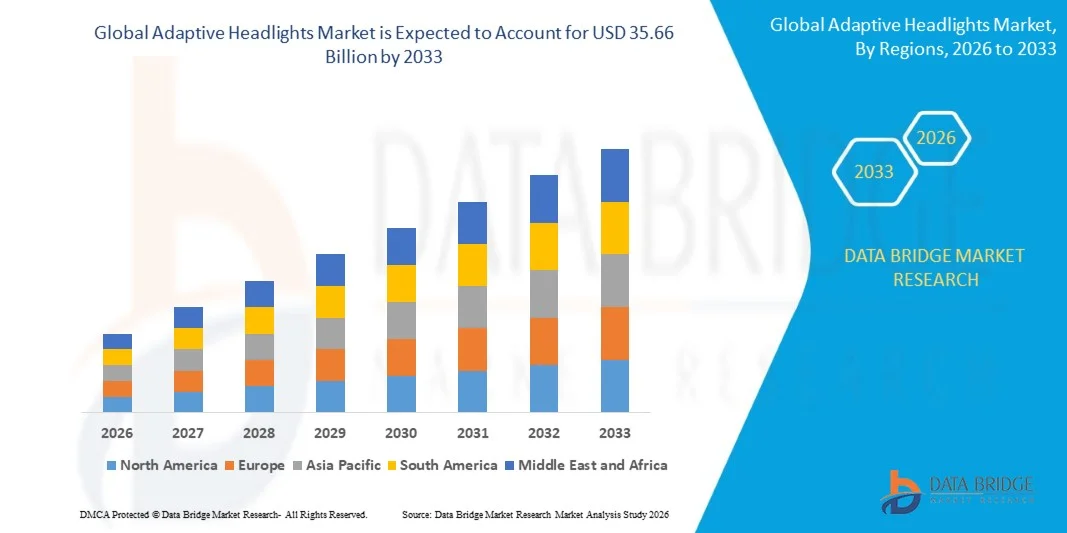
- As per Data Bridge Market Research Analysis the global adaptive headlights market size was valued at USD 8.18 billion in 2025 and is expected to reach USD 35.66 billion by 2033, at a CAGR of 20.20% during the forecast period
- The market growth is largely driven by increasing safety awareness among consumers and stringent automotive safety regulations, encouraging automakers to integrate advanced lighting technologies such as adaptive headlights in passenger and commercial vehicles
- Furthermore, rising adoption of connected vehicles, electric vehicles, and advanced driver-assistance systems (ADAS) is establishing adaptive headlights as a critical component for enhancing night-time visibility, accident prevention, and overall driving safety. These converging trends are accelerating market penetration, thereby significantly boosting industry growth
Market Size & Forecast
- Global Market Value (2025): USD 8.18 billion
- Expected Market Value (2033): USD 35.66 billion
- Forecast CAGR (2026–2033): 20.20%
What are the Major Takeaways of Adaptive Headlights Market?
- Adaptive headlights, offering dynamic light distribution that adjusts based on driving conditions, vehicle speed, and road curvature, are becoming essential safety and convenience features in modern vehicles due to their ability to enhance night-time visibility and reduce accidents
- The increasing demand for adaptive headlights is primarily fueled by technological advancements in LED, matrix, and laser lighting systems, growing consumer preference for advanced vehicle safety features, and the rising production of premium and electric vehicles incorporating smart lighting solutions
- North America dominated the adaptive headlights market with a share of around 40% in 2025, due to rising demand for advanced vehicle safety features and growing adoption of premium and mid-range vehicles equipped with adaptive lighting systems
- Asia-Pacific is expected to be the fastest growing region in the adaptive headlights market during the forecast period due to rapid vehicle sales, urbanization, and rising safety awareness in countries such as China, Japan, and India
- Passenger car segment dominated the market with a market share of 68.8% in 2025, due to widespread adoption across mid-range and luxury passenger vehicles. Consumers increasingly prioritize adaptive headlights for improved safety during night-time driving, city commuting, and long-distance travel. Passenger cars also benefit from the integration of adaptive lighting with other driver-assistance technologies such as lane detection and collision avoidance, enhancing overall vehicle intelligence
Report Scope and Adaptive Headlights Market Segmentation
|
Attributes |
Adaptive Headlights Key Market Insights |
|
Segments Covered |
|
|
Countries Covered |
North America
Europe
Asia-Pacific
Middle East and Africa
South America
|
|
Key Market Players |
|
|
Market Opportunities |
|
|
Value Added Data Infosets |
In addition to the insights on market scenarios such as market value, growth rate, segmentation, geographical coverage, and major players, the market reports curated by the Data Bridge Market Research also include in-depth expert analysis, geographically represented company-wise production and capacity, network layouts of distributors and partners, detailed and updated price trend analysis and deficit analysis of supply chain and demand. |
What is the Key Trend in the Adaptive Headlights Market ?
“Rising Integration of ADAS and Connected Vehicle Technologies”
- A significant trend in the adaptive headlights market is the growing integration of these systems with advanced driver-assistance systems (ADAS) and connected vehicle technologies, driven by the rising need for enhanced road safety, improved visibility, and real-time traffic responsiveness. This integration is positioning adaptive headlights as a critical component of modern intelligent automotive lighting solutions
- For instance, Hella and Valeo supply adaptive headlight modules that interface with ADAS sensors, such as cameras and radar, enabling dynamic beam adjustment and lane-based illumination. These systems improve driver awareness, reduce glare for oncoming traffic, and enhance overall night-time driving safety
- The adoption of adaptive headlights in luxury and mid-range vehicles is increasing as they support intelligent light distribution that responds to speed, steering, and environmental conditions. This is making adaptive lighting a key differentiator in vehicle safety and user experience
- Automakers are leveraging connected vehicle technologies to enable headlights that communicate with other vehicles and infrastructure, allowing predictive illumination in complex driving scenarios. Such advancements are contributing to the evolution of fully networked lighting systems that enhance road safety
- Consumer demand for vehicles equipped with smart lighting systems is rising as these headlights improve visibility during adverse weather and reduce accident risks. This trend reinforces the strategic value of adaptive headlights in the automotive safety ecosystem
- The market is witnessing strong growth in regulatory adoption and standardization, where vehicle safety regulations in the U.S., Europe, and China are encouraging integration of adaptive lighting systems. This trend is accelerating investment in research and development and driving the deployment of intelligent automotive lighting technologies
Adaptive Headlights Market Dynamics
Driver
“Increasing Automotive Safety Regulations and Consumer Safety Awareness”
- Rising government safety mandates and increasing consumer awareness of driving safety are driving demand for adaptive headlight systems that reduce nighttime accidents and enhance visibility. These factors are motivating automakers to prioritize adaptive lighting features in new vehicle models
- For instance, BMW incorporates adaptive LED headlights across its vehicles to meet stringent European NCAP safety standards, providing improved beam patterns and glare-free illumination that directly addresses safety regulations
- The expansion of ADAS technologies and automated driving features is further increasing the integration of adaptive headlights, as intelligent lighting is critical for collision avoidance, pedestrian detection, and lane guidance
- Consumer willingness to invest in vehicles with enhanced safety features is reinforcing this driver, as adaptive headlights are perceived as essential for modern automotive safety
- Global initiatives to standardize vehicle lighting technologies, such as UNECE regulations, are promoting broader adoption, providing long-term market support and incentivizing manufacturers to innovate in adaptive headlight design
Restraint/Challenge
“High Development and Implementation Costs of Advanced Headlight Systems”
- The adaptive headlights market faces challenges due to the high costs associated with designing, testing, and integrating intelligent lighting systems into vehicles. Advanced modules require sophisticated optics, microcontrollers, and sensor fusion technologies, increasing overall vehicle production expenses
- For instance, Osram’s adaptive lighting solutions involve complex LED matrices and precision lens systems, which elevate component and assembly costs for automakers
- Integrating these systems with ADAS, vehicle networks, and control software requires substantial R&D investment and specialized engineering, contributing to long development timelines
- Maintaining reliability under harsh automotive environments, including temperature fluctuations and vibrations, adds complexity and further increases production costs
- The challenge of balancing performance, regulatory compliance, and affordability continues to constrain widespread adoption, compelling manufacturers to optimize designs and seek cost-effective solutions without compromising functionality
How is the Adaptive Headlights Market Segmented ?
The market is segmented on the basis of type, vehicle type, and sales channel.
• By Type
On the basis of type, the adaptive headlights market is segmented into LED, Xenon, and Halogen. The LED segment dominated the market with the largest revenue share in 2025, driven by its superior energy efficiency, longer lifespan, and enhanced brightness and beam control. Automotive manufacturers increasingly prefer LED adaptive headlights for premium and mid-range vehicles due to their ability to deliver precise illumination and support dynamic lighting features. Consumer demand also favors LED headlights for improved night-time visibility, reduced glare for oncoming traffic, and compatibility with modern vehicle electronic systems. In addition, technological advancements in LED modules allow for integration with sensors and cameras, enabling adaptive lighting that responds to steering angle, speed, and road conditions, making them highly reliable and safe for drivers.
The Xenon segment is anticipated to witness the fastest growth rate from 2026 to 2033, fueled by rising adoption in luxury and high-performance vehicles. For instance, companies such as BMW are integrating Xenon adaptive headlights in their premium models to offer brighter and more focused lighting. Xenon lamps provide superior illumination compared with Halogen, enhancing driver visibility in adverse weather and high-speed conditions. Their ability to produce a whiter, more natural light improves overall driving safety while maintaining aesthetic appeal. The segment’s growth is further supported by increased consumer preference for technologically advanced lighting systems in modern vehicles.
• By Vehicle Type
On the basis of vehicle type, the adaptive headlights market is segmented into passenger cars and commercial vehicles. The passenger car segment held the largest market revenue share of 68.8% in 2025, driven by widespread adoption across mid-range and luxury passenger vehicles. Consumers increasingly prioritize adaptive headlights for improved safety during night-time driving, city commuting, and long-distance travel. Passenger cars also benefit from the integration of adaptive lighting with other driver-assistance technologies such as lane detection and collision avoidance, enhancing overall vehicle intelligence. Manufacturers are investing in advanced adaptive headlight systems for passenger cars to meet evolving safety regulations and customer expectations. The segment remains dominant due to high production volumes and strong consumer awareness regarding automotive safety features.
The commercial vehicle segment is expected to witness the fastest CAGR from 2026 to 2033, fueled by increasing safety regulations and the growing focus on reducing road accidents involving trucks and buses. For instance, Volvo has implemented adaptive headlight systems in its commercial trucks to enhance visibility during night-time operations. Adaptive headlights in commercial vehicles help in reducing glare for oncoming traffic and improving illumination in poorly lit roads. Rising fleet modernization programs and adoption of smart lighting solutions in logistics and transportation sectors also drive this segment’s growth. The segment benefits from the combination of regulatory support and increasing safety-conscious fleet operators.
• By Sales Channel
On the basis of sales channel, the adaptive headlights market is segmented into OEM and aftermarket. The OEM segment dominated the market with the largest revenue share in 2025, driven by high adoption of adaptive headlights as standard or optional equipment in new vehicles. Automakers are increasingly incorporating adaptive headlights at the production stage to enhance vehicle safety, meet regulatory requirements, and offer differentiated premium features. OEM-installed systems benefit from better integration with vehicle electronics, sensors, and driver-assistance systems, ensuring optimal performance. Consumer preference for factory-installed, reliable lighting solutions further reinforces the dominance of the OEM segment. The segment also gains momentum due to strong collaboration between automotive OEMs and headlight technology providers.
The aftermarket segment is anticipated to witness the fastest growth rate from 2026 to 2033, fueled by rising demand for vehicle upgrades and retrofitting of advanced lighting systems. For instance, companies such as Hella are providing adaptive LED retrofit solutions for older vehicles to improve nighttime visibility and comply with updated safety standards. The aftermarket segment offers flexibility for vehicle owners to enhance lighting performance without replacing the entire vehicle. Increasing awareness of night-time driving safety and availability of affordable retrofit kits further drive segment growth. The aftermarket channel continues to expand as vehicle owners seek customizable and technologically advanced lighting solutions.
Which Region Holds the Largest Share of the Adaptive Headlights Market ?
- North America dominated the adaptive headlights market with the largest revenue share of around 40% in 2025, driven by rising demand for advanced vehicle safety features and growing adoption of premium and mid-range vehicles equipped with adaptive lighting systems
- Consumers in the region increasingly value enhanced night-time visibility, reduced glare for oncoming traffic, and seamless integration with driver-assistance technologies such as lane detection and collision avoidance
- This widespread adoption is further supported by high disposable incomes, strong automotive R&D infrastructure, and increasing consumer awareness regarding vehicle safety and technological innovations
U.S. Adaptive Headlights Market Insight
The U.S. adaptive headlights market captured the largest revenue share in 2025 within North America, fueled by the rising integration of ADAS and growing demand for automotive safety enhancements. Consumers increasingly prioritize features such as automatic high-beam adjustment and cornering lights for safer night driving. The surge in electric and premium vehicle sales, combined with advancements in LED and matrix lighting technologies, further propels the market. In addition, the integration of adaptive headlights with vehicle connectivity systems and navigation data is significantly driving adoption. Robust automotive manufacturing infrastructure and government initiatives promoting road safety also support market expansion.
Europe Adaptive Headlights Market Insight
The Europe adaptive headlights market is projected to register substantial growth during the forecast period, primarily driven by strict automotive safety regulations and incentives for advanced lighting systems. For instance, BMW and Audi are actively incorporating matrix LED and laser headlight technologies across their vehicle lineups to comply with Euro NCAP standards. Increasing urbanization, traffic congestion, and demand for energy-efficient lighting solutions are fostering adoption. European consumers are also attracted to features such as glare-free high beams and adaptive cornering lights. The market is witnessing growth across passenger cars, SUVs, and commercial vehicles, with adaptive headlights being integrated into both new models and vehicle upgrades.
U.K. Adaptive Headlights Market Insight
The U.K. adaptive headlights market is expected to grow at a notable CAGR, driven by rising safety awareness and the expanding adoption of premium vehicles. Concerns over night-time road accidents and pedestrian safety are motivating consumers and fleet operators to opt for adaptive lighting solutions. Moreover, the U.K.’s strong automotive R&D ecosystem and increasing integration of connected car technologies are supporting market growth. In addition, manufacturers are introducing adaptive headlights compatible with intelligent vehicle systems, enhancing convenience and safety for drivers.
Germany Adaptive Headlights Market Insight
The Germany adaptive headlights market is projected to expand considerably, fueled by technological innovation and stringent vehicle safety standards. German automotive manufacturers such as Mercedes-Benz and Volkswagen are leading the integration of adaptive and matrix LED headlights in luxury and mid-range vehicles. Germany’s focus on sustainability and energy-efficient lighting systems promotes adoption, particularly in urban and high-traffic areas. Integration with advanced driver-assistance systems, such as lane-keeping and adaptive cruise control, is increasing. Consumer preference for technologically advanced, safe, and reliable lighting solutions aligns with the local market demand.
Asia-Pacific Adaptive Headlights Market Insight
The Asia-Pacific adaptive headlights market is poised to grow at the fastest CAGR during the forecast period of 2026 to 2033, driven by rapid vehicle sales, urbanization, and rising safety awareness in countries such as China, Japan, and India. Increasing penetration of luxury vehicles and the growing trend of smart and connected cars are driving adoption. For instance, Toyota and Hyundai are launching vehicles with adaptive LED headlight systems across APAC markets to enhance night-time safety. Government initiatives promoting vehicle safety standards, coupled with affordability of automotive lighting technologies, are enabling wider adoption across the region.
Japan Adaptive Headlights Market Insight
The Japan adaptive headlights market is gaining traction due to high vehicle safety standards, advanced automotive technology, and consumer preference for convenience. Japanese manufacturers are focusing on integrating adaptive headlights with smart sensors and AI-assisted driving features. Urban population density and frequent night driving demand improved visibility, fueling growth. In addition, the aging population is likely to increase demand for adaptive lighting systems that enhance driver comfort and reduce accidents. Integration with connected vehicle technologies, including collision avoidance systems, further supports adoption in passenger and commercial vehicles.
China Adaptive Headlights Market Insight
The China adaptive headlights market accounted for the largest market revenue share in Asia-Pacific in 2025, attributed to rapid vehicle production, increasing vehicle ownership, and rising safety awareness. Domestic and international manufacturers are actively introducing vehicles with matrix LED and adaptive high-beam systems. The government’s push for road safety and smart mobility solutions is supporting market expansion. For instance, BYD and NIO have incorporated advanced adaptive lighting systems in electric and hybrid models. Affordable vehicle lighting technologies, coupled with the growing electric vehicle segment, are driving the adoption of adaptive headlights across passenger and commercial vehicles.
Which are the Top Companies in Adaptive Headlights Market ?
The adaptive headlights industry is primarily led by well-established companies, including:
- Robert Bosch GmbH (Germany)
- HELLA GmbH & Co. KGaA (Germany)
- Koito Manufacturing Co., Ltd. (Japan)
- Marelli Holdings Co., Ltd. (Italy)
- STANLEY ELECTRIC CO., LTD. (Japan)
- North American Lighting Inc (U.S.)
- Varroc Group (India)
- ZKW Group GmbH (Austria)
- OSRAM / ams OSRAM (Germany)
- Valeo (France)
- SL Corporation (South Korea)
- Johnson Electric Holdings Limited (Hong Kong)
- General Electric (U.S.)
What are Latest Developments in Adaptive Headlights Market ?
- In 2024, ZF Friedrichshafen introduced its latest radar-integrated adaptive lighting system, which dynamically adjusts headlights based on vehicle speed, road conditions, and surrounding environmental data captured by radar sensors. This development strengthens the company’s position in the growing market for autonomous and semi-autonomous vehicles by offering enhanced night-driving safety and contributing to regulatory compliance, making it a pivotal technology for the adoption of advanced driver-assistance systems (ADAS)
- In 2024, Valeo unveiled its AI-based adaptive lighting system for premium vehicles, utilizing machine learning to optimize light distribution according to road curvature, traffic density, and weather conditions. This innovation enhances night-driving safety and driver comfort while reinforcing Valeo’s leadership in the adaptive headlights segment, positioning the company favorably in the luxury vehicle and high-performance lighting market
- In 2024, Osram launched a smart headlight designed for autonomous vehicles that integrates laser and LED technologies with real-time sensor data to dynamically adjust the beam. This advancement directly addresses the increasing demand for precision lighting in self-driving cars and strengthens Osram’s market presence in the autonomous mobility and high-tech automotive lighting sectors
- In 2023, Magneti Marelli partnered with leading electric vehicle manufacturers to integrate adaptive headlights into new EV models, focusing on energy-efficient lighting without compromising performance. This strategic collaboration positions Magneti Marelli as a key player in the EV adaptive lighting market and supports the broader trend of electrification and smart vehicle safety enhancements
- In 2023, Hella introduced a modular lighting platform for automakers, offering customizable adaptive headlights with Matrix LED and optional laser lights for both electric and traditional vehicles. This platform enhances Hella’s market competitiveness by providing scalable and flexible lighting solutions, catering to the rising demand for advanced, high-performance adaptive headlights in diverse vehicle segments

- Interactive Data Analysis Dashboard
- Company Analysis Dashboard for high growth potential opportunities
- Research Analyst Access for customization & queries
- Competitor Analysis with Interactive dashboard
- Latest News, Updates & Trend analysis
- Harness the Power of Benchmark Analysis for Comprehensive Competitor Tracking
Global Adaptive Headlights Market, Supply Chain Analysis and Ecosystem Framework
To support market growth and help clients navigate the impact of geopolitical shifts, DBMR has integrated in-depth supply chain analysis into its Global Adaptive Headlights Market research reports. This addition empowers clients to respond effectively to global changes affecting their industries. The supply chain analysis section includes detailed insights such as Global Adaptive Headlights Market consumption and production by country, price trend analysis, the impact of tariffs and geopolitical developments, and import and export trends by country and HSN code. It also highlights major suppliers with data on production capacity and company profiles, as well as key importers and exporters. In addition to research, DBMR offers specialized supply chain consulting services backed by over a decade of experience, providing solutions like supplier discovery, supplier risk assessment, price trend analysis, impact evaluation of inflation and trade route changes, and comprehensive market trend analysis.
Data collection and base year analysis are done using data collection modules with large sample sizes. The stage includes obtaining market information or related data through various sources and strategies. It includes examining and planning all the data acquired from the past in advance. It likewise envelops the examination of information inconsistencies seen across different information sources. The market data is analysed and estimated using market statistical and coherent models. Also, market share analysis and key trend analysis are the major success factors in the market report. To know more, please request an analyst call or drop down your inquiry.
The key research methodology used by DBMR research team is data triangulation which involves data mining, analysis of the impact of data variables on the market and primary (industry expert) validation. Data models include Vendor Positioning Grid, Market Time Line Analysis, Market Overview and Guide, Company Positioning Grid, Patent Analysis, Pricing Analysis, Company Market Share Analysis, Standards of Measurement, Global versus Regional and Vendor Share Analysis. To know more about the research methodology, drop in an inquiry to speak to our industry experts.
Data Bridge Market Research is a leader in advanced formative research. We take pride in servicing our existing and new customers with data and analysis that match and suits their goal. The report can be customized to include price trend analysis of target brands understanding the market for additional countries (ask for the list of countries), clinical trial results data, literature review, refurbished market and product base analysis. Market analysis of target competitors can be analyzed from technology-based analysis to market portfolio strategies. We can add as many competitors that you require data about in the format and data style you are looking for. Our team of analysts can also provide you data in crude raw excel files pivot tables (Fact book) or can assist you in creating presentations from the data sets available in the report.













