


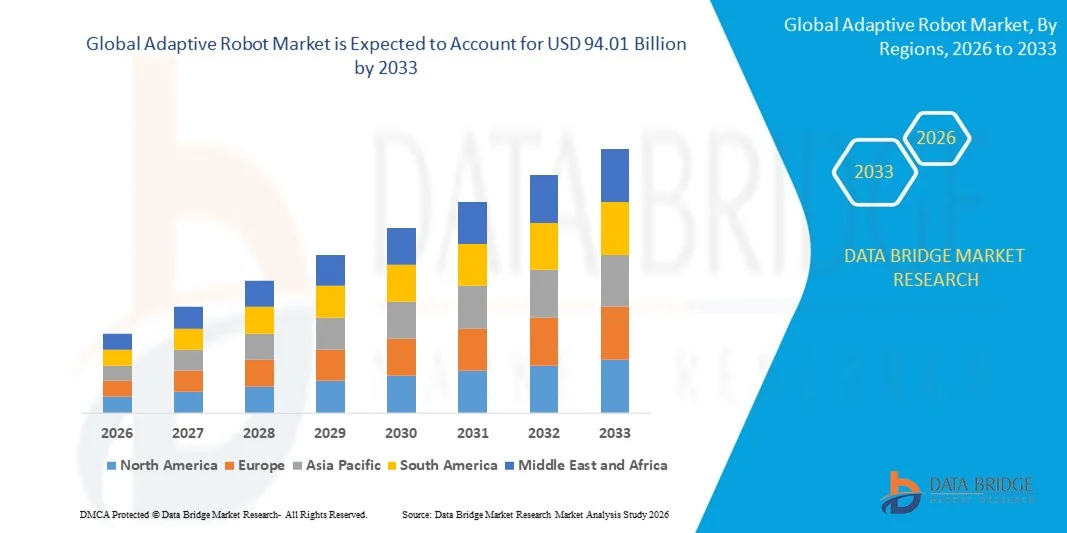
What is the Global Adaptive Robot Market Size and Growth Rate?
- The global adaptive robot market size was valued at USD 13.80 billion in 2025 and is expected to reach USD 94.01 billion by 2033, at a CAGR of 27.10% during the forecast period
- The integration of technologies such as vision and sensing, speech recognition and deep learning and mobility and navigation and increasing development in artificial intelligence are the major factors driving the adaptive robot market
- The transformation from single-purpose machines into multi-purpose adaptive machines and their use in industrial applications such as optimizing logistics process, facility management, customer service and engagement, logistics process, inventory management and packaging and assembling of parts among others accelerate the adaptive robot market growth
What are the Major Takeaways of Adaptive Robot Market?
- The utilization of the technology for automation of manufacturing process from start to finish, improvising supply chain efficiencies, understanding biological neural networks and automation of quality control and testing process influences the adaptive robot market
- In addition, rising cost of manufacturing, increasing number of research and development and surge in investment positively affect the adaptive robot market
- North America dominated the adaptive robot market with a 35.57% revenue share in 2025, driven by strong adoption of industrial automation, AI-driven robotics, and collaborative robots across the U.S. and Canada
- Asia-Pacific is projected to register the fastest CAGR of 10.59% from 2026 to 2033, driven by rapid industrial automation, strong manufacturing ecosystems, and rising investments in AI and robotics across China, Japan, India, South Korea, and Southeast Asia
- The Vision and Sensors segment dominated the market with an estimated 41.6% share in 2025, as adaptive robots heavily rely on cameras, LiDAR, force sensors, and tactile sensors to perceive environments and interact safely with humans
Report Scope and Adaptive Robot Market Segmentation
|
Attributes |
Adaptive Robot Key Market Insights |
|
Segments Covered |
|
|
Countries Covered |
North America
Europe
Asia-Pacific
Middle East and Africa
South America
|
|
Key Market Players |
|
|
Market Opportunities |
|
|
Value Added Data Infosets |
In addition to the insights on market scenarios such as market value, growth rate, segmentation, geographical coverage, and major players, the market reports curated by the Data Bridge Market Research also include in-depth expert analysis, pricing analysis, brand share analysis, consumer survey, demography analysis, supply chain analysis, value chain analysis, raw material/consumables overview, vendor selection criteria, PESTLE Analysis, Porter Analysis, and regulatory framework. |
What is the Key Trend in the Adaptive Robot Market?
Rapid Shift Toward AI-Driven, Compact, and Software-Defined Adaptive Robots
- The adaptive robot market is witnessing growing adoption of compact, sensor-rich, and AI-enabled robots designed to operate in dynamic and unstructured environments across manufacturing, logistics, healthcare, and service applications
- Manufacturers are increasingly introducing software-defined and learning-based adaptive robots with real-time perception, force sensing, vision systems, and edge AI to enable safe human–robot collaboration
- Rising demand for flexible, lightweight, and easily deployable robotic systems is driving adoption across SMEs, R&D centers, warehouses, and smart factories
- For instance, companies such as KUKA, FANUC, Boston Dynamics, and Universal Robots are advancing adaptive robotics with machine learning, autonomous navigation, and environment-aware manipulation
- Growing need for rapid task reconfiguration, real-time decision-making, and multi-tasking capabilities is accelerating the shift toward adaptive, self-learning robotic platforms
- As industries move toward automation 4.0, Adaptive Robots are becoming essential for flexible production, intelligent automation, and human-centric workplaces
What are the Key Drivers of Adaptive Robot Market?
- Rising demand for flexible automation solutions capable of adapting to changing tasks, product variations, and uncertain environments
- For instance, during 2024–2025, leading robotics manufacturers expanded their portfolios with AI-powered adaptive robots supporting vision-guided manipulation and autonomous learning
- Growing adoption of smart manufacturing, warehouse automation, healthcare robotics, and service robots across the U.S., Europe, and Asia-Pacific is boosting market demand
- Advancements in artificial intelligence, machine vision, sensors, edge computing, and digital twins have significantly improved robot adaptability and performance
- Increasing use of collaborative robots (cobots) and mobile adaptive robots is creating demand for safer, perception-driven robotic systems
- Supported by sustained investments in robotics R&D, AI innovation, and industrial automation, the Adaptive Robot market is expected to witness strong long-term growth
Which Factor is Challenging the Growth of the Adaptive Robot Market?
- High initial costs of AI-enabled hardware, sensors, and advanced control software limit adoption among small enterprises
- For instance, during 2024–2025, rising costs of precision sensors, AI chips, and robotic components increased system prices for several vendors
- Complexity in robot programming, AI training, system integration, and maintenance increases dependence on skilled professionals
- Limited awareness and technical expertise in emerging economies slow deployment of adaptive robotic systems
- Concerns related to safety standards, interoperability, and cybersecurity create adoption barriers in regulated industries
- To overcome these challenges, companies are focusing on modular designs, cloud-based learning platforms, cost-optimized robots, and user-friendly programming interfaces to expand global adoption of adaptive robots
How is the Adaptive Robot Market Segmented?
The market is segmented on the basis of technology, computing location, application, and end-user.
- By Technology
On the basis of technology, the adaptive robot market is segmented into Vision and Sensors, Learning, Perception and Speech Recognition, and Mobility and Navigation. The Vision and Sensors segment dominated the market with an estimated 41.6% share in 2025, as adaptive robots heavily rely on cameras, LiDAR, force sensors, and tactile sensors to perceive environments and interact safely with humans. These technologies are widely deployed in manufacturing, logistics, and healthcare for object detection, collision avoidance, and precision handling.
The Learning segment is expected to grow at the fastest CAGR from 2026 to 2033, driven by increasing adoption of machine learning and reinforcement learning that enables robots to self-improve, adapt to new tasks, and operate autonomously in dynamic environments.
- By Computing Location
Based on computing location, the market is segmented into On-Board and On-Cloud. The On-Board computing segment dominated the market with around 58.2% share in 2025, as real-time decision-making, low latency, and safety-critical operations require local processing in adaptive robots used in factories, hospitals, and warehouses.
The On-Cloud segment is projected to witness the fastest growth during the forecast period, supported by advancements in cloud robotics, 5G connectivity, and centralized AI training. Cloud-based computing enables large-scale data processing, continuous learning, and fleet-level optimization, making it increasingly attractive for service and mobile adaptive robots.
- By Application
On the basis of application, the adaptive robot market is segmented into Industrial Robot and Service Robot. The Industrial Robot segment dominated the market with a 63.4% share in 2025, driven by widespread deployment in automotive manufacturing, electronics assembly, logistics automation, and smart factories. Adaptive industrial robots improve productivity through flexibility, quick reprogramming, and human–robot collaboration.
The Service Robot segment is expected to grow at the fastest CAGR from 2026 to 2033, fueled by rising use in healthcare assistance, hospitality, retail automation, cleaning, and personal services, where adaptability and autonomous interaction are critical.
- By End-User
By end-user, the market is segmented into Entertainment, Automotive, BFSI, Healthcare, and Retail. The Automotive segment held the largest market share of 34.7% in 2025, supported by extensive use of adaptive robots in vehicle assembly, welding, inspection, and autonomous logistics.
The Healthcare segment is anticipated to register the fastest growth rate over the forecast period, driven by increasing demand for surgical robots, rehabilitation robots, patient assistance systems, and hospital automation, where adaptability, precision, and safety are essential.
Which Region Holds the Largest Share of the Adaptive Robot Market?
- North America dominated the adaptive robot market with a 35.57% revenue share in 2025, driven by strong adoption of industrial automation, AI-driven robotics, and collaborative robots across the U.S. and Canada. High investments in advanced manufacturing, warehouse automation, defence robotics, and healthcare automation continue to fuel demand for adaptive robots capable of real-time learning, perception, and decision-making
- Leading companies and research institutions in North America are actively developing AI-enabled, vision-based, and self-learning robotic systems, strengthening the region’s technological leadership. Continuous funding in robotics R&D, AI software, and smart factory initiatives supports long-term market expansion
- A strong talent pool, mature robotics ecosystem, and early adoption of next-generation automation solutions further reinforce North America’s market dominance
U.S. Adaptive Robot Market Insight
The U.S. is the largest contributor in North America, supported by extensive deployment of adaptive robots in automotive manufacturing, logistics, defence, healthcare, and retail automation. Rising adoption of collaborative robots, AI-powered service robots, and autonomous mobile robots accelerates market growth, backed by strong startup ecosystems and government-supported innovation programs.
Canada Adaptive Robot Market Insight
Canada contributes steadily to regional growth, driven by increasing use of adaptive robots in healthcare, research labs, smart warehouses, and industrial automation. Government funding, skilled robotics talent, and growing AI research capabilities strengthen adoption across the country.
Asia-Pacific Adaptive Robot Market
Asia-Pacific is projected to register the fastest CAGR of 10.59% from 2026 to 2033, driven by rapid industrial automation, strong manufacturing ecosystems, and rising investments in AI and robotics across China, Japan, India, South Korea, and Southeast Asia. Expanding use of adaptive robots in electronics manufacturing, automotive production, logistics, and service applications fuels regional growth.
China Adaptive Robot Market Insight
China leads Asia-Pacific due to large-scale manufacturing automation, strong government support for robotics, and rapid deployment of AI-enabled industrial and service robots, boosting both domestic use and exports.
Japan Adaptive Robot Market Insight
Japan shows steady growth supported by advanced robotics expertise, ageing population needs, and strong adoption of adaptive robots in automotive manufacturing, healthcare assistance, and industrial automation.
India Adaptive Robot Market Insight
India is emerging as a high-growth market, driven by expanding manufacturing automation, rising startup activity, and increasing adoption of adaptive robots in logistics, healthcare, and smart factories.
South Korea Adaptive Robot Market Insight
South Korea contributes significantly through strong demand for adaptive robots in electronics manufacturing, automotive assembly, and smart factories, supported by advanced AI integration and robust industrial infrastructure.
Which are the Top Companies in Adaptive Robot Market?
The adaptive robot industry is primarily led by well-established companies, including:
- Robotiq (Canada)
- Soft Robotics (U.S.)
- Rethink Robotics (U.S.)
- MABI Robotic AG (Switzerland)
- KUKA AG (Germany)
- Yaskawa America, Inc. (U.S.)
- Epson America, Inc. (U.S.)
- Boston Dynamics (U.S.)
- Anki (U.S.)
- Aethon (U.S.)
- FANUC (Japan)
- SILÉANE (France)
- iRobot Corporation (U.S.)
- Robert Bosch GmbH (Germany)
- Huawei Technologies Co., Ltd. (China)
- Google (U.S.)
- TOYOTA MOTOR CORPORATION (Japan)
- TelepresenceRobots (U.S.)
- HONDA (Japan)
- Teledyne SeaBotix (U.S.)
What are the Recent Developments in Global Adaptive Robot Market?
- In March 2024, Keysight and Q-CTRL formed a collaboration to accelerate next-generation quantum infrastructure software, strengthening innovation in quantum computing development and ecosystem advancement
- In March 2024, Rohde and Schwarz launched advanced phase noise analysis and VCO measurement capabilities up to 50 GHz with its R&S FSPN 50 solution, enhancing high-precision RF testing and supporting more efficient signal validation for advanced applications
- In January 2024, Fortive announced the completion of its acquisition of EA Elektro-Automatik, expanding its electronic test and measurement portfolio and reinforcing its global market position

- Interactive Data Analysis Dashboard
- Company Analysis Dashboard for high growth potential opportunities
- Research Analyst Access for customization & queries
- Competitor Analysis with Interactive dashboard
- Latest News, Updates & Trend analysis
- Harness the Power of Benchmark Analysis for Comprehensive Competitor Tracking
Global Adaptive Robot Market, Supply Chain Analysis and Ecosystem Framework
To support market growth and help clients navigate the impact of geopolitical shifts, DBMR has integrated in-depth supply chain analysis into its Global Adaptive Robot Market research reports. This addition empowers clients to respond effectively to global changes affecting their industries. The supply chain analysis section includes detailed insights such as Global Adaptive Robot Market consumption and production by country, price trend analysis, the impact of tariffs and geopolitical developments, and import and export trends by country and HSN code. It also highlights major suppliers with data on production capacity and company profiles, as well as key importers and exporters. In addition to research, DBMR offers specialized supply chain consulting services backed by over a decade of experience, providing solutions like supplier discovery, supplier risk assessment, price trend analysis, impact evaluation of inflation and trade route changes, and comprehensive market trend analysis.
Data collection and base year analysis are done using data collection modules with large sample sizes. The stage includes obtaining market information or related data through various sources and strategies. It includes examining and planning all the data acquired from the past in advance. It likewise envelops the examination of information inconsistencies seen across different information sources. The market data is analysed and estimated using market statistical and coherent models. Also, market share analysis and key trend analysis are the major success factors in the market report. To know more, please request an analyst call or drop down your inquiry.
The key research methodology used by DBMR research team is data triangulation which involves data mining, analysis of the impact of data variables on the market and primary (industry expert) validation. Data models include Vendor Positioning Grid, Market Time Line Analysis, Market Overview and Guide, Company Positioning Grid, Patent Analysis, Pricing Analysis, Company Market Share Analysis, Standards of Measurement, Global versus Regional and Vendor Share Analysis. To know more about the research methodology, drop in an inquiry to speak to our industry experts.
Data Bridge Market Research is a leader in advanced formative research. We take pride in servicing our existing and new customers with data and analysis that match and suits their goal. The report can be customized to include price trend analysis of target brands understanding the market for additional countries (ask for the list of countries), clinical trial results data, literature review, refurbished market and product base analysis. Market analysis of target competitors can be analyzed from technology-based analysis to market portfolio strategies. We can add as many competitors that you require data about in the format and data style you are looking for. Our team of analysts can also provide you data in crude raw excel files pivot tables (Fact book) or can assist you in creating presentations from the data sets available in the report.













