


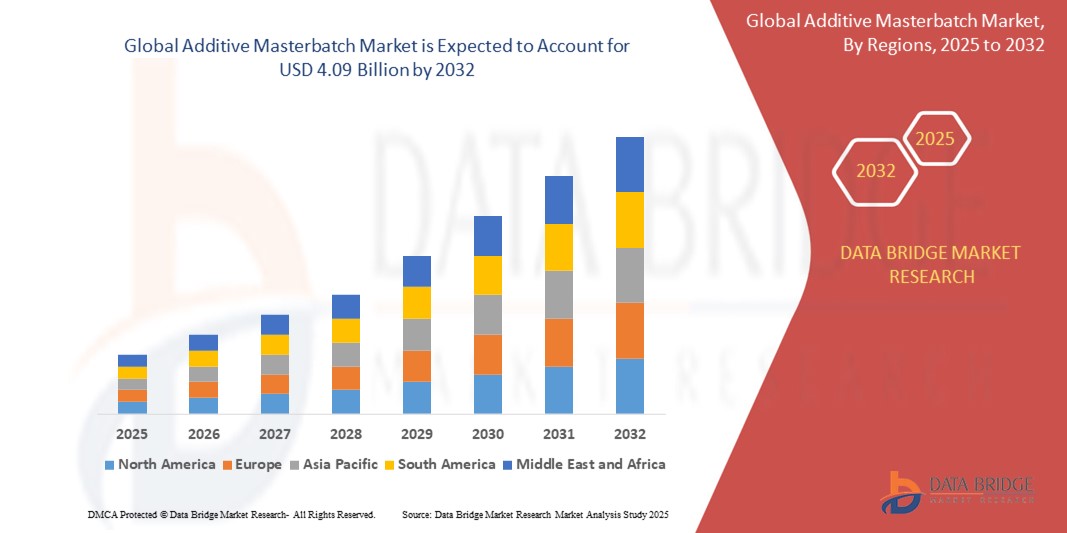
Additive Masterbatch Market Size
- The global additive masterbatch market size was valued at USD 2.53 billion in 2024 and is expected to reach USD 4.09 billion by 2032, at a CAGR of 6.20% during the forecast period
- The market growth is largely fueled by the increasing demand for performance-enhancing plastic additives across industries such as packaging, automotive, and construction, where manufacturers seek improved durability, UV resistance, antimicrobial properties, and flame retardancy
- Furthermore, growing environmental regulations, advancements in polymer processing, and rising use of recyclable and sustainable plastic materials are encouraging adoption of additive masterbatches, significantly boosting market expansion across both developed and emerging economies
Additive Masterbatch Market Analysis
- Additive masterbatch is a concentrated mixture of additives, such as pigments, UV stabilizers, or flame retardants, evenly dispersed in a polymer carrier. It's used in plastics manufacturing to impart specific properties or enhance performance. By incorporating additives at precise concentrations, masterbatch simplifies the production process, ensuring consistent quality and reducing the risk of handling multiple additives separately during manufacturing
- The escalating demand for additive masterbatches is primarily driven by rapid industrialization, rising focus on sustainable and high-performance plastics, stricter environmental regulations, and the growing need for customized polymer solutions across both emerging and developed markets
- Asia-Pacific dominated the additive masterbatch market with a share of 30.5% in 2024, due to the rapid growth of the packaging, automotive, and construction sectors
- North America is expected to be the fastest growing region in the additive masterbatch market during the forecast period due to rising demand for specialty additives in food packaging, automotive interiors, and medical devices
- Polyethylene (PE) segment dominated the market with a market share of 38.5% in 2024, due to its widespread use in flexible packaging and plastic film applications. Its compatibility with a broad range of additives, cost-effectiveness, and ease of processing make it the preferred choice across end-use industries. PE’s dominance is further supported by ongoing demand in food packaging, agricultural films, and consumer goods sectors
Report Scope and Additive Masterbatch Market Segmentation
|
Attributes |
Additive Masterbatch Key Market Insights |
|
Segments Covered |
|
|
Countries Covered |
North America
Europe
Asia-Pacific
Middle East and Africa
South America
|
|
Key Market Players |
|
|
Market Opportunities |
|
|
Value Added Data Infosets |
In addition to the insights on market scenarios such as market value, growth rate, segmentation, geographical coverage, and major players, the market reports curated by the Data Bridge Market Research also include import export analysis, production capacity overview, production consumption analysis, price trend analysis, climate change scenario, supply chain analysis, value chain analysis, raw material/consumables overview, vendor selection criteria, PESTLE Analysis, Porter Analysis, and regulatory framework. |
Additive Masterbatch Market Trends
“Rising Shift Toward Sustainable and Functional Additives”
- A significant and accelerating trend in the global additive masterbatch market is the shift toward sustainable and multifunctional additive solutions, driven by increasing environmental regulations, consumer demand for eco-friendly plastics, and the rise of circular economy practices
- For instance, Clariant has introduced halogen-free flame retardants and bio-based stabilizers to align with global sustainability goals while enhancing performance in packaging and consumer goods
- The demand for additives that offer dual or multiple functionalities—such as UV resistance combined with antimicrobial protection—is growing, enabling manufacturers to reduce formulation complexity and cost
- This trend is reshaping product development pipelines, with R&D investments focused on compatibility with recycled resins and improving additive dispersion to maintain quality in secondary-use plastics
- Key players are leveraging this trend by launching additive masterbatches aligned with recycling guidelines and sustainability certifications, gaining competitive advantage and addressing brand commitments to environmental stewardship
- As pressure from both regulators and consumers mounts, the drive for sustainable, high-efficiency additive masterbatches is expected to define future market innovation and differentiation strategies
Additive Masterbatch Market Dynamics
Driver
“Growing Demand for High-Performance Plastic Applications”
- The rising need for advanced plastic products with enhanced properties across industries such as packaging, automotive, construction, and electronics is a major driver fueling the additive masterbatch market. These additives improve material strength, thermal resistance, anti-fogging, and UV stability
- For instance, LyondellBasell supplies additive masterbatches used in automotive interiors for heat and flame resistance, while Ampacet Corporation offers anti-static and antimicrobial variants widely used in medical and food packaging films
- As industries seek lightweight, durable, and regulatory-compliant materials, additive masterbatches enable customization of polymer performance to suit end-use applications
- The ability to tailor properties without altering base resin formulations significantly reduces manufacturing costs and material waste, making additives essential to process optimization
- The steady growth of high-performance plastic use, particularly in emerging economies undergoing industrial modernization, ensures continued market momentum for additive masterbatch solutions
Restraint/Challenge
“Volatile Raw Material Prices and Supply Chain Disruptions”
- Volatility in raw material prices and supply chain instability presents a significant challenge to the additive masterbatch market, affecting cost structures, lead times, and production planning
- For instance, price fluctuations in key inputs such as like titanium dioxide, carbon black, and polymer resins—exacerbated by geopolitical tensions, energy crises, and trade restrictions—have led to margin pressure for producers and converters alike
- Managing these uncertainties requires strategic procurement, inventory management, and reliance on diversified supplier networks, but price hikes and delayed shipments still impact profitability and customer relationships
- Manufacturers are under pressure to maintain competitive pricing while absorbing cost increases, which may hinder innovation investments or lead to product reformulations with lower performance
- Building supply chain resilience through digitalization, regional manufacturing hubs, and strategic stockpiling will be crucial to ensuring operational continuity and market stability in the face of persistent disruptions
Additive Masterbatch Market Scope
The market is segmented on the basis of type, carrier resin, and end user.
• By Type
On the basis of type, the additive masterbatch market is segmented into Antimicrobial, Flame Retardant, Antioxidant, and Others. The antimicrobial segment held the largest market share in 2024, driven by rising hygiene concerns and increasing demand for bacteria-resistant surfaces in healthcare, food packaging, and consumer products. The segment’s growth is underpinned by regulatory pushes for safer and longer-lasting materials, especially in post-pandemic manufacturing environments. Its integration into medical devices, kitchenware, and sanitary packaging ensures consistent demand across multiple sectors.
The flame retardant segment is projected to witness the fastest growth from 2025 to 2032, fueled by tightening fire safety regulations in construction, automotive, and electronics industries. As urbanization and smart infrastructure development expand globally, manufacturers are increasingly adopting flame retardant solutions to meet compliance standards. Enhanced formulations with halogen-free properties and thermal stability are also driving adoption among environmentally conscious brands.
• By Carrier Resin
Based on carrier resin, the market is segmented into Polyethylene (PE), Polystyrene (PS), Polypropylene (PP), Polyvinyl Chloride (PVC), Polyethylene Terephthalate (PET), and Others. Polyethylene (PE) led the market with a revenue share of 38.5% in 2024 due to its widespread use in flexible packaging and plastic film applications. Its compatibility with a broad range of additives, cost-effectiveness, and ease of processing make it the preferred choice across end-use industries. PE’s dominance is further supported by ongoing demand in food packaging, agricultural films, and consumer goods sectors.
Polypropylene (PP) is expected to register the fastest growth during the forecast period owing to its expanding role in automotive components, medical devices, and rigid packaging. PP’s higher temperature resistance, excellent mechanical strength, and adaptability to advanced additives make it ideal for performance-critical applications. Increasing usage in lightweight vehicle parts and recyclable packaging is anticipated to further propel segment expansion.
• By End User
On the basis of end user, the additive masterbatch market is categorized into Packaging, Building and Construction, Automotive, Consumer Goods, Agriculture, Electrical and Electronics, and Others. The packaging segment dominated the market in 2024, reflecting sustained demand for enhanced plastic performance in food, pharmaceutical, and retail packaging. Additives are increasingly used to provide UV protection, antimicrobial features, and extended shelf life, especially amid growing e-commerce and food delivery trends. The sector's constant evolution and need for innovation help maintain packaging’s lead in additive consumption.
The automotive segment is forecasted to grow at the highest CAGR from 2025 to 2032, driven by the industry's focus on lightweighting, sustainability, and enhanced safety. Additive masterbatches are integral to producing vehicle components with flame retardant, anti-static, and UV-resistant properties. Rising EV production and the shift toward more durable and recyclable interior materials are contributing to increased additive adoption in automotive manufacturing.
Additive Masterbatch Market Regional Analysis
- Asia-Pacific dominated the additive masterbatch market with the largest revenue share of 30.5% in 2024, driven by the rapid growth of the packaging, automotive, and construction sectors
- Rising industrialization, increasing demand for plastic modification, and supportive manufacturing infrastructure are key growth enablers across the region
- Government initiatives promoting plastic recycling, local availability of raw materials, and expansion of polymer processing facilities are further accelerating market adoption in both domestic and export-oriented industries
China Additive Masterbatch Market Insight
The China market led the Asia-Pacific region in 2024 due to its dominance in plastic manufacturing, strong export capacity, and widespread adoption of additive-enhanced polymers across packaging and automotive industries. Local producers are investing in high-performance masterbatch solutions, including antimicrobial and flame-retardant variants, to meet evolving domestic standards and global quality requirements.
India Additive Masterbatch Market Insight
India's additive masterbatch market is growing rapidly, fueled by expanding consumer goods, packaging, and construction sectors. Rising demand for cost-effective and durable plastic products in rural and urban areas is propelling the use of additives. Additionally, government programs promoting “Make in India” and plastic industry growth are supporting local production capacity and innovation in additive formulations.
Europe Additive Masterbatch Market Insight
The Europe additive masterbatch market is expected to grow steadily, supported by stringent environmental regulations and increasing demand for sustainable, recyclable plastic solutions. The region is focusing on halogen-free, bio-based, and low-VOC additives aligned with EU circular economy goals. A strong presence of automotive and electronics manufacturing, particularly in Germany and France, continues to drive demand for functional additives.
Germany Additive Masterbatch Market Insight
Germany's market is expanding due to high demand for technical plastics in automotive, electrical, and packaging sectors. German manufacturers are prioritizing sustainable additives and advanced compounding techniques to meet EU green standards. Innovations in flame retardant and UV-resistant masterbatches are enabling high-performance applications while aligning with recycling targets.
North America Additive Masterbatch Market Insight
North America is projected to register the fastest CAGR from 2025 to 2032, driven by rising demand for specialty additives in food packaging, automotive interiors, and medical devices. The region benefits from advanced R&D, strong end-user industries, and increasing emphasis on recyclability and regulatory compliance. Technological advancements in biodegradable and functional additives are further boosting adoption.
U.S. Additive Masterbatch Market Insight
The U.S. market held the largest share in North America in 2024, owing to the extensive use of plastic additives in industrial packaging, construction materials, and automotive parts. Growth is supported by innovation in additive technologies, regulatory alignment for food safety and fire resistance, and high consumer demand for durable and high-performance plastic products.
Additive Masterbatch Market Share
The additive masterbatch industry is primarily led by well-established companies, including:
- CLARIANT (Switzerland)
- LyondellBasell Industries Holdings B.V. (U.S.)
- Avient Corporation (U.S.)
- PLASTIKA KRITIS S.A. (Greece)
- Plastiblends (India)
- Dow (U.S.)
- PPM (Germany)
- RTP Company (U.S.)
- Ampacet Corporation (U.S.)
- Tosaf Compounds Ltd. (U.S.)
- Astra Polymers (Saudi Arabia)
- Prayag Polytech (India)
- Alok Masterbatches Pvt. Ltd (India)
- Dainichiseika Color & Chemicals Mfg.Co.,Ltd. (Japan)
- Rajiv Plastic Industries (India)
Latest Developments in Global Additive Masterbatch Market
- In December 2023, Ampacet launched ColorMark, a groundbreaking technology enhancing masterbatch additives, enabling processors to intricately etch permanent lettering and designs onto dark plastic surfaces. This innovation promises to revolutionize product labeling and branding within the plastics industry
- In December 2023, MechNano, renowned for its contributions to 3D printing materials, partnered with Bomar to pioneer a novel low-viscosity masterbatch tailored for 3D printing resins. This collaboration aims to enhance printing efficiency and output quality, pushing the boundaries of additive manufacturing
- In November 2023, Cabot Corporation introduced REPLASBLAK, its latest circular black masterbatch product line featuring certified materials. Cabot's launch marked a significant milestone with the unveiling of three products certified by the International Sustainability & Carbon Certification (ISCC PLUS), powered by EVOLVE Sustainable Solutions, setting new standards for sustainability in the masterbatch industry
- In July 2020, PolyOne Corporation, a global leader in sustainable solutions and specialized polymer materials, concluded the acquisition of Clariant Chemicals India's additive masterbatch business and Ltd's color division. This strategic move bolstered PolyOne's position in the market, expanding its portfolio and reinforcing its commitment to delivering sustainable solutions to customers worldwide

- Interactive Data Analysis Dashboard
- Company Analysis Dashboard for high growth potential opportunities
- Research Analyst Access for customization & queries
- Competitor Analysis with Interactive dashboard
- Latest News, Updates & Trend analysis
- Harness the Power of Benchmark Analysis for Comprehensive Competitor Tracking
Global Additive Masterbatch Market, Supply Chain Analysis and Ecosystem Framework
To support market growth and help clients navigate the impact of geopolitical shifts, DBMR has integrated in-depth supply chain analysis into its Global Additive Masterbatch Market research reports. This addition empowers clients to respond effectively to global changes affecting their industries. The supply chain analysis section includes detailed insights such as Global Additive Masterbatch Market consumption and production by country, price trend analysis, the impact of tariffs and geopolitical developments, and import and export trends by country and HSN code. It also highlights major suppliers with data on production capacity and company profiles, as well as key importers and exporters. In addition to research, DBMR offers specialized supply chain consulting services backed by over a decade of experience, providing solutions like supplier discovery, supplier risk assessment, price trend analysis, impact evaluation of inflation and trade route changes, and comprehensive market trend analysis.
Data collection and base year analysis are done using data collection modules with large sample sizes. The stage includes obtaining market information or related data through various sources and strategies. It includes examining and planning all the data acquired from the past in advance. It likewise envelops the examination of information inconsistencies seen across different information sources. The market data is analysed and estimated using market statistical and coherent models. Also, market share analysis and key trend analysis are the major success factors in the market report. To know more, please request an analyst call or drop down your inquiry.
The key research methodology used by DBMR research team is data triangulation which involves data mining, analysis of the impact of data variables on the market and primary (industry expert) validation. Data models include Vendor Positioning Grid, Market Time Line Analysis, Market Overview and Guide, Company Positioning Grid, Patent Analysis, Pricing Analysis, Company Market Share Analysis, Standards of Measurement, Global versus Regional and Vendor Share Analysis. To know more about the research methodology, drop in an inquiry to speak to our industry experts.
Data Bridge Market Research is a leader in advanced formative research. We take pride in servicing our existing and new customers with data and analysis that match and suits their goal. The report can be customized to include price trend analysis of target brands understanding the market for additional countries (ask for the list of countries), clinical trial results data, literature review, refurbished market and product base analysis. Market analysis of target competitors can be analyzed from technology-based analysis to market portfolio strategies. We can add as many competitors that you require data about in the format and data style you are looking for. Our team of analysts can also provide you data in crude raw excel files pivot tables (Fact book) or can assist you in creating presentations from the data sets available in the report.













