


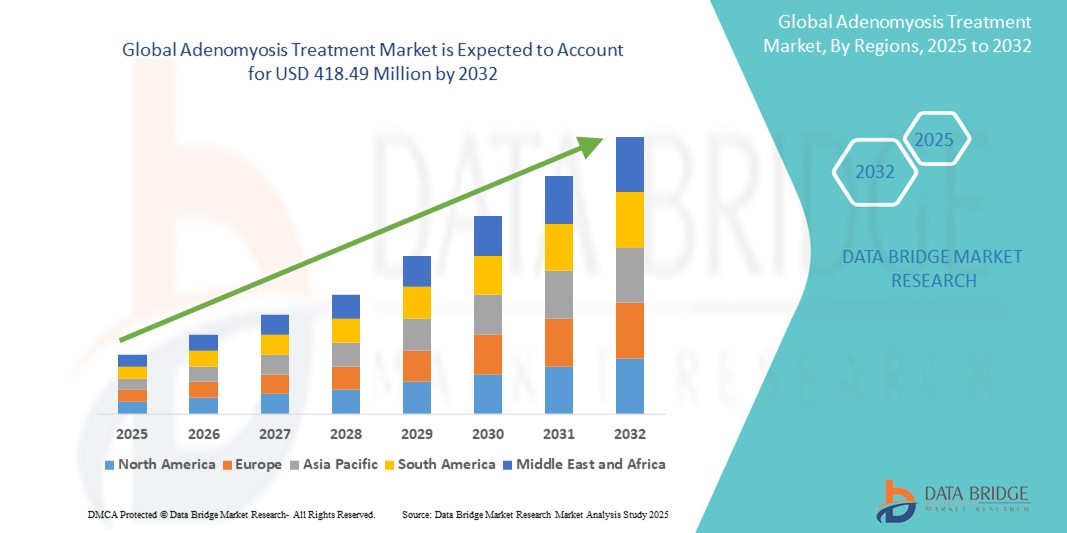
Adenomyosis Treatment Market Size
- The global adenomyosis treatment market size was valued at USD 303.45 Million in 2024 and is expected to reach approximately USD 418.49 Million by 2032, at a CAGR of around 4.10% during the forecast period.
- The market growth is largely fueled by the increasing prevalence of adenomyosis globally, a rise in demand for novel therapies, and advancements in diagnostic technologies, particularly non-invasive imaging techniques like MRI and transvaginal ultrasonography.
- Moreover, rising awareness regarding women's health and improved healthcare infrastructure, coupled with investments in research and development for advanced medical treatment options, including both hormonal therapies and minimally invasive procedures, are establishing effective adenomyosis treatments as crucial for improving patient quality of life. These converging factors are accelerating the uptake of adenomyosis treatment solutions, thereby significantly boosting the industry's growth.
Adenomyosis Treatment Market Analysis
- Adenomyosis, a gynecological condition characterized by the presence of endometrial tissue within the muscular walls of the uterus, significantly impacts women's health. Treatment for adenomyosis is increasingly vital, offering symptom management and improved quality of life for affected individuals.
- The escalating demand for adenomyosis treatment is primarily fueled by the increasing global prevalence of the condition, rising awareness among women and healthcare professionals, and continuous advancements in diagnostic technologies and therapeutic approaches.
- North America is expected to hold the largest market share in the adenomyosis treatment market by 2032, driven by a well-established healthcare infrastructure, high healthcare expenditure, and a greater emphasis on women's health initiatives, particularly in the U.S. and Canada.
- Asia-Pacific is expected to be the fastest-growing region in the adenomyosis treatment market during the forecast period due to improving healthcare access, increasing disposable incomes, and a growing awareness of women's reproductive health in countries like China and India.
- The hormone medications segment is expected to dominate the adenomyosis treatment market with a significant market share by 2032, largely driven by their established efficacy in managing symptoms like pain and heavy bleeding, and the development of new hormonal therapies including GnRH agonists and selective progesterone receptor modulators.
Report Scope and Adenomyosis Treatment Market Segmentation
|
Attributes |
Adenomyosis Treatment Key Market Insights |
|
Segments Covered |
|
|
Countries Covered |
North America
Europe
Asia-Pacific
Middle East and Africa
South America
|
|
Key Market Players |
|
|
Market Opportunities |
|
|
Value Added Data Infosets |
In addition to the insights on market scenarios such as market value, growth rate, segmentation, geographical coverage, and major players, the market reports curated by the Data Bridge Market Research also include in-depth expert analysis, pricing analysis, brand share analysis, consumer survey, demography analysis, supply chain analysis, value chain analysis, raw material/consumables overview, vendor selection criteria, PESTLE Analysis, Porter Analysis, and regulatory framework. |
Adenomyosis Treatment Market Trends
“Advancements in Diagnostic Imaging and Minimally Invasive Procedures”
- A major and accelerating trend in the global adenomyosis treatment market is the deepening integration of advanced diagnostic imaging techniques, particularly high-resolution MRI and transvaginal ultrasonography, with evolving minimally invasive surgical procedures. This fusion of technologies is significantly enhancing diagnostic accuracy and treatment efficacy for patients.
- For instance, advanced MRI protocols, such as diffusion-weighted imaging, are seamlessly integrated into diagnostic workflows, allowing for more precise identification of adenomyotic lesions. Similarly, developments in hysteroscopic and laparoscopic techniques are being used to perform targeted resections while preserving uterine function.
- Additionally,the integration of advanced imaging in adenomyosis treatment enables features such as detailed mapping of lesion size and location to potentially suggest optimal surgical approaches and providing more intelligent guidance during minimally invasive procedures. For instance, some specialized ultrasound machines utilize advanced software to improve visualization of the junctional zone and can aid in guiding uterine artery embolization. Furthermore, minimally invasive capabilities offer patients the ease of reduced recovery times, allowing them to experience less pain and quicker return to daily activities.
- The seamless integration of diagnostic imaging with surgical planning platforms facilitates centralized control over various aspects of the treatment pathway. Through a single interface, clinicians can manage diagnosis, surgical strategy, and post-operative monitoring, creating a unified and optimized patient care experience.
- This trend towards more intelligent, precise, and less invasive treatment systems is fundamentally reshaping patient expectations for adenomyosis management. Consequently, companies such as GE Healthcare and Siemens Healthineers are developing advanced imaging modalities with features such as improved tissue characterization and real-time guidance capabilities for interventional procedures.
- The demand for adenomyosis treatments that offer seamless integration of advanced diagnostics and minimally invasive options is growing rapidly across both hospital and specialized clinic sectors, as patients increasingly prioritize accurate diagnosis and less burdensome treatment pathways.
Adenomyosis Treatment Market Dynamics
Driver
“Growing Need Due to Rising Prevalence and Advancements in Diagnosis”
- The rising prevalence of adenomyosis globally, coupled with accelerating advancements in diagnostic techniques, is a significant driver for the heightened demand for adenomyosis treatments.
- For instance, the improved accessibility and resolution of diagnostic tools like transvaginal ultrasonography and MRI are enabling earlier and more accurate diagnoses of adenomyosis, leading to a larger identified patient population requiring treatment. A report published in Diagnostics in early 2024 highlighted that while historically considered a disease of older, multiparous women, recent advancements in non-invasive diagnostic tools and increased awareness are enabling earlier diagnoses, even in younger patients.
- As healthcare professionals become more adept at recognizing the subtle signs of adenomyosis and patients become more aware of their symptoms, the demand for effective interventions for pain and heavy bleeding is rising. This drives the adoption of various treatment modalities.
- Additionally, the growing focus on women's health and the desire for improved quality of life are making effective adenomyosis management an integral component of comprehensive gynecological care, offering symptomatic relief and, in some cases, fertility preservation.
- The increasing investment in research and development for new pharmacological and minimally invasive treatment options, alongside rising awareness campaigns, are key factors propelling the adoption of adenomyosis treatments. The trend towards personalized medicine and the increasing availability of tailored treatment plans further contribute to market growth.
Restraint/Challenge
“Challenges in Early Diagnosis and High Treatment Costs”
- Challenges surrounding the definitive early diagnosis of adenomyosis and the relatively high initial costs associated with advanced treatment options pose a significant barrier to broader market penetration. As adenomyosis symptoms can overlap with other gynecological conditions, misdiagnosis or delayed diagnosis is common, preventing timely intervention.
- For instance, while MRI is highly effective in diagnosing adenomyosis, its higher cost and limited accessibility in some regions compared to ultrasound can delay definitive diagnosis for many patients. Data from sources like Lybrate.com indicate that while a basic pelvic exam might cost around ₹700-₹1000 in India, an MRI for adenomyosis can range from ₹6,000-₹8,000, representing a significant cost difference.
- Addressing these diagnostic challenges through increased physician education, wider access to advanced imaging, and the development of non-invasive biomarkers is crucial for improving patient outcomes. Additionally, the relatively high initial cost of some advanced adenomyosis treatments, particularly surgical interventions like hysterectomy or uterine artery embolization, can be a barrier to adoption for patients without adequate insurance coverage, particularly in developing regions.
- While non-surgical options like hormone medications are generally more affordable, the perceived premium for specialized procedures can still hinder widespread adoption, especially for those who face significant financial constraints.
- Overcoming these challenges through enhanced diagnostic pathways, improved insurance coverage for advanced treatments, and the development of more affordable and accessible therapeutic options will be vital for sustained market growth.
Adenomyosis Treatment Market Scope
The market is segmented on the basis of type, treatment, diagnosis, and application.
- By Type
On the basis of type, the adenomyosis treatment market is segmented into focal, adenomyoma, diffuse, and others. The diffuse segment is expected to hold the largest market revenue share by 2032, driven by its higher prevalence, often reported between 20% to 70% in hysterectomy specimens, and more widespread uterine involvement compared to focal forms. Diffuse adenomyosis often presents with more severe symptoms, necessitating broader treatment approaches. The market also sees strong demand for diffuse type treatments due to the ongoing research into non-surgical management options. The adenomyoma segment is anticipated to witness the fastest growth rate from 2024 to 2032, fueled by increasing diagnostic capabilities that allow for better identification of these benign masses, with studies suggesting its incidence in the general population can be around 1%, and it frequently coexists with uterine fibroids. Adenomyomas, often resembling fibroids, are increasingly targeted with conservative surgical approaches, driving demand for specialized treatments. The potential for fertility preservation with specific treatments for adenomyomas also contributes to their growing popularity.
• By Treatment
On the basis of treatment, the adenomyosis treatment market is segmented into anti-inflammatory drugs, hormone medications, hysterectomy, uterine artery embolization, endometrial ablation, and others. The hormone medications segment is expected to hold the largest market revenue share by 2032, driven by their effectiveness in managing symptoms like pain and heavy menstrual bleeding, and their non-invasive nature, with some reports indicating that hormone-related therapies account for a significant portion of the overall adenomyosis drug market, with one report suggesting the overall adenomyosis market is projected to grow at a CAGR of 4.81% from 2025-2035. Hormonal therapies, including GnRH agonists and progestins, are often the first line of treatment, making them a popular choice for long-term symptom control. The uterine artery embolization (UAE) segment is expected to witness the fastest CAGR from 2024 to 2032, driven by its minimally invasive nature and uterus-sparing benefits, making it an attractive option for women who wish to preserve fertility or avoid hysterectomy, with studies showing an efficacy rate of approximately 75-82% in reducing symptoms and improving quality of life for adenomyosis patients. UAE is particularly popular for its relatively quick recovery time and ability to reduce adenomyosis symptoms effectively.
• By Diagnosis
On the basis of diagnosis, the adenomyosis treatment market is segmented into ultrasound, MRI, endometrial biopsy, and others. The ultrasound segment is expected to hold the largest market revenue share by 2032, driven by its widespread availability, cost-effectiveness, and non-invasive nature, making it the primary diagnostic tool for initial assessment. Transvaginal ultrasonography (TVS) offers real-time imaging, facilitating immediate diagnostic insights. The MRI segment is expected to witness the fastest CAGR from 2024 to 2032, favored for its superior soft tissue contrast and ability to provide detailed anatomical information, enabling more accurate and definitive diagnosis of adenomyosis, especially for subtle or atypical cases. MRI is particularly valuable for surgical planning and for distinguishing adenomyosis from other uterine pathologies.
• By Application
On the basis of application, the adenomyosis treatment market is segmented into hospitals, clinics, research institutes, and others. The hospitals segment is expected to account for the largest market revenue share by 2032, driven by the comprehensive range of diagnostic and treatment services offered, including surgical procedures and specialized medical consultations. Hospitals serve as primary centers for complex adenomyosis cases and emergency care. The clinics segment is expected to witness the fastest CAGR from 2024 to 2032, driven by the growing number of specialized women's health clinics and fertility centers that offer focused diagnosis and management of adenomyosis. Clinics provide accessible and often less costly options for routine check-ups and non-surgical treatments.
Adenomyosis Treatment Market Regional Analysis
• North America
North America is expected to dominate the adenomyosis treatment market with the largest revenue share of 38.5% by 2032, driven by a well-developed healthcare infrastructure, high healthcare expenditure, and a strong emphasis on women's health.
Consumers in the region highly value access to advanced diagnostic technologies and a wide range of treatment options.
Additionally, this widespread adoption is further supported by rising awareness among both patients and healthcare providers, and the increasing availability of specialized clinics, establishing effective adenomyosis treatment as a favored solution for improving women's health outcomes.
• U.S. Adenomyosis Treatment Market Insight
The U.S. adenomyosis treatment market captured the largest revenue share of 79% within North America in 2025, driven by the high prevalence of gynecological disorders, well-developed healthcare infrastructure, and the broad clinical preference for advanced diagnostic and minimally invasive treatment options in both general and specialized women’s health care. Consumers are increasingly prioritizing comprehensive and personalized treatment plans for chronic conditions like adenomyosis. The growing demand for minimally invasive procedures, combined with robust insurance coverage and access to innovative therapies, further propels the adenomyosis treatment industry. Moreover, the increasing collaboration between academic institutions and pharmaceutical companies for drug discovery and development is significantly contributing to the market's expansion.
• Europe Adenomyosis Treatment Market Insight
The Europe adenomyosis treatment market is projected to expand at steady CAGR throughout the forecast period, primarily driven by increasing awareness of women's health issues and improving diagnostic capabilities across the region. The increase in gynecological research, coupled with the demand for less invasive treatment options, is fostering the adoption of various therapies for adenomyosis. European patients are also drawn to the advancements in personalized medicine and comprehensive care these treatments offer. The region is experiencing significant growth across hospital, clinic, and research institute applications, with adenomyosis treatments being incorporated into standard gynecological practices and specialized women's health centers.
• U.K. Adenomyosis Treatment Market Insight
The U.K. adenomyosis treatment market is anticipated to grow at a notable CAGR during the forecast period, driven by the escalating focus on women's health and a desire for improved diagnostic accuracy and effective symptom management. Additionally, concerns regarding chronic pelvic pain and heavy menstrual bleeding are encouraging both patients and healthcare providers to explore advanced treatment solutions. The U.K.’s embrace of specialized women's health services, alongside its robust healthcare infrastructure and National Health Service (NHS) initiatives, is expected to continue to stimulate market growth.
• Germany Adenomyosis Treatment Market Insight
The Germany adenomyosis treatment market is projected to expand at a substantial CAGR of 5.6% during the forecast period, fueled by increasing awareness of gynecological conditions and the demand for technologically advanced, patient-centric solutions. Germany’s well-developed healthcare system, combined with its emphasis on research and innovation, promotes the adoption of modern adenomyosis treatments, particularly in university hospitals and specialized clinics. The integration of advanced diagnostic tools with therapeutic strategies is also becoming increasingly prevalent, with a strong preference for effective, evidence-based solutions aligning with local patient expectations.
• Asia-Pacific Adenomyosis Treatment Market Insight
The Asia-Pacific adenomyosis treatment market is forecast to grow at the fastest CAGR of 6.6% during the forecast period, driven by increasing awareness campaigns, rising disposable incomes, and improving healthcare infrastructure in countries such as China, Japan, and India. The region's growing inclination towards accessible and affordable healthcare, supported by government initiatives promoting women's health, is driving the adoption of adenomyosis treatments. Furthermore, as APAC invests more in medical research and development, the availability and affordability of advanced diagnostic and therapeutic options for adenomyosis are expanding to a wider patient base.
• Japan Adenomyosis Treatment Market Insight
The Japan adenomyosis treatment market is gaining traction supported by the country’s advanced medical technology, rapid urbanization, and strong emphasis on public health. The Japanese market places a significant emphasis on precise diagnosis and effective management, and the adoption of adenomyosis treatments is driven by the increasing number of women seeking specialized gynecological care. The integration of cutting-edge imaging techniques with conservative treatment approaches is fueling growth. Moreover, Japan's aging population is likely to spur demand for less invasive, effective treatment solutions in both hospital and clinic settings.
• China Adenomyosis Treatment Market Insight
The China adenomyosis treatment market accounted for the largest market revenue share in Asia-Pacific, attributed to the country's expanding healthcare expenditure, rapid urbanization, and high rates of female population with gynecological conditions. China stands as one of the largest markets for women's healthcare services, and adenomyosis treatments are becoming increasingly sought after in public and private hospitals. The push towards improving healthcare accessibility and the availability of both traditional and modern therapeutic options, alongside strong domestic medical device and pharmaceutical manufacturers, are key factors propelling the market in China.
Adenomyosis Treatment Market Share
The adenomyosis treatment industry is primarily led by well-established pharmaceutical and medical device companies, including:
- Bayer AG (Germany)
- Ferring B.V. (Netherlands)
- Johnson & Johnson (U.S.)
- Novartis AG (Switzerland)
- Merck KGaA (Germany)
- Pfizer Inc. (U.S.)
- Specialty European Pharma (U.K.)
- AbbVie Inc. (U.S.)
- Sanofi (France)
- Myovant Sciences (U.S.)
- Teva Pharmaceutical Industries Ltd. (Israel)
- Astellas Pharma Inc. (Japan)
- Organon & Co. (U.S.)
- Eli Lilly and Company (U.S.)
- Roche Holding AG (Switzerland)
- Bristol Myers Squibb Company (U.S.)
- AstraZeneca plc (U.K.)
- Amgen Inc. (U.S.)
- Gilead Sciences, Inc. (U.S.)
- Takeda Pharmaceutical Company Limited (Japan)
Latest Developments in Global Adenomyosis Treatment Market
- In November 2021, Theramex obtained the Femarelle product license to treat menopause symptoms. These products, which are used to balance estrogen levels in women from perimenopause through menopause to post-menopause, are designed to relieve symptoms and conditions that can overlap with adenomyosis symptoms. This move underscores Theramex's dedication to delivering innovative, reliable women's health solutions.
- In October 2021, Bayer AG initiated the phase III clinical program OASIS for its investigational drug for symptomatic uterine fibroids, which often co-exist with adenomyosis. This program highlights Bayer's commitment to developing cutting-edge therapies that address common gynecological conditions, ensuring greater relief and improved quality of life for women. While not directly for adenomyosis, advancements in related conditions often benefit the adenomyosis treatment landscape.

- Interactive Data Analysis Dashboard
- Company Analysis Dashboard for high growth potential opportunities
- Research Analyst Access for customization & queries
- Competitor Analysis with Interactive dashboard
- Latest News, Updates & Trend analysis
- Harness the Power of Benchmark Analysis for Comprehensive Competitor Tracking
Data collection and base year analysis are done using data collection modules with large sample sizes. The stage includes obtaining market information or related data through various sources and strategies. It includes examining and planning all the data acquired from the past in advance. It likewise envelops the examination of information inconsistencies seen across different information sources. The market data is analysed and estimated using market statistical and coherent models. Also, market share analysis and key trend analysis are the major success factors in the market report. To know more, please request an analyst call or drop down your inquiry.
The key research methodology used by DBMR research team is data triangulation which involves data mining, analysis of the impact of data variables on the market and primary (industry expert) validation. Data models include Vendor Positioning Grid, Market Time Line Analysis, Market Overview and Guide, Company Positioning Grid, Patent Analysis, Pricing Analysis, Company Market Share Analysis, Standards of Measurement, Global versus Regional and Vendor Share Analysis. To know more about the research methodology, drop in an inquiry to speak to our industry experts.
Data Bridge Market Research is a leader in advanced formative research. We take pride in servicing our existing and new customers with data and analysis that match and suits their goal. The report can be customized to include price trend analysis of target brands understanding the market for additional countries (ask for the list of countries), clinical trial results data, literature review, refurbished market and product base analysis. Market analysis of target competitors can be analyzed from technology-based analysis to market portfolio strategies. We can add as many competitors that you require data about in the format and data style you are looking for. Our team of analysts can also provide you data in crude raw excel files pivot tables (Fact book) or can assist you in creating presentations from the data sets available in the report.












