


What is the Advanced Cardiovascular Life Support Market Size and Growth Rate?
-
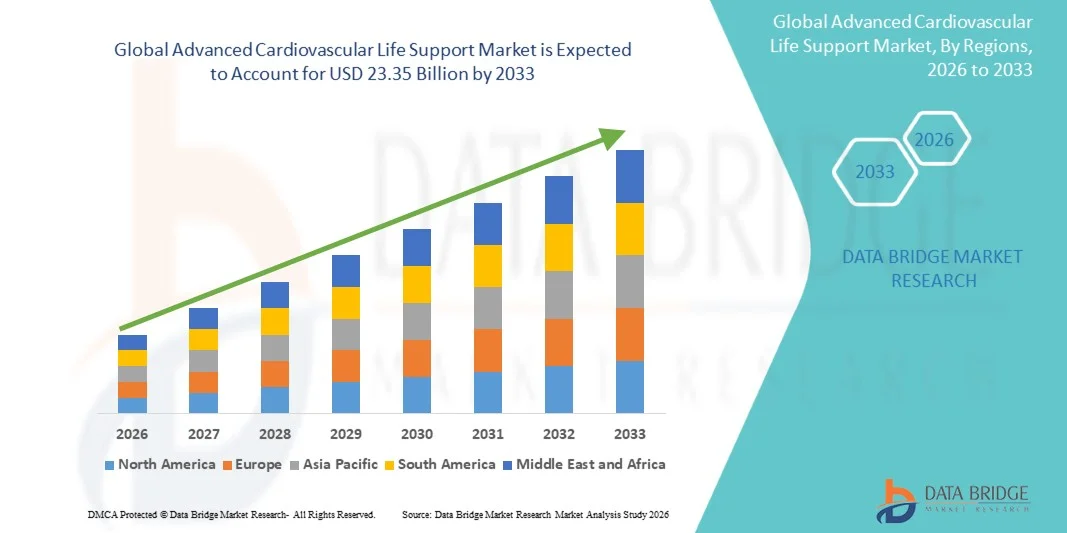
As per Data Bridge Market Research Analysis the global advanced cardiovascular life support market size was valued at USD 11.73 billion in 2025 and is expected to reach USD 23.35 billion by 2033, at a CAGR of 8.99% during the forecast period
-
The market growth is largely fueled by technological advancements in emergency cardiac care protocols and equipment, rising awareness about timely intervention in cardiac emergencies, broader implementation of structured ACLS training programs, and growing healthcare expenditure across both developed and emerging economies
- Furthermore, rising demand for integrated cardiovascular life support technologies that enable rapid response in hospitals, ambulances, and emergency care settings is establishing advanced ACLS systems as essential components of critical care infrastructure. These converging factors are accelerating the uptake of advanced cardiovascular life support solutions, thereby significantly boosting the industry’s growth
Market Size & Forecast
Global Market Value (2025): USD 11.73 Billion
Expected Market Value (2033): USD 23.35 Billion
Forecast CAGR (2026–2033): 8.99%%
Advanced Cardiovascular Life Support Market Analysis
- Advanced cardiovascular life support, providing structured protocols, equipment, and training for managing cardiac emergencies, is increasingly a vital component of modern healthcare infrastructure in hospitals, ambulances, and emergency care settings due to its ability to improve patient survival rates, enable rapid intervention, and integrate with broader critical care systems
- The escalating demand for advanced cardiovascular life support is primarily fueled by the rising prevalence of cardiovascular diseases, growing awareness about timely cardiac emergency intervention, and an increasing emphasis on structured training and certification programs for healthcare professionals
- North America dominated the advanced cardiovascular life support market with the largest revenue share of 42.5% in 2025, characterized by advanced healthcare infrastructure, high adoption of emergency care protocols, and a strong presence of key industry players, with the U.S. experiencing substantial growth in ACLS adoption across hospitals and pre-hospital emergency services, driven by innovations in automated monitoring devices, airway management systems, and integrated life support solutions
- Asia-Pacific is expected to be the fastest-growing region in the advanced cardiovascular life support market during the forecast period due to increasing healthcare investments, rising incidence of cardiovascular diseases, and expansion of emergency care facilities in urban and semi-urban areas
- Airway Management segment dominated the advanced cardiovascular life support market with a market share of 38.4% in 2025, driven by its critical role in maintaining patient oxygenation during cardiac emergencies, widespread adoption in hospitals and ambulances, and growing integration with other life support interventions such as electrical therapy and advanced monitoring systems
How is the Advanced Cardiovascular Life Support Market Segmented?
|
Attributes |
Advanced Cardiovascular Life Support Key Market Insights |
|
Segments Covered |
|
|
Countries Covered |
North America
Europe
Asia-Pacific
Middle East and Africa
South America
|
|
Key Market Players |
|
|
Market Opportunities |
|
|
Value Added Data Infosets |
In addition to the insights on market scenarios such as market value, growth rate, segmentation, geographical coverage, and major players, the market reports curated by the Data Bridge Market Research also include in-depth expert analysis, patient epidemiology, pipeline analysis, pricing analysis, and regulatory framework |
What is the Key Trend in the Advanced Cardiovascular Life Support Market?
“Integration of AI and Predictive Monitoring in Emergency Care”
- A significant and accelerating trend in the global advanced cardiovascular life support market is the integration of artificial intelligence (AI) and predictive monitoring systems into emergency care devices and protocols, enhancing the speed and accuracy of cardiac interventions
- For instance, AI-enabled defibrillators can analyze patient vitals in real-time and suggest optimized shock delivery or medication administration, assisting healthcare professionals in making faster decisions during critical cardiac events
- AI integration in ACLS allows continuous learning from patient outcomes, improving predictive alerting for high-risk cardiac events and enabling hospitals to proactively manage patient care. Furthermore, predictive analytics can help prioritize critical cases, ensuring timely intervention
- The seamless combination of AI and ACLS protocols with hospital information systems allows centralized monitoring of multiple patients, enabling care teams to track interventions, synchronize devices, and optimize emergency response workflows
- This trend towards more intelligent, data-driven, and interconnected life support systems is reshaping expectations for emergency cardiac care. Consequently, companies are developing AI-enabled ACLS devices that automatically suggest intervention steps and integrate predictive alerts for critical conditions
- The demand for advanced cardiovascular life support solutions with AI and predictive monitoring integration is growing rapidly across hospitals, cardiac centers, and emergency care services, as healthcare providers increasingly prioritize patient survival and workflow efficiency
- Collaborations between ACLS device manufacturers and software companies to create integrated digital dashboards for real-time emergency management are also gaining traction, driving innovation and adoption in hospitals
Advanced Cardiovascular Life Support Market Dynamics
Driver
“Rising Incidence of Cardiovascular Diseases and Hospital Investments”
- The increasing prevalence of cardiovascular diseases, coupled with growing investments in hospital infrastructure and emergency care facilities, is a significant driver for the heightened demand for advanced cardiovascular life support
- For instance, in March 2025, a leading U.S. hospital network deployed AI-assisted ACLS protocols across its cardiac care units to improve response time and patient outcomes, reflecting a strategic push for advanced cardiac emergency solutions
- As healthcare providers aim to reduce mortality in cardiac emergencies, ACLS systems provide structured protocols, real-time monitoring, and rapid intervention capabilities, offering clear advantages over conventional emergency response measures
- Furthermore, rising awareness about the importance of ACLS certification among medical professionals and the increasing adoption of structured training programs are strengthening market demand
- Investments in modern emergency response infrastructure, combined with the growing integration of ACLS devices into hospital emergency workflows, are key factors propelling the adoption of these life support systems in both developed and emerging markets
- Government initiatives and funding to improve cardiac emergency response capabilities, including national ACLS training programs, are accelerating adoption across public and private healthcare sectors
- Technological advancements in portable ACLS devices and integration with ambulance systems are enabling faster response times in pre-hospital emergency care, further driving market growth
Restraint/Challenge
“High Costs and Implementation Complexity”
- The relatively high cost of advanced ACLS devices and training programs poses a significant challenge to widespread adoption, particularly for smaller healthcare facilities or budget-constrained hospitals
- For instance, reports indicate that hospitals in developing regions often delay upgrading to AI-enabled defibrillators due to budget limitations, despite recognizing their clinical benefits
- In addition, the complexity of implementing integrated ACLS protocols and ensuring staff are adequately trained in both traditional and AI-assisted emergency procedures can hinder adoption. Companies emphasize comprehensive training programs and intuitive device interfaces to address these challenges
- While costs are gradually decreasing with technological advances, the premium associated with high-end ACLS solutions can still restrict adoption, especially in regions with limited healthcare spending
- Overcoming these challenges through cost-effective device options, scalable training programs, and simplified AI integration will be vital for sustained growth of the Advanced Cardiovascular Life Support market
- Variability in regional healthcare regulations and certification standards can delay ACLS adoption, requiring manufacturers to customize devices and training solutions for compliance in multiple markets
- Limited awareness among healthcare providers in rural or underdeveloped regions about the benefits of modern ACLS systems also constrains market penetration, highlighting the need for targeted education and outreach programs
Advanced Cardiovascular Life Support Market Scope
The market is segmented on the basis of techniques, algorithm, instruments, and end users.
- By Techniques
On the basis of techniques, the Advanced Cardiovascular Life Support market is segmented into airway management, non-invasive airway, endotracheal intubation, electrical therapy, and lethal arrhythmias. The Airway Management segment dominated the market with the largest revenue share of 38.4% in 2025, driven by its critical role in ensuring patient oxygenation during cardiac emergencies. Hospitals and emergency care providers prioritize airway management tools as they stabilize patients with compromised breathing quickly and effectively. The segment’s dominance is supported by the adoption of advanced devices such as supraglottic airways and portable ventilators that integrate with AI-assisted monitoring systems. Airway management also complements other life support interventions, enabling coordinated emergency responses. Continuous updates to ACLS protocols and training programs emphasize airway management, reinforcing its widespread adoption. The growing incidence of cardiovascular and respiratory emergencies globally further sustains demand for reliable airway management solutions in pre-hospital and hospital environments.
The Electrical Therapy segment is expected to witness the fastest CAGR from 2026 to 2033, fueled by the rising adoption of defibrillators, pacemakers, and automated external defibrillators (AEDs) in hospitals and ambulances. Electrical therapy devices allow immediate intervention for arrhythmias and cardiac arrest, significantly improving patient survival rates. Integration with AI-enabled monitoring systems enhances timely shock delivery and alerts during emergencies. Portable and semi-automated electrical therapy devices are increasingly preferred in pre-hospital care due to ease of use and rapid deployment. Awareness campaigns emphasizing early defibrillation benefits are driving adoption among healthcare professionals. In addition, favorable reimbursement policies and regulatory approvals are expanding access to these life-saving devices worldwide.
- By Algorithm
On the basis of algorithm, the Advanced Cardiovascular Life Support market is segmented into cardiac arrest, acute coronary syndromes, bradycardia, tachycardia, and suspected stroke algorithms. The Cardiac Arrest algorithm segment dominated the market with the largest revenue share in 2025, driven by its essential role in guiding structured interventions for life-threatening cardiac events. Hospitals and emergency medical services rely on these protocols for standardized procedures including chest compressions, defibrillation, and medication administration, ensuring consistent patient outcomes. Continuous updates by leading medical organizations enhance trust and adoption among certified ACLS practitioners. Integration with AI-enabled monitoring devices allows real-time decision support during cardiac arrests. Training and simulation programs focus heavily on cardiac arrest algorithms, further reinforcing demand. Growing awareness of the importance of early and effective intervention in cardiac arrest situations globally sustains the dominance of this segment.
The Acute Coronary Syndromes (ACS) algorithm segment is expected to witness the fastest growth from 2026 to 2033, fueled by the rising incidence of coronary artery disease and related cardiac emergencies. ACS algorithms guide timely diagnosis and intervention, including medication administration and reperfusion strategies, which are critical to improving survival rates. Integration with digital monitoring systems and AI-driven decision support tools enhances protocol effectiveness. Hospitals are increasingly incorporating ACS algorithms into emergency workflows to minimize treatment delays. Government initiatives promoting cardiovascular awareness and early treatment are driving adoption. Increasing adoption of remote patient monitoring and tele-cardiology solutions is also expanding the reach of ACS algorithm protocols in both urban and semi-urban regions.
- By Instruments
On the basis of instruments, the market is segmented into devices and accessories. The Devices segment dominated the market with the largest revenue share in 2025, driven by widespread adoption of defibrillators, ventilators, and monitoring equipment in hospitals and emergency care units. Devices form the backbone of ACLS interventions, enabling rapid and accurate responses during cardiac emergencies. Integration with AI-based monitoring enhances decision-making and predictive capabilities. Hospitals prefer advanced devices that combine multiple functionalities for airway management, electrical therapy, and vital sign monitoring. Continuous technological innovation, such as portable and automated devices, is improving accessibility in pre-hospital and emergency settings. Increasing focus on emergency preparedness in both developed and emerging markets further supports strong demand for devices.
The Accessories segment is expected to witness the fastest CAGR from 2026 to 2033, fueled by rising use of electrodes, airway adjuncts, sensors, and monitoring consumables that complement primary ACLS devices. Accessories enhance device performance, ensure accurate readings, and enable seamless integration with advanced monitoring systems. The growing emphasis on personalized and efficient emergency care is driving demand for high-quality accessories. Accessories are also critical for simulation-based ACLS training, ensuring healthcare professionals are well-prepared for real-life emergencies. Increasing adoption of smart, IoT-enabled accessories is contributing to growth. The segment benefits from repeat demand due to consumable nature and widespread use in hospitals and training centers.
- By End Users
On the basis of end users, the market is segmented into medical training centres, cardiac catheterization labs, hospitals, and others. The Hospitals segment dominated the market with the largest revenue share in 2025, as hospitals form the primary infrastructure for emergency cardiac care. Hospitals invest heavily in ACLS devices, training programs, and integrated monitoring systems to ensure optimal patient outcomes. Adoption is driven by the increasing incidence of cardiovascular diseases and the need for rapid intervention. Hospitals also integrate ACLS solutions with telemedicine and remote monitoring systems to enhance efficiency. The presence of trained personnel and structured emergency protocols further reinforces hospitals as the dominant end-user segment. Expanding hospital networks in both developed and emerging markets continue to drive market growth.
The Medical Training Centres segment is expected to witness the fastest growth from 2026 to 2033, driven by rising demand for ACLS certification and skill development among healthcare professionals. These centers offer simulation-based training, hands-on workshops, and e-learning programs to improve emergency response capabilities. Growing emphasis on compliance with updated ACLS protocols and standardized certifications is fueling adoption. Partnerships between device manufacturers and training institutes are enhancing access to cutting-edge technology. Increasing government and institutional support for professional development in emergency care is driving growth. Expansion of online and hybrid ACLS training programs is further accelerating the segment’s adoption globally.
Which Region Holds the Largest Share of the Advanced Cardiovascular Life Support Market?
- North America dominated the advanced cardiovascular life support market with the largest revenue share of 42.5% in 2025, characterized by advanced healthcare infrastructure, high adoption of emergency care protocols, and a strong presence of key industry players
- Healthcare providers in the region prioritize rapid intervention systems, AI-assisted monitoring, and structured ACLS training programs to improve patient survival rates in hospitals, cardiac centers, and pre-hospital emergency services
- This strong adoption is further supported by high healthcare expenditure, well-established regulatory frameworks, and increasing investments in hospital emergency preparedness, establishing advanced cardiovascular life support solutions as the standard for critical cardiac care in both public and private healthcare facilities
U.S. Advanced Cardiovascular Life Support Market Insight
The U.S. advanced cardiovascular life support market captured the largest revenue share of 45% in 2025 within North America, fueled by advanced hospital infrastructure and the rapid adoption of AI-assisted monitoring and emergency care protocols. Healthcare providers are increasingly prioritizing rapid intervention systems, structured ACLS training programs, and integration of predictive analytics to improve patient survival rates. The growing prevalence of cardiovascular diseases, combined with rising awareness about early response in cardiac emergencies, is further driving market growth. Moreover, the focus on professional certification and simulation-based ACLS training ensures healthcare personnel are highly skilled in advanced cardiac interventions, supporting sustained adoption of ACLS solutions.
Europe Advanced Cardiovascular Life Support Market Insight
The Europe advanced cardiovascular life support market is projected to expand at a substantial CAGR throughout the forecast period, primarily driven by stringent healthcare regulations and increasing demand for high-quality emergency cardiac care. Rising investments in hospital emergency infrastructure and advanced monitoring systems are fostering ACLS adoption. European healthcare providers are increasingly integrating ACLS solutions into hospitals, cardiac centers, and pre-hospital care facilities to improve survival rates. The region also benefits from strong government support for emergency response training programs and continuous professional education in ACLS protocols.
U.K. Advanced Cardiovascular Life Support Market Insight
The U.K. advanced cardiovascular life support market is anticipated to grow at a noteworthy CAGR during the forecast period, driven by increasing hospital investments and the adoption of AI-assisted emergency care systems. The rising prevalence of cardiac emergencies and public awareness regarding timely intervention is prompting both private and public healthcare facilities to implement structured ACLS protocols. The U.K.’s advanced healthcare infrastructure, combined with a focus on training and certification programs, is expected to continue stimulating market growth.
Germany Advanced Cardiovascular Life Support Market Insight
The Germany advanced cardiovascular life support market is expected to expand at a considerable CAGR during the forecast period, fueled by rising awareness of cardiac emergency management and growing hospital investments in life-saving equipment. Germany’s well-developed healthcare infrastructure, coupled with a focus on innovation and technology integration, promotes ACLS adoption, particularly in hospitals and cardiac care units. The integration of ACLS devices with AI-enabled monitoring systems and pre-hospital emergency protocols is becoming increasingly prevalent. Emphasis on training and compliance with regulatory standards further supports market growth.
Asia-Pacific Advanced Cardiovascular Life Support Market Insight
The Asia-Pacific advanced cardiovascular life support market is poised to grow at the fastest CAGR of 22% during 2026–2033, driven by increasing cardiovascular disease prevalence, rapid urbanization, and expansion of hospital and emergency care infrastructure in countries such as China, Japan, and India. Government initiatives to improve healthcare services, combined with rising awareness about the importance of ACLS protocols, are driving adoption. The region’s growing inclination toward AI-enabled emergency monitoring and pre-hospital care systems is further fueling market growth. In addition, technological collaborations and training programs are expanding access to advanced ACLS solutions across APAC.
Japan Advanced Cardiovascular Life Support Market Insight
The Japan advanced cardiovascular life support market is gaining momentum due to the country’s focus on advanced healthcare technologies, high standards of hospital care, and the rising prevalence of cardiovascular conditions. Hospitals and emergency care units are increasingly adopting AI-assisted monitoring and predictive analytics to enhance rapid cardiac intervention. Integration with telemedicine and remote patient monitoring systems is accelerating the implementation of ACLS protocols. Moreover, Japan’s aging population is boosting demand for efficient and reliable life support solutions in both residential healthcare facilities and hospital settings.
India Advanced Cardiovascular Life Support Market Insight
The India advanced cardiovascular life support market accounted for the largest market revenue share in Asia-Pacific in 2025, attributed to the country’s growing hospital network, rising cardiovascular disease burden, and increasing awareness of emergency care protocols. The expansion of private and public hospitals, coupled with government initiatives promoting cardiac care and ACLS training, is driving adoption. India is also witnessing growing use of AI-enabled monitoring systems, portable life support devices, and structured training programs to improve emergency response. Affordable ACLS solutions and partnerships with domestic and international device manufacturers further support market growth.
Which are the Top Companies in Advanced Cardiovascular Life Support Market?
The Advanced Cardiovascular Life Support industry is primarily led by well-established companies, including:
- Medtronic (Ireland)
- Koninklijke Philips N.V. (Netherlands)
- ZOLL Medical Corporation (U.S.)
- GE Healthcare (U.S.)
- Abbott (U.S.)
- Cardiac Science Corporation (U.S.)
- Michigan Instruments (U.S.)
- Asahi Kasei Corporation (Japan)
- Schiller AG (Switzerland)
- NIHON KOHDEN CORPORATION (Japan)
- Biotronik SE & Co. KG (Germany)
- Boston Scientific Corporation (U.S.)
- Mindray Medical International Limited (China)
- LivaNova PLC (U.K.)
- MicroPort Scientific Corporation (China)
- Getinge AB (Sweden)
- CPR Medical Devices, Inc. (Canada)
- Smiths Medical (U.K.)
- Ambu A/S (Denmark
- Stryker (U.S.)
What are the Recent Developments in Global Advanced Cardiovascular Life Support Market?
- In October 2025, the American Heart Association published its official 2025 American Heart Association Guidelines for CPR and Emergency Cardiovascular Care (ECC), updating protocols spanning Basic Life Support (BLS), Advanced Cardiovascular Life Support (ACLS), and related resuscitation care to reflect the latest science and evidence on saving lives from cardiac emergencies
- In May 2025, the Society for Cardiovascular Angiography & Interventions (SCAI) presented research at the Scientific Sessions showing how AI‑paired wearables and remote patient monitoring can detect cardiovascular events (including those leading to cardiac arrest) earlier, improving the ability to intervene before emergencies escalate
- In October 2024, artificial intelligence (AI) integration into ACLS systems emerged as a major development, with AI‑driven tools enabling faster and more accurate decision support during cardiac emergencies, helping clinicians interpret complex data and potentially enhancing patient outcomes in real time
- In February 2024, the American College of Cardiology (ACC) and AI health tech company Aidoc announced a collaboration to integrate AI technology into cardiovascular care workflows, enabling better identification of coronary artery calcification and improved follow‑up care advancements that support earlier intervention and potentially improved outcomes in cardiac emergency contexts
- In December 2023, the American Heart Association (AHA) released a focused update to its adult Advanced Cardiovascular Life Support (ACLS) guidelines, incorporating the latest clinical evidence to refine treatment recommendations for cardiac arrest, medication use, and use of extracorporeal CPR (ECPR) in refractory cases, aiming to improve patient survival and standardize emergency cardiovascular care practices

- Interactive Data Analysis Dashboard
- Company Analysis Dashboard for high growth potential opportunities
- Research Analyst Access for customization & queries
- Competitor Analysis with Interactive dashboard
- Latest News, Updates & Trend analysis
- Harness the Power of Benchmark Analysis for Comprehensive Competitor Tracking
Data collection and base year analysis are done using data collection modules with large sample sizes. The stage includes obtaining market information or related data through various sources and strategies. It includes examining and planning all the data acquired from the past in advance. It likewise envelops the examination of information inconsistencies seen across different information sources. The market data is analysed and estimated using market statistical and coherent models. Also, market share analysis and key trend analysis are the major success factors in the market report. To know more, please request an analyst call or drop down your inquiry.
The key research methodology used by DBMR research team is data triangulation which involves data mining, analysis of the impact of data variables on the market and primary (industry expert) validation. Data models include Vendor Positioning Grid, Market Time Line Analysis, Market Overview and Guide, Company Positioning Grid, Patent Analysis, Pricing Analysis, Company Market Share Analysis, Standards of Measurement, Global versus Regional and Vendor Share Analysis. To know more about the research methodology, drop in an inquiry to speak to our industry experts.
Data Bridge Market Research is a leader in advanced formative research. We take pride in servicing our existing and new customers with data and analysis that match and suits their goal. The report can be customized to include price trend analysis of target brands understanding the market for additional countries (ask for the list of countries), clinical trial results data, literature review, refurbished market and product base analysis. Market analysis of target competitors can be analyzed from technology-based analysis to market portfolio strategies. We can add as many competitors that you require data about in the format and data style you are looking for. Our team of analysts can also provide you data in crude raw excel files pivot tables (Fact book) or can assist you in creating presentations from the data sets available in the report.













