


Advanced Chromatography Purification Systems Market Overview
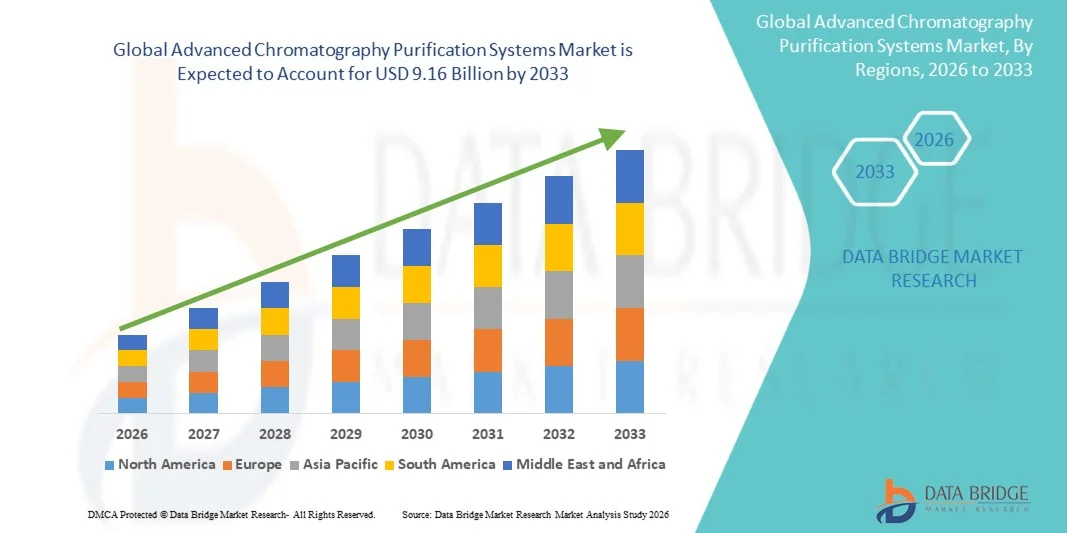
The Advanced Chromatography Purification Systems Market was valued at USD 3.28 billion in 2025 and is projected to reach USD 9.16 billion by 2033, growing at a CAGR of 13.70% from 2026 to 2033. The Advanced Chromatography Purification Systems Market is experiencing consistent growth driven by increasing demand for high-purity biologics, pharmaceuticals, and specialty chemicals, along with rapid advancements in separation science technologies. The expansion of biologics production, including monoclonal antibodies, vaccines, recombinant proteins, and cell and gene therapy products, is significantly accelerating the adoption of advanced chromatography systems across downstream processing workflows. Manufacturers are increasingly deploying high-resolution liquid chromatography platforms, automated purification systems, and continuous chromatography technologies to improve yield, reduce processing time, and enhance product consistency in large-scale biomanufacturing environments.
The rising complexity of biologic drug molecules and stricter regulatory requirements for product purity and safety are further compelling pharmaceutical and biotechnology companies to invest in advanced purification solutions. Increasing emphasis on cost-efficient downstream processing, coupled with the shift toward single-use and modular bioprocessing systems, is supporting market expansion across both developed and emerging regions. In addition, growing investments in biopharmaceutical manufacturing capacity, contract development and manufacturing organizations (CDMOs), and research-scale purification systems are strengthening the adoption of advanced chromatography purification technologies globally.
Market Size & Forecast
- Global Market Value (2025): USD 3.28 Billion
- Expected Market Value (2033): USD 9.16 Billion
- Forecast CAGR (2026–2033): 13.70%
- Leading Region in 2025: North America
- Fastest Growing Region: Asia-Pacific
Key Market Trends & Insights
- North America dominated the Advanced Chromatography Purification Systems Market with the largest revenue share of 34.12% in 2025, driven by strong pharmaceutical R&D infrastructure, high adoption of advanced analytical technologies, and the presence of leading biopharmaceutical companies and research institutes.
- The liquid chromatography systems segment dominated the market with a share of 42.35% in 2025, driven by its extensive use in pharmaceutical analysis, biologics purification, quality control, and complex molecular separation applications.
- Asia-Pacific is expected to be the fastest-growing region at a CAGR of 7.4% from 2026 to 2033, fueled by rapid expansion of pharmaceutical manufacturing, rising R&D investments, and increasing adoption of advanced chromatography technologies in China, India, and Japan.
- Ion exchange chromatography systems are projected to be the fastest-growing product type, registering a CAGR of 7.1%, driven by growing use in protein purification, monoclonal antibody production, and biologics manufacturing.
Report Scope and Advanced Chromatography Purification Systems Market Segmentation
|
Attributes |
Advanced Chromatography Purification Systems Key Market Insights |
|
Segments Covered |
|
|
Countries Covered |
North America · U.S. · Canada · Mexico Europe · Germany · France · U.K. · Netherlands · Switzerland · Belgium · Russia · Italy · Spain · Turkey · Rest of Europe Asia-Pacific · China · Japan · India · South Korea · Singapore · Malaysia · Australia · Thailand · Indonesia · Philippines · Rest of Asia-Pacific Middle East and Africa · Saudi Arabia · U.A.E. · South Africa · Egypt · Israel · Rest of Middle East and Africa South America · Brazil · Argentina · Rest of South America |
|
Key Market Players |
• Thermo Fisher Scientific Inc. (U.S.) |
|
Market Opportunities |
· Expansion of biologics and biosimilars production · Adoption of continuous and automated chromatography technologies · Growth of CDMO outsourcing and single-use purification systems |
|
Value Added Data Infosets |
In addition to the insights on market scenarios such as market value, growth rate, segmentation, geographical coverage, and major players, the market reports curated by the Data Bridge Market Research also include in-depth expert analysis, geographically represented company-wise production and capacity, network layouts of distributors and partners, detailed and updated price trend analysis and deficit analysis of supply chain and demand. |
Advanced Chromatography Purification Systems Market Trends
Trend: Growing Adoption of Advanced Chromatography in Motorsports & High-Precision Training Applications
The increasing adoption of advanced chromatography purification systems in high-performance testing and analytical simulation environments is being observed across specialized research and motorsport-linked engineering applications, where precise chemical and biochemical analysis supports material validation and performance optimization. Professional research laboratories and automotive R&D centers are leveraging high-fidelity chromatographic analysis systems to evaluate fuel compositions, lubricant behavior, and bio-based material performance under extreme operating conditions. Integration of real-time analytical data acquisition enables highly accurate monitoring of molecular-level changes during testing, improving predictive performance modeling. Research institutes and technical academies are increasingly using chromatography-based analytical systems to train scientists and engineers in high-precision separation and purification techniques. The incorporation of advanced software analytics and automated sample processing is improving reproducibility and reducing experimental variability. Increasing adoption of VR-enabled laboratory training platforms is supporting immersive learning in chromatography workflows. Growing demand for high-resolution separation techniques in materials research is further supporting system adoption. These systems are also being used in pharmaceutical simulation environments to replicate production-scale purification processes. Rising emphasis on data-driven laboratory operations is strengthening demand for integrated analytical platforms. Continuous improvements in detection sensitivity and throughput are enhancing application scope. Overall, advanced chromatography systems are becoming essential tools in high-precision research and simulation-based analytical training ecosystems.
Advanced Chromatography Purification Systems Market Dynamics
Key Market Driver: Rising Demand from Biopharmaceutical Manufacturing and Precision Drug Development
The rapid expansion of biopharmaceutical production, particularly monoclonal antibodies, vaccines, and recombinant proteins, is significantly driving demand for advanced chromatography purification systems. These systems play a critical role in ensuring high-purity separation, structural integrity, and regulatory compliance of complex biologic drug substances. Pharmaceutical and biotechnology companies are increasingly integrating automated liquid chromatography and affinity-based purification platforms into large-scale production workflows. Growing global biologics pipelines, especially in oncology and autoimmune diseases, are further strengthening system adoption. Increasing investments in biomanufacturing infrastructure across North America, Europe, and Asia-Pacific are accelerating deployment of high-throughput purification technologies. The shift toward continuous bioprocessing is further enhancing demand for real-time, high-efficiency separation systems. Regulatory agencies such as the US FDA and EMA are emphasizing stricter purity and quality standards, pushing manufacturers toward advanced analytical systems. Expansion of CDMO-driven biologics outsourcing is also contributing to market growth. Integration of AI-driven process optimization and automated fraction collection systems is improving efficiency and yield. Rising demand for personalized medicine and precision therapeutics is further strengthening analytical requirements. Increasing R&D expenditure by leading biopharma companies is accelerating adoption. Overall, biopharmaceutical expansion remains the strongest structural driver of the chromatography purification systems market.
Key Restraint/Challenge: High Capital Investment and Operational Complexity
A major restraint in the Advanced Chromatography Purification Systems Market is the high initial investment required for sophisticated analytical platforms. Modern chromatography systems, particularly high-performance liquid chromatography (HPLC) and ion exchange systems, involve significant costs associated with instrumentation, software integration, and laboratory infrastructure. The total cost of ownership is further increased by recurring expenses such as consumables, columns, reagents, calibration, and maintenance. Smaller research laboratories, academic institutes, and emerging-market manufacturers often face barriers to adoption due to budget constraints. In addition, the requirement for highly skilled personnel to operate and maintain advanced systems increases operational complexity. Frequent system validation and regulatory documentation requirements also add to operational burden in pharmaceutical environments. Integration with digital laboratory information management systems (LIMS) can further increase setup complexity and cost. Rapid technological advancements often lead to faster obsolescence cycles, requiring continuous upgrades. Limited standardization across platforms can create interoperability challenges in multi-vendor environments. Supply chain dependencies for specialized resins and columns can also affect operational continuity. Despite strong demand, these financial and technical barriers restrict widespread adoption. Overall, cost and complexity remain key challenges limiting market penetration in smaller and mid-scale facilities.
Key Market Opportunity: Integration of AI, Automation, and Continuous Chromatography Platforms
The integration of artificial intelligence, automation, and continuous processing technologies presents a significant growth opportunity in the advanced chromatography purification systems market. AI-enabled chromatography platforms can optimize separation conditions in real time, improving yield, purity, and process efficiency. Machine learning algorithms are increasingly being used to predict elution profiles and reduce experimental trial-and-error cycles. Automation in sample preparation, injection, and fraction collection is enhancing throughput and reproducibility in pharmaceutical laboratories. The development of continuous chromatography systems is enabling large-scale, cost-efficient biologics manufacturing with reduced downtime. Cloud-based analytical platforms are allowing remote monitoring and data-driven process optimization across multiple facilities. Increasing adoption of digital twins in bioprocessing is improving predictive maintenance and system calibration. Expansion of smart laboratories in North America, Europe, and Asia-Pacific is accelerating adoption of integrated analytical ecosystems. Growing demand for high-throughput screening in drug discovery is further boosting adoption of automated chromatography systems. Collaborations between pharmaceutical companies and technology providers are driving innovation in hybrid analytical platforms. Rising investments in Industry 4.0-enabled biomanufacturing infrastructure are supporting long-term market expansion. Overall, digital transformation is creating strong opportunities for next-generation chromatography purification systems globally.
Advanced Chromatography Purification Systems Market Scope
The advanced chromatography purification systems market is segmented on the basis of product type and end user.
- By Product Type
On the basis of product type, the Advanced Chromatography Purification Systems Market is segmented into liquid chromatography systems, gas chromatography systems, ion exchange chromatography systems, affinity chromatography systems, and others. The liquid chromatography systems segment dominated the market with a share of 42.35% in 2025, driven by its extensive use in pharmaceutical analysis, biologics purification, quality control, and complex molecular separation applications. These systems are widely adopted across drug development pipelines due to their high accuracy, reproducibility, and compatibility with a broad range of biomolecules. Increasing demand for monoclonal antibodies, vaccines, and biosimilars is significantly strengthening adoption. Integration of automated and high-throughput liquid chromatography platforms is improving laboratory efficiency. Growing emphasis on regulatory compliance and product purity is further supporting segment dominance. Technological advancements in high-performance liquid chromatography (HPLC) systems are enhancing resolution and sensitivity. Rising investments in biopharmaceutical R&D are accelerating system deployment. Expansion of contract research and manufacturing activities is further reinforcing demand. Increasing use in clinical and preclinical research is strengthening market penetration. Overall, liquid chromatography remains the backbone of modern purification workflows globally.
The ion exchange chromatography systems segment is expected to witness the fastest growth at a CAGR of 7.3% from 2026 to 2033, driven by increasing use in protein purification and biologics manufacturing. These systems are highly effective in separating charged biomolecules with high selectivity and yield. Rising production of monoclonal antibodies and recombinant proteins is boosting adoption. Pharmaceutical companies are increasingly integrating ion exchange platforms into downstream processing workflows. Advancements in resin technology are improving binding capacity and efficiency. Automation and process intensification are reducing processing time and cost. Increasing regulatory requirements for high-purity biologics are supporting demand. Growing outsourcing of biologics manufacturing to CDMOs is further accelerating usage. Expansion of large-scale bioprocessing facilities is strengthening adoption. Rising focus on continuous bioprocessing is enhancing system relevance. Overall, ion exchange systems are emerging as a key growth driver in purification technologies.
- By End User
On the basis of end user, the Advanced Chromatography Purification Systems Market is segmented into pharmaceutical & biotechnology companies, academic & research institutes, food & beverage industry, environmental testing laboratories, and others. The pharmaceutical & biotechnology companies segment dominated the market with a share of 39.18% in 2025, driven by strong demand for high-purity separation in drug discovery, biologics development, and vaccine manufacturing. These organizations rely heavily on chromatography systems for ensuring product safety, quality, and regulatory compliance. Increasing global biologics pipelines are significantly supporting system adoption. Strong R&D investments in oncology, immunology, and rare diseases are further boosting demand. Integration of advanced automation and digital chromatography platforms is improving efficiency. Large-scale manufacturing facilities are widely deploying high-performance purification systems. Strategic collaborations with CDMOs are enhancing production scalability. Growing emphasis on precision medicine is increasing analytical requirements. Expansion of biopharmaceutical manufacturing capacity across emerging markets is strengthening growth. Continuous technological innovation is improving system performance and throughput. Overall, pharma and biotech companies remain the primary demand drivers in the market.
The environmental testing laboratories segment is expected to witness the fastest growth at a CAGR of 7.0% from 2026 to 2033, driven by increasing regulatory requirements for pollution monitoring and chemical analysis. These laboratories widely use chromatography systems for water quality testing, soil analysis, and air pollutant detection. Rising environmental awareness and stricter government regulations are boosting demand. Expanding industrial activities are increasing the need for contamination monitoring. Adoption of advanced gas and liquid chromatography systems is improving detection accuracy. Increasing investments in environmental safety infrastructure are supporting growth. Growing focus on sustainable development is strengthening testing requirements. Government-funded environmental monitoring programs are expanding globally. Technological advancements are enhancing sensitivity and analytical precision. Integration of automated sample handling is improving workflow efficiency. Overall, environmental laboratories are emerging as a high-growth application segment in chromatography systems.
Advanced Chromatography Purification Systems Market Regional Analysis
North America dominated the Advanced Chromatography Purification Systems Market and accounted for the largest revenue share of 34.12% in 2025, driven by strong pharmaceutical R&D infrastructure, high adoption of advanced analytical technologies, and the presence of leading biopharmaceutical companies and research institutes. The region benefits from well-established downstream processing capabilities, extensive biologics manufacturing capacity, and continuous investment in innovation for high-purity separation and purification systems used in drug development and production.
U.S. Advanced Chromatography Purification Systems Market Insight
The U.S. advanced chromatography purification systems market is witnessing strong growth due to rising investments in biologics development, monoclonal antibody production, and next-generation therapeutic research. The country’s robust biopharmaceutical ecosystem, along with increasing adoption of automated and high-resolution chromatography platforms, is driving demand across pharmaceutical companies, CDMOs, and research institutes. In addition, continuous advancements in process analytical technologies and downstream purification efficiency are accelerating system adoption across large-scale manufacturing facilities.
Europe Advanced Chromatography Purification Systems Market Insight
The Europe advanced chromatography purification systems market remains a major contributor to global revenue, supported by strong regulatory frameworks, growing biopharmaceutical production, and increasing R&D activities across major economies. Widespread use of chromatography systems in biologics manufacturing, academic research, and industrial applications is supporting steady market expansion. Rising investments in sustainable and high-efficiency purification technologies are further enhancing adoption across the region.
U.K. Advanced Chromatography Purification Systems Market Insight
The U.K. advanced chromatography purification systems market is experiencing steady growth driven by expanding life sciences research, increasing biopharma manufacturing activities, and strong academic-industry collaboration. Growing demand for high-precision separation and purification technologies in vaccine development and protein-based therapeutics is further supporting market expansion. Integration of automation and digital bioprocessing tools is improving efficiency and process consistency.
Germany Advanced Chromatography Purification Systems Market Insight
The Germany advanced chromatography purification systems market is expanding due to the country’s strong chemical and pharmaceutical manufacturing base, advanced research capabilities, and increasing focus on high-quality biologics production. Companies are increasingly investing in advanced purification platforms to improve yield, reduce production costs, and meet strict regulatory standards. Continuous innovation in chromatography media and system design is further strengthening market growth.
Asia-Pacific Advanced Chromatography Purification Systems Market Insight
The Asia-Pacific advanced chromatography purification systems market is expected to witness rapid growth, driven by expanding pharmaceutical manufacturing capacity, rising R&D investments, and increasing adoption of advanced purification technologies in emerging economies. Countries such as China, India, Japan, and South Korea are investing heavily in biologics production and research infrastructure, supporting strong demand for chromatography systems. Growing outsourcing to CDMOs and rising healthcare needs are further accelerating regional expansion.
Japan Advanced Chromatography Purification Systems Market Insight
The Japan advanced chromatography purification systems market is witnessing consistent growth due to strong pharmaceutical innovation, increasing biologics production, and advanced research capabilities. Japanese manufacturers are increasingly adopting high-precision purification technologies to support monoclonal antibody production, vaccine development, and protein purification applications. Emphasis on quality control and process efficiency is further driving market adoption.
China Advanced Chromatography Purification Systems Market Insight
The China advanced chromatography purification systems market is growing rapidly, supported by expanding biopharmaceutical manufacturing, increasing government support for life sciences, and rising investments in R&D infrastructure. Growing adoption of advanced separation technologies in domestic pharmaceutical companies and CDMOs is significantly boosting demand. In addition, increasing focus on biosimilars and innovative biologics is strengthening long-term market growth.
Advanced Chromatography Purification Systems Market Share
The advanced chromatography purification systems industry is primarily led by well-established companies, including:
- Thermo Fisher Scientific Inc. (U.S.)
- Merck KGaA (Germany)
- Danaher Corporation (U.S.)
- Sartorius AG (Germany)
- Agilent Technologies Inc. (U.S.)
- Bio-Rad Laboratories Inc. (U.S.)
- Waters Corporation (U.S.)
- Shimadzu Corporation (Japan)
- GE HealthCare (Cytiva) (U.S./U.K.)
- Tosoh Corporation (Japan)
- PerkinElmer Inc. (U.S.)
- Hitachi High-Tech Corporation (Japan)
- KNAUER Wissenschaftliche Geräte GmbH (Germany)
- YMC Co., Ltd. (Japan)
- Pall Corporation (U.S.)
- Repligen Corporation (U.S.)
- Avantor Inc. (U.S.)
- Eppendorf SE (Germany)
- Hamilton Company (U.S.)
- Showa Denko Materials Co., Ltd. (Japan)
Latest Developments in Advanced Chromatography Purification Systems Market
- In October 2021, Thermo Fisher Scientific, a leading life sciences company, introduced the Thermo Scientific HyPeak single-use chromatography system, designed for scalable bioprocessing applications from process development to large-scale manufacturing. The system enables efficient purification of therapeutic proteins and vaccines while reducing buffer consumption and improving product yield. It is integrated with Emerson’s DeltaV automation platform, allowing seamless process control and tech transfer in biomanufacturing workflows. This development highlights the industry shift toward single-use and continuous chromatography technologies in biologics production
- In October 2021, CEM Corporation launched the Prodigy Preparative High-Performance Liquid Chromatography (HPLC) system, targeting peptide and biomolecule purification applications. The system features elevated temperature chromatography, improving separation efficiency and resolution for complex compounds. It supports direct scale-up from analytical to preparative workflows, significantly accelerating drug discovery and purification processes in pharmaceutical research. This launch strengthened rapid purification capabilities in early-stage drug development pipelines
- In May 2022, Biotage announced the launch of the Biotage Selekt Enkel flash purification system, expanding its chromatography purification portfolio for research and drug discovery applications. The system was designed to improve workflow efficiency, reduce solvent consumption, and support both normal-phase and reversed-phase separations. It enables faster compound isolation in pharmaceutical and academic laboratories, enhancing productivity in early-stage chemical and biological research
- In June 2022, Waters Corporation expanded its chromatography portfolio with upgrades to its ACQUITY and Alliance HPLC systems, introducing enhanced sensitivity, improved automation, and stronger integration with laboratory informatics systems. These enhancements improved analytical precision and reproducibility in pharmaceutical quality control and biopharmaceutical testing environments. The update reinforced Waters’ position in high-performance liquid chromatography solutions for regulated industries
- In April 2024, Agilent Technologies launched the InfinityLab LC Series (Infinity III platform), a next-generation liquid chromatography system designed to enhance laboratory productivity and analytical accuracy. The system introduced advanced automation features, barcode-based sample tracking, and improved system intelligence for reducing manual errors. It also improved connectivity and integration with laboratory data systems, supporting digital transformation in analytical laboratories
- In September 2023, Shimadzu Corporation expanded its Nexera series UHPLC systems, introducing improved ultra-high-pressure performance, higher resolution separation capabilities, and enhanced software-driven automation. These systems were designed to support advanced pharmaceutical research, environmental analysis, and food safety testing applications. The upgrade improved efficiency in high-throughput analytical workflows across regulated industries
- In March 2024, Thermo Fisher Scientific introduced enhancements to its Vanquish UHPLC platform, focusing on higher resolution separations, improved pressure tolerance, and enhanced system intelligence features. The updated platform supports complex biologics analysis and high-throughput pharmaceutical workflows. These advancements strengthened its adoption in biopharmaceutical R&D and quality control laboratories

- Interactive Data Analysis Dashboard
- Company Analysis Dashboard for high growth potential opportunities
- Research Analyst Access for customization & queries
- Competitor Analysis with Interactive dashboard
- Latest News, Updates & Trend analysis
- Harness the Power of Benchmark Analysis for Comprehensive Competitor Tracking
Data collection and base year analysis are done using data collection modules with large sample sizes. The stage includes obtaining market information or related data through various sources and strategies. It includes examining and planning all the data acquired from the past in advance. It likewise envelops the examination of information inconsistencies seen across different information sources. The market data is analysed and estimated using market statistical and coherent models. Also, market share analysis and key trend analysis are the major success factors in the market report. To know more, please request an analyst call or drop down your inquiry.
The key research methodology used by DBMR research team is data triangulation which involves data mining, analysis of the impact of data variables on the market and primary (industry expert) validation. Data models include Vendor Positioning Grid, Market Time Line Analysis, Market Overview and Guide, Company Positioning Grid, Patent Analysis, Pricing Analysis, Company Market Share Analysis, Standards of Measurement, Global versus Regional and Vendor Share Analysis. To know more about the research methodology, drop in an inquiry to speak to our industry experts.
Data Bridge Market Research is a leader in advanced formative research. We take pride in servicing our existing and new customers with data and analysis that match and suits their goal. The report can be customized to include price trend analysis of target brands understanding the market for additional countries (ask for the list of countries), clinical trial results data, literature review, refurbished market and product base analysis. Market analysis of target competitors can be analyzed from technology-based analysis to market portfolio strategies. We can add as many competitors that you require data about in the format and data style you are looking for. Our team of analysts can also provide you data in crude raw excel files pivot tables (Fact book) or can assist you in creating presentations from the data sets available in the report.













