


What is the Advanced Suspension Control System Market Size and Growth Rate?
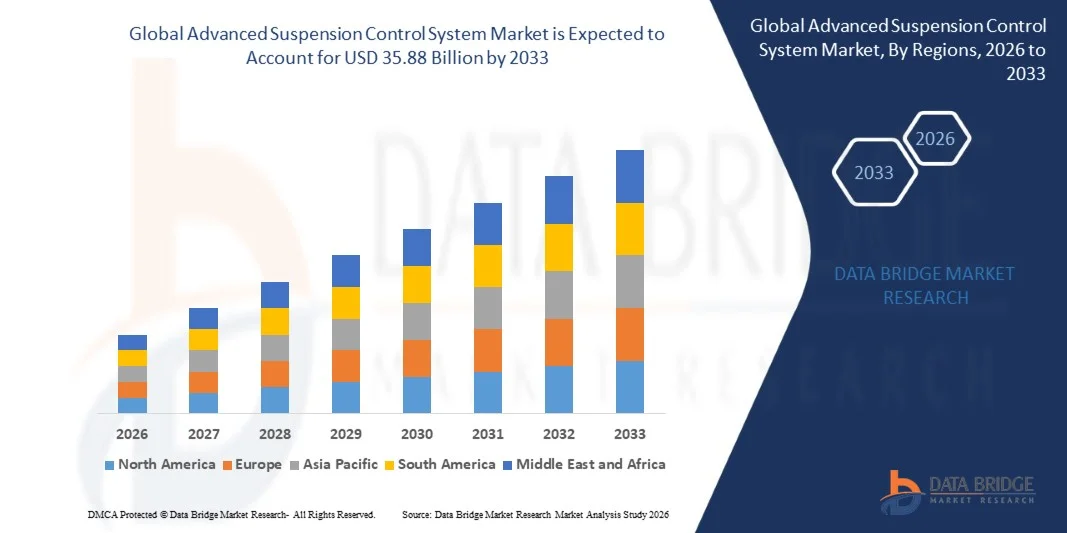
- As per Data Bridge Market Research analysis, the advanced suspension control system market was valued at USD 18.41 billion in 2025 and is projected to reach USD 35.88 billion by 2033, growing at a CAGR of 8.7% from 2026 to 2033.
- The market is experiencing strong growth driven by rising consumer demand for enhanced ride comfort and handling precision, rapid advancements in electronic damping and sensor technologies, and expanding integration of suspension control systems across passenger, commercial, and electric vehicle platforms.
- The growing emphasis on vehicle safety, stability, and driving dynamics, combined with stricter emission and ride-quality regulations, is compelling automotive OEMs to integrate active and semi-active suspension systems into a broader range of vehicle segments. Electromagnetic and electro-hydraulic suspension technologies are increasingly replacing conventional passive suspension setups, offering adaptive, real-time damping control and improved energy efficiency.
- The rising penetration of connected and software-defined vehicle architectures is further accelerating adoption, as advanced suspension control units increasingly interface with broader vehicle safety, stability, and driver-assistance systems to deliver coordinated, data-driven ride-management capabilities.
Market Size & Forecast
- Global Market Value (2025): USD 18.41 Billion
- Expected Market Value (2033): USD 35.88 Billion
- Forecast CAGR (2026–2033): 8.7%
- Leading Region in 2025: Europe
- Fastest Growing Region: Asia-Pacific
What are the Major Takeaways of the Advanced Suspension Control System Market?
- Europe dominated the global advanced suspension control system market with the largest revenue share of 34.72% in 2025, supported by a strong presence of premium automakers and extensive investment in ride-comfort and vehicle-dynamics engineering.
- Asia-Pacific is expected to be the fastest-growing region at a CAGR of 10.4% from 2026 to 2033, fueled by rising vehicle production, growing consumer preference for premium ride features, and expanding adoption in China, India, Japan, and South Korea.
- The semi-active suspension system segment led the market with a 44.63% share in 2025, driven by its cost-effective balance between ride comfort and handling performance across mid-range and premium passenger vehicles.
- Active suspension systems are the fastest-growing system type, projected to register a CAGR of 11.2%, reflecting rising integration of fully electronic, real-time adaptive damping in luxury and electric vehicles.
- The passenger cars segment dominated the vehicle type category with a 52.86% revenue share in 2025, led by automotive OEMs adopting suspension control systems for comfort, safety, and driving-dynamics differentiation.
- OEM sales channel accounted for 68.45% of the market share in 2025, preferred due to factory-fitted integration, warranty assurance, and system calibration with vehicle electronic architecture.
- The electronic control units segment is the fastest-growing component category, with a CAGR of 9.9%, driven by demand for centralized, software-defined control of ride height, damping force, and vehicle stability.
- The ride comfort & stability control application segment held the largest share of 39.75% in 2025, reflecting strong OEM focus on occupant comfort and vehicle stability as primary purchase drivers for advanced suspension systems.
- The luxury & premium vehicle class segment accounted for 46.29% of market revenue in 2025, underscoring the continued concentration of advanced suspension adoption among high-end vehicle manufacturers, though mid-range adoption is expanding quickly.
- The hydraulic suspension technology segment led the market with a 33.28% share in 2025, supported by its widespread use in commercial vehicles and premium passenger cars requiring reliable load-handling and damping performance.
Report Scope and Advanced Suspension Control System Market Segmentation
|
Attributes |
Advanced Suspension Control System Key Market Insights |
|
Segments Covered |
|
|
Countries Covered |
North America
Europe
Asia-Pacific
Middle East and Africa
South America
|
|
Key Market Players |
|
|
Market Opportunities |
|
|
Value Added Data Infosets |
In addition to the insights on market scenarios such as market value, growth rate, segmentation, geographical coverage, and major players, the market reports curated by the Data Bridge Market Research also include in-depth expert analysis, geographically represented company-wise production and capacity, network layouts of distributors and partners, detailed and updated price trend analysis, and deficit analysis of supply chain and demand. |
What is the Key Trend in the Advanced Suspension Control System Market?
- Automotive OEMs are increasingly adopting fully active suspension systems to differentiate premium and electric vehicle models through superior ride comfort, cornering stability, and adaptive road-condition response, while reducing reliance on mechanical damping components.
- For instance, in March 2025, Mercedes-Benz continued expanding deployment of its ACTIVE BODY CONTROL suspension across its electric vehicle lineup, enabling real-time chassis adjustments that improve energy efficiency and occupant comfort during dynamic driving conditions.
- Real-time sensor fusion, combining accelerometers, height sensors, and steering-angle inputs, is enabling suspension control units to anticipate road irregularities and adjust damping force within milliseconds.
- Suppliers are increasingly collaborating with software and semiconductor companies to develop domain-specific chassis controllers capable of processing suspension, braking, and steering data simultaneously, enabling more holistic vehicle-dynamics management and reducing overall system latency.
- Suspension technology providers are increasingly leveraging machine learning algorithms to develop predictive, self-learning ride-control systems that continuously calibrate to individual driving styles and road profiles.
- For instance, in February 2025, ZF Friedrichshafen expanded its sky-hook damping control software suite to include predictive terrain-scanning capability, allowing suspension units to pre-adjust damping force ahead of detected road surface changes.
- Suppliers are also developing modular, scalable suspension-control platforms that can be configured across multiple vehicle segments, reducing engineering and validation costs for automakers while accelerating time-to-market for new ride-comfort features.
- For instance, in January 2025, Continental AG introduced a scalable air suspension architecture designed to serve compact SUVs through full-size luxury sedans using a shared electronic control unit and software base, reducing development complexity for automotive OEMs.
- As automakers and technology suppliers continue to prioritize ride comfort, vehicle stability, and electrification compatibility, the adoption of advanced suspension control systems is expected to accelerate, reinforcing their role as a core differentiator in next-generation vehicle engineering.
What are the Key Drivers of the Advanced Suspension Control System Market?
- The rapid growth of premium and electric vehicle segments has significantly increased demand for advanced suspension systems capable of delivering superior ride comfort, reduced body roll, and adaptive handling across diverse driving and road conditions.
- For instance, in April 2025, Tenneco expanded its Monroe Intelligent Suspension portfolio with a new semi-active damping platform designed specifically for electric SUVs, enabling automakers to offset added battery weight while preserving ride quality.
- Automotive OEMs and Tier-1 suppliers are increasingly integrating suspension control electronics into broader vehicle software architectures to enhance safety, reduce development cycles, and support over-the-air calibration updates.
- For instance, in December 2024, Continental AG expanded its production of electronically controlled air suspension modules to support growing OEM demand for adjustable ride height and load-leveling features across SUV and luxury sedan platforms.
- Rising consumer awareness of ride quality and vehicle safety, combined with expanding availability of financing options for premium vehicle features, is encouraging mainstream automakers to offer advanced suspension packages as optional or standard equipment across a wider range of models.
- For instance, in October 2024, Hyundai Mobis announced the expansion of its electronic suspension production lines to support growing OEM orders for mid-range sedans and SUVs equipped with continuously variable damping control, reflecting rising mainstream demand for adaptive ride technologies.
- With the automotive industry increasingly prioritizing driving dynamics, occupant comfort, and electrification-compatible chassis systems, advanced suspension control systems will remain essential to the development of next-generation passenger and commercial vehicles.
Which Factors are Challenging the Growth of the Advanced Suspension Control System Market?
- Advanced suspension control systems require substantial upfront investment due to the integration of high-precision sensors, electronic control units, actuators, and specialized damping hardware.
- These high costs limit adoption among budget and economy vehicle segments, particularly in price-sensitive and emerging automotive markets.
- For instance, in September 2024, a leading Tier-1 supplier reported that the cost of fully active suspension modules remains nearly three times higher than conventional passive damping systems, restricting adoption to premium and luxury vehicle categories.
- The high capital investment and recurring maintenance costs associated with advanced suspension systems continue to restrict adoption, particularly among entry-level vehicle manufacturers and cost-conscious consumers. This cost barrier slows market penetration in price-sensitive and emerging regions, limiting the widespread deployment of advanced suspension technologies despite growing demand.
- The added weight and packaging complexity of active and semi-active suspension components can pose engineering challenges for compact vehicle platforms with limited chassis space, requiring additional design and validation effort from automotive OEMs.
- Limited availability of skilled technicians for diagnosing and servicing electronically controlled suspension systems in aftermarket and rural service networks further constrains the pace of adoption in certain regional markets.
- Supply chain dependency on specialized sensors, semiconductors, and precision-machined actuator components exposes manufacturers to potential production delays and cost fluctuations during periods of global component shortages, adding further pressure on pricing and delivery timelines across the value chain.
How is the Advanced Suspension Control System Market Segmented?
The advanced suspension control system market is segmented on the basis of system type, component, technology, vehicle type, application, sales channel, end user, actuation mechanism, and vehicle class.
- By System Type
On the basis of system type, the global advanced suspension control system market is segmented into active suspension systems, semi-active suspension systems, and adaptive suspension systems. The semi-active suspension system segment dominated the market with a 44.63% share in 2025, owing to its cost-effective balance between comfort and handling performance, along with extensive deployment across mid-range and premium passenger vehicles. These systems deliver real-time damping adjustment without the higher cost and power demands of fully active setups, making them the preferred choice for volume automakers and Tier-1 suppliers.
The active suspension system segment is projected to register the fastest growth at a CAGR of 11.2% from 2026 to 2033, driven by rising demand for fully adaptive ride and handling control. Advances in electromagnetic and electro-hydraulic actuation, combined with declining component costs and growing adoption in electric and luxury vehicles, are accelerating segment expansion.
- By Component
On the basis of component, the global advanced suspension control system market is segmented into sensors, electronic control units, actuators, air springs & compressors, and dampers & struts. The sensors segment led the market with a 28.47% share in 2025, supported by extensive use in ride-height detection, load monitoring, and vehicle-dynamics measurement across active and semi-active suspension platforms.
The electronic control units segment is expected to experience the fastest growth at a CAGR of 9.9% from 2026 to 2033, driven by increasing demand for centralized, software-defined suspension calibration and integration with broader vehicle safety and stability systems.
- By Technology
On the basis of technology, the global advanced suspension control system market is segmented into electromagnetic suspension, hydraulic suspension, pneumatic suspension, and electro-hydraulic suspension. The hydraulic suspension segment dominated the market with a share of 33.28% in 2025 due to its widespread adoption in commercial vehicles and premium passenger cars, offering reliable load handling and damping performance. additionally, established supply chains and proven durability continue to support strong OEM preference for hydraulic suspension platforms across multiple vehicle categories.
The electromagnetic suspension segment is anticipated to witness the fastest CAGR of 10.8% from 2026 to 2033, driven by this growth is fueled by increasing adoption of fully electronic, energy-recuperative damping systems in electric and luxury vehicles. automakers and technology providers are investing in electromagnetic actuation to achieve faster response times, improved energy efficiency, and precise ride-control customization, further accelerating segment growth.
- By Vehicle Type
On the basis of vehicle type, the global advanced suspension control system market is segmented into passenger cars, light commercial vehicles, heavy commercial vehicles, and electric vehicles. The passenger cars segment dominated the market with a share of 52.86% in 2025 due to its widespread adoption across premium, mid-range, and performance vehicle categories seeking enhanced ride comfort and handling precision. the growing integration of semi-active and active suspension technologies by automotive OEMs to differentiate vehicle models and improve driving dynamics is reinforcing the dominance of this segment.
The electric vehicles segment is expected to witness the fastest CAGR of 12.5% from 2026 to 2033, driven by the rising need to offset added battery weight, optimize energy efficiency, and preserve ride quality in electric vehicle platforms. additionally, growing investment by EV manufacturers in adaptive suspension technologies to enhance range, stability, and passenger comfort is further accelerating adoption across this segment.
- By Application
On the basis of application, the global advanced suspension control system market is segmented into ride comfort & stability control, load leveling, off-road & terrain adaptation, and handling & cornering performance. The ride comfort & stability control segment dominated the market with a share of 39.75% in 2025 due to its critical role in enhancing occupant comfort, reducing body roll, and maintaining vehicle stability across varied road and driving conditions. high adoption is driven by the increasing consumer preference for premium ride quality and growing integration of sensor-based, real-time damping adjustment across passenger and electric vehicles.
The off-road & terrain adaptation segment is expected to witness the fastest CAGR of 10.1% from 2026 to 2033, this growth is driven by increasing demand for adaptive suspension systems in SUVs, pickup trucks, and specialty vehicles operating across variable terrain. advanced terrain-sensing technologies and adjustable ride-height capabilities are improving off-road performance and expanding adoption among adventure and utility vehicle manufacturers.
- By Sales Channel
On the basis of sales channel, the global advanced suspension control system market is segmented into OEM and aftermarket. The OEM segment dominated the market with a share of 68.45% in 2025 due to its preference among automotive manufacturers requiring factory-calibrated integration, warranty assurance, and compatibility with broader vehicle electronic architectures. additionally, established relationships between suspension technology providers and automakers are facilitating faster product development cycles and reinforcing this segment’s leading market position.
The aftermarket segment is expected to witness the fastest CAGR of 9.4% from 2026 to 2033, driven by this growth is primarily driven by rising vehicle parc, increasing consumer interest in performance upgrades, and growing availability of retrofit suspension control kits through specialized distributors and e-commerce channels.
- By End User
On the basis of end user, the global advanced suspension control system market is segmented into automotive OEMs, aftermarket service providers, fleet operators, and research & testing institutions. The automotive OEMs segment dominated the market with a share of 61.32% in 2025 due to its central role in vehicle design, chassis engineering, and integration of advanced ride-control technologies across new vehicle platforms. the widespread adoption of active and semi-active suspension systems for comfort, safety, and driving-dynamics differentiation is reinforcing strong demand from this segment.
The fleet operators segment is expected to witness the fastest CAGR of 9.6% from 2026 to 2033, driven by the rising need for enhanced vehicle stability, cargo protection, and driver comfort across commercial and logistics fleets. additionally, growing emphasis on operational efficiency and reduced maintenance costs is further accelerating adoption of advanced suspension technologies among fleet operators.
- By Actuation Mechanism
On the basis of actuation mechanism, the global advanced suspension control system market is segmented into electromechanical actuators, hydraulic actuators, and magnetorheological actuators. The hydraulic actuators segment dominated the market with a share of 41.16% in 2025 due to its proven reliability, high load-bearing capacity, and extensive use across commercial and premium passenger vehicles. established manufacturing processes and cost-effective production continue to reinforce OEM preference for hydraulic actuation across a broad range of vehicle platforms.
The magnetorheological actuators segment is expected to witness the fastest CAGR of 11.6% from 2026 to 2033, driven by this growth is primarily fueled by increasing adoption of fluid-based, variable-damping technology that enables near-instantaneous adjustment of suspension stiffness. automakers are increasingly integrating magnetorheological dampers into luxury and performance vehicles to deliver superior ride-handling balance without complex mechanical linkages.
- By Vehicle Class
On the basis of vehicle class, the global advanced suspension control system market is segmented into economy, mid-range, and luxury & premium. The luxury & premium segment dominated the market with a share of 46.29% in 2025 due to its early and extensive adoption of active and semi-active suspension technologies as standard or optional equipment for ride comfort and brand differentiation. strong consumer willingness to pay for advanced ride-control features continues to support this segment’s leading position.
The mid-range segment is expected to witness the fastest CAGR of 10.7% from 2026 to 2033, driven by the increasing trickle-down of semi-active and electronically controlled suspension technologies into mainstream vehicle platforms. additionally, declining component costs and rising consumer expectations for premium ride quality in non-luxury vehicles are further accelerating adoption across this segment.
Which Region Holds the Largest Share of the Advanced Suspension Control System Market?
- Europe dominated the advanced suspension control system market and accounted for the largest revenue share of 34.72% in 2025, supported by a strong presence of premium and luxury automakers, advanced chassis-engineering capabilities, and significant investment in ride-comfort and vehicle-dynamics technologies.
- The region also benefits from stringent vehicle safety and emissions regulations, high adoption of electronically controlled suspension platforms, and growing use of active suspension systems across passenger and electric vehicle segments. Increasing focus on driving-dynamics differentiation and electrification continues to strengthen Europe’s leadership position in the global market.
U.K. Advanced Suspension Control System Market Insight
The U.K. advanced suspension control system market is expanding steadily due to rising adoption of adaptive suspension technologies in performance vehicles, luxury automobiles, and specialty vehicle manufacturing. Increasing investments in advanced chassis-testing infrastructure and growing demand for cost-effective, retrofit-friendly suspension solutions are contributing to market growth. Furthermore, integration of AI-based predictive damping and real-time sensor technologies is improving suspension responsiveness and ride quality, positioning the U.K. as a key innovation hub in the advanced suspension control system industry.
Germany Advanced Suspension Control System Market Insight
The Germany advanced suspension control system market is experiencing steady growth, supported by the country’s strong automotive manufacturing base, advanced chassis-engineering capabilities, and increasing adoption of electronically controlled damping technologies. Automotive OEMs and Tier-1 suppliers are increasingly integrating active and semi-active suspension systems into premium and electric vehicle platforms. Continuous advancements in electromagnetic actuation, sensor fusion, and predictive control software, along with strong government focus on vehicle safety and innovation, are further driving market growth in Germany.
Asia-Pacific Advanced Suspension Control System Market Insight
The Asia-Pacific advanced suspension control system market is expected to witness rapid growth, driven by increasing vehicle production, expanding electric vehicle adoption, and rising consumer preference for premium ride features across countries such as China, India, and Japan. Growing awareness regarding driving comfort and safety, rising adoption of electronically controlled suspension technologies, and increasing demand for scalable, cost-effective ride-control solutions are supporting regional market expansion. Additionally, the growing presence of automotive R&D centers and component manufacturing hubs is accelerating suspension technology adoption across passenger and commercial vehicle sectors.
Japan Advanced Suspension Control System Market Insight
The Japan advanced suspension control system market is witnessing consistent growth due to rising investments in advanced chassis and ride-control technologies, automotive innovation, and vehicle safety initiatives. Automotive manufacturers and component suppliers are increasingly adopting high-precision suspension systems for performance vehicles, commercial fleets, and export markets. Moreover, increasing integration of electro-hydraulic and electromagnetic technologies and the country’s focus on efficient, comfortable mobility solutions are further contributing to market growth.
China Advanced Suspension Control System Market Insight
The China advanced suspension control system market is growing rapidly, driven by increasing vehicle production, expanding electric vehicle manufacturing, and rising consumer demand for enhanced ride comfort and handling performance. Growing adoption of electromagnetic and air suspension platforms across passenger, luxury, and electric vehicle segments is significantly boosting market demand. In addition, rising investments in automotive R&D, increasing domestic component manufacturing capabilities, and rapid technological advancements are positioning China as one of the fastest-growing markets for advanced suspension control systems globally.
Which are the Top Companies in Advanced Suspension Control System Market?
The advanced suspension control system industry is primarily led by well-established companies, including:
- ZF Friedrichshafen AG (Germany)
- Marelli Holdings Co., Ltd. (Japan)
- ThyssenKrupp Bilstein GmbH (Germany)
- Hitachi Astemo, Ltd. (Japan)
- KYB Corporation (Japan)
- Multimatic Inc. (Canada)
- Continental AG (Germany)
- Öhlins Racing AB (Sweden)
- Robert Bosch GmbH (Germany)
- Tenneco Inc. (U.S.)
- Hyundai Mobis Co., Ltd. (South Korea)
- Vitesco Technologies Group AG (Germany)
- HL Mando Corporation (South Korea)
- BWI Group (China)
- Sachs (ZF Group) (Germany)
- AVL List GmbH (Austria)
- Fox Factory Holding Corp. (U.S.)
- Air Lift Company (U.S.)
- Firestone Industrial Products Co., LLC (U.S.)
- Dunlop Systems and Components Ltd. (U.K.)
- Aisin Corporation (Japan)
- Nissin Kogyo Co., Ltd. (Japan)
- WABCO Holdings Inc. (Belgium)
- Magneti Marelli (Italy)
- Delphi Technologies (U.K.)
What are Latest Developments in Advanced Suspension Control System Market?
- In September 2025, ZF Friedrichshafen unveiled its next-generation fully active suspension platform, sMOTION, integrating electromechanical actuators capable of individually controlling each wheel’s damping force in real time. The system reduces body roll and pitch by over 50% compared to conventional setups, reflecting modernized electronics and improved energy recuperation. This new platform strengthens ZF’s market leadership in suspension technology by boosting ride comfort, handling precision, and energy efficiency.
- In January 2025, Tenneco Inc. expanded its Monroe Intelligent Suspension manufacturing capacity in North America to meet rising OEM demand for semi-active damping modules across SUV and electric vehicle platforms, strengthening its production capabilities and supply chain resilience for advanced suspension components.
- In November 2025, Continental AG launched an upgraded electronically controlled air suspension module featuring integrated predictive road-scanning software, allowing vehicles to pre-adjust damping force based on camera and sensor-detected road conditions. This development strengthens Continental’s position in the advanced suspension control system market by enabling automakers to enhance ride comfort and handling stability through real-time, data-driven suspension calibration.
- In November 2024, HL Mando Corporation introduced a new generation of continuously controlled electronic suspension systems designed for global OEM platforms, featuring improved actuator response times and enhanced compatibility with electric vehicle architectures. The upgrade also expanded suspension calibration capabilities for heavy-duty and commercial vehicle applications.
- In June 2023, Hitachi Astemo participated in a joint research initiative with academic and industry partners to develop next-generation electromagnetic suspension actuators for electric vehicles. The company contributed its suspension control expertise to support simulation and validation of energy-recuperative damping systems in laboratory and on-road testing environments, demonstrating the application of advanced suspension research in future mobility solutions.
- In August 2024, Öhlins Racing AB expanded its electronic suspension product line for performance and motorsport-derived road vehicles, introducing a new continuously variable damping unit with improved response time and remote software calibration capability, strengthening its position among premium and performance vehicle manufacturers.
- In May 2024, KYB Corporation opened a new manufacturing facility in India dedicated to producing electronically controlled dampers for passenger and electric vehicles, aimed at meeting rising regional demand and supporting global export requirements for advanced suspension components. The facility incorporates automated precision-assembly lines to improve production consistency and reduce lead times for OEM customers across Asia-Pacific.

- Interactive Data Analysis Dashboard
- Company Analysis Dashboard for high growth potential opportunities
- Research Analyst Access for customization & queries
- Competitor Analysis with Interactive dashboard
- Latest News, Updates & Trend analysis
- Harness the Power of Benchmark Analysis for Comprehensive Competitor Tracking
Data collection and base year analysis are done using data collection modules with large sample sizes. The stage includes obtaining market information or related data through various sources and strategies. It includes examining and planning all the data acquired from the past in advance. It likewise envelops the examination of information inconsistencies seen across different information sources. The market data is analysed and estimated using market statistical and coherent models. Also, market share analysis and key trend analysis are the major success factors in the market report. To know more, please request an analyst call or drop down your inquiry.
The key research methodology used by DBMR research team is data triangulation which involves data mining, analysis of the impact of data variables on the market and primary (industry expert) validation. Data models include Vendor Positioning Grid, Market Time Line Analysis, Market Overview and Guide, Company Positioning Grid, Patent Analysis, Pricing Analysis, Company Market Share Analysis, Standards of Measurement, Global versus Regional and Vendor Share Analysis. To know more about the research methodology, drop in an inquiry to speak to our industry experts.
Data Bridge Market Research is a leader in advanced formative research. We take pride in servicing our existing and new customers with data and analysis that match and suits their goal. The report can be customized to include price trend analysis of target brands understanding the market for additional countries (ask for the list of countries), clinical trial results data, literature review, refurbished market and product base analysis. Market analysis of target competitors can be analyzed from technology-based analysis to market portfolio strategies. We can add as many competitors that you require data about in the format and data style you are looking for. Our team of analysts can also provide you data in crude raw excel files pivot tables (Fact book) or can assist you in creating presentations from the data sets available in the report.













