Aerospace Cyber Warfare Market Size
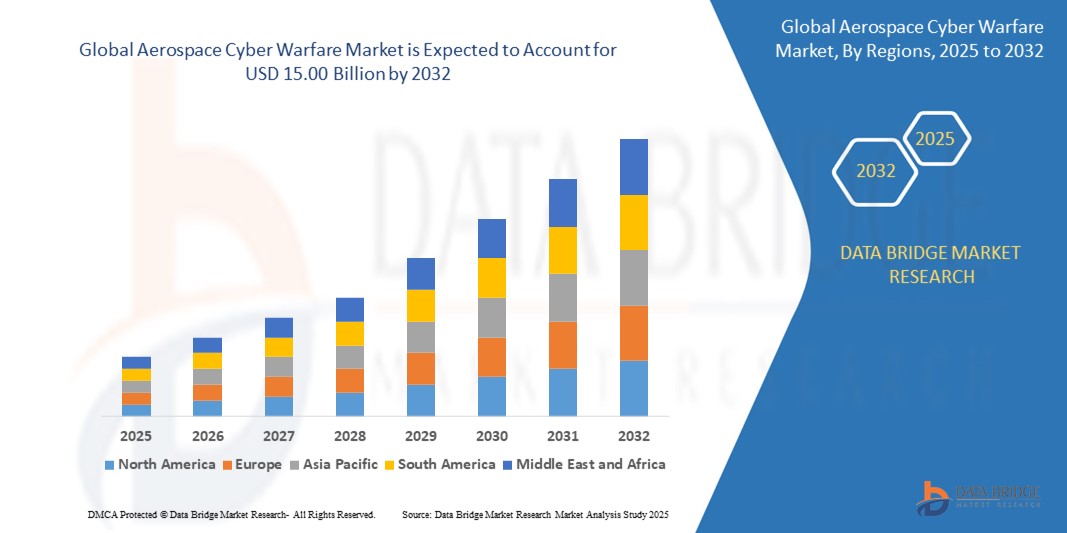
- The global aerospace cyber warfare market size was valued at USD 4.33 billion in 2024 and is expected to reach USD 15.00 billion by 2032, at a CAGR of 16.80% during the forecast period
- The market growth is largely fuelled by the rising incidence of cyber threats targeting military aircraft, satellites, and aerospace communication systems, along with increasing government defense budgets and demand for secure aerospace networks
- Rapid advancements in artificial intelligence, machine learning, and blockchain are playing a critical role in developing sophisticated cyber defense systems tailored for aerospace applications, further accelerating market expansion
Aerospace Cyber Warfare Market Analysis
- The growing integration of digital systems and Internet of Things (IoT) technologies in aerospace operations has elevated the risk of cyberattacks, prompting significant investments in cybersecurity solutions
- Military and defense agencies are focusing on strengthening cybersecurity frameworks across avionics, command and control systems, and satellite communications, driving the adoption of advanced threat detection and response platforms
- North America dominated the aerospace cyber warfare market with the largest revenue share in 2024, driven by increasing investments in defense modernization, sophisticated cyber threat landscapes, and the presence of leading aerospace and cybersecurity firms
- Asia-Pacific region is expected to witness the highest growth rate in the global aerospace cyber warfare market, driven by surging military expenditures, increasing adoption of advanced aerospace systems, and strategic government initiatives aimed at cyber securing both civil and military aviation and space programs across key economies such as China, Japan, India, and South Korea
- The solutions segment dominated the market with the largest market revenue share in 2024, driven by heightened demand for cyber defense platforms, intrusion detection systems, and secure network communication tools across both military and commercial aerospace operations. The growing sophistication of cyber threats targeting command-and-control systems, avionics, and satellite infrastructure continues to push defense agencies and aerospace firms to invest heavily in integrated cybersecurity solutions. The segment also benefits from the need for mission-critical, real-time threat analysis and the adoption of artificial intelligence-driven monitoring systems to ensure resilient aerospace operations
Report Scope and Aerospace Cyber Warfare Market Segmentation
|
Attributes |
Aerospace Cyber Warfare Key Market Insights |
|
Segments Covered |
|
|
Countries Covered |
North America
Europe
Asia-Pacific
Middle East and Africa
South America
|
|
Key Market Players |
|
|
Market Opportunities |
• Rising Adoption of AI-Based Threat Detection in Aerospace Systems • Increasing Investments in Cybersecurity Infrastructure by Defense Agencies |
|
Value Added Data Infosets |
In addition to the market insights such as market value, growth rate, market segments, geographical coverage, market players, and market scenario, the market report curated by the Data Bridge Market Research team includes in-depth expert analysis, import/export analysis, pricing analysis, production consumption analysis, and pestle analysis. |
Aerospace Cyber Warfare Market Trends
“Integration of Artificial Intelligence and Machine Learning in Cyber Defense Operations”
- The integration of artificial intelligence and machine learning in cyber warfare systems is transforming threat detection and response strategies by enabling real-time pattern recognition, predictive analytics, and anomaly identification within mission-critical aerospace platforms
- The increasing convergence of satellite-based communications with cloud networks and edge computing is creating a new cyber frontier that demands enhanced perimeter defense and secure data relay protocols for space-to-ground and inter-satellite links
- Adoption of zero-trust architecture is growing in aerospace cybersecurity strategies as organizations move toward granular access controls and identity verification to prevent lateral movement of threats across systems
- For instance, Lockheed Martin and the U.S. Space Force have collaborated on AI-powered cyber intelligence solutions to secure satellite networks and early warning systems, demonstrating the growing industry focus on next-gen proactive threat management
- As digitalization accelerates across air and space assets, the emphasis on intelligent, predictive, and adaptive cybersecurity frameworks will define the future trajectory of the aerospace cyber warfare market
Aerospace Cyber Warfare Market Dynamics
Driver
“Increasing Cyber Threats Targeting Aerospace Infrastructure”
• The increasing volume and sophistication of cyberattacks targeting aerospace systems is compelling governments and private firms to invest heavily in robust cyber defense solutions that can safeguard command, control, and navigation infrastructure
• Nation-state threat actors and advanced persistent threats (APTs) are leveraging backdoor intrusions, supply chain vulnerabilities, and ransomware to disrupt satellite, drone, and flight control systems, driving demand for high-resilience cybersecurity
• Regulatory frameworks such as NIST, GDPR, and military cybersecurity mandates are forcing aerospace stakeholders to implement layered security protocols that ensure data integrity and operational continuity across defense platforms
• For instance, the European Space Agency has launched dedicated initiatives to protect its Galileo system from cyberattacks, showcasing how critical national assets are now central to cyber defense policies
• As global aerospace systems become more interconnected and data-reliant, the pressure to deploy comprehensive cybersecurity solutions will intensify, establishing cyber warfare as a foundational element of aerospace modernization programs
Restraint/Challenge
“High Cost and Complexity of Cybersecurity Integration in Legacy Aerospace Systems”
• Legacy aerospace systems pose major integration challenges as they lack native cyber protection layers, making it complex and costly to retrofit new security technologies without disrupting operational functionality, and these systems often rely on outdated protocols that are incompatible with modern cybersecurity architectures, increasing their vulnerability to sophisticated attacks
• High costs associated with system redesigns, software compatibility, and cybersecurity personnel training are deterring small and mid-size defense operators from upgrading outdated infrastructure, as limited budgets and unclear return on investment reduce the willingness to undertake large-scale modernization efforts
• The shortage of aerospace-specific cybersecurity talent combined with resistance to downtime during implementation is further slowing the adoption of advanced cyber protection measures, especially in mission-critical operations where any interruption can compromise national security or delay high-priority projects
• For instance, government-led modernization efforts in parts of Asia-Pacific have faced multi-year delays due to technical bottlenecks in integrating cybersecurity frameworks with legacy satellite systems, with several countries reporting project postponements because of inadequate integration tools, personnel shortages, and system reliability concerns
• Unless scalable, cost-effective retrofitting solutions are developed and supported by training programs and incentives, cybersecurity implementation in older aerospace platforms will remain a significant market restraint as many organizations continue to operate vulnerable infrastructure under increasing threat exposure
Aerospace Cyber Warfare Market Scope
The market is segmented on the basis of component and deployment type.
- By Component
On the basis of component, the aerospace cyber warfare market is segmented into solutions and services. The solutions segment dominated the market with the largest market revenue share in 2024, driven by heightened demand for cyber defense platforms, intrusion detection systems, and secure network communication tools across both military and commercial aerospace operations. The growing sophistication of cyber threats targeting command-and-control systems, avionics, and satellite infrastructure continues to push defense agencies and aerospace firms to invest heavily in integrated cybersecurity solutions. The segment also benefits from the need for mission-critical, real-time threat analysis and the adoption of artificial intelligence-driven monitoring systems to ensure resilient aerospace operations.
The services segment is expected to witness the fastest growth rate from 2025 to 2032, fuelled by increasing reliance on third-party vendors for cybersecurity consulting, system integration, training, and ongoing threat response. Organizations across the aerospace ecosystem are increasingly outsourcing their cybersecurity needs to specialized service providers in order to keep pace with evolving threat vectors and regulatory compliance standards. The demand for managed detection and response (MDR), vulnerability assessment, and continuous monitoring services is growing rapidly among both government and private aerospace contractors.
- By Deployment Type
On the basis of deployment type, the aerospace cyber warfare market is segmented into on-premises and cloud. The on-premises segment held the largest market revenue share in 2024, primarily due to the need for high levels of data confidentiality, control, and physical security in military and aerospace defense environments. On-premises deployment enables sensitive command systems, air traffic control data, and satellite communication frameworks to remain within secure infrastructures that meet stringent national security standards. Many government agencies and aerospace defense organizations prefer on-premises architecture to ensure full sovereignty over their cyber operations and infrastructure
The cloud segment is expected to witness the fastest growth rate from 2025 to 2032, driven by its scalability, cost-efficiency, and ability to support remote operations and distributed networks. Cloud deployment is becoming increasingly attractive for commercial aerospace firms and space technology startups that require flexible cybersecurity solutions without the burden of maintaining extensive on-site infrastructure. The adoption of cloud-native cybersecurity platforms, automated threat detection, and secure cloud communications is accelerating across the aerospace supply chain, particularly in research, design, and simulation operations.
Aerospace Cyber Warfare Market Regional Analysis
• North America dominated the aerospace cyber warfare market with the largest revenue share in 2024, driven by increasing investments in defense modernization, sophisticated cyber threat landscapes, and the presence of leading aerospace and cybersecurity firms
• The region benefits from a high concentration of aerospace defense contractors and ongoing governmental initiatives that emphasize cyber readiness and the integration of resilient technologies across aerial, space, and ground platforms
• The United States, in particular, plays a critical role in driving the region’s leadership, with strong funding for cyber warfare programs and collaborations between military, private, and academic institutions to develop advanced defense-grade solutions
U.S. Aerospace Cyber Warfare Market Insight
The U.S. aerospace cyber warfare market held the largest share in North America in 2024, driven by robust Department of Defense funding and extensive public-private partnerships focused on securing air and space-based assets. Rising concerns over satellite hacking, drone signal interference, and cyber-physical attacks have accelerated the adoption of AI-driven threat detection and defense systems. Continuous investments in cybersecurity frameworks, such as the Zero Trust model and digital twin technologies, are also contributing to the market's rapid expansion
Europe Aerospace Cyber Warfare Market Insight
The Europe aerospace cyber warfare market is expected to witness the fastest growth rate from 2025 to 2032, propelled by increased geopolitical tensions, a renewed focus on space defense, and enhanced cybersecurity mandates across the European Union. Several countries are investing in the integration of cyber shields in their air and missile defense networks, and collaborating through NATO and bilateral programs to standardize resilience across allied aerospace fleets. In addition, a growing number of aerospace OEMs in the region are embedding native cybersecurity in their product development lifecycles
U.K. Aerospace Cyber Warfare Market Insight
The U.K. aerospace cyber warfare market is expected to witness the fastest growth rate from 2025 to 2032, supported by national initiatives aimed at strengthening cyber defenses in critical aerospace infrastructures. The Ministry of Defence has prioritized the integration of cyber capabilities into both legacy and next-generation platforms, while local companies are investing in threat intelligence and intrusion prevention systems. As part of its National Cyber Strategy, the U.K. is also enhancing aerospace-related research and innovation ecosystems in cyber resilience
Germany Aerospace Cyber Warfare Market Insight
Germany's aerospace cyber warfare market is expected to witness the fastest growth rate from 2025 to 2032, driven by heightened cyber threat awareness, industrial digitization, and cross-sector collaborations to protect aerospace systems. The country is modernizing its cyber defense posture within both civilian and military aerospace domains, with efforts focused on secure satellite communication, avionics hardening, and AI-enhanced monitoring tools. German initiatives to establish sovereign cyber capabilities through programs such as GAIA-X are further amplifying the market’s potential
Asia-Pacific Aerospace Cyber Warfare Market Insight
The Asia-Pacific aerospace cyber warfare market is expected to witness the fastest growth rate from 2025 to 2032, fueled by rising defense expenditures, technological advancement, and increased focus on cyber readiness in countries such as China, Japan, South Korea, and India. Regional governments are strengthening policies around aerospace security and investing in indigenous cyber-defense technologies for both commercial and military aerospace sectors. The rapid expansion of aviation infrastructure and smart defense ecosystems is further bolstering adoption
China Aerospace Cyber Warfare Market Insight
China’s aerospace cyber warfare market captured the largest share within Asia-Pacific in 2024, supported by massive state-led investments in cybersecurity infrastructure and next-generation aerospace programs. The country is integrating advanced cyber capabilities into its satellite constellations, unmanned aerial systems, and military aircraft, while promoting public-private partnerships to localize innovation. China’s strategy to attain cyber sovereignty and leadership in AI-driven warfare tools continues to drive growth across the sector
Japan Aerospace Cyber Warfare Market Insight
Japan's aerospace cyber warfare market is expected to witness the fastest growth rate from 2025 to 2032, driven by rising concerns over foreign cyber threats targeting its aerospace and satellite systems. The government has implemented strict cybersecurity standards for its aviation sector and is promoting cyber hardening of critical systems such as satellite communications and navigation platforms. Investments in quantum cryptography, AI-enabled analytics, and cross-ministerial cyber coordination are enhancing Japan's defensive capabilities and boosting its market footprint
Aerospace Cyber Warfare Market Share
The Aerospace Cyber Warfare industry is primarily led by well-established companies, including:
- Cisco Systems, Inc. (U.S.)
- IBM (U.S.)
- RTX (U.S.)
- Northrop Grumman (U.S.)
- Lockheed Martin Corporation (U.S.)
- Boeing (U.S.)
- General Dynamics Corporation (U.S.)
- BAE Systems (U.K.)
- AIRBUS (France)
- Leonardo S.p.A. (Italy)
- Honeywell International, Inc. (U.S.)
- Thales (France)
- Collins Aerospace (U.S.)
- Palo Alto Networks (U.S.)
- F-Secure (Finland)
- L3Harris Technologies, Inc. (U.S.)
- Comcast Technology Solutions (U.S.)
- Qualys, Inc. (U.S.)
- Accenture (Ireland)
Latest Developments in Global Aerospace Cyber Warfare Market
- In January 2023, The Aerospace Corporation introduced the Space Attack Research and Tactic Analysis (SPARTA) framework designed to identify specific threats that hackers may present to space systems. This innovative framework aims to enhance understanding of potential vulnerabilities within space infrastructure and devise effective countermeasures. By focusing on the unique challenges posed by cyberattacks in the space domain, SPARTA seeks to improve the security and resilience of aerospace operations. The initiative underscores the increasing importance of cybersecurity in safeguarding critical space assets from evolving threats

- Interactive Data Analysis Dashboard
- Company Analysis Dashboard for high growth potential opportunities
- Research Analyst Access for customization & queries
- Competitor Analysis with Interactive dashboard
- Latest News, Updates & Trend analysis
- Harness the Power of Benchmark Analysis for Comprehensive Competitor Tracking
Data collection and base year analysis are done using data collection modules with large sample sizes. The stage includes obtaining market information or related data through various sources and strategies. It includes examining and planning all the data acquired from the past in advance. It likewise envelops the examination of information inconsistencies seen across different information sources. The market data is analysed and estimated using market statistical and coherent models. Also, market share analysis and key trend analysis are the major success factors in the market report. To know more, please request an analyst call or drop down your inquiry.
The key research methodology used by DBMR research team is data triangulation which involves data mining, analysis of the impact of data variables on the market and primary (industry expert) validation. Data models include Vendor Positioning Grid, Market Time Line Analysis, Market Overview and Guide, Company Positioning Grid, Patent Analysis, Pricing Analysis, Company Market Share Analysis, Standards of Measurement, Global versus Regional and Vendor Share Analysis. To know more about the research methodology, drop in an inquiry to speak to our industry experts.
Data Bridge Market Research is a leader in advanced formative research. We take pride in servicing our existing and new customers with data and analysis that match and suits their goal. The report can be customized to include price trend analysis of target brands understanding the market for additional countries (ask for the list of countries), clinical trial results data, literature review, refurbished market and product base analysis. Market analysis of target competitors can be analyzed from technology-based analysis to market portfolio strategies. We can add as many competitors that you require data about in the format and data style you are looking for. Our team of analysts can also provide you data in crude raw excel files pivot tables (Fact book) or can assist you in creating presentations from the data sets available in the report.