


What is the Aerospace Metal Matrix Composites (MMC) Market Size and Growth Rate?
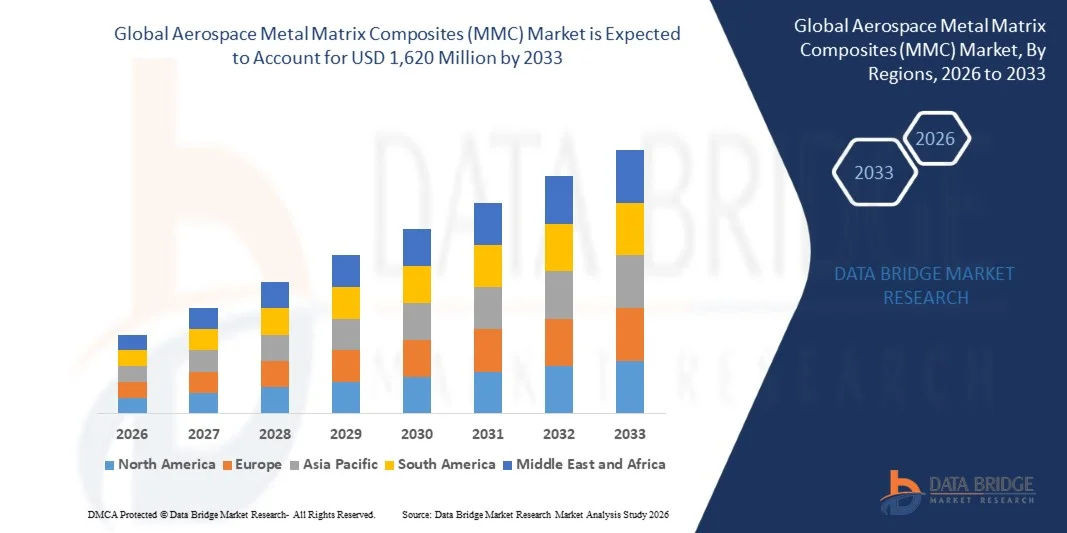
- As per Data Bridge Market Research analysis, the aerospace metal matrix composites (MMC) market was valued at USD 780 million in 2025 and is projected to reach USD 1,620 million by 2033, growing at a CAGR of 11.40% from 2026 to 2033.
- The market is experiencing consistent growth driven by rising demand for lightweight, high-strength structural and thermal-management materials in next-generation aircraft, rapid advancements in liquid-state, solid-state, and additive manufacturing processing technologies, and expanding applications across aero-engine, airframe, and spacecraft component production.
- The increasing focus on fuel efficiency and payload optimization across commercial and military aircraft programs, combined with stricter defense procurement requirements for high-temperature and damage-tolerant structural materials, is compelling aircraft OEMs, aero-engine manufacturers, and defense agencies to adopt aerospace metal matrix composites. Aluminum- and titanium-based MMCs reinforced with silicon carbide and carbon-based fibres are replacing conventional metallic alloys in many programs, offering superior specific strength, thermal stability, and dimensional stability for demanding aerospace and defense applications.
Market Size & Forecast
- Global Market Value (2025): USD 780 million
- Expected Market Value (2033): USD 1,620 million
- Forecast CAGR (2026–2033): 11.40%
- Leading Region in 2025: North America
- Fastest Growing Region: Asia-Pacific
What are the Major Takeaways of the Aerospace Metal Matrix Composites (MMC) Market?
- North America dominated the global aerospace metal matrix composites (MMC) market in 2025, supported by the strong presence of established aircraft OEMs, aero-engine manufacturers, and defense agencies, along with extensive qualification and long-term supply programs for advanced structural materials.
- Asia-Pacific is expected to be the fastest-growing region during the forecast period, fueled by expanding commercial aircraft manufacturing capacity, increasing indigenous defense aircraft and UAV programs, and growing investments in advanced materials research across China, Japan, and India.
- The aluminum matrix composites segment dominated the market by matrix material, driven by its widespread use in airframe, landing gear, and aircraft interior components due to its favorable balance of lightweight properties, cost-effectiveness, and processing maturity.
- The titanium matrix composites segment is expected to witness the fastest growth by matrix material, reflecting rising adoption in high-temperature aero-engine and hypersonic vehicle applications where superior strength-to-weight and thermal performance are critical.
- The silicon carbide segment dominated the market by reinforcement material, owing to its extensive use across particle- and fibre-reinforced MMC systems for structural and thermal-management aerospace components.
- The aero-engine components segment dominated the market by component and application, led by widespread adoption of MMCs in compressor, turbine, and casing components requiring high-temperature strength and dimensional stability.
Report Scope and Aerospace Metal Matrix Composites (MMC) Market Segmentation
|
Attributes |
Aerospace MMC Key Market Insights |
|
Segments Covered |
|
|
Countries Covered |
North America
Europe
Asia-Pacific
South America
Middle East and Africa
|
|
Key Market Players |
|
|
Market Opportunities |
|
|
Value Added Data Infosets |
In addition to insights on market value, growth rate, segmentation, geographic coverage, and major players, reports curated by Data Bridge Market Research also include in-depth expert analysis, geographically represented company-wise production and capacity, distributor and partner network layouts, detailed and updated price trend analysis, and deficit analysis of supply and demand. |
What is the Key Trend in the Aerospace Metal Matrix Composites (MMC) Market?
- Leading advanced materials companies are increasingly securing qualification programs and long-term supply agreements with aircraft OEMs and prime contractors to broaden their aerospace MMC portfolios, secure program-of-record demand, and reduce the cost and risk associated with material qualification cycles for new aircraft platforms.
- For instance, in April 2025, Materion Corporation announced that its SupremEX metal matrix composite would be supplied for components on the U.S. Army’s Future Long-Range Assault Aircraft (FLRAA) tiltrotor prototypes, following selection by Bell Textron Inc., strengthening Materion’s position as a qualified MMC supplier for next-generation military rotorcraft programs.
- Real-time material qualification and testing protocols enable aerospace manufacturers to analyze thermal stability, fatigue resistance, and dimensional tolerance with high precision during MMC component development.
- Aero-engine and airframe manufacturers are leveraging additive manufacturing and near-net-shape processing of MMCs to provide standardized, weight-optimized components for commercial and defense aircraft programs.
- For instance, in April 2025, Mitsubishi Materials Corporation unveiled a new metal matrix composite offering high thermal conductivity and low thermal expansion, developed via powder metallurgy to balance thermal performance and manufacturability for thermal-management applications.
- As aircraft OEMs and defense agencies continue to prioritize lightweighting and high-temperature performance, the adoption of advanced aerospace metal matrix composites is expected to accelerate, reinforcing MMCs as a core material technology in next-generation aerospace and defense structural and thermal-management applications.
What are the Key Drivers of the Aerospace Metal Matrix Composites (MMC) Market?
- The rapid advancement of defense modernization programs and next-generation aircraft development has significantly increased demand for high-performance metal matrix composites capable of meeting stringent weight, strength, and thermal-management requirements across military and commercial aerospace platforms.
- For instance, in July 2025, CPS Technologies Corporation was awarded its fourth Small Business Innovation Research (SBIR) contract of the year, a U.S. Navy Phase I award focused on reducing the weight of the Amphibious Combat Vehicle (ACV) through redesigned lightweight metal matrix composite components, underscoring the growing role of MMCs in defense platform weight-reduction programs.
- Aircraft OEMs, aero-engine manufacturers, and defense agencies are integrating aerospace metal matrix composites into their component development programs to reduce structural weight, extend component life, and enhance thermal and dimensional performance.
- For instance, in October 2023, Materion Corporation was awarded a USD 5 million contract from the United States Air Force Research Laboratory to expand its research and development of additive manufacturing for beryllium and aluminum-beryllium alloys, supporting advanced optics structures, guidance systems, and thermal-management applications for defense and aerospace markets.
- With the aerospace and defense industry increasingly relying on lightweight, high-temperature-capable materials to accelerate performance gains and ensure mission readiness, aerospace metal matrix composites will remain indispensable for the development of next-generation aircraft, spacecraft, and defense platforms.
Which Factors are Challenging the Growth of the Aerospace Metal Matrix Composites (MMC) Market?
- Aerospace metal matrix composite production requires significant investment due to the complexity of liquid-state, solid-state, and deposition processing routes, along with the need for specialized reinforcement materials, precision machining, and extensive qualification testing infrastructure.
- These high costs and lengthy qualification cycles limit adoption among smaller component manufacturers and emerging aerospace supply chains.
- For instance, industry consolidation activity such as the Plansee Group’s acquisition of Mi-Tech Tungsten Metals, completed in November 2022 following a review process that spanned more than a year with federal regulatory authorities, illustrates the extended timelines, regulatory scrutiny, and capital requirements associated with scaling specialized refractory and composite material supply capacity for aerospace and defense applications.
- The high capital investment and extended qualification timelines associated with aerospace metal matrix composite production continue to restrict adoption, particularly among smaller Tier 2 and Tier 3 component manufacturers. This barrier slows market penetration in price-sensitive and emerging aerospace supply chains, limiting the widespread deployment of advanced MMC processing infrastructure despite growing program demand.
How is the Aerospace Metal Matrix Composites (MMC) Market Segmented?
The aerospace metal matrix composites (MMC) market is segmented on the basis of matrix material, reinforcement material, reinforcement form, manufacturing process, product form, aircraft and aerospace platform, component and application, functional requirement, end user, and sales channel.
- By Matrix Material
On the basis of matrix material, the global aerospace metal matrix composites (MMC) market is segmented into aluminum matrix composites, titanium matrix composites, magnesium matrix composites, nickel matrix composites, copper matrix composites, cobalt matrix composites, iron and steel matrix composites, refractory metal matrix composites, and intermetallic matrix composites. The aluminum matrix composites segment dominated the market, owing to its favorable balance of lightweight properties, cost-effectiveness, and established processing routes, making it the preferred choice across airframe, landing gear, and aircraft interior structural components.
The titanium matrix composites segment is expected to witness the fastest growth, driven by rising adoption in high-temperature aero-engine, hypersonic vehicle, and advanced structural applications where superior specific strength and thermal performance are essential.
- By Reinforcement Material
On the basis of reinforcement material, the global aerospace metal matrix composites (MMC) market is segmented into silicon carbide, aluminum oxide/alumina, carbon-based reinforcement, boron-based reinforcement, carbide reinforcement, nitride reinforcement, oxide reinforcement, metallic and intermetallic reinforcement, and hybrid reinforcement. The silicon carbide segment dominated the market, supported by its extensive use across particle- and fibre-reinforced MMC systems for structural and thermal-management components requiring high stiffness and wear resistance.
The carbon-based reinforcement segment is expected to experience the fastest growth, driven by increasing adoption of carbon fibre and graphene-reinforced MMC systems in weight-critical airframe and satellite structural applications.
- By Reinforcement Form
On the basis of reinforcement form, the global aerospace metal matrix composites (MMC) market is segmented into particle-reinforced MMCs, short-fibre-reinforced MMCs, continuous-fibre-reinforced MMCs, whisker-reinforced MMCs, wire-reinforced MMCs, flake-reinforced MMCs, layered/laminar MMCs, preform-reinforced MMCs, and nanostructure-reinforced MMCs. The particle-reinforced MMCs segment dominated the market due to its widespread adoption in structural and thermal-management components, supported by mature, cost-effective processing routes and design flexibility across multiple platforms.
The continuous-fibre-reinforced MMCs segment is expected to witness the fastest growth, driven by increasing demand for high-strength, high-stiffness reinforcement architectures in next-generation aero-engine and structural applications.
- By Manufacturing Process
On the basis of manufacturing process, the global aerospace metal matrix composites (MMC) market is segmented into liquid-state processing, solid-state processing, deposition processing, fibre lay-up and consolidation, additive manufacturing, in-situ reaction processing, semi-solid processing, forging and extrusion, and joining and secondary consolidation. The liquid-state processing segment dominated the market, supported by its established, cost-effective, and scalable production routes for aluminum- and magnesium-based MMC components across commercial and defense aerospace programs.
The additive manufacturing segment is expected to witness the fastest growth, driven by increasing adoption of near-net-shape and geometrically complex MMC component production, enabling reduced material waste and faster qualification cycles for advanced aerospace applications.
- By Product Form
On the basis of product form, the global aerospace metal matrix composites (MMC) market is segmented into powders and feedstock, billets, ingots, plates, sheets, foils, bars and rods, tubes and pipes, wires, tapes and monotapes, preforms, near-net-shaped components, fully machined components, and coatings and surface layers. The fully machined components segment dominated the market, supported by strong demand for ready-to-install, precision-finished MMC parts across aero-engine, airframe, and structural applications.
The near-net-shaped components segment is expected to witness the fastest growth, driven by increasing adoption of advanced processing and additive manufacturing routes that reduce machining time, material waste, and overall component lead time.
- By Aircraft and Aerospace Platform
On the basis of aircraft and aerospace platform, the global aerospace metal matrix composites (MMC) market is segmented into commercial fixed-wing aircraft, rotary-wing aircraft, military fixed-wing aircraft, unmanned aerial vehicles, spacecraft, launch vehicles, missiles and guided systems, advanced air mobility platforms, and airport ground support equipment. The commercial fixed-wing aircraft segment dominated the market, supported by high production volumes, extensive component qualification programs, and growing adoption of lightweight materials to improve fuel efficiency across narrow-body and wide-body aircraft fleets.
The advanced air mobility platforms segment is expected to witness the fastest growth, driven by rising development of electric vertical take-off and landing aircraft and hybrid-electric platforms that require lightweight, thermally efficient structural and propulsion materials.
- By Component and Application
On the basis of component and application, the global aerospace metal matrix composites (MMC) market is segmented into aero-engine components, auxiliary power unit components, airframe and structural components, landing gear and braking components, propulsion and propeller components, aircraft interior components, avionics and electronic packaging, spacecraft and satellite components, launch-vehicle and missile components, and ground support equipment components. The aero-engine components segment dominated the market, led by widespread adoption of MMCs in compressor, turbine, and casing components requiring high-temperature strength, dimensional stability, and wear resistance.
The avionics and electronic packaging segment is expected to witness the fastest growth, driven by rising demand for lightweight, high-thermal-conductivity heat sinks, housings, and substrates that support increasingly compact and power-dense avionics and radar systems.
- By Functional Requirement
On the basis of functional requirement, the global aerospace metal matrix composites (MMC) market is segmented into lightweight structural performance, high-temperature performance, thermal management, wear and friction resistance, dimensional stability, damage tolerance, corrosion and environmental resistance, radiation and shielding performance, ballistic and protective performance, and multifunctional performance. The lightweight structural performance segment dominated the market, supported by its central role in airframe, landing gear, and structural bracket applications where specific strength and stiffness directly influence overall aircraft fuel efficiency.
The thermal management segment is expected to witness the fastest growth, driven by increasing demand for high-thermal-conductivity, low-coefficient-of-expansion materials in avionics, radar, and power-electronic packaging applications.
- By End User
On the basis of end user, the global aerospace metal matrix composites (MMC) market is segmented into commercial aircraft OEMs, military aircraft OEMs, helicopter OEMs, turboprop aircraft OEMs, business and general aviation OEMs, aero-engine manufacturers, auxiliary power unit manufacturers, aircraft seating manufacturers, aircraft interior-system manufacturers, avionics and electronic-system manufacturers, satellite manufacturers, launch-vehicle manufacturers, missile and defence-system manufacturers, unmanned aerial vehicle manufacturers, airport ground support equipment manufacturers, tier 1 aerospace component manufacturers, tier 2 and tier 3 precision component manufacturers, maintenance repair and overhaul organizations, government space and defence agencies, and research and technology organizations. The commercial aircraft OEMs segment dominated the market, supported by large-scale production programs, established supplier qualification frameworks, and continued adoption of lightweight materials to meet fuel-efficiency and emissions targets.
The unmanned aerial vehicle manufacturers segment is expected to witness the fastest growth, driven by rising production of both military and commercial UAV platforms that require lightweight, high-strength structural and thermal-management materials to maximize payload and endurance.
- By Sales Channel
On the basis of sales channel, the global aerospace metal matrix composites (MMC) market is segmented into direct sales, long-term supply agreements, joint development and qualification programs, build-to-print manufacturing contracts, build-to-specification manufacturing contracts, licensed manufacturing, captive/in-house production, aerospace material service centres, specialized engineering and component integrators, and aftermarket and MRO contracts. The long-term supply agreements segment dominated the market, supported by aircraft OEMs and prime contractors favoring qualified, program-of-record suppliers to ensure consistent material quality and supply continuity across multi-year aircraft production programs.
The joint development and qualification programs segment is expected to witness the fastest growth, driven by increasing collaboration between advanced materials companies and aircraft OEMs to co-develop and qualify new MMC formulations for emerging platforms such as advanced air mobility and hypersonic systems.
Which Region Holds the Largest Share of the Aerospace Metal Matrix Composites (MMC) Market?
- North America dominated the aerospace metal matrix composites (MMC) market in 2025, supported by the strong presence of established aircraft OEMs, aero-engine manufacturers, and defense agencies, along with well-developed material qualification frameworks and long-term supply programs.
- The region also benefits from substantial defense modernization spending, robust aerospace R&D infrastructure, and growing use of MMCs across commercial, military, and space platforms. Increasing focus on lightweighting and next-generation aircraft development continues to strengthen North America’s leadership position in the global market.
U.S. Aerospace Metal Matrix Composites (MMC) Market Insight
The U.S. aerospace metal matrix composites (MMC) market is experiencing steady growth, supported by rising adoption of lightweight materials in commercial aircraft, military rotorcraft, and defense platform development programs. Increasing investments in advanced materials research and growing demand for cost-effective, qualification-ready MMC solutions are contributing to market growth. Furthermore, integration of additive manufacturing, advanced processing technologies, and strong defense procurement programs is improving component performance and positioning the U.S. as a key innovation hub in the aerospace MMC industry.
Germany Aerospace Metal Matrix Composites (MMC) Market Insight
The Germany aerospace metal matrix composites (MMC) market is expanding steadily due to the country’s strong aerospace manufacturing base, advanced materials research capabilities, and increasing adoption of next-generation processing technologies. Aircraft component manufacturers, aero-engine producers, and research institutes are increasingly utilizing MMCs for precision structural and thermal-management applications, quality-driven component development, and R&D activities. Continuous advancements in processing technology, reinforcement material integration, and sustainable production formulations, along with strong government focus on aerospace innovation, are further driving market growth in Germany.
Asia-Pacific Aerospace Metal Matrix Composites (MMC) Market Insight
The Asia-Pacific aerospace metal matrix composites (MMC) market is expected to witness rapid growth, driven by expanding commercial aircraft manufacturing capacity, increasing indigenous defense aircraft and UAV programs, and rising investments in advanced materials infrastructure across countries such as China, Japan, and India. Growing awareness regarding lightweighting and fuel-efficiency benefits, rising adoption of advanced processing technologies, and increasing demand for scalable and cost-effective structural material solutions are supporting regional market expansion. Additionally, the growing presence of commercial and defense aerospace manufacturing hubs is accelerating MMC adoption across the region.
Japan Aerospace Metal Matrix Composites (MMC) Market Insight
The Japan aerospace metal matrix composites (MMC) market is witnessing consistent growth due to rising investments in advanced materials technologies, aero-engine component development, and precision manufacturing initiatives. Aircraft component manufacturers, materials companies, and research institutes are increasingly adopting high-performance MMCs for precision structural and thermal-management applications, component life extension, and R&D purposes. Moreover, increasing integration of powder metallurgy and advanced reinforcement technologies and the country’s focus on precision manufacturing are further contributing to market growth.
China Aerospace Metal Matrix Composites (MMC) Market Insight
The China aerospace metal matrix composites (MMC) market is growing rapidly, driven by increasing domestic commercial aircraft production, expanding defense aerospace programs, and rising government focus on advanced materials self-sufficiency. Growing adoption of lightweight, high-performance structural materials across commercial, military, and space platforms is significantly boosting market demand. In addition, rising investments in aerospace materials R&D, increasing awareness regarding fuel-efficiency and payload optimization, and rapid technological advancements are positioning China as one of the fastest-growing markets for aerospace metal matrix composites globally.
Which are the Top Companies in Aerospace Metal Matrix Composites (MMC) Market?
The aerospace metal matrix composites (MMC) industry is primarily led by well-established companies, including:
- Materion Corporation (U.S.)
- CPS Technologies Corporation (U.S.)
- DWA Aluminum Composites USA, Inc. (U.S.)
- TISICS Ltd. (U.K.)
- Elementum 3D, Inc. (U.S.)
- Gamma Alloys, Inc. (U.S.)
- Fortius Metals, Inc. (U.S.)
- Touchstone Research Laboratory, Ltd. (U.S.)
- FMW Composite Systems, Inc. (U.S.)
- Denka Company Limited (Japan)
- Ferrotec Holdings Corporation (Japan)
- Sumitomo Electric Industries, Ltd. (Japan)
- Japan Fine Ceramics Co., Ltd. (Japan)
- Schunk Carbon Technology GmbH (Germany)
- Coherent Corp. – M Cubed Technologies (U.S.)
- CeramTec GmbH (Germany)
- Plansee SE (Austria)
- A.L.M.T. Corp. (Japan)
- Proterial, Ltd. (Japan)
- H.C. Starck Solutions (Germany)
- Elmet Technologies LLC (U.S.)
- Mi-Tech Tungsten Metals, LLC (U.S.)
- Nippon Tungsten Co., Ltd. (Japan)
- Mitsubishi Materials Corporation (Japan)
- Oerlikon Metco (Switzerland)
- Hyperion Materials & Technologies (U.S.)
- Ceratizit S.A. (Luxembourg)
- Kennametal Inc. (U.S.)
- Sandvik AB (Sweden)
- Kyocera Corporation (Japan)
What are Latest Developments in Aerospace Metal Matrix Composites (MMC) Market?
- In April 2025, Materion Corporation announced that its SupremEX metal matrix composite would be supplied for components on the U.S. Army’s Future Long-Range Assault Aircraft (FLRAA) tiltrotor prototypes, following selection by Bell Textron Inc., a Textron Inc. company responsible for the FLRAA design and prototype construction. The development strengthens Materion’s position as a qualified MMC supplier for next-generation military rotorcraft programs.
- In July 2025, CPS Technologies Corporation secured its fourth Small Business Innovation Research (SBIR) contract of the year, a U.S. Navy Phase I award focused on reducing the weight of the Amphibious Combat Vehicle (ACV) through redesigned metal matrix composite armor, suspension, and hatch components, reinforcing the company’s growing role in defense platform lightweighting programs.
- In April 2025, Mitsubishi Materials Corporation unveiled a new metal matrix composite offering high thermal conductivity and low thermal expansion, developed via powder metallurgy to balance thermal performance and manufacturability for electronics and thermal-management applications.
- In October 2023, Materion Corporation was awarded a USD 5 million contract from the United States Air Force Research Laboratory to expand its research and development of additive manufacturing for beryllium and aluminum-beryllium alloys, supporting advanced optics structures, guidance systems, and thermal-management applications for defense and aerospace markets.
- In November 2022, the Plansee Group completed its acquisition of Mi-Tech Tungsten Metals, LLC, a leading U.S. manufacturer of tungsten-based composite products and components for aerospace, energy, and engineering applications, following a multi-month federal regulatory review process, strengthening Plansee’s tungsten and refractory metal composite market position in North America.

- Interactive Data Analysis Dashboard
- Company Analysis Dashboard for high growth potential opportunities
- Research Analyst Access for customization & queries
- Competitor Analysis with Interactive dashboard
- Latest News, Updates & Trend analysis
- Harness the Power of Benchmark Analysis for Comprehensive Competitor Tracking
Data collection and base year analysis are done using data collection modules with large sample sizes. The stage includes obtaining market information or related data through various sources and strategies. It includes examining and planning all the data acquired from the past in advance. It likewise envelops the examination of information inconsistencies seen across different information sources. The market data is analysed and estimated using market statistical and coherent models. Also, market share analysis and key trend analysis are the major success factors in the market report. To know more, please request an analyst call or drop down your inquiry.
The key research methodology used by DBMR research team is data triangulation which involves data mining, analysis of the impact of data variables on the market and primary (industry expert) validation. Data models include Vendor Positioning Grid, Market Time Line Analysis, Market Overview and Guide, Company Positioning Grid, Patent Analysis, Pricing Analysis, Company Market Share Analysis, Standards of Measurement, Global versus Regional and Vendor Share Analysis. To know more about the research methodology, drop in an inquiry to speak to our industry experts.
Data Bridge Market Research is a leader in advanced formative research. We take pride in servicing our existing and new customers with data and analysis that match and suits their goal. The report can be customized to include price trend analysis of target brands understanding the market for additional countries (ask for the list of countries), clinical trial results data, literature review, refurbished market and product base analysis. Market analysis of target competitors can be analyzed from technology-based analysis to market portfolio strategies. We can add as many competitors that you require data about in the format and data style you are looking for. Our team of analysts can also provide you data in crude raw excel files pivot tables (Fact book) or can assist you in creating presentations from the data sets available in the report.












