


What is the Aerospace Raw Materials Market Size and Growth Rate?
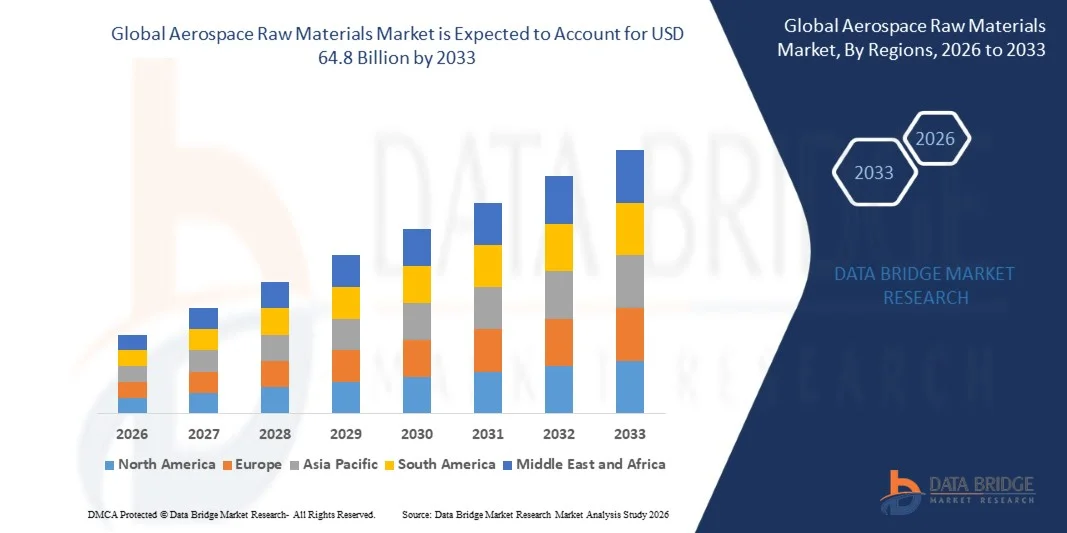
- As per Data Bridge Market Research analysis, the aerospace raw materials market was valued at USD 47.3 billion in 2025 and is projected to reach USD 64.8 billion by 2033, growing at a CAGR of 7.80% from 2026 to 2033.
- The market is experiencing consistent growth driven by rising commercial aircraft production, increasing defense modernization programs, and expanding applications of lightweight, high-strength materials across next-generation airframes, engines, and space platforms.
- The increasing production of narrow-body and wide-body commercial aircraft, combined with rising defense procurement budgets, is compelling aircraft OEMs, engine OEMs, and Tier-1 aerostructure manufacturers to secure qualified sources of aluminum, titanium, nickel-based superalloys, and composite materials. Advanced manufacturing routes such as additive manufacturing feedstock and automated fiber placement materials are increasingly complementing traditional forging, casting, and rolling processes in many markets, offering improved material efficiency, weight reduction, and design flexibility.
Market Size & Forecast
- Global Market Value (2025): USD 47.3 Billion
- Expected Market Value (2033): USD 64.8 Billion
- Forecast CAGR (2026–2033): 7.80%
- Leading Region in 2025: North America
- Fastest Growing Region: Asia-Pacific
What are the Major Takeaways of the Aerospace Raw Materials Market?
- North America dominated the global aerospace raw materials market in 2025, supported by the region's extensive commercial and military aircraft manufacturing base, strong presence of leading aluminum, titanium, and superalloy producers, and well-established defense procurement infrastructure.
- Asia-Pacific is expected to be the fastest-growing region from 2026 to 2033, fueled by expanding commercial aircraft fleets, rising domestic aerospace manufacturing programs, and growing investment in defense modernization across China, Japan, and India.
- The aluminum & aluminum alloys segment dominated the market by material type, supported by its widespread use across airframe structures, fuselage skins, and wing components owing to its favorable strength-to-weight ratio and cost efficiency.
- The composite materials segment is expected to witness the fastest growth among material types, driven by increasing adoption of carbon-fiber-reinforced polymer and other advanced composites in next-generation airframes and engine nacelles.
- The commercial aircraft segment led the market by aircraft and aerospace platform, driven by sustained narrow-body and wide-body aircraft production to meet rising global air travel demand.
- The advanced air mobility segment is expected to register the fastest growth among aircraft and aerospace platforms, driven by increasing development activity around electric and hybrid-electric VTOL aircraft.
What is the Report Scope and Segmentation of Aerospace Raw Materials Market?
|
Attributes |
Aerospace Raw Materials Key Market Insights |
|
Segments Covered |
|
|
Countries Covered |
North America
Europe
Asia-Pacific
South America
Middle East and Africa
|
|
Key Market Players |
|
|
Market Opportunities |
|
|
Value Added Data Infosets |
In addition to insights on market value, growth rate, segmentation, geographic coverage, and major players, reports curated by Data Bridge Market Research also include in-depth expert analysis, geographically represented company-wise production and capacity, distributor and partner network layouts, detailed and updated price trend analysis, and deficit analysis of supply and demand. |
What is the Key Trend in the Aerospace Raw Materials Market?
- Aerospace material producers are increasingly investing in domestic, high-purity production capacity to strengthen supply chain resilience for critical defense and aerospace applications.
- Expanded production capabilities enable manufacturers to reduce reliance on imported specialty materials while meeting stringent qualification requirements for next-generation aircraft and defense programs.
- For instance, in September 2025, Arconic Corporation commissioned a $57.5 million expansion project at its Davenport Works facility in Iowa, effectively doubling domestic production of high purity aluminum for next-generation aerospace and defense applications.
- As aircraft OEMs and defense agencies continue to prioritize supply chain security, material innovation, and weight reduction, the expansion of domestic production capacity and advanced material qualification is expected to accelerate, reinforcing raw material supply as a core enabler of next-generation aerospace platforms.
What are the Key Drivers of the Aerospace Raw Materials Market?
- The sustained recovery and growth of commercial aircraft production has significantly increased demand for qualified aluminum, titanium, and composite materials capable of meeting stringent aerospace certification standards.
- For instance, Constellium SE secured a new multi-year supply agreement with Airbus covering a wide range of aluminum alloy extrusions, including its aluminum-lithium product line, supplied from its French facilities at Issoire and Montreuil-Juigné.
- Aircraft OEMs and Tier-1 aerostructure manufacturers are increasingly qualifying advanced composite materials to reduce airframe weight, improve fuel efficiency, and meet emissions reduction targets.
- For instance, Hexcel Corporation introduced its latest Hextow carbon fiber innovation, reinforcing its position in delivering lightweight composite structures for aerospace applications.
- With the aerospace industry increasingly relying on qualified, high-performance raw materials for airframes, engines, and space platforms, aerospace raw materials will remain indispensable for both commercial and military aviation programs.
Which Factors are Challenging the Growth of the Aerospace Raw Materials Market?
- Aerospace raw material production requires significant upfront investment in specialized melting, forging, and composite processing infrastructure to meet stringent aerospace qualification and certification standards.
- These high costs, combined with long qualification cycles for new material sources, limit the ability of smaller producers to enter or expand within the aerospace raw materials supply chain.
- For instance, Carpenter Technology Corporation announced a brownfield primary and secondary melt capacity expansion to accelerate growth across its aerospace and defense, medical, and energy end markets, reflecting the substantial capital investment required to scale qualified specialty metal production.
- The high capital investment and lengthy qualification timelines associated with aerospace-grade raw materials continue to restrict adoption, particularly among smaller regional suppliers. This barrier slows market penetration in emerging aerospace manufacturing regions, limiting the widespread expansion of qualified raw material capacity despite growing demand.
How is the Aerospace Raw Materials Market Segmented?
The aerospace raw materials market is segmented on the basis of material type, product form, manufacturing/processing route, aircraft & aerospace platform, end user and distribution channel.
- By Material Type
On the basis of material type, the global aerospace raw materials market is segmented into aluminum & aluminum alloys, titanium & titanium alloys, steel & specialty steel, nickel & nickel-based superalloys, and composite materials. The aluminum & aluminum alloys segment dominates the market, owing to its extensive use across fuselage skins, wing structures, and airframe components where its favorable strength-to-weight ratio, machinability, and cost efficiency make it the preferred choice for high-volume commercial aircraft production.
The composite materials segment is witnessing the fastest growth, driven by rising adoption of carbon-fiber-reinforced polymer and other advanced composites in next-generation airframes, engine nacelles, and interior structures as manufacturers prioritize weight reduction and fuel efficiency.
- By Product Form
On the basis of product form, the global aerospace raw materials market is segmented into metallic material forms and composite material forms. The metallic material forms segment dominates the market, supported by widespread use of plate, sheet, forging stock, and extrusion products across structural airframe and engine component manufacturing.
The composite material forms segment is witnessing the fastest growth, driven by rising demand for prepreg rolls, unidirectional tapes, and woven fabrics used in automated fiber placement and automated tape laying manufacturing processes.
- By Manufacturing/Processing Route
On the basis of manufacturing/processing route, the global aerospace raw materials market is segmented into primary melting & alloying, casting processes, forging processes, rolling processes, extrusion, powder metallurgy, and composite layup processes. The forging processes segment dominates the market due to its widespread adoption for producing high-strength, fatigue-resistant structural components such as landing gear, engine discs, and structural fittings that require superior mechanical properties.
The additive manufacturing feedstock and composite layup processes are witnessing the fastest growth, driven by increasing adoption of automated fiber placement, automated tape laying, and additive manufacturing techniques that enable complex, lightweight component geometries with reduced material waste.
- By Aircraft & Aerospace Platform
On the basis of aircraft & aerospace platform, the global aerospace raw materials market is segmented into commercial aircraft, military aircraft, advanced air mobility, and space platforms. The commercial aircraft segment dominates the market, supported by sustained narrow-body and wide-body aircraft production programs among leading airframe manufacturers to meet rising global passenger and cargo air travel demand.
The advanced air mobility segment is witnessing the fastest growth, driven by increasing development and early production activity around electric VTOL, hybrid-electric VTOL, and urban air mobility aircraft as new entrants and established OEMs invest in next-generation aviation platforms.
- By End User
On the basis of end user, the global aerospace raw materials market is segmented into aircraft OEMs, engine OEMs, Tier-I aerostructure manufacturers, Tier-II & Tier-III component manufacturers, aircraft maintenance, repair and overhaul (MRO) providers, and satellite & spacecraft manufacturers. The aircraft OEMs segment dominates the market, given their central role in specifying and qualifying raw materials for airframe and structural component production across commercial and military aircraft programs.
The Tier-II & Tier-III component manufacturers segment is witnessing the fastest growth, driven by increasing outsourcing of machined and formed component production as aircraft OEMs and Tier-I suppliers expand their qualified supplier networks to support rising production rates.
- By Distribution Channel
On the basis of distribution channel, the global aerospace raw materials market is segmented into direct sales to OEMs, service center sales, authorized distributor sales, online procurement platforms, and government & defense procurement channels. The direct sales to OEMs segment dominates the market, supported by long-term supply agreements and qualified sourcing arrangements between raw material producers and major aircraft and engine manufacturers.
The government & defense procurement channels segment is witnessing the fastest growth, driven by rising defense modernization budgets and increasing direct procurement of qualified aerospace-grade materials to support military aircraft and space platform programs.
Which Region Holds the Largest Share of the Aerospace Raw Materials Market?
- North America dominated the aerospace raw materials market, supported by the region's extensive commercial and military aircraft manufacturing base, strong presence of leading aluminum, titanium, and superalloy producers, and well-established defense procurement infrastructure across the U.S. and Canada.
- The region also benefits from sustained investment in domestic material production capacity, growing reshoring of critical aerospace and defense supply chains, and continued expansion of commercial aircraft production programs. Rising investment in high-purity aluminum and advanced titanium alloy capacity continues to strengthen North America's leadership position in the global market.
U.S. Aerospace Raw Materials Market Insight
The U.S. aerospace raw materials market is experiencing steady growth, supported by the country's large commercial and military aircraft manufacturing base, expanding defense modernization programs, and increasing investment in domestic high-purity aluminum and titanium production capacity. Rising investments in melting, forging, and composite processing infrastructure are contributing to market growth. Furthermore, growing government focus on supply chain security for critical aerospace and defense materials is reinforcing the U.S. position as the leading market for aerospace raw materials.
Canada Aerospace Raw Materials Market Insight
The Canada aerospace raw materials market is expanding steadily due to the country's established aerospace manufacturing base, growing investment in advanced materials research, and increasing collaboration between raw material producers and aircraft component manufacturers. Continuous advancements in composite material processing and rising domestic aerospace program activity are further driving market growth in Canada.
Asia-Pacific Aerospace Raw Materials Market Insight
The Asia-Pacific aerospace raw materials market is expected to witness the fastest growth globally, driven by expanding commercial aircraft fleets, rising domestic aerospace manufacturing programs, and growing investment in defense modernization across China, Japan, and India. Growing awareness regarding supply chain diversification, rising adoption of advanced aerospace materials, and increasing demand for domestically produced aluminum, titanium, and composite materials are supporting regional market expansion. Additionally, the growing presence of regional aerospace OEM and component manufacturing facilities is accelerating raw material demand across the region.
China Aerospace Raw Materials Market Insight
The China aerospace raw materials market is witnessing consistent growth due to rising investments in domestic aerospace manufacturing capabilities, expanding commercial aircraft production programs, and strong government focus on aerospace and defense self-sufficiency. Material producers, Tier-I aerostructure manufacturers, and component suppliers are increasingly investing in domestic aluminum, titanium, and composite material production to reduce reliance on imported materials. Moreover, increasing integration of advanced manufacturing processes and the country's focus on efficient, resilient aerospace supply chains are further contributing to market growth.
Japan Aerospace Raw Materials Market Insight
The Japan aerospace raw materials market is growing steadily, driven by the country's strong precision engineering base, established presence of global composite material manufacturers, and rising investment in next-generation aerospace material technologies. Growing adoption of advanced composite and titanium material platforms across commercial and defense aerospace programs is significantly boosting market demand. In addition, rising investments in aerospace material R&D and increasing collaboration with global aircraft OEMs are positioning Japan as a key growth market for aerospace raw materials.
Which are the Top Companies in the Aerospace Raw Materials Market?
The aerospace raw materials industry is primarily led by well-established companies, including:
- Arconic Corporation (U.S.)
- Alcoa Corporation (U.S.)
- Constellium SE (France)
- Kaiser Aluminum Corporation (U.S.)
- Novelis Inc. (U.S.)
- Luxfer MEL Technologies (U.K.)
- ATI Inc. (U.S.)
- Carpenter Technology Corporation (U.S.)
- Titanium Metals Corporation (TIMET) (U.S.)
- VSMPO-AVISMA Corporation (Russia)
- Haynes International, Inc. (U.S.)
- Aubert & Duval (France)
- voestalpine Böhler Edelstahl GmbH & Co KG (Austria)
- Special Metals Corporation (U.S.)
- Perryman Company (U.S.)
- Materion Corporation (U.S.)
- Hexcel Corporation (U.S.)
- Toray Industries, Inc. (Japan)
- Teijin Limited (Japan)
- Mitsubishi Chemical Group Corporation (Japan)
- SGL Carbon SE (Germany)
- Syensqo SA (Belgium)
- Park Aerospace Corp. (U.S.)
- Gurit Holding AG (Switzerland)
- Owens Corning (U.S.)
What are Latest Developments in the Aerospace Raw Materials Market?
- In September 2025, Arconic Corporation commissioned a USD 57.5 million expansion project at its Davenport Works facility in Iowa, effectively doubling domestic production of high purity aluminum, a critical material for next-generation aerospace and defense applications.
- Constellium SE secured a new multi-year supply agreement with Airbus covering a wide range of aluminum alloy extrusions, including its aluminum-lithium product line, supplied from its French facilities at Issoire and Montreuil-Juigné, reinforcing Constellium's position as a qualified aerospace aluminum extrusion supplier.
- Hexcel Corporation introduced its latest Hextow carbon fiber innovation, strengthening its position in delivering lightweight composite structures for aerospace applications.
- Carpenter Technology Corporation announced a brownfield primary and secondary melt capacity expansion to accelerate growth across its aerospace and defense, medical, and energy end markets, supporting rising demand for qualified specialty metal production.
- GKN Aerospace and GE Aerospace extended their partnership for aeroengine development and production, reinforcing continued collaboration across the aerospace materials and component supply chain.

- Interactive Data Analysis Dashboard
- Company Analysis Dashboard for high growth potential opportunities
- Research Analyst Access for customization & queries
- Competitor Analysis with Interactive dashboard
- Latest News, Updates & Trend analysis
- Harness the Power of Benchmark Analysis for Comprehensive Competitor Tracking
Data collection and base year analysis are done using data collection modules with large sample sizes. The stage includes obtaining market information or related data through various sources and strategies. It includes examining and planning all the data acquired from the past in advance. It likewise envelops the examination of information inconsistencies seen across different information sources. The market data is analysed and estimated using market statistical and coherent models. Also, market share analysis and key trend analysis are the major success factors in the market report. To know more, please request an analyst call or drop down your inquiry.
The key research methodology used by DBMR research team is data triangulation which involves data mining, analysis of the impact of data variables on the market and primary (industry expert) validation. Data models include Vendor Positioning Grid, Market Time Line Analysis, Market Overview and Guide, Company Positioning Grid, Patent Analysis, Pricing Analysis, Company Market Share Analysis, Standards of Measurement, Global versus Regional and Vendor Share Analysis. To know more about the research methodology, drop in an inquiry to speak to our industry experts.
Data Bridge Market Research is a leader in advanced formative research. We take pride in servicing our existing and new customers with data and analysis that match and suits their goal. The report can be customized to include price trend analysis of target brands understanding the market for additional countries (ask for the list of countries), clinical trial results data, literature review, refurbished market and product base analysis. Market analysis of target competitors can be analyzed from technology-based analysis to market portfolio strategies. We can add as many competitors that you require data about in the format and data style you are looking for. Our team of analysts can also provide you data in crude raw excel files pivot tables (Fact book) or can assist you in creating presentations from the data sets available in the report.












