


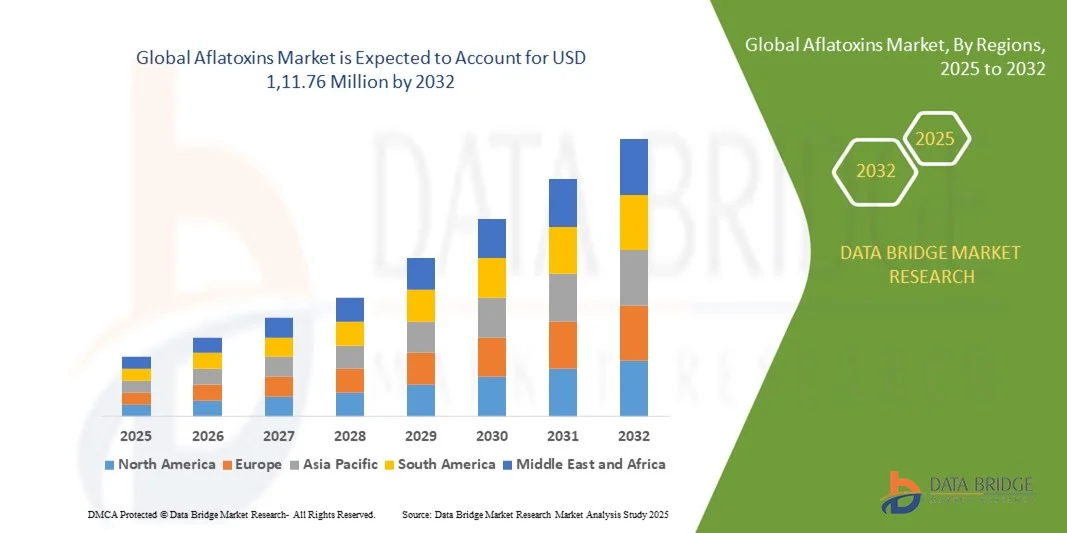
Global Aflatoxins Market Size
- The global aflatoxins market size was valued at USD 642.24 million in 2024 and is projected to reach USD 1,11.76 million by 2032, growing at a CAGR of 7.10% during the forecast period.
- Market growth is primarily driven by increasing concerns over food safety, regulatory pressures, and the heightened need for aflatoxin detection and control across the food and agriculture industries.
- Additionally, advancements in testing technologies, rising awareness among producers and consumers, and government initiatives to curb aflatoxin contamination are further accelerating demand, propelling substantial expansion within the global aflatoxins market.
Global Aflatoxins Market Analysis
- Aflatoxins, toxic secondary metabolites produced by certain molds, are increasingly recognized as critical contaminants in the food and agriculture sectors, with heightened global efforts toward monitoring, detection, and regulation due to their severe impact on food safety and public health.
- The rising demand for aflatoxin detection and control is primarily driven by increased food safety awareness, tightening international regulatory standards, and the global rise in food trade, especially in high-risk commodities such as grains, nuts, and spices.
- Europe dominated the global aflatoxins market in 2024 with the largest revenue share of 38.4%, attributed to its advanced food safety infrastructure, stringent government regulations, and robust investments in agricultural biotechnology and testing technologies, with the U.S. playing a key role in aflatoxin surveillance across food supply chains.
- Asia-Pacific is anticipated to be the fastest growing region in the aflatoxins market over the forecast period, driven by rising agricultural exports, increasing government-led food safety programs, and growing awareness among producers and consumers in countries such as India and China.
- The aspergillus flavus segment dominated the market with the largest revenue share of 56.3% in 2024, owing to its widespread presence in crops like maize, peanuts, and cottonseed, especially under warm and humid storage conditions.
Report Scope and Global Aflatoxins Market Segmentation
|
Attributes |
Aflatoxins Key Market Insights |
|
Segments Covered |
|
|
Countries Covered |
North America
Europe
Asia-Pacific
Middle East and Africa
South America
|
|
Key Market Players |
|
|
Market Opportunities |
|
|
Value Added Data Infosets |
In addition to the insights on market scenarios such as market value, growth rate, segmentation, geographical coverage, and major players, the market reports curated by the Data Bridge Market Research also include in-depth expert analysis, pricing analysis, brand share analysis, consumer survey, demography analysis, supply chain analysis, value chain analysis, raw material/consumables overview, vendor selection criteria, PESTLE Analysis, Porter Analysis, and regulatory framework. |
Global Aflatoxins Market Trends
Enhanced Precision and Predictive Capabilities Through AI and Machine Learning
- A significant and accelerating trend in the global Aflatoxins Market is the integration of artificial intelligence (AI) and machine learning (ML) in aflatoxin detection, risk assessment, and food safety monitoring systems. This technological evolution is transforming how agricultural producers, food manufacturers, and regulators identify and manage contamination risks.
- For instance, several modern aflatoxin detection platforms now use AI-driven image recognition and data analytics to rapidly analyze grain or nut samples, flagging potential contamination with greater accuracy than traditional methods. Systems like DeepAgro and AI-based hyperspectral imaging tools are helping stakeholders identify infected crops before harvest, enabling proactive responses.
- AI is also being used to build predictive models that assess contamination risk based on variables like temperature, humidity, and crop storage conditions. These models help farmers and supply chain managers make informed decisions about harvesting, handling, and storage to minimize aflatoxin formation.
- Furthermore, integration with IoT-enabled sensors allows for real-time monitoring of environmental conditions in storage facilities. Combined with ML algorithms, these systems can trigger automatic alerts or even corrective actions (like adjusting ventilation or temperature) when conditions become favorable for mold growth.
- The shift toward AI-powered surveillance is not only improving detection accuracy and speed but also reducing reliance on time-consuming lab-based testing. Companies such as Eurofins Scientific and SGS SA are investing in smart diagnostic platforms that integrate AI to streamline aflatoxin monitoring in large-scale operations.
- As the food industry becomes more digitized, the demand for automated, AI-enabled aflatoxin monitoring solutions is rising sharply, especially among exporters, regulatory bodies, and producers in high-risk regions. This trend is redefining industry standards for food safety and is expected to continue driving innovation and adoption across the global market.
Global Aflatoxins Market Dynamics
Driver
Growing Need Due to Rising Food Safety Concerns and Regulatory Compliance
- The increasing prevalence of food contamination incidents, especially in high-risk commodities like maize, peanuts, and spices, is a major driver for the growing demand for aflatoxin detection and control solutions across the global food and agriculture sectors.
- For instance, in May 2024, SGS SA announced the expansion of its global food safety testing services to include rapid aflatoxin screening solutions using AI-based analytics and portable devices, aiming to help exporters in emerging markets meet strict international standards.
- As governments and international bodies continue tightening food safety regulations (e.g., EU Maximum Residue Limits and Codex standards), producers and exporters are under pressure to implement more frequent and accurate aflatoxin testing to avoid trade rejections and public health risks.
- Furthermore, increasing consumer awareness of foodborne illnesses and the demand for clean-label, contaminant-free food is pushing food companies to invest in transparent testing and traceability systems, making aflatoxin detection a crucial part of quality assurance.
- Technological advancements such as portable biosensors, lab-on-a-chip devices, and blockchain-based traceability are enabling faster and more cost-effective aflatoxin monitoring across supply chains, encouraging broader adoption even in developing regions with limited lab infrastructure.
Restraint/Challenge
High Testing Costs and Limited Access to Rapid Detection in Developing Regions
- Despite growing demand, high costs associated with advanced aflatoxin testing technologies—such as HPLC, ELISA, and LC-MS/MS—pose a barrier to widespread adoption, especially among smallholder farmers and food processors in low-income countries.
- For Instance, many rural producers in sub-Saharan Africa or Southeast Asia lack the resources or infrastructure needed to implement consistent aflatoxin screening, making them vulnerable to crop rejection and lost income in export markets.
- In addition, the limited availability of affordable and portable rapid test kits can slow down detection and response times, allowing contaminated products to enter food chains before being identified. This gap hinders compliance with international safety standards and affects global trade opportunities.
- Another key challenge is the lack of trained personnel and standardized testing protocols across regions, which can lead to inconsistent results and reduced confidence in testing outcomes. This limits the effectiveness of national food safety programs and restricts market access for small-scale producers.
- Addressing these challenges will require targeted efforts, including public-private partnerships, government subsidies for testing equipment, and training initiatives to build local capacity. Companies like NEOGEN Corporation and R-Biopharm AG are working to reduce costs by developing user-friendly, field-deployable aflatoxin testing kits aimed at improving accessibility in underserved regions.
Global Aflatoxins Market Scope
The aflatoxins market is segmented on the basis of species type, exposure method, detection method type, and metabolite type.
- By Species Type
On the basis of species type, the aflatoxins market is segmented into Aspergillus flavus and Aspergillus parasiticus. The Aspergillus flavus segment dominated the market with the largest revenue share of 56.3% in 2024, owing to its widespread presence in crops like maize, peanuts, and cottonseed, especially under warm and humid storage conditions. Its capability to produce the highly toxic Aflatoxin B1 makes it a major focus of global food safety efforts. Testing and mitigation strategies are often prioritized for A. flavus due to its dominance in agricultural contamination cases.
The Aspergillus parasiticus segment is projected to witness the fastest CAGR from 2025 to 2032, driven by its growing identification in high-value crops like tree nuts and spices. As global trade expands and food safety regulations tighten, the need to monitor A. parasiticus—especially in regions with rising temperatures—is expected to increase significantly, boosting the demand for species-specific detection tools.
- By Exposure Method
Based on exposure method, the market is segmented into plant products, animal products, and air media. The plant product segment held the largest revenue share of 64.8% in 2024, due to the high susceptibility of grains, nuts, spices, and dried fruits to aflatoxin contamination both pre- and post-harvest. Countries dependent on agriculture or exports of these commodities have accelerated surveillance and control measures, increasing demand for aflatoxin detection tools in plant-based supply chains.
The air media segment is expected to witness the fastest growth from 2025 to 2032, as research intensifies on occupational exposure in agricultural and storage environments. Airborne spores of aflatoxin-producing fungi are increasingly being studied in grain silos, food processing facilities, and animal farms. This growing concern is prompting the development of airborne detection methods, particularly in developed countries focused on worker safety and indoor air quality standards.
- By Detection Method Type
On the basis of detection method type, the market is segmented into chromatographic methods, spectroscopic methods, and immunochemical methods. The chromatographic methods segment dominated in 2024 with a market share of 48.6%, owing to its high precision and widespread use in regulatory and commercial testing. Techniques like HPLC and LC-MS/MS are the gold standard for aflatoxin quantification due to their sensitivity and reliability, particularly in export testing.
However, the immunochemical methods segment is projected to register the fastest CAGR from 2025 to 2032, driven by the demand for rapid, cost-effective, and field-deployable solutions. ELISA kits and lateral flow assays are increasingly used in low-resource settings and by food producers for quick screening. Innovations in biosensor technologies and portable immunoassays are further enhancing the appeal of this method, especially in emerging markets.
- By Metabolite Type
Based on metabolite type, the market is segmented into Aflatoxin B1 and B2, Aflatoxin G1 and G2, Aflatoxin M1 and M2, and Aflatoxin Q1. The Aflatoxin B1 and B2 segment held the largest market revenue share of 52.1% in 2024, primarily because Aflatoxin B1 is the most toxic and commonly occurring aflatoxin in food products. It is classified as a Group 1 carcinogen by the WHO and is subject to strict global regulatory limits, making its detection a top priority for food safety authorities.
The Aflatoxin M1 and M2 segment is projected to experience the fastest growth rate from 2025 to 2032, due to increased testing in dairy products. Aflatoxin M1, a metabolite of Aflatoxin B1, appears in milk when livestock consume contaminated feed, prompting regulatory scrutiny in milk and infant formula. Growing dairy consumption globally and stricter milk safety standards are driving this segment’s rapid expansion.
Global Aflatoxins Market Regional Analysis
- Europe dominated the global aflatoxins market with the largest revenue share of 38.4% in 2024, driven by stringent food safety regulations, high levels of agricultural trade, and increasing awareness regarding the health risks of aflatoxin exposure.
- Consumers and producers in the region prioritize contamination-free food, prompting widespread adoption of advanced aflatoxin detection technologies across the supply chain—from farming and storage to processing and export.
- This leadership position is further supported by robust infrastructure for food testing, active government surveillance programs (e.g., FDA monitoring), and the presence of major food safety solution providers. As food exporters seek compliance with global standards, demand for accurate and rapid aflatoxin testing continues to grow, particularly in the U.S. and Canada.
U.K. Aflatoxins Market Insight
The U.K. aflatoxins market is anticipated to grow at a noteworthy CAGR over the forecast period, driven by the country’s focus on food traceability, consumer protection, and post-Brexit regulatory enforcement. With the rise in imported agricultural goods, aflatoxin testing has become more prevalent across ports, distribution centers, and food manufacturing facilities. National food safety bodies are also collaborating with academic institutions to enhance early detection technologies. Additionally, consumer preference for certified-safe and clean-label products continues to drive investments in advanced testing and supply chain monitoring.
Germany Aflatoxins Market Insight
The Germany aflatoxins market is expected to expand at a considerable CAGR, fueled by its position as a major importer and processor of agricultural commodities in Europe. Germany’s strong emphasis on product quality, sustainability, and public health aligns with robust regulatory enforcement around mycotoxin limits. Technological innovation, particularly in chromatographic and biosensor-based testing, is being actively integrated into food production lines. Increasing demand from organic food producers and the feed industry is also supporting growth, as Germany continues to prioritize consumer trust and food chain transparency.
U.S. Aflatoxins Market Insight
The U.S. aflatoxins market captured the largest revenue share of 79% in North America in 2024, driven by stringent regulatory frameworks enforced by the FDA and USDA, along with increasing demand for food safety across the supply chain. High consumption of grains, nuts, and dairy products—commodities often vulnerable to aflatoxin contamination—makes routine testing essential. The presence of advanced food testing infrastructure, public health awareness, and strict import-export controls further support the market. Technological advancements, including AI-powered diagnostic tools and portable aflatoxin detectors, are gaining popularity across food processing, agriculture, and regulatory agencies in the U.S.
Asia-Pacific Aflatoxins Market Insight
The Asia-Pacific aflatoxins market is poised to grow at the fastest CAGR of 25.6% during the forecast period (2025–2032), driven by rising agricultural exports, expanding food processing industries, and greater awareness of food safety risks. Countries like China, India, and Vietnam are investing heavily in food quality infrastructure to meet international standards and reduce crop rejection rates. Government-led programs promoting aflatoxin control, alongside the increasing availability of rapid testing kits, are encouraging market adoption. Additionally, growing concerns over food security and cross-border trade compliance are reinforcing the need for comprehensive aflatoxin monitoring in the region.
Japan Aflatoxins Market Insight
The Japan aflatoxins market is gaining traction, supported by the country’s emphasis on stringent food safety protocols and its import-dependent food economy. Aflatoxin testing is critical for imports like nuts, spices, and processed grain products. The government’s proactive stance on public health and precision agriculture is fostering the adoption of portable and automated detection solutions. Japan’s aging population and strong demand for high-quality, contaminant-free foods are also prompting food manufacturers and retailers to integrate aflatoxin testing into routine quality control.
China Aflatoxins Market Insight
The China aflatoxins market accounted for the largest revenue share in Asia-Pacific in 2024, attributed to the country’s massive agricultural sector and growing export obligations. As China works to align with global food safety standards, the use of rapid aflatoxin testing solutions is expanding across grain storage, milling, and food packaging industries. The government's initiatives to reduce post-harvest losses and contamination risks are supporting large-scale deployment of detection systems. Furthermore, strong domestic manufacturing of aflatoxin testing kits and devices contributes to both affordability and widespread access, boosting market penetration across rural and industrial areas.
Global Aflatoxins Market Share
The Aflatoxins industry is primarily led by well-established companies, including:
- ARBRO PHARMACEUTICALS PVT. LTD (India)
- Symbio Laboratories (Australia)
- Eurofins Scientific (Luxembourg)
- ERBER AG (Austria)
- Bureau Veritas (France)
- SGS SA (Switzerland)
- NEOGEN CORPORATION (U.S.)
- Trilogy Analytical Laboratory (U.S.)
- General Mills Inc (U.S.)
- EnviroLogix (U.S.)
- R-Biopharm AG (Germany)
- Alpha MOS (France)
- OMIC USA (U.S.)
- Cayman Chemical (U.S.)
- bioMérieux SA (France)
- ALS Limited (Australia)
- AsureQuality (New Zealand)
- Charm Sciences (U.S.)
- Premier Analytical Services (U.K.)
- Intertek Group plc (U.K.)
What are the Recent Developments in Global Aflatoxins Market?
- In June 2023, Eurofins Scientific expanded its global footprint by opening a state-of-the-art mycotoxin testing laboratory in São Paulo, Brazil, aimed at strengthening aflatoxin monitoring in key agricultural exports such as corn and peanuts. The facility features advanced LC-MS/MS and ELISA capabilities, enabling rapid, high-throughput testing aligned with global safety standards. This initiative reflects Eurofins’ strategic commitment to supporting Latin American exporters in complying with strict international food safety regulations, particularly in the growing aflatoxins control market.
- In May 2023, NEOGEN Corporation launched Reveal® Q+ MAX for Aflatoxin M1, a lateral flow test specifically designed for the dairy industry. This new solution allows for rapid and quantitative detection of aflatoxin M1 in milk within minutes, helping dairy processors and quality control labs meet evolving regulatory limits. The product demonstrates NEOGEN's commitment to delivering accessible, on-site testing tools that empower producers to ensure product safety and minimize contamination risks.
- In April 2023, R-Biopharm AG, a leading diagnostics company based in Germany, announced the release of its RIDASCREEN® FAST Aflatoxin SC, a next-generation ELISA test kit that delivers results in under 8 minutes. Designed for high-efficiency labs and grain handlers, the kit supports enhanced workflow speed without compromising on accuracy. This development marks R-Biopharm’s ongoing efforts to modernize aflatoxin testing and meet growing demand for time-sensitive, scalable food safety solutions.
- In February 2023, SGS SA collaborated with Southeast Asian agricultural exporters on a pilot program introducing portable aflatoxin testing units for on-field screening. Using handheld immunoassay technology, the initiative aims to reduce post-harvest losses and improve compliance with EU and U.S. import standards. This program supports SGS’s broader strategy of promoting affordable, decentralized food testing infrastructure in emerging markets.
- In January 2023, bioMérieux SA announced the integration of its VIDAS® aflatoxin detection platform with blockchain-based traceability systems, offering end-to-end visibility for food supply chains. This breakthrough enables real-time sharing of test results with suppliers, regulators, and retailers, enhancing transparency and trust. The innovation reflects the company’s commitment to combining advanced biosciences with digital tools to elevate global food safety and support regulatory compliance in the aflatoxins market.

- Interactive Data Analysis Dashboard
- Company Analysis Dashboard for high growth potential opportunities
- Research Analyst Access for customization & queries
- Competitor Analysis with Interactive dashboard
- Latest News, Updates & Trend analysis
- Harness the Power of Benchmark Analysis for Comprehensive Competitor Tracking
Global Aflatoxins Market, Supply Chain Analysis and Ecosystem Framework
To support market growth and help clients navigate the impact of geopolitical shifts, DBMR has integrated in-depth supply chain analysis into its Global Aflatoxins Market research reports. This addition empowers clients to respond effectively to global changes affecting their industries. The supply chain analysis section includes detailed insights such as Global Aflatoxins Market consumption and production by country, price trend analysis, the impact of tariffs and geopolitical developments, and import and export trends by country and HSN code. It also highlights major suppliers with data on production capacity and company profiles, as well as key importers and exporters. In addition to research, DBMR offers specialized supply chain consulting services backed by over a decade of experience, providing solutions like supplier discovery, supplier risk assessment, price trend analysis, impact evaluation of inflation and trade route changes, and comprehensive market trend analysis.
Data collection and base year analysis are done using data collection modules with large sample sizes. The stage includes obtaining market information or related data through various sources and strategies. It includes examining and planning all the data acquired from the past in advance. It likewise envelops the examination of information inconsistencies seen across different information sources. The market data is analysed and estimated using market statistical and coherent models. Also, market share analysis and key trend analysis are the major success factors in the market report. To know more, please request an analyst call or drop down your inquiry.
The key research methodology used by DBMR research team is data triangulation which involves data mining, analysis of the impact of data variables on the market and primary (industry expert) validation. Data models include Vendor Positioning Grid, Market Time Line Analysis, Market Overview and Guide, Company Positioning Grid, Patent Analysis, Pricing Analysis, Company Market Share Analysis, Standards of Measurement, Global versus Regional and Vendor Share Analysis. To know more about the research methodology, drop in an inquiry to speak to our industry experts.
Data Bridge Market Research is a leader in advanced formative research. We take pride in servicing our existing and new customers with data and analysis that match and suits their goal. The report can be customized to include price trend analysis of target brands understanding the market for additional countries (ask for the list of countries), clinical trial results data, literature review, refurbished market and product base analysis. Market analysis of target competitors can be analyzed from technology-based analysis to market portfolio strategies. We can add as many competitors that you require data about in the format and data style you are looking for. Our team of analysts can also provide you data in crude raw excel files pivot tables (Fact book) or can assist you in creating presentations from the data sets available in the report.













