


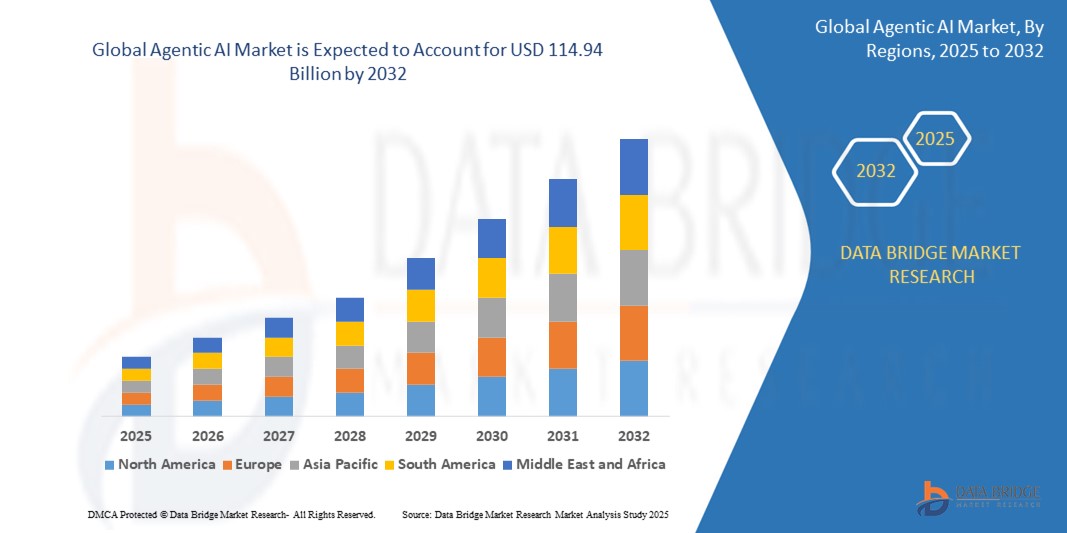
Agentic AI Market Size
- The global agentic AI market size was valued at USD 7.57 billion in 2024 and is expected to reach USD 114.94 billion by 2032, at a CAGR of 40.50% during the forecast period
- The market growth is largely fueled by the rapid advancement in artificial intelligence and automation technologies, enabling AI agents to autonomously perform complex tasks across various enterprise functions, including customer service, operations, and decision-making workflows
- Furthermore, rising enterprise demand for intelligent, scalable, and interoperable systems is positioning agentic AI as a core component in digital transformation strategies. These converging factors are accelerating the deployment of agent-based solutions across industries, thereby significantly boosting the market’s expansion
Agentic AI Market Analysis
- Agentic AI refers to autonomous software systems or agents capable of perceiving environments, making decisions, and taking actions with minimal human intervention. These agents are designed to operate independently or collaboratively, streamlining operations across domains such as IT service management, supply chain, planning, and customer engagement
- The growing demand for agentic AI is driven by increased enterprise focus on efficiency, scalability, and intelligent automation. As businesses seek to reduce manual workloads, enhance decision accuracy, and support real-time responsiveness, agentic AI is emerging as a transformative solution across sectors
- North America dominated the agentic AI market with a share of 40.6% in 2024, due to rapid advancements in AI technologies, strong digital infrastructure, and widespread enterprise adoption of intelligent automation solutions
- Asia-Pacific is expected to be the fastest growing region in the agentic AI market during the forecast period due to booming industrial digitalization, strong AI investments, and growing enterprise demand for automation in countries such as China, Japan, and India
- Computational agents segment dominated the market with a market share of 59.1% in 2024, due to their core role in enabling autonomous decision-making, data interpretation, and process optimization across digital environments. These agents are widely adopted in enterprise applications due to their flexibility, scalability, and compatibility with existing IT infrastructures. Their ability to process large volumes of data, identify patterns, and provide actionable recommendations makes them integral to workflow automation and decision support systems
Report Scope and Agentic AI Market Segmentation
|
Attributes |
Agentic AI Key Market Insights |
|
Segments Covered |
|
|
Countries Covered |
North America
Europe
Asia-Pacific
Middle East and Africa
South America
|
|
Key Market Players |
|
|
Market Opportunities |
|
|
Value Added Data Infosets |
In addition to the market insights such as market value, growth rate, market segments, geographical coverage, market players, and market scenario, the market report curated by the Data Bridge Market Research team includes in-depth expert analysis, import/export analysis, pricing analysis, production consumption analysis, and pestle analysis. |
Agentic AI Market Trends
Increasing Complexity of Business Environments
- The agentic AI market is rapidly expanding as enterprises seek AI systems capable of independently reasoning, planning, and adapting to complex and dynamic business environments to enhance operational agility and innovation
- For instance, companies such as IBM and SS&C Blue Prism are deploying agentic AI solutions that autonomously handle up to 80% of routine customer service issues, reducing operational overhead and streamlining workflows in complex service environments
- Advances in multi-agent collaboration allow AI systems to work collectively on complex tasks, providing scalable automation across cross-functional enterprise operations
- Growing need for continuous decision-making and real-time responsiveness in industries such as finance, healthcare, and supply chain management drives agentic AI adoption
- Integration of agentic AI with digital ecosystems and APIs enables seamless orchestration of workflows across multiple data sources and systems, supporting more sophisticated automated processes
- The trend toward self-healing systems, where agentic AI detects and resolves system faults autonomously, is enhancing reliability and reducing downtime in critical enterprise infrastructure
Agentic AI Market Dynamics
Driver
Increasing Adoption Across Various Sectors
- Rising adoption of agentic AI spans diverse industries, driven by increasing demand for autonomous systems that improve efficiency, reduce manual intervention, and optimize complex workflows
- For instance, major enterprises in sectors such as finance, healthcare, IT services, and manufacturing—including Google DeepMind, Microsoft, and Amazon Web Services—leverage agentic AI for automation in planning, decision support, navigation, and operational tasks
- Growing acceptance of AI-driven digital transformation initiatives accelerates agentic AI deployment for enhanced customer engagement, predictive analytics, and risk management
- Regulatory focus on compliance and data governance incentivizes adoption of smart agentic systems capable of auditing and reporting while minimizing human error
- Expansion of cloud computing, edge AI, and improved machine learning models is enabling scalable, secure, and flexible implementation of agentic AI solutions across global markets
Restraint/Challenge
Data Privacy and Security Concerns
- Concerns around data privacy, cybersecurity, and ethical use present significant barriers to agentic AI market growth, especially as these systems process sensitive and high-volume enterprise data
- For instance, companies such as Meta and Adobe face challenges ensuring agentic AI solutions comply with regulations such as GDPR and CCPA, while protecting against data breaches and unauthorized access
- The autonomous nature of agentic AI raises issues of accountability, making it difficult to trace decisions and enforce compliance in highly regulated industries
- Integration of agentic AI in legacy systems often introduces vulnerabilities that require enhanced security protocols, increasing implementation complexity and cost
- User trust and acceptance are contingent on transparency, explainability, and ethical AI frameworks, which are still evolving and contribute to slower adoption in risk-averse sectors
Agentic AI Market Scope
The market is segmented on the basis of software, agent role, and application.
- By Software
On the basis of software, the Agentic AI market is segmented into computational agents and robotic agents. The computational agents segment accounted for the largest market revenue share of 59.1% in 2024, driven by their core role in enabling autonomous decision-making, data interpretation, and process optimization across digital environments. These agents are widely adopted in enterprise applications due to their flexibility, scalability, and compatibility with existing IT infrastructures. Their ability to process large volumes of data, identify patterns, and provide actionable recommendations makes them integral to workflow automation and decision support systems.
The robotic agents segment is expected to witness the fastest growth rate from 2025 to 2032, owing to their rising deployment in physical environments such as logistics, manufacturing, and healthcare. These agents integrate advanced AI with robotics to carry out tasks involving real-world navigation, manipulation, and interaction. Increased demand for autonomous delivery systems, warehouse automation, and assistive robots in healthcare is accelerating the adoption of robotic agents, making them a pivotal component of next-gen AI solutions.
- By Agent Role
On the basis of agent role, the market is segmented into marketing, sales, operations & supply chain, and ITSM. The operations & supply chain segment dominated the market in 2024, supported by the need for intelligent systems that can autonomously monitor, predict, and optimize supply chain performance. Agentic AI facilitates real-time coordination, demand forecasting, and adaptive logistics, enhancing operational agility and minimizing downtime. Organizations leverage these agents to streamline procurement, production scheduling, and inventory management with minimal human intervention.
The marketing segment is projected to register the fastest growth from 2025 to 2032, driven by the growing use of AI agents in customer engagement, personalization, and real-time analytics. These agents autonomously manage content distribution, campaign performance tracking, and behavior-driven customer interactions, significantly improving marketing ROI. Their ability to simulate human-such as conversations and optimize touchpoints across digital platforms enhances user experience and brand loyalty.
- By Application
On the basis of application, the Agentic AI market is categorized into workflow automation, planning & decision support, and navigation & mobility. The workflow automation segment held the largest share in 2024, propelled by the increasing demand for operational efficiency and reduced manual workload in business processes. Agentic AI streamlines repetitive tasks, automates interdepartmental communication, and ensures task execution with minimal supervision, making it indispensable across IT, HR, and finance operations.
The navigation & mobility segment is anticipated to grow at the fastest rate from 2025 to 2032, spurred by advancements in autonomous systems and smart transportation. AI agents in this category are being integrated into drones, autonomous vehicles, and mobile robots, enabling dynamic path planning, obstacle avoidance, and environment adaptation. The growing focus on urban mobility, intelligent transport systems, and last-mile delivery is further fueling this segment’s rapid expansion.
Agentic AI Market Regional Analysis
- North America dominated the agentic AI market with the largest revenue share of 40.6% in 2024, driven by rapid advancements in AI technologies, strong digital infrastructure, and widespread enterprise adoption of intelligent automation solutions
- The region’s early embrace of agent-based systems for workflow automation, planning, and customer engagement across sectors such as finance, healthcare, and retail supports its market dominance
- A robust ecosystem of AI startups, favorable regulatory frameworks, and a high concentration of tech-savvy enterprises further bolster the growth of agentic AI in both on-premises and cloud deployments
U.S. Agentic AI Market Insight
The U.S. agentic AI market captured the largest revenue share in 2024 within North America, fueled by aggressive investment in enterprise AI deployment and an accelerated shift toward autonomous business processes. Organizations are leveraging agentic systems to streamline operations, improve customer experience, and optimize supply chain logistics. The widespread integration of agentic AI with cloud platforms and enterprise software, along with strong demand for intelligent virtual agents in customer support and IT service management, continues to drive the market forward.
Europe Agentic AI Market Insight
The Europe agentic AI market is projected to grow at a strong CAGR throughout the forecast period, supported by increasing digital transformation initiatives across the public and private sectors. The region’s focus on data privacy and ethical AI aligns well with the development of transparent, explainable agentic systems. Adoption is rising across industries such as manufacturing, finance, and logistics, where intelligent agents assist in real-time decision-making, resource planning, and customer engagement.
U.K. Agentic AI Market Insight
The U.K. agentic AI market is expected to grow at a notable CAGR, driven by a growing emphasis on AI-led business process optimization and the expanding footprint of AI in retail, banking, and government services. The demand for intelligent agents in planning, workflow automation, and customer interaction is growing rapidly, backed by strong institutional support for AI innovation and digital transformation.
Germany Agentic AI Market Insight
The Germany agentic AI market is anticipated to expand at a steady CAGR, underpinned by the country’s focus on industrial automation and AI-based innovation in logistics and manufacturing. The integration of computational agents in Industry 4.0 initiatives and the rise of robotic process automation (RPA) are key trends. High standards for data security and performance reliability further influence the deployment of agentic systems in enterprise environments.
Asia-Pacific Agentic AI Market Insight
The Asia-Pacific agentic AI market is forecast to register the fastest CAGR from 2025 to 2032, propelled by booming industrial digitalization, strong AI investments, and growing enterprise demand for automation in countries such as China, Japan, and India. Government-led smart city programs and increasing cloud adoption are accelerating the deployment of agentic systems across sectors ranging from healthcare to retail and manufacturing.
Japan Agentic AI Market Insight
The Japan agentic AI market is advancing rapidly, supported by the country’s focus on robotics, automation, and high-efficiency enterprise solutions. Agentic AI is being increasingly integrated into sectors such as transportation, healthcare, and government to manage workflows, assist with planning, and improve mobility. Aging demographics and labor shortages are also encouraging adoption of intelligent systems that reduce human workload and enhance service delivery.
China Agentic AI Market Insight
The China agentic AI market accounted for the largest revenue share in Asia-Pacific in 2024, driven by strong government backing for AI development, expanding AI capabilities across sectors, and high adoption of intelligent digital platforms. China’s large base of AI developers, robust manufacturing infrastructure, and demand for smart enterprise solutions are accelerating the integration of agentic AI into planning, automation, and customer-facing roles across industries
Agentic AI Market Share
The agentic AI industry is primarily led by well-established companies, including:
- Tesla (U.S.)
- OpenAI (U.S.)
- Microsoft (U.S.)
- Google (U.S.)
- AWS (U.S.)
- IBM (U.S.)
- Anduril (U.S.)
- NVIDIA (U.S.)
- Wayve (U.K.)
- Amelia (U.S.)
- Kore.ai (U.S.)
- SoftBank Robotics (Japan)
- Seegrid (U.S.)
- Cognigy (Germany)
- ANYbotics (Switzerland)
Latest Developments in Global Agentic AI Market
- In May 2025, IBM unveiled advanced tools and frameworks for building and managing AI agent networks, significantly strengthening its position in the agentic AI landscape. The launch includes domain-specific agents for HR, procurement, and sales, integrated with AWS Marketplace technologies. The planned integration between Amazon Q index and IBM watsonx Orchestrate will enable agents to act on third-party data from platforms such as Salesforce, Slack, and Zendesk, fostering more intelligent and personalized automation—thereby accelerating enterprise adoption of agentic systems
- In April 2025, Microsoft enhanced its Dynamics 365 suite by embedding AI-powered Copilot and agent capabilities across core modules. These upgrades improve task automation, customer service, sales productivity, finance operations, and HR workflows. By integrating automation, analytics, and agentic features, Microsoft is reinforcing the utility of agentic AI for large-scale enterprise productivity, fueling broader market penetration
- In April 2025, Google introduced Agent Space, a transformative platform enabling businesses to develop AI agents capable of collaborating across organizations using a unified Agent-to-Agent (A2A) protocol. This innovation simplifies agent creation and interoperability, unlocking new efficiencies in workflow automation, real-time data research, and task orchestration. It is expected to lay the foundation for a future marketplace of interoperable AI agents, significantly advancing the agentic AI ecosystem
- In April 2025, Waymo and Toyota announced a strategic partnership to accelerate autonomous vehicle development using agentic AI technologies. By merging Waymo’s autonomous driving capabilities with Toyota’s vehicle design expertise, the collaboration is poised to advance agent-driven mobility solutions, expanding the application scope of agentic AI in the automotive sector

- Interactive Data Analysis Dashboard
- Company Analysis Dashboard for high growth potential opportunities
- Research Analyst Access for customization & queries
- Competitor Analysis with Interactive dashboard
- Latest News, Updates & Trend analysis
- Harness the Power of Benchmark Analysis for Comprehensive Competitor Tracking
Data collection and base year analysis are done using data collection modules with large sample sizes. The stage includes obtaining market information or related data through various sources and strategies. It includes examining and planning all the data acquired from the past in advance. It likewise envelops the examination of information inconsistencies seen across different information sources. The market data is analysed and estimated using market statistical and coherent models. Also, market share analysis and key trend analysis are the major success factors in the market report. To know more, please request an analyst call or drop down your inquiry.
The key research methodology used by DBMR research team is data triangulation which involves data mining, analysis of the impact of data variables on the market and primary (industry expert) validation. Data models include Vendor Positioning Grid, Market Time Line Analysis, Market Overview and Guide, Company Positioning Grid, Patent Analysis, Pricing Analysis, Company Market Share Analysis, Standards of Measurement, Global versus Regional and Vendor Share Analysis. To know more about the research methodology, drop in an inquiry to speak to our industry experts.
Data Bridge Market Research is a leader in advanced formative research. We take pride in servicing our existing and new customers with data and analysis that match and suits their goal. The report can be customized to include price trend analysis of target brands understanding the market for additional countries (ask for the list of countries), clinical trial results data, literature review, refurbished market and product base analysis. Market analysis of target competitors can be analyzed from technology-based analysis to market portfolio strategies. We can add as many competitors that you require data about in the format and data style you are looking for. Our team of analysts can also provide you data in crude raw excel files pivot tables (Fact book) or can assist you in creating presentations from the data sets available in the report.













