Global Agricultural Acaricides Market Size
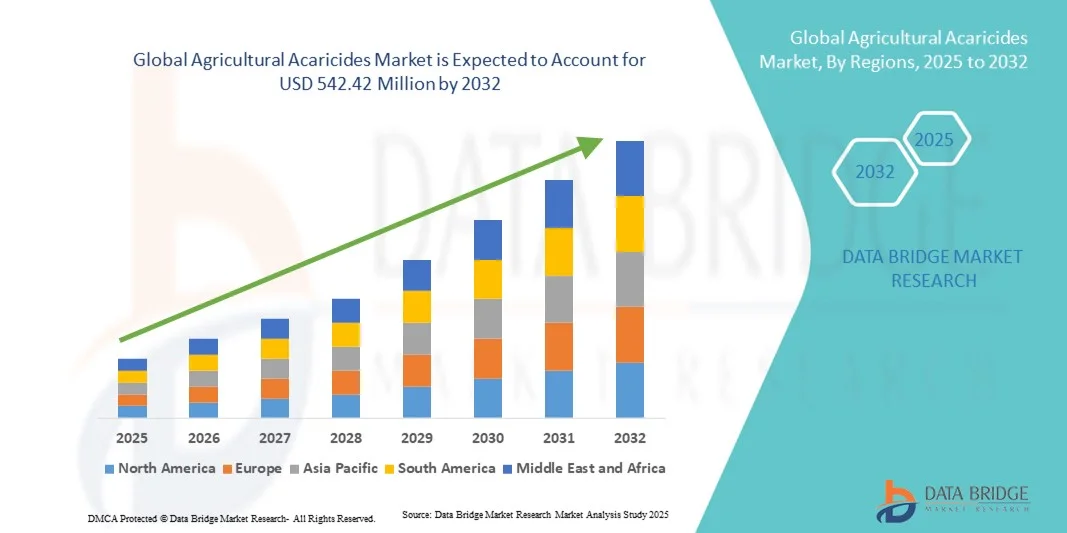
- The global Agricultural Acaricides Market size was valued at USD 353.44 million in 2024 and is expected to reach USD 542.42 million by 2032, at a CAGR of 5.50% during the forecast period.
- The market growth is largely driven by increasing global demand for sustainable crop protection solutions and advancements in agrochemical formulations, which enhance pest control efficiency and crop yield.
- Furthermore, rising awareness among farmers about integrated pest management practices and the need to combat acarid infestations is promoting the adoption of effective acaricide solutions. These factors are collectively fueling market expansion and supporting the industry’s robust growth trajectory.
Global Agricultural Acaricides Market Analysis
- Agricultural acaricides, used to control mites and ticks in crops, are increasingly essential for ensuring high crop yields and protecting agricultural productivity across both large-scale and smallholder farms, due to their effectiveness, targeted action, and compatibility with integrated pest management practices.
- The rising demand for agricultural acaricides is primarily driven by the increasing prevalence of mite infestations, growing global food demand, and the need for sustainable and efficient crop protection solutions.
- Asia-Pacific dominated the Global Agricultural Acaricides Market with the largest revenue share of 37% in 2024, supported by advanced agricultural practices, high adoption of modern agrochemicals, and a strong presence of key industry players, with the U.S. experiencing significant growth in acaricide usage across major crops such as corn, soy, and vegetables due to innovations in formulation and application technologies.
- North America is expected to be the fastest-growing region in the Global Agricultural Acaricides Market during the forecast period, driven by rising agricultural investments, increasing crop cultivation areas, and a growing focus on improving food security in countries such as China and India.
- The organophosphates segment dominated the market with the largest revenue share of 38.5% in 2024, driven by their high efficacy against a broad spectrum of mite species and established use in commercial and smallholder farming.
Report Scope and Global Agricultural Acaricides Market Segmentation
|
Attributes |
Agricultural Acaricides Key Market Insights |
|
Segments Covered |
|
|
Countries Covered |
North America
Europe
Asia-Pacific
Middle East and Africa
South America
|
|
Key Market Players |
|
|
Market Opportunities |
|
|
Value Added Data Infosets |
In addition to the insights on market scenarios such as market value, growth rate, segmentation, geographical coverage, and major players, the market reports curated by the Data Bridge Market Research also include import export analysis, production capacity overview, production consumption analysis, price trend analysis, climate change scenario, supply chain analysis, value chain analysis, raw material/consumables overview, vendor selection criteria, PESTLE Analysis, Porter Analysis, and regulatory framework. |
Global Agricultural Acaricides Market Trends
Enhanced Crop Protection Through Smart and Precision Technologies
- A significant and accelerating trend in the global Agricultural Acaricides Market is the integration of precision agriculture technologies and digital farming solutions. These innovations allow farmers to monitor pest populations, optimize acaricide application, and reduce chemical usage, significantly enhancing crop protection efficiency.
- For instance, drone-based spraying systems and GPS-guided tractors enable targeted application of acaricides on affected areas, minimizing wastage and environmental impact. Similarly, IoT-enabled soil and crop sensors provide real-time data on pest infestations, helping farmers make timely and informed decisions on acaricide use.
- AI integration in agricultural acaricide management allows predictive pest modeling and automated alerts for potential mite outbreaks. Some platforms, such as Taranis and CropX, use AI and machine learning to analyze field data, improving decision-making for optimal acaricide application and reducing crop losses. Furthermore, these systems help identify patterns in pest activity, enabling farmers to adopt proactive rather than reactive treatment strategies.
- The seamless integration of acaricide management with farm management software facilitates centralized control over multiple farm operations. Through a single platform, farmers can manage pest control alongside irrigation, fertilization, and crop monitoring, creating a unified and highly efficient agricultural workflow.
- This trend towards smarter, data-driven, and interconnected pest management systems is fundamentally reshaping farmer expectations for crop protection. Consequently, companies such as BASF, Syngenta, and Corteva are developing AI-enabled acaricide solutions and precision application technologies to improve efficacy, reduce chemical use, and enhance sustainability.
- The demand for intelligent, precision-based acaricide solutions is growing rapidly across both large-scale commercial farms and smallholder operations, as agricultural stakeholders increasingly prioritize efficiency, sustainability, and improved crop yields.
Global Agricultural Acaricides Market Dynamics
Driver
Growing Need Due to Rising Pest Infestations and Agricultural Intensification
- The increasing prevalence of mite and tick infestations in crops, coupled with the intensification of agricultural practices, is a significant driver for the heightened demand for agricultural acaricides.
- For instance, in 2024, Syngenta introduced new acaricide formulations with improved efficacy and reduced environmental impact, targeting common mite species in high-value crops. Such innovations by leading companies are expected to drive the growth of the agricultural acaricides market during the forecast period.
- As farmers face more frequent pest outbreaks due to changing climate conditions and monoculture practices, acaricides offer effective solutions for protecting yields, preventing crop losses, and ensuring food security. Advanced products now provide targeted action, residual control, and compatibility with integrated pest management (IPM) programs, giving them an advantage over traditional pest control methods.
- Furthermore, the growing adoption of modern farming technologies and sustainable agriculture practices is making acaricides an essential component of crop protection strategies. These solutions can be integrated with precision agriculture tools, such as drones and smart spraying systems, to optimize application and reduce chemical usage.
- The convenience of ready-to-use formulations, compatibility with diverse crops, and the ability to manage pest control efficiently across large farmlands are key factors propelling the adoption of acaricides in both commercial and smallholder farming operations. Additionally, the increasing availability of environmentally friendly and low-toxicity products further supports market growth.
Restraint/Challenge
Concerns Regarding Environmental Impact and Regulatory Compliance
- Concerns surrounding the environmental impact of chemical acaricides, including potential toxicity to non-target species and contamination of soil and water, pose a significant challenge to broader market adoption. As acaricides are used extensively, stringent regulations and sustainability expectations require careful management of chemical usage.
- For instance, regulatory bodies in the EU and North America have imposed strict guidelines on residue limits, environmental safety, and permissible active ingredients, making compliance a critical consideration for manufacturers and farmers alike.
- Addressing these concerns through the development of low-toxicity formulations, biopesticides, and eco-friendly application methods is crucial for building trust among farmers and regulators. Companies such as BASF, Corteva, and UPL emphasize sustainable product lines and integrated pest management compatibility in their marketing to reassure stakeholders.
- Additionally, the relatively higher cost of some advanced acaricide formulations compared to conventional pesticides can be a barrier for price-sensitive farmers, particularly in developing regions. While standard products remain affordable, premium eco-friendly or AI-assisted application solutions often come with higher costs.
- Overcoming these challenges through innovation in environmentally safe products, regulatory compliance, and farmer education on proper usage will be vital for sustained growth in the global agricultural acaricides market.
Global Agricultural Acaricides Market Scope
Agricultural acaricides market is segmented on the basis of type and application.
- By Type
On the basis of type, the Global Agricultural Acaricides Market is segmented into organophosphates, carbamates, organochlorines, pyrethrins, pyrethroids, and others. The organophosphates segment dominated the market with the largest revenue share of 38.5% in 2024, driven by their high efficacy against a broad spectrum of mite species and established use in commercial and smallholder farming. Organophosphates are widely preferred due to their fast-acting properties, cost-effectiveness, and compatibility with various crops, including cereals, vegetables, and fruits. Their extensive adoption is supported by well-established application protocols and familiarity among farmers.
The pyrethroids segment is anticipated to witness the fastest growth rate of 20.3% from 2025 to 2032, fueled by increasing demand for safer and environmentally compatible acaricides. Pyrethroids are known for their low mammalian toxicity, high stability under field conditions, and effectiveness at low doses. Rising awareness about sustainable pest control and stricter regulatory compliance are further contributing to the growth of this segment across both developed and emerging markets.
- By Application
On the basis of application, the Global Agricultural Acaricides Market is segmented into spray, dipping vat, hand dressing, and others. The spray segment accounted for the largest market revenue share of 46.1% in 2024, driven by its ease of use, uniform coverage, and ability to treat large areas efficiently. Spraying is particularly preferred for high-value crops such as fruits and vegetables, where precise and rapid control of mite infestations is critical to prevent yield losses and maintain quality standards. Farmers favor spray applications due to their adaptability with modern equipment, including motorized sprayers and drone-based systems, which enhance efficiency and reduce labor intensity.
The hand dressing segment is expected to witness the fastest CAGR from 2025 to 2032 at 19.8%, driven by its relevance in small-scale and organic farming operations. Hand dressing allows targeted acaricide application to specific plants or affected areas, minimizing chemical wastage and environmental impact. The growing adoption of precision agriculture techniques, sustainable farming practices, and increasing awareness of eco-friendly pest management solutions are key factors supporting the expansion of the hand dressing segment, particularly in regions with smallholder farms.
Global Agricultural Acaricides Market Regional Analysis
- Asia-Pacific dominated the Global Agricultural Acaricides Market with the largest revenue share of 37% in 2024, driven by the extensive adoption of advanced agricultural practices, modern farming technologies, and a strong emphasis on crop protection.
- Farmers and agribusinesses in the region prioritize high-efficiency acaricides to protect high-value crops such as fruits, vegetables, and cereals from mite infestations, minimizing yield losses and ensuring consistent product quality.
- The market growth is further supported by favorable government regulations, well-established distribution networks, high awareness of integrated pest management (IPM) strategies, and increasing investment in agricultural research and innovation, making North America a key hub for the adoption of advanced acaricide solutions across commercial and smallholder farms alike.
U.S. Agricultural Acaricides Market Insight
The U.S. agricultural acaricides market captured the largest revenue share of 81% in North America in 2024, driven by the extensive adoption of modern pest management practices and high-value crop production. Farmers increasingly prioritize effective mite control solutions to safeguard yield and quality in fruits, vegetables, and cereals. The growing awareness of integrated pest management (IPM), technological advancements in application methods, and favorable government regulations supporting safe pesticide use further propel market growth. Additionally, the rising focus on sustainable and efficient crop protection practices, combined with well-established distribution channels, enhances the accessibility and adoption of advanced acaricides across the country.
Europe Agricultural Acaricides Market Insight
The Europe agricultural acaricides market is projected to expand at a substantial CAGR during the forecast period, driven by strict regulatory frameworks for pesticide use and the increasing need to protect high-value crops. Rising consumer demand for high-quality, residue-free produce, coupled with growing awareness of crop protection techniques, is fostering market growth. Adoption spans residential farms, commercial farms, and greenhouse operations, with acaricides being integrated into both conventional and organic pest management strategies.
U.K. Agricultural Acaricides Market Insight
The U.K. agricultural acaricides market is expected to grow at a noteworthy CAGR, fueled by increasing awareness of pest management, crop protection, and sustainable farming practices. Concerns regarding crop losses from mite infestations are encouraging farmers to adopt advanced acaricide solutions. The country’s well-developed agricultural infrastructure, research-driven innovations, and access to high-quality products support growth across commercial, greenhouse, and smallholder farming operations.
Germany Agricultural Acaricides Market Insight
The Germany agricultural acaricides market is anticipated to expand at a considerable CAGR, supported by strong agricultural research initiatives, emphasis on sustainability, and rising adoption of integrated pest management practices. Farmers in Germany prefer technologically advanced and eco-friendly acaricide formulations to manage mite infestations in fruits, vegetables, and cereals. The integration of modern spraying technologies and precise application techniques further boosts market penetration in both commercial and small-scale farms.
Asia-Pacific Agricultural Acaricides Market Insight
The Asia-Pacific agricultural acaricides market is poised to grow at the fastest CAGR of 24% during the forecast period of 2025 to 2032, driven by rapid urbanization, increasing disposable incomes, and rising demand for high-yield crop production. Countries such as China, India, and Japan are witnessing strong adoption due to growing awareness of pest management practices, technological advancements in acaricide formulations, and government initiatives promoting agricultural modernization.
Japan Agricultural Acaricides Market Insight
The Japan agricultural acaricides market is gaining momentum due to the country’s advanced agricultural practices, technological adoption, and focus on high-quality crop production. Japanese farmers increasingly adopt precise acaricide applications and innovative pest control solutions to manage mite infestations in fruits, vegetables, and specialty crops. The integration of eco-friendly and efficient acaricides with modern farming methods drives market growth across commercial and greenhouse farms.
China Agricultural Acaricides Market Insight
The China agricultural acaricides market accounted for the largest revenue share in Asia-Pacific in 2024, fueled by rapid urbanization, expansion of commercial farms, and high agricultural output requirements. The country’s large middle-class consumer base demands high-quality, safe produce, boosting the adoption of effective acaricides. Government support for modernized agriculture, increasing awareness of integrated pest management, and the presence of leading domestic manufacturers contribute to strong market growth across both large-scale and smallholder farming operations.
Global Agricultural Acaricides Market Share
The Agricultural Acaricides industry is primarily led by well-established companies, including:
• BASF SE (Germany)
• Syngenta AG (Switzerland)
• Corteva Agriscience (U.S.)
• ADAMA Agricultural Solutions Ltd. (Israel)
• UPL Limited (India)
• FMC Corporation (U.S.)
• Arysta LifeScience Corporation (Japan)
• Bayer CropScience (Germany)
• Valent U.S.A. LLC (U.S.)
• Nufarm Limited (Australia)
• Sharda Cropchem Ltd. (India)
• China National Agrochemical Corporation (China)
• Dow AgroSciences (U.S.)
• Sumitomo Chemical Co., Ltd. (Japan)
• Manica Group (India)
• Killgerm Chemicals Ltd. (U.K.)
• ADAMA Makhteshim (Israel)
• ChemChina Agrochemical Division (China)
• De Sangosse (France)
• Gowan Company (U.S.)
What are the Recent Developments in Global Agricultural Acaricides Market?
- In April 2023, BASF SE (Germany) launched a new range of advanced acaricide formulations targeting mite infestations in fruit and vegetable crops in South Africa. This initiative emphasizes BASF’s commitment to providing innovative crop protection solutions tailored to regional agricultural challenges, leveraging global research expertise to improve yield and quality. The development reinforces BASF’s leadership position in the global agricultural acaricides market.
- In March 2023, Syngenta AG (Switzerland) introduced its next-generation acaricide spray in India, specifically designed for high-value crops such as cotton and vegetables. The formulation offers enhanced efficacy, reduced environmental impact, and compatibility with integrated pest management (IPM) practices, highlighting Syngenta’s focus on sustainable and effective pest control solutions.
- In March 2023, Corteva Agriscience (U.S.) rolled out a digital pest monitoring program alongside its acaricide products in China. The initiative integrates IoT-based sensors and AI analytics to optimize acaricide application timing and dosage, demonstrating Corteva’s innovative approach to precision agriculture and sustainable mite management.
- In February 2023, UPL Limited (India) announced a strategic collaboration with local farming cooperatives in Southeast Asia to enhance access to high-performance acaricides. The partnership aims to improve crop protection practices, increase efficiency, and support farmer education on integrated pest management strategies, reflecting UPL’s commitment to regional market development.
- In January 2023, ADAMA Agricultural Solutions Ltd. (Israel) launched a new acaricide formulation with long-lasting residual activity for commercial vegetable farms in Europe. This product, compatible with organic farming methods, emphasizes ADAMA’s dedication to combining efficacy with environmental sustainability, offering growers enhanced protection against mite infestations while adhering to regulatory standards.

- Interactive Data Analysis Dashboard
- Company Analysis Dashboard for high growth potential opportunities
- Research Analyst Access for customization & queries
- Competitor Analysis with Interactive dashboard
- Latest News, Updates & Trend analysis
- Harness the Power of Benchmark Analysis for Comprehensive Competitor Tracking
Data collection and base year analysis are done using data collection modules with large sample sizes. The stage includes obtaining market information or related data through various sources and strategies. It includes examining and planning all the data acquired from the past in advance. It likewise envelops the examination of information inconsistencies seen across different information sources. The market data is analysed and estimated using market statistical and coherent models. Also, market share analysis and key trend analysis are the major success factors in the market report. To know more, please request an analyst call or drop down your inquiry.
The key research methodology used by DBMR research team is data triangulation which involves data mining, analysis of the impact of data variables on the market and primary (industry expert) validation. Data models include Vendor Positioning Grid, Market Time Line Analysis, Market Overview and Guide, Company Positioning Grid, Patent Analysis, Pricing Analysis, Company Market Share Analysis, Standards of Measurement, Global versus Regional and Vendor Share Analysis. To know more about the research methodology, drop in an inquiry to speak to our industry experts.
Data Bridge Market Research is a leader in advanced formative research. We take pride in servicing our existing and new customers with data and analysis that match and suits their goal. The report can be customized to include price trend analysis of target brands understanding the market for additional countries (ask for the list of countries), clinical trial results data, literature review, refurbished market and product base analysis. Market analysis of target competitors can be analyzed from technology-based analysis to market portfolio strategies. We can add as many competitors that you require data about in the format and data style you are looking for. Our team of analysts can also provide you data in crude raw excel files pivot tables (Fact book) or can assist you in creating presentations from the data sets available in the report.