What is the Agricultural Biodegradable Mulch Films Market Size and Growth Rate?
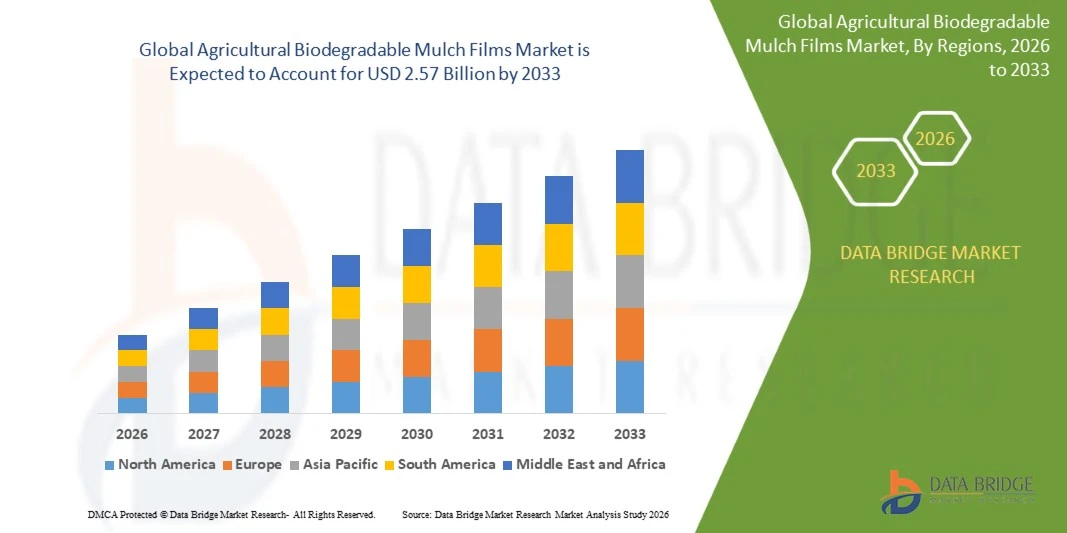
- As per Data Bridge Market Research analysis, the agricultural biodegradable mulch films market was valued at USD 1.30 billion in 2025 and is projected to reach USD 2.57 billion by 2033, growing at a CAGR of 8.90% from 2026 to 2033.
- The market is experiencing consistent growth driven by rising demand for sustainable agricultural inputs, increasing awareness of soil pollution caused by conventional plastic mulch films, and expanding adoption of biodegradable polymer technologies across modern farming practices.
- Growing concerns over plastic residues in agricultural soil, combined with regulatory support for environmentally sustainable farming, are encouraging farmers to adopt biodegradable mulch films. These films help conserve soil moisture, suppress weeds, regulate soil temperature, and reduce the need to retrieve and dispose of conventional plastic films after harvesting, supporting wider adoption across fruit, vegetable, and specialty crop production.
Market Size & Forecast
- Global Market Value (2025): USD 1.30 Billion
- Expected Market Value (2033): USD 2.57 Billion
- Forecast CAGR (2026–2033): 8.90%
- Leading Region in 2025: North America
- Fastest Growing Region: Asia Pacific
What are the Major Takeaways of the Agricultural Biodegradable Mulch Films Market?
- North America dominated the agricultural biodegradable mulch films market with the largest revenue share of 32.3% in 2025, supported by sustainable agriculture initiatives, increasing awareness of plastic pollution in farmland, and rising demand for environmentally friendly crop production solutions
- Asia-Pacific is expected to be the fastest-growing region at a CAGR of 8.4% from 2026 to 2033, fueled by extensive agricultural activities and increasing adoption of biodegradable films in China, India, and Japan.
- The thermoplastic starch (TPS) segment led the market with a 35% share in 2025, driven by the availability of renewable starch feedstocks, biodegradability, and potential to reduce reliance on petroleum-based plastics
- Starch blended with polyhydroxyalkanoate (PHA) are the fastest-growing material type, projected to register a CAGR of 10.5%, reflecting the surge in demand for soil-biodegradable polymer blends, increasing concerns over agricultural plastic pollution, and advancements in sustainable film formulations
- The fruits and vegetables segment dominated the crop type category with a 45% revenue share in 2025, led by increasing adoption of biodegradable mulch films for weed suppression and reduced plastic residue in intensive horticultural production.
- Horticulture accounted for 40% of the market share in 2025, preferred by fruit and vegetable growers for effective weed suppression, and reduced plastic waste from conventional mulch films.
- The less than 20 micron segment is the fastest-growing film thickness category, with a CAGR of 9.8%, driven by increasing demand for lightweight biodegradable films, cost-efficient agricultural mulching solutions, and advancements in biodegradable polymer formulations that improve film performance and soil degradation.
Report Scope and Agricultural Biodegradable Mulch Films Market Segmentation
|
Attributes |
Agricultural Biodegradable Mulch Films Key Market Insights |
|
Segments Covered |
|
|
Countries Covered |
North America
Europe
Asia-Pacific
Middle East and Africa
South America
|
|
Key Market Players |
|
|
Market Opportunities |
|
|
Value Added Data Infosets |
In addition to the insights on market scenarios such as market value, growth rate, segmentation, geographical coverage, and major players, the market reports curated by the Data Bridge Market Research also include import export analysis, production capacity overview, production consumption analysis, price trend analysis, climate change scenario, supply chain analysis, value chain analysis, raw material/consumables overview, vendor selection criteria, PESTLE Analysis, Porter Analysis, and regulatory framework. |
What is the Key Trend in the Agricultural Biodegradable Mulch Films Market?
- Agricultural producers are increasingly adopting biodegradable mulch films to conserve soil moisture, suppress weed growth, regulate soil temperature, and reduce the environmental burden associated with conventional plastic mulch disposal.
- For instance, in January 2026, Fraunhofer FEP launched the EU-funded CELLAGRI project to develop cellulose-based mulch films with water-management structures, targeting at least a 30% reduction in environmental impact compared with conventional plastic mulch films.
- Advanced biodegradable formulations are increasingly designed to balance mechanical strength, moisture retention, and controlled biodegradation under different agricultural soil conditions.
- Manufacturers and research institutions are exploring starch-based, cellulose-based, and other bio-composite materials to improve film performance while reducing dependence on petroleum-derived plastics.
- For instance, in October 2024, a study published in Science of the Total Environment investigated mulch films developed from cotton gin waste, reporting no pesticide residues in the raw material, no ultraviolet light transmission through the films, and rapid degradation of buried film sections
- As farmers and manufacturers increasingly prioritize soil health, resource efficiency, and sustainable crop production, continued innovation in biodegradable materials is expected to accelerate adoption across horticulture and open-field agriculture.
What are the Key Drivers of the Agricultural Biodegradable Mulch Films Market?
- The growing concerns over agricultural plastic pollution and microplastic accumulation in farmland are increasing demand for biodegradable mulch films that can break down in soil under appropriate conditions.
- For instance, in July 2025, a study published in Plants evaluated biodegradable mulch films in onion cultivation across multiple regions and growing seasons in South Korea. The study found that biodegradable films achieved yield increases of more than 13% compared with non-mulched cultivation, while providing weed suppression comparable to conventional polyethylene films.
- Rising demand for sustainable crop production is encouraging farmers to adopt biodegradable films that provide weed control, moisture conservation, and temperature regulation without requiring conventional plastic film retrieval after harvesting.
- For instance, in November 2024, a study published in Field Crops Research investigated black biodegradable mulch films in rain-fed wheat production on China's Loess Plateau. The research found that biodegradable film mulching increased wheat grain yield and net returns while reducing the carbon footprint, demonstrating its potential to improve agricultural productivity and environmental performance.
- As environmental awareness and sustainable farming requirements continue to influence agricultural input selection, demand for effective biodegradable mulch films is expected to increase across commercial farming applications.
What Factors are Challenging the Growth of the Agricultural Biodegradable Mulch Films Market?
- Biodegradable mulch films often involve higher material and production costs than conventional polyethylene films, limiting affordability for price-sensitive farmers and large-scale agricultural operations.
- For instance, in February 2022, a study published in Science of the Total Environment found that field degradation of soil-biodegradable mulch films in a Mediterranean climate could take 21–58 months to achieve 90% degradation, exceeding the two-year laboratory benchmark in some conditions.
- Variations in soil temperature, moisture, pH, and microbial activity can affect biodegradation rates, creating challenges in ensuring consistent performance across different climatic and farming conditions.
- For instance, in May 2025, a study published in Environmental Research found that after three growing seasons, biodegradable PBAT mulch-film treatments contained 1,560–1,820 microplastic particles per kilogram of soil, compared with 747–840 particles per kilogram in conventional polyethylene treatments, highlighting concerns about field degradation and residual fragments.
- The combination of higher costs, variable field degradation, performance requirements, and certification needs continues to challenge widespread adoption, particularly among farmers operating with limited budgets and inconsistent access to advanced agricultural inputs.
How is the Agricultural Biodegradable Mulch Films Market Segmented?
The agricultural biodegradable mulch films market is segmented on the basis of material type, crop type, application, and film thickness.
- By Material Type
On the basis of material type, the agricultural biodegradable mulch films market is segmented into thermoplastic starch (TPS), starch blended with polylactic acid (PLA), starch blended with polyhydroxyalkanoate (PHA), aliphatic-aromatic copolyesters (AAC), polybutylene succinate (PBS), and other biodegradable polymer blends. The thermoplastic starch (TPS) segment is estimated to dominate the market with 35% share in 2025, owing to the availability of renewable starch feedstocks, biodegradability, and potential to reduce reliance on petroleum-based plastics. Starch-based materials can be processed into films suitable for agricultural mulching when appropriately formulated. Their compatibility with other biodegradable polymers enables manufacturers to adjust flexibility, strength, and degradation characteristics. Increasing interest in renewable agricultural inputs is supporting research and development in starch-based films. However, moisture sensitivity and mechanical limitations can require blending or additional formulation measures.
The starch blended with polyhydroxyalkanoate (PHA) segment is estimated to be among the fastest-growing material categories, registering at CAGR of 10.5% from 2026 to 2033, as agricultural film manufacturers explore polymer combinations that balance biodegradability with functional performance. PHA is produced biologically by microorganisms and can offer biodegradation advantages under suitable environmental conditions. Blending PHA with starch can help manufacturers develop films with different mechanical and processing characteristics. Growing attention to soil pollution and end-of-life management is encouraging research into these materials. Improvements in polymer processing and formulation may help address performance limitations and production costs. Adoption will depend on the availability of commercial-grade materials, field performance, and verified biodegradation under intended agricultural conditions.
- By Crop Type
On the basis of crop type, the agricultural biodegradable mulch films market is segmented into fruits and vegetables, grains and oilseeds, flowers and plants, and other specialty crops. The fruits and vegetables segment is estimated to dominate the market with 45% share in 2025, driven by extensive use of mulch films in commercial horticulture and intensive crop production. These films help conserve soil moisture, suppress weed growth, and regulate soil temperature around plant roots. They can also reduce direct contact between fruits and soil, helping maintain produce quality in selected cultivation systems. Growing demand for strawberries, tomatoes, peppers, melons, and other high-value crops is supporting the use of biodegradable alternatives. Increasing concerns about plastic residues in cultivated soil are further encouraging farmers to consider biodegradable films.
The grains and oilseeds segment is estimated to be among the fastest-growing crop categories, registering at CAGR of 9.5% from 2026 to 2033, as farmers and researchers investigate biodegradable mulch films for crops such as wheat, maize, and oilseed crops. Mulching can help conserve soil moisture in water-limited farming environments and moderate soil temperatures during crop establishment. These benefits may be particularly relevant in regions experiencing irregular rainfall and rising agricultural input costs. Research into biodegradable films for cereal cultivation is helping evaluate their suitability beyond traditional horticultural applications. However, large cultivated areas, material costs, and the need for mechanized film application can influence commercial adoption. Improvements in film strength, installation methods, and biodegradation performance could support wider use.
- By Application
On the basis of application, the agricultural biodegradable mulch films market is segmented into horticulture, open-field agriculture, greenhouse and protected cultivation, and landscaping and other agricultural applications. The horticulture segment is estimated to dominate the market with 40% share in 2025, because fruit, vegetable, and ornamental crop cultivation frequently relies on mulching to manage soil conditions. Biodegradable films can help reduce weed competition and limit moisture loss from the soil surface. Their use can also reduce the need to retrieve conventional plastic films after cultivation when the product is appropriately certified and degrades under the intended conditions. Increasing demand for sustainably produced horticultural crops is encouraging growers to explore alternatives to petroleum-based mulch materials. The segment also benefits from opportunities to develop crop-specific films with different thicknesses and degradation periods.
The open-field agriculture segment is estimated to be among the fastest-growing application categories, registering at CAGR of 9.2% from 2026 to 2033, as farmers seek practical alternatives to conventional plastic mulch across larger cultivation areas. Biodegradable films can support moisture conservation and weed management while potentially reducing the labor associated with collecting and disposing of used plastic films. Their suitability for different crops depends on soil conditions, weather, cultivation duration, and the availability of appropriate machinery. Increasing attention to agricultural plastic waste is encouraging field trials and commercial evaluation of soil-biodegradable materials. Advances in polymer blends and film manufacturing may improve durability during cultivation while enabling degradation after use. However, cost competitiveness and consistent field performance remain important considerations for large-scale deployment.
- By Film Thickness
On the basis of film thickness, the agricultural biodegradable mulch films market is segmented into less than 20 microns, 20–35 microns, and above 35 microns. The 20–35 microns segment is estimated to dominate the market with 40% share in 2025, as this thickness range can offer a practical balance between material consumption, mechanical strength, and handling requirements for selected agricultural applications. Films within this range can be designed to provide weed suppression and soil moisture conservation during crop growth. Their performance depends on polymer composition, film structure, environmental exposure, and the duration of the cultivation cycle. Manufacturers can adjust formulations to improve resistance to tearing and premature degradation in the field. Farmers also consider installation methods, crop requirements, and overall input costs when selecting film thickness.
The less than 20 microns segment is estimated to be among the fastest-growing thickness categories, registering at CAGR of 9.8% from 2026 to 2033, as manufacturers develop thinner biodegradable films that reduce material consumption and may lower the amount of polymer required per cultivated area. Such films can be suitable for applications where shorter crop cycles and lower mechanical demands permit the use of lightweight materials. Advances in polymer blending and film-processing technologies may help improve uniformity and handling performance at reduced thicknesses. Lower material requirements can also support efforts to improve cost efficiency, although the overall economics depend on the formulation and production process. However, thin films may be more susceptible to tearing, wind damage, and premature breakdown under demanding field conditions. Their commercial suitability therefore depends on matching film properties with crop duration, local climate, and installation practices.
Which Region Holds the Largest Share of the Agricultural Biodegradable Mulch Films Market?
- North America dominated the agricultural biodegradable mulch films market with the largest revenue share of 32.3% in 2025, supported by sustainable agriculture initiatives, increasing awareness of plastic pollution in farmland, and rising demand for environmentally friendly crop production solutions
- The region also benefits from advancements in biodegradable polymer technologies, increasing emphasis on soil health and resource-efficient farming, and growing adoption of mulch films across fruit, vegetable, and specialty crop production. Supportive sustainability initiatives and continued innovation in agricultural materials are strengthening North America's position in the global market.
U.S. Agricultural Biodegradable Mulch Films Market Insight
The U.S. agricultural biodegradable mulch films market is witnessing strong growth due to rising adoption of sustainable farming practices, increasing concerns regarding agricultural plastic waste, and growing demand for environmentally friendly crop production solutions. The country’s advanced agricultural sector, along with increasing use of biodegradable polymer materials, is driving demand across fruit, vegetable, and specialty crop cultivation. In addition, growing emphasis on soil health, moisture conservation, and reducing plastic residue in farmland is accelerating the adoption of biodegradable mulch films among farmers.
Asia-Pacific Agricultural Biodegradable Mulch Films Market Insight
The Asia-Pacific agricultural biodegradable mulch films market is expected to witness rapid growth, driven by extensive agricultural activities, rising demand for sustainable farming inputs, and increasing awareness of plastic pollution across countries such as China, India, and Japan. Growing adoption of biodegradable materials, expanding fruit and vegetable cultivation, and increasing demand for efficient weed control and moisture retention solutions are supporting regional market expansion. In addition, government initiatives promoting sustainable agriculture and advancements in biodegradable polymer formulations are accelerating adoption across the region.
Japan Agricultural Biodegradable Mulch Films Market Insight
The Japan agricultural biodegradable mulch films market is witnessing consistent growth due to rising investments in sustainable agricultural technologies, increasing concerns regarding plastic waste, and growing demand for efficient crop production practices. Farmers and agricultural organizations are increasingly adopting biodegradable films to suppress weeds, conserve soil moisture, and regulate soil temperature across horticultural applications. Moreover, advancements in biodegradable polymer formulations and the country’s focus on environmentally responsible farming practices are further contributing to market growth.
China Agricultural Biodegradable Mulch Films Market Insight
The China agricultural biodegradable mulch films market is growing rapidly, driven by extensive crop cultivation, increasing government focus on agricultural sustainability, and rising concerns regarding residual plastic pollution in farmland. Growing adoption of biodegradable mulch films across fruit, vegetable, and field crop production is boosting market demand. In addition, increasing investments in biodegradable polymer technologies, rising awareness of soil health, and initiatives to reduce conventional plastic film waste are positioning China as a key market for agricultural biodegradable mulch films.
U.K. Agricultural Biodegradable Mulch Films Market Insight
The U.K. agricultural biodegradable mulch films market is experiencing steady growth, supported by rising adoption of sustainable farming practices, increasing emphasis on reducing agricultural plastic waste, and growing demand for environmentally friendly crop management solutions. Increasing interest in biodegradable materials for horticulture and specialty crop cultivation is contributing to market growth. Furthermore, advancements in compostable and soil-biodegradable polymer formulations, along with stronger attention to soil quality and resource-efficient farming, are supporting the adoption of biodegradable mulch films across the U.K.
Germany Agricultural Biodegradable Mulch Films Market Insight
The Germany agricultural biodegradable mulch films market is expanding steadily due to the country’s strong focus on environmental sustainability, advanced agricultural practices, and increasing adoption of alternatives to conventional plastic mulch films. Farmers and agricultural research organizations are exploring biodegradable films to improve weed control, conserve moisture, and reduce plastic residues in cultivated soils. Continuous advancements in bio-based materials, growing interest in circular agricultural solutions, and increasing emphasis on sustainable crop production are further driving market growth in Germany.
Which are the Top Companies in Agricultural Biodegradable Mulch Films Market?
The agricultural biodegradable mulch films industry is primarily led by well-established companies, including:
- BASF SE (Germany)
- Kingfa Sci.&Tech. Co.,Ltd. (China)
- NatureWorks LLC (U.S.)
- RKW SE (Germany)
- Armando Álvarez S.A. (Spain)
- Groupe Barbier (France)
- Agriplast Tech India Pvt. Ltd. (India)
- Pooja Plastic Industries (India)
- Organix Solutions (U.S.)
- FKuR Kunststoff GmbH (Germany)
- AB Rani Plast Oy (Finland)
- PLASTIKA KRITIS S.A. (Greece)
- Ginegar Plastic Products Ltd. (Israel)
- Tilak Polypack (India)
- Green Dot Bioplastics, Inc. (U.S.)
- Al-Pack Enterprises Ltd. (Canada)
- Dubois Agrinovation (Canada)
- FilmOrganic (U.S.)
- PolyExpert Inc. (Canada)
- Braskem S.A. (Brazil)
What are Latest Developments in Agricultural Biodegradable Mulch Films Market?
- In July 2025, researchers from Central South University of Forestry and Technology announced the development of a bamboo-residue-based biodegradable liquid mulch film designed for selenium-enriched crop cultivation. The material uses bamboo waste as a renewable raw material and is intended to help retain soil moisture, regulate temperature, control weeds, and support soil health. This development highlights the potential of agricultural residues to create more sustainable alternatives to conventional plastic mulch films.
- In April 2024, researchers published a study on a spray-on, environmentally friendly degradable mulch material made primarily from renewable resources, including rapeseed oil, starch, and sodium alginate. The material maintained its function during a six-month outdoor field test and demonstrated effective weed suppression in greenhouse experiments. The development offers a potential alternative to conventional sheet films, with application methods that could reduce installation labor and adapt to different agricultural conditions.
- In October 2023, researchers published findings on the long-term degradation of biodegradable mulch films in agricultural soil. The field study examined PBAT- and PLA-based films incorporated into soil after maize cultivation, tracking the formation and decline of macroplastic and microplastic fragments over time. The findings provided important evidence on how biodegradable mulch materials behave under real agricultural conditions and highlighted the need to assess their complete degradation and potential soil impacts
- In October 2022, researchers published field-experiment findings evaluating biodegradable mulch film as an alternative to polyethylene film in rain-fed maize cultivation. The study compared the films across two sites and found that the effectiveness of biodegradable mulch depended partly on precipitation and local growing conditions. In some semiarid areas, biodegradable film improved yield and water productivity, supporting further development of crop- and climate-specific biodegradable mulch solutions.
- In October 2021, Fraunhofer Institute for Silicate Research ISC announced research into biodegradable mulch papers through the NewHyPe project, working with European research and industry partners. The project focused on cellulose-based paper with a protective hybrid coating designed to improve wet strength and durability throughout the growing season while allowing the material to decompose afterward. The initiative represented an important development in paper-based alternatives to petroleum-derived agricultural mulch films

- Interactive Data Analysis Dashboard
- Company Analysis Dashboard for high growth potential opportunities
- Research Analyst Access for customization & queries
- Competitor Analysis with Interactive dashboard
- Latest News, Updates & Trend analysis
- Harness the Power of Benchmark Analysis for Comprehensive Competitor Tracking
Data collection and base year analysis are done using data collection modules with large sample sizes. The stage includes obtaining market information or related data through various sources and strategies. It includes examining and planning all the data acquired from the past in advance. It likewise envelops the examination of information inconsistencies seen across different information sources. The market data is analysed and estimated using market statistical and coherent models. Also, market share analysis and key trend analysis are the major success factors in the market report. To know more, please request an analyst call or drop down your inquiry.
The key research methodology used by DBMR research team is data triangulation which involves data mining, analysis of the impact of data variables on the market and primary (industry expert) validation. Data models include Vendor Positioning Grid, Market Time Line Analysis, Market Overview and Guide, Company Positioning Grid, Patent Analysis, Pricing Analysis, Company Market Share Analysis, Standards of Measurement, Global versus Regional and Vendor Share Analysis. To know more about the research methodology, drop in an inquiry to speak to our industry experts.
Data Bridge Market Research is a leader in advanced formative research. We take pride in servicing our existing and new customers with data and analysis that match and suits their goal. The report can be customized to include price trend analysis of target brands understanding the market for additional countries (ask for the list of countries), clinical trial results data, literature review, refurbished market and product base analysis. Market analysis of target competitors can be analyzed from technology-based analysis to market portfolio strategies. We can add as many competitors that you require data about in the format and data style you are looking for. Our team of analysts can also provide you data in crude raw excel files pivot tables (Fact book) or can assist you in creating presentations from the data sets available in the report.