What is the Agricultural Biologicals Market Size and Growth Rate?
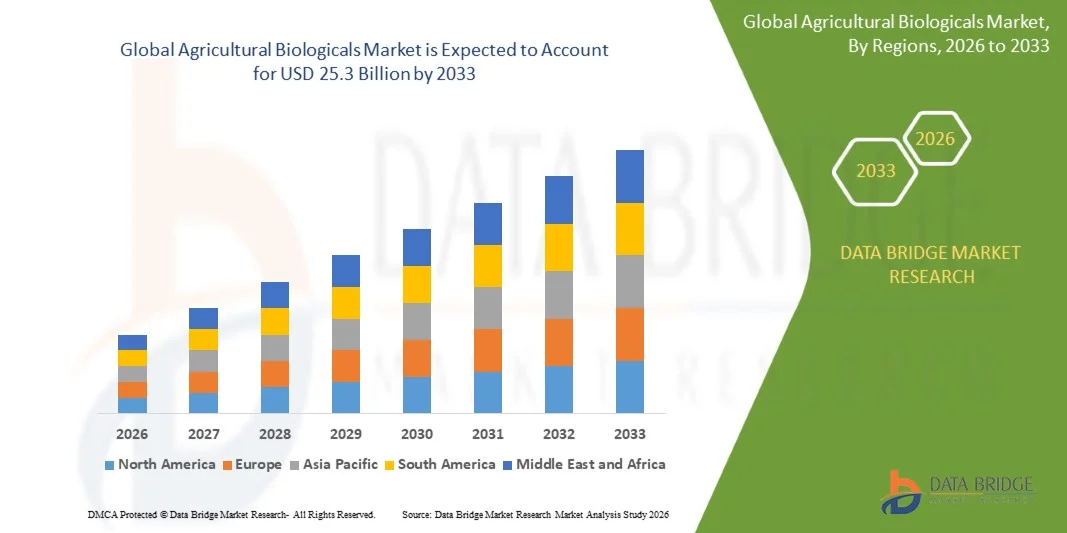
- As per Data Bridge Market Research analysis, the agricultural biologicals market was valued at USD 18.44 billion in 2025 and is projected to reach USD 25.3 billion by 2033, growing at a CAGR of 12.00% from 2026 to 2033.
- The market is expanding due to the rising adoption of sustainable agricultural practices, increasing demand for biological crop protection and plant nutrition solutions, growing preference for organic and residue-free food production, increasing regulatory pressure on synthetic agricultural inputs, advancements in microbial and biotechnology-based formulations, and growing emphasis on soil health and crop productivity.
- Agricultural biologicals are increasingly being adopted as sustainable alternatives or complementary solutions to conventional agricultural inputs, including biopesticides, biofertilizers, and biostimulants, because they support crop protection, nutrient efficiency, plant health, and resilience while reducing dependence on synthetic chemicals.
Market Size & Forecast
- Global Market Value (2025): USD 18.44 billion
- Expected Market Value (2033): USD 25.3 billion
- Forecast CAGR (2026–2033): 12.00%
- Leading Region in 2025: Europe
- Fastest Growing Region: Asia-Pacific
What are the Major Takeaways of the Agricultural Biologicals Market?
- Europe dominated the global agricultural biologicals market with a revenue share of 34.3% in 2025, supported by the well-established agricultural sector, increasing adoption of sustainable farming practices, growing demand for organically cultivated food products, strong awareness of soil health management, and early adoption of biological crop protection solutions.
- Asia Pacific is expected to be the fastest-growing regional market, registering a CAGR of 9.6% from 2025 to 2030, driven by increasing agricultural production, rising food demand, growing regulatory emphasis on sustainable farming, expanding adoption of eco-friendly crop protection and nutrient management solutions, and increasing demand across major agricultural economies such as China, India, Japan, and Australia.
- The biopesticides segment dominated the product category with a market share of 56.7% in 2025, supported by widespread application across soil and foliage, increasing demand for biological crop protection, growing preference for reduced chemical usage, and rising adoption of microbial and biochemical pest-control solutions.
- The biostimulants segment is an 8.5% CAGR from 2026 to 2033, highlighting the growing importance of this product category within agricultural biologicals expected to witness strong growth during the forecast period, driven by increasing demand for solutions that improve nutrient uptake, crop growth, plant health, yield stability, and resistance to environmental stresses.
- The cereals and grains segment dominated the crop-type category with a market share of 37.1% in 2025, supported by increasing global consumption of wheat, rice, corn, barley, and millet, rising demand for improved crop productivity, and growing adoption of biofertilizers and other biological inputs in cereal cultivation.
- The foliar spray segment dominated the application method category with a market share of 63.7% in 2025, supported by its ability to deliver biological inputs directly to plant leaves, improve nutrient absorption efficiency, provide rapid correction of nutrient deficiencies, and support higher crop productivity.
- The soil treatment segment is gaining importance in the Agricultural Biologicals market, foliar treatment held 78.6%, while soil and seed treatment represented the remaining applications in 2025 driven by increasing focus on soil health, microbial activity, nutrient availability, and sustainable crop production.
Report Scope and Agricultural Biologicals Market Segmentation
|
Attributes |
Agricultural Biologicals Key Market Insights |
|
Segments Covered |
|
|
Countries Covered |
North America
Europe
Asia-Pacific
Middle East and Africa
South America
|
|
Key Market Players |
|
|
Market Opportunities |
|
|
Value Added Data Infosets |
In addition to the insights on market scenarios such as market value, growth rate, segmentation, geographical coverage, and major players, the market reports curated by the Data Bridge Market Research also include in-depth expert analysis, geographically represented company-wise production and capacity, network layouts of distributors and partners, detailed and updated price trend analysis and deficit analysis of supply chain and demand. |
What is the Key Trend in the Agricultural Biologicals Market?
- Increasing adoption of advanced biological solutions and microbial-based technologies is becoming a major trend in the global Agricultural Biologicals market, as farmers and agricultural companies increasingly seek sustainable alternatives and complementary solutions to conventional crop protection products. Agricultural biologicals, including biopesticides, biostimulants, microbial products, and biological seed treatments, are increasingly being adopted to support crop productivity, soil health, nutrient-use efficiency, and resistance to environmental stresses.
- Integration of agricultural biologicals with soil health management, integrated crop protection, and precision agriculture is gaining importance as growers seek more targeted and sustainable approaches to crop production. Advances in microbial fermentation, botanical extracts, biological active ingredients, and data-driven agriculture are supporting the development of more effective and application-specific biological solutions.
- For instance, in May 2026, BASF Agricultural Solutions commissioned its new BioHub fermentation plant in Ludwigshafen, Germany, representing a high double-digit million-euro investment to strengthen its portfolio of biological and biotechnology-based crop protection solutions. The facility uses fermentation technology to manufacture biological active ingredients, including biological fungicides and biological seed-treatment products, while improving production flexibility and supply-chain resilience.
- Overall, the agricultural biologicals market is increasingly shaped by microbial fermentation, engineered biologicals, mycorrhizal technologies, botanical-based products, biological seed treatments, soil-health solutions, and integration with sustainable crop-management systems. Agricultural companies are therefore moving toward biological solutions that can complement conventional crop protection while improving crop resilience, nutrient efficiency, soil health, and environmental sustainability.
What are the Key Drivers of the Agricultural Biologicals Market?
- Increasing adoption of sustainable agricultural practices and biological crop inputs is becoming a major driver of the global Agricultural Biologicals market, as farmers increasingly seek alternatives and complements to conventional synthetic agricultural inputs. Agricultural biologicals, including biocontrols, biostimulants, and nutrient-use-efficiency products, support crop protection, nutrient utilization, soil health, yield improvement, and resilience against environmental stresses such as drought and heat.
- Growing demand for improved nutrient-use efficiency and climate-resilient crop production is further accelerating the adoption of agricultural biologicals. Biostimulants and microbial-based solutions are increasingly being applied to plants, seeds, and soil to improve nutrient uptake, strengthen tolerance to abiotic stresses, enhance crop quality, and support productivity while reducing dependence on conventional inputs.
- For instance, in June 2026, India's Institute of Pesticide Formulation Technology organized BIOPSF 2026, focusing on next-generation bio-inputs, including bio-based pesticides, stimulants, and fertilizers. The event brought together policymakers, scientists, industry participants, regulators, and agricultural innovators to discuss the development and adoption of bio-based agricultural inputs, demonstrating increasing institutional support for agricultural biologicals.
- Overall, the agricultural biologicals market is increasingly shaped by sustainable farming, biological crop protection, biostimulants, nutrient-use efficiency, soil-health management, climate-resilient agriculture, microbial biotechnology, and AI-enabled product development. Increasing pressure to improve agricultural productivity while reducing environmental impact is encouraging farmers and agricultural companies to integrate biological solutions with conventional crop protection and nutrient-management programs
What Factors are Challenging the Growth of the Agricultural Biologicals Market?
- Regulatory complexity and lack of harmonized standards are becoming major challenges in the global Agricultural Biologicals market, as biological products including biopesticides, biofertilizers, and biostimulants are subject to different registration requirements across countries. Differences in regulatory definitions, efficacy requirements, environmental assessments, and approval procedures can increase development costs and delay commercialization, particularly for smaller biologicals manufacturers.
- Variability in field performance is limiting the wider adoption of Agricultural Biologicals, as the effectiveness of microbial and biological products can be influenced by soil conditions, temperature, humidity, crop variety, application timing, and other environmental factors. Unlike conventional chemical inputs, biological products may require more precise application conditions and integrated management practices to achieve consistent results.
- For instance, in February 2026, HIL (India) Limited signed a technology transfer agreement with Agrinnovate India Limited for commercialization of Trichoderma viride 1.5% WP, a biological control technology developed by ICAR-IIHR. The development demonstrates the importance of technology transfer, regulatory commercialization, and industry partnerships in expanding access to biological agricultural solutions.
- Overall, the agricultural biologicals market is increasingly challenged by regulatory fragmentation, inconsistent field performance, limited farmer awareness, formulation and shelf-life constraints, complex commercialization pathways, and the need for stronger technical support. Companies are therefore focusing on improved formulations, field validation, farmer education, strategic partnerships, microbial discovery, and regulatory capabilities to improve product reliability and accelerate adoption.
How is the Agricultural Biologicals Market Segmented?
The global agricultural biologicals market is segmented on the basis of function type, source, and application method.
- By Function Type
On the basis of function type, the global agricultural biologicals market is segmented into biopesticides, biostimulants, and biofertilizers. The biopesticides segment dominated the market with a market share of 56.7% in 2025, driven by increasing demand for biological crop protection, growing restrictions on synthetic pesticides, rising adoption of integrated pest management practices, and increasing demand for residue-free agricultural products. Biopesticides are widely used for controlling insects, pathogens, and other crop pests through microbial, biochemical, and naturally derived solutions.
The biostimulants segment is projected to register the fastest growth, with a CAGR of 13.2% from 2026 to 2033, supported by increasing demand for improved nutrient-use efficiency, crop growth, stress tolerance, yield enhancement, and sustainable crop production.
- By Source
On the basis of source, the global agricultural biologicals market is segmented into microbial, natural products, and biochemicals. The microbial segment dominated the market with a market share of 52.4% in 2025, supported by the widespread use of beneficial bacteria, fungi, and other microorganisms in biopesticides, biofertilizers, and biostimulants. Microbial solutions are increasingly adopted because of their ability to improve nutrient availability, enhance soil health, support plant growth, and provide biological crop protection.
The natural products segment is projected to register the fastest growth, with a CAGR of 12.9% from 2026 to 2033, driven by increasing demand for botanical extracts, plant-derived compounds, natural pest-control solutions, and environmentally compatible agricultural inputs.
- By Application Method
On the basis of application method, the global agricultural biologicals market is segmented into foliar spray, soil treatment, seed treatment, and others. The foliar spray segment dominated the market with a market share of 63.7% in 2025, supported by its ability to deliver biological inputs directly to plant foliage, improve nutrient absorption, provide rapid correction of deficiencies, and enhance crop productivity.
The seed treatment segment is projected to register the fastest growth, with a CAGR of 8.9% from 2026 to 2033, driven by increasing demand for improved seed vigor, enhanced germination, early-stage biological crop protection, improved nutrient utilization, and targeted delivery of microbial solutions.
Which Region Holds the Largest Share of the Agricultural Biologicals Market?
- Europe accounted for the largest share of the global agricultural biologicals market, with a revenue share of 34.3% in 2025, supported by the increasing adoption of sustainable agricultural practices, growing demand for biological crop protection products, rising awareness regarding soil health, expansion of organic and regenerative farming, and strong presence of agricultural biotechnology companies. The region benefits from established agricultural infrastructure, increasing adoption of integrated pest management practices, supportive initiatives for sustainable agriculture, and growing investment in biological crop protection and plant health solutions.
- The U.K. represents the major contributor within Europe, supported by its large-scale agricultural production, increasing adoption of biopesticides and biostimulants, growing demand for residue-free agricultural products, and strong research and development activities in agricultural biotechnology. Increasing farmer adoption of biological inputs, expansion of precision agriculture, and development of microbial-based crop protection solutions are further supporting regional market growth.
U.S. Agricultural Biologicals Market Insight
The U.S. agricultural biologicals market is witnessing growth due to increasing adoption of sustainable farming practices, rising demand for residue-free agricultural products, and growing use of biological crop protection solutions. Increasing awareness regarding soil health, integrated pest management, and regenerative agriculture is further supporting market expansion. Biopesticides, biostimulants, and biofertilizers are increasingly being adopted across major crop production systems. Strong agricultural biotechnology capabilities, continued product innovation, and investments in microbial-based solutions are supporting market development. In addition, increasing farmer awareness and the integration of biological inputs with precision agriculture are creating further opportunities for market growth.
Canada Agricultural Biologicals Market Insight
The Canada agricultural biologicals market is witnessing steady growth driven by increasing adoption of sustainable farming practices, rising demand for biological crop protection solutions, and growing emphasis on soil health and environmentally responsible agriculture. Biopesticides represented the largest function segment, while biostimulants are projected to register the fastest growth.
Asia-Pacific Agricultural Biologicals Market Insight
The Asia-Pacific agricultural biologicals market is witnessing strong growth due to increasing adoption of sustainable farming practices, rising demand for biological crop protection products, expanding organic agriculture, and growing awareness regarding soil health and environmental sustainability. Countries such as China, India, Japan, and Australia are increasingly adopting biopesticides, biofertilizers, and biostimulants to improve crop productivity and reduce dependence on synthetic agricultural inputs. Government initiatives supporting sustainable agriculture, increasing investments in agricultural biotechnology, and the expansion of microbial-based solutions are further supporting market growth across the region.
China Agricultural Biologicals Market Insight
The China agricultural biologicals market is witnessing steady growth, supported by increasing adoption of sustainable farming practices, rising demand for biological crop protection, and government initiatives promoting reduced dependence on chemical agricultural inputs. Biopesticides represented the largest function segment, while biostimulants are projected to record the fastest growth.
Japan Agricultural Biologicals Market Insight
Japan's agricultural biologicals market is witnessing growth due to increasing adoption of sustainable farming practices, rising demand for environmentally friendly crop protection solutions, and growing emphasis on reducing dependence on synthetic agricultural inputs. The country's aging agricultural workforce is encouraging the adoption of efficient biological solutions that support crop productivity and soil health. Increasing cultivation of high-value crops, government support for sustainable agriculture, and advancements in microbial-based biopesticides, biostimulants, and biofertilizers are further supporting market expansion. Growing consumer preference for safe and residue-free food products is also contributing to the adoption of agricultural biologicals across Japan.
Germany Agricultural Biologicals Market Insight
Germany represents a significant market for agricultural biologicals in Europe, supported by increasing adoption of sustainable farming practices, growing demand for residue-free agricultural products, and stringent regulations concerning synthetic pesticides and fertilizers. The country is witnessing rising use of biopesticides, biostimulants, and biofertilizers to improve soil health, crop productivity, and nutrient-use efficiency. Strong agricultural research capabilities, increasing investment in biological crop protection technologies, and growing awareness among farmers regarding integrated pest management are further supporting market growth. The expansion of organic farming and sustainable crop production is expected to create additional opportunities for agricultural biologicals in Germany.
U.K. Agricultural Biologicals Market Insight
The U.K. agricultural biologicals market is witnessing increasing adoption of biopesticides, biostimulants, and biofertilizers as sustainable farming practices gain importance. Growing regulatory pressure to reduce dependence on synthetic agricultural inputs, rising demand for residue-free food, and increasing focus on soil health are supporting market growth. The expansion of regenerative agriculture and integrated pest management is further encouraging the use of biological solutions. In addition, advancements in microbial formulations, biological crop protection technologies, and sustainable nutrient-management solutions are creating opportunities for agricultural biologicals across cereals, grains, fruits, vegetables, and other major crops.
Which are the Top Companies in Agricultural Biologicals Market?
The Agricultural Biologicals industry is primarily led by well-established companies, including:
- Syngenta (Switzerland)
- Dow (U.S.)
- Bayer | Crop Science (Germany)
- BASF SE (Germany)
- Isagro S.p.A. (Italy)
- Novozymes A/S (Denmark)
- Marrone Bio Innovations Inc. (U.S.)
- Valent BioSciences (U.S.)
- Koppert Biological Systems US (U.S.)
- UPL (India)
What are Latest Developments in Agricultural Biologicals Market?
- In September 2026, Bayer and Robigo announced a Series A financing initiative led by Leaps by Bayer to accelerate engineered microbial biopesticides. The biological solutions are being developed for fungal diseases affecting soybeans and specialty crops, supporting the advancement of engineered biological crop-protection technologies.
- In July 2026, Syngenta and Groundwork BioAg entered a strategic partnership to commercialize mycorrhizal biological products and soil-carbon solutions. The initial focus includes corn, soybeans, cereals, and sunflower across Latin America and Europe, combining crop-performance solutions with soil-health and carbon-credit opportunities.
- In May 2026, Bayer and bp formed a long-term strategic alliance to scale camelina under the newgold brand. The collaboration is focused on commercializing camelina as an intermediate crop for biodiesel, renewable diesel, and sustainable aviation fuel, beginning in North America.
- In May 2026, UPL secured Fertilizer Control Order registration in India for Bioclassic, a biostimulant from its Natural Plant Protection biologicals business. The registration enables commercialization of the product for Indian farmers and strengthens UPL's biologicals portfolio in the country.
- In April 2026, BASF Agricultural Solutions completed the acquisition of AgBiTech, a biological crop-protection company specializing in naturally occurring viruses for controlling caterpillar pests. The transaction expanded BASF's biological crop-protection portfolio and strengthened its presence across major agricultural markets.

- Interactive Data Analysis Dashboard
- Company Analysis Dashboard for high growth potential opportunities
- Research Analyst Access for customization & queries
- Competitor Analysis with Interactive dashboard
- Latest News, Updates & Trend analysis
- Harness the Power of Benchmark Analysis for Comprehensive Competitor Tracking
Data collection and base year analysis are done using data collection modules with large sample sizes. The stage includes obtaining market information or related data through various sources and strategies. It includes examining and planning all the data acquired from the past in advance. It likewise envelops the examination of information inconsistencies seen across different information sources. The market data is analysed and estimated using market statistical and coherent models. Also, market share analysis and key trend analysis are the major success factors in the market report. To know more, please request an analyst call or drop down your inquiry.
The key research methodology used by DBMR research team is data triangulation which involves data mining, analysis of the impact of data variables on the market and primary (industry expert) validation. Data models include Vendor Positioning Grid, Market Time Line Analysis, Market Overview and Guide, Company Positioning Grid, Patent Analysis, Pricing Analysis, Company Market Share Analysis, Standards of Measurement, Global versus Regional and Vendor Share Analysis. To know more about the research methodology, drop in an inquiry to speak to our industry experts.
Data Bridge Market Research is a leader in advanced formative research. We take pride in servicing our existing and new customers with data and analysis that match and suits their goal. The report can be customized to include price trend analysis of target brands understanding the market for additional countries (ask for the list of countries), clinical trial results data, literature review, refurbished market and product base analysis. Market analysis of target competitors can be analyzed from technology-based analysis to market portfolio strategies. We can add as many competitors that you require data about in the format and data style you are looking for. Our team of analysts can also provide you data in crude raw excel files pivot tables (Fact book) or can assist you in creating presentations from the data sets available in the report.